Key takeaways
- ChatGPT has no fixed rank. For local prompts you track mention rate, answer position and citations, per city, over repeated runs.
- City-level accuracy depends on how a tool collects data: real-UI collection with location control beats a generic API call with a city name pasted into the prompt.
- Radarkit, Promptwatch, BrightLocal and Nightwatch cover different parts of the local problem. Pick based on whether you need monitoring only, or monitoring plus fixes.
- Most roundups on this topic are written by vendors who rank themselves first. Verify pricing and city coverage yourself before you buy.
- Tracking is the easy half. The work is getting listed in the roundups and review sites ChatGPT already cites for your category.
Why local businesses need a different kind of rank tracker
Someone types "best family lawyer in Austin" into ChatGPT. They get one synthesized answer with maybe three businesses named. There is no page two and no map pack with ten pins. You are in the answer or you are not.
Google Business Profile insights still tell you about calls, direction requests and profile views. They say nothing about whether an AI assistant recommends you. That gap is what ChatGPT rank trackers fill, and the local version has a harder job than the generic one, because the answer changes with the city, the neighborhood and sometimes the phrasing of "near me."
There is also a mental shift. A Google tracker records "position 4." A ChatGPT tracker records something fuzzier: did you appear, how early in the answer, and were you cited with a link. Run the same prompt ten times and you can get ten slightly different lists. So the useful numbers are rates and averages, not single positions.
What city-level ChatGPT tracking actually measures
Four metrics matter for a local business:
- Mention rate: the share of runs of a prompt where your business is named.
- Position: where you land in the list of businesses the answer names. Earlier is better.
- Citations: whether the answer links to your site, or to a third party that mentions you (a directory, a roundup, a review site).
- Competitor share: which local rivals show up when you do not.
The city part is where tools differ most. There are roughly three ways a tracker can handle location:
- Put the city in the prompt text ("best dentist in Chicago"). Cheap, works anywhere, but ignores how the interface behaves for a user physically in Chicago.
- Route the request through a proxy or location setting so the AI interface answers as if asked from that place.
- Do both, and also track per-neighborhood or exact coordinates.
Method one is a fine starting point. Method two matters more once you run multiple locations, because ChatGPT and Google's AI surfaces use location signals when they decide which businesses to name.
Quick comparison of local-capable AI trackers
The table below mixes what the vendors say on their own pages with what I could confirm. Treat prices as starting points and check the vendor site.
| Tool | Local approach | Best for | Notes |
|---|---|---|---|
| Radarkit | City-level data, real-user 4G proxies, 50+ countries | Local businesses and agencies wanting location-based AI tracking | Vendor lists entry pricing from $29/month with 72-hour refresh on the entry plan (unverified) |
| Promptwatch | Country on every plan; state/city on Business and agency plans; exact-coordinate pinning on higher plans | Teams that want to track and then fix visibility | Includes crawler logs, citations, content tools |
| Nightwatch | Geographic targeting, AI Overview flagging | SEO teams managing clients in several areas | Traditional rank tracker with AI features |
| BrightLocal | Local rankings, listings and reviews | Multi-location businesses needing classic local SEO data | Strong on the Google side |
| Leapd Alex | Prompt tracking, citations, competitor share | Small teams on a budget | Vendor lists $39/month; not a local specialist |
| Peec AI, Otterly.AI | Prompt-level monitoring | Marketing teams wanting clean reports | Monitoring-focused |
The tools worth a look
Radarkit
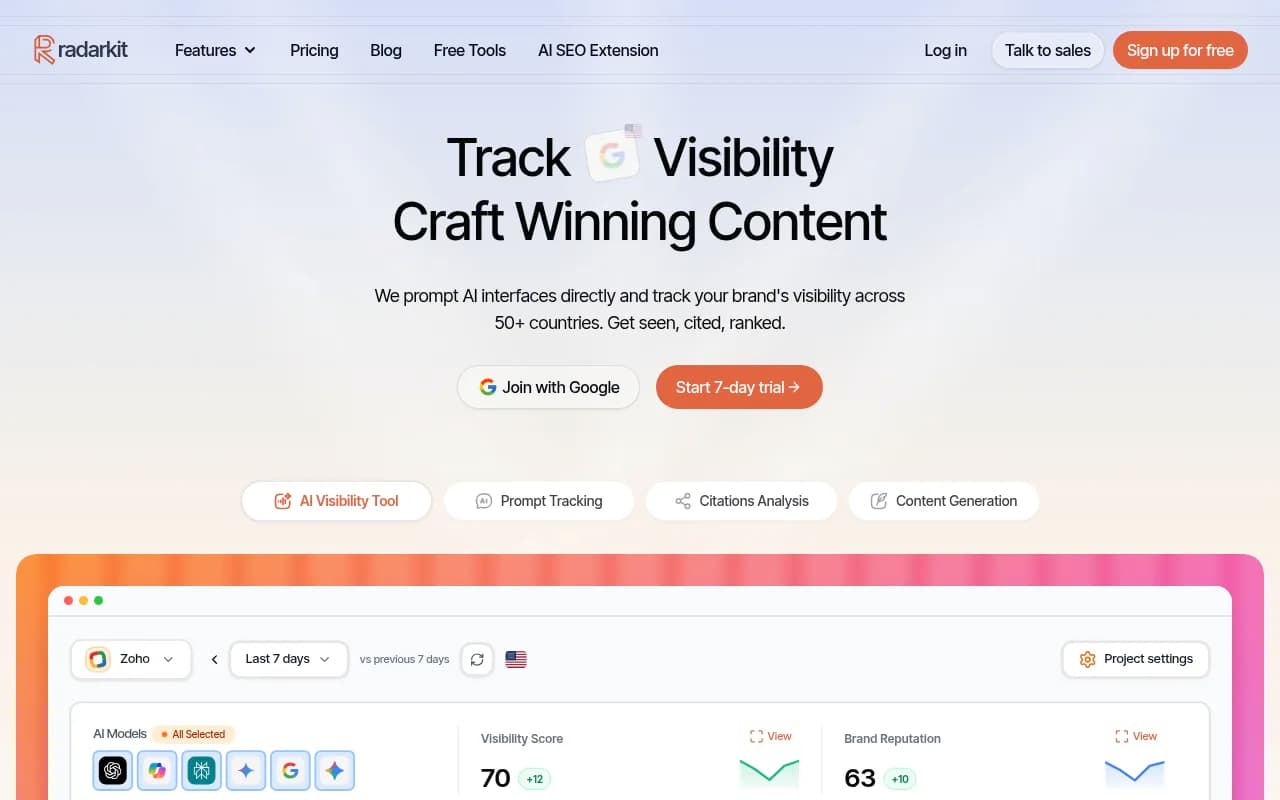
Radarkit is the most local-specific option in the research. It is built around the question "does the AI recommend my business for city, neighborhood and near-me prompts," and it collects answers through real-user 4G proxies so the response reflects what someone in that city sees. It covers ChatGPT, Google AI Overviews, AI Mode, Gemini, Perplexity and Copilot.
Two caveats. First, the most detailed claims about Radarkit come from Radarkit's own blog and from AIclicks, and both list it first in their rankings. Second, the entry plan reportedly refreshes every 72 hours, which is fine for a trend line but slow if you are testing a change.
Promptwatch
Promptwatch is the pick when you want more than a dashboard. It monitors the real interfaces of ChatGPT, Google AI Overviews, Google AI Mode, Gemini, Perplexity, Copilot and others, with country tracking on every plan and state and city tracking on Business and agency plans. On Business, Agency Scale and Enterprise you can pin a monitor to exact coordinates (accuracy radius 20 m to 5 km), so answers come back as if asked from that spot. That is the feature built for franchises and multi-location brands.

The reason I would shortlist it for a local business is what happens after the tracking. A gap analysis shows which prompts you lose, crawler logs show whether AI bots can even read your location pages, and the Content Agent can write and publish pages to WordPress, Webflow or Framer. Pricing starts at $95/month for Essential, but city-level tracking sits on Business at $579/month, so it fits a multi-location operator or an agency better than a single-site plumber. Confirm current numbers at promptwatch.com/pricing. One honest limit: it tracks AI answers, not the classic Google local pack, so you still want a map-pack tool beside it.
If you manage several client locations, the agency plans start at $199/month.
BrightLocal
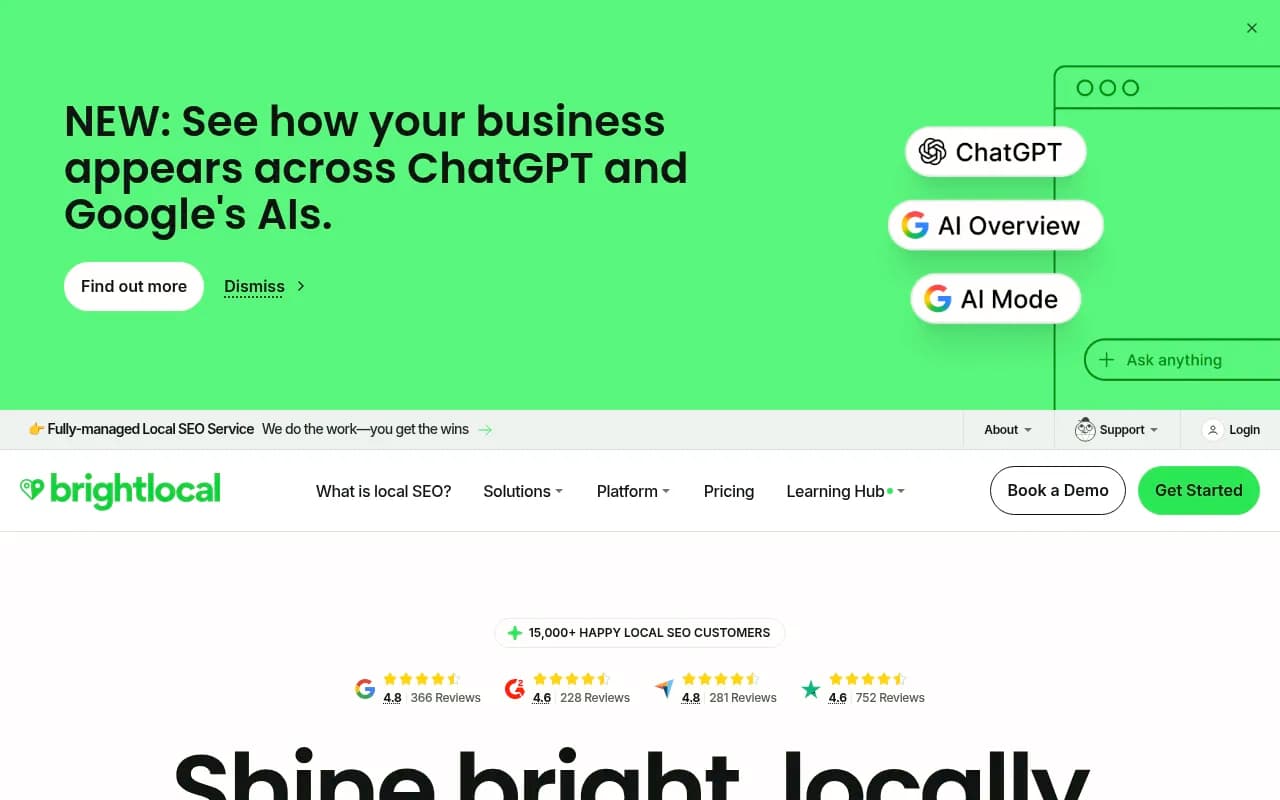
BrightLocal covers the other half of local visibility: Google rankings, listings and reviews. It is not a ChatGPT tracker, but reviews and listings feed the sources ChatGPT leans on, so it earns a spot in the stack.
Nightwatch
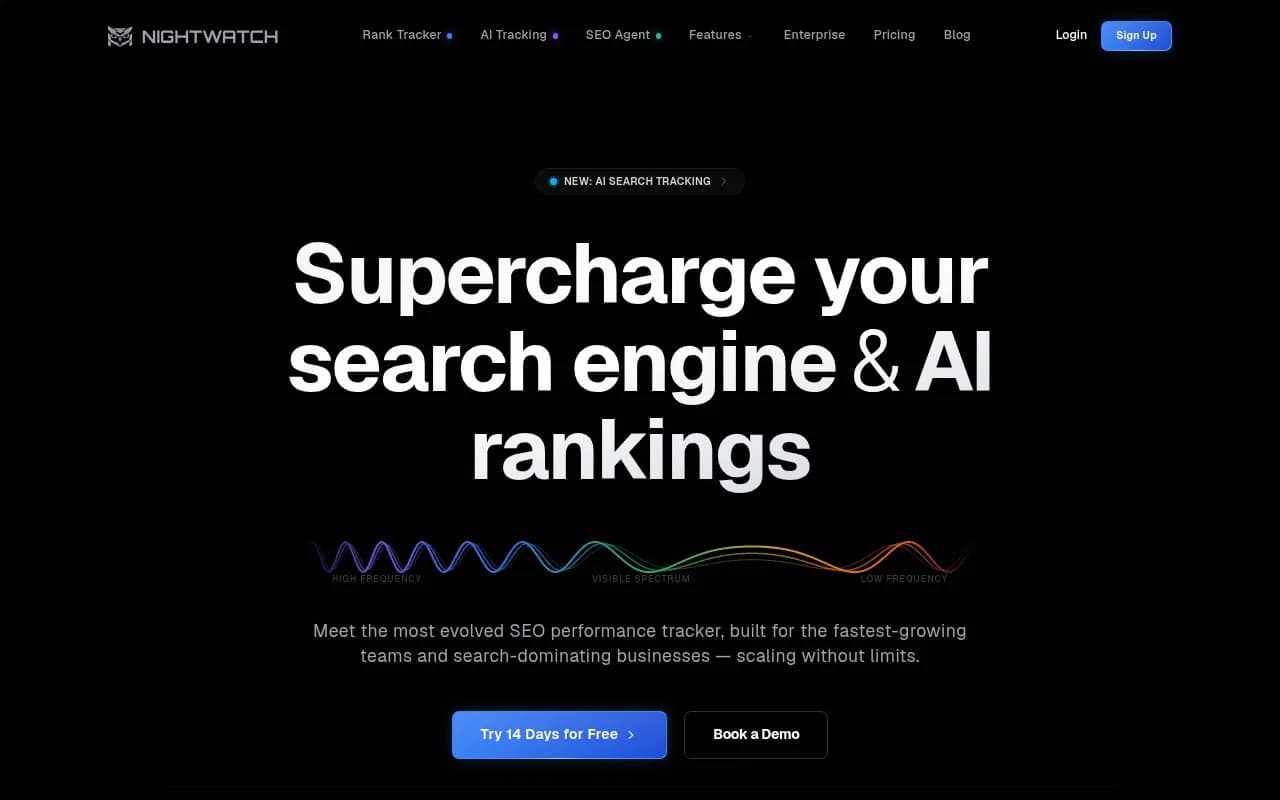
Nightwatch is a conventional rank tracker with AI search monitoring and geographic targeting. One roundup singles it out for flagging when your URLs appear in Google AI Overviews. Reasonable if your team lives in rank-tracker workflows already.
Other options in the category
Peec AI and Otterly.AI are clean prompt trackers with reporting, suited to marketing teams that need monitoring and do not need city granularity.


Leapd's Alex is the cheapest entry in the research at a listed $39/month, and it tracks mentions, citations and competitors. Its own blog names it the best ChatGPT rank tracker, which you should read with the usual salt.
Search Atlas bundles local map-pack geo-grids with AI tracking if you want one platform for both.
For a wider scan of the category, the GEO software directory lists dozens more.
How to choose: a short decision guide
Single location, small budget. Start with a free manual check. Run your ten most valuable prompts yourself, in an incognito window, and write down the results. Then pick a $29 to $95 tool if the habit sticks.
Several locations or a franchise. You need real city or coordinate-level collection, per-location reporting and exports. This is where Radarkit and Promptwatch Business earn their cost.
Agency with local clients. Look for unlimited projects, white-label reporting and an API. Agency plans from Promptwatch, or Radarkit and Rankability, are the ones to demo.
You already pay for a local SEO suite. Add one AI tracker rather than replacing it. BrightLocal for the map pack, plus an AI tool for ChatGPT answers.
Questions to ask any vendor
- Is the data collected from the real ChatGPT interface or from an API?
- How is location applied: prompt text, proxy, or coordinates?
- How many times is each prompt run, and how often?
- Can I export responses and see the full answer text, not just a score?
- What happens to my historical data when ChatGPT changes how it searches?
The last one matters. ChatGPT's behavior moves. Promptwatch Data recorded that ChatGPT's average searches per response sat around 2.15 in early December, eased to about 1.84 by early March, and fell to 1.0 once fanouts returned in April (ChatGPT query fanouts report). A tool that cannot show you the trend will not explain why your numbers jumped.
What ChatGPT cites for local-style prompts
Tracking tells you where you stand. To change it, you need to know what ChatGPT pulls from. Promptwatch Data analyzed ChatGPT citations from Sep 28 to Oct 4, 2026, and the commercial-prompt breakdown is the closest proxy for "best plumber in Austin":
| Content type | Share of citations on commercial prompts |
|---|---|
| Product pages | 26.0% |
| Landing pages | 20.6% |
| Listicles | 15.0% |
| Comparisons | 7.9% |
Those four types add up to almost 70%. Across all prompts, product pages led at 22.4%, with landing pages at 16.8% and listicles at 13.6%. On branded prompts, reviews were 5.6%, more than three times their overall share (ChatGPT citation share by content type).
Two caveats. This report is not city-level, and it does not isolate local queries, so read it as direction, not a local benchmark. Still, the pattern is useful. For a service business, "product page" translates into a clear service page, and "landing page" into a service-in-city page.
Fixing what the tracker shows you
Here is the order I would work in.
1. Make sure AI crawlers can read your site
If GPTBot or OAI-SearchBot are blocked, nothing else matters. Check robots.txt and your CDN rules. A free check like the Agentic Readiness Check shows which AI crawlers can get in.
2. Build one clear page per service per city
ChatGPT's searches are short and keyword-like. In the Promptwatch fanout data, the average query length fell from about 117 characters in December to roughly 53 characters once fanouts returned in April. My inference, not a Promptwatch claim: a page whose heading reads "Emergency plumber in Austin" matches that kind of query more easily than a vague "Our services" page. Avoid thin copy-and-swap city pages though. Include real details: neighborhoods served, prices or ranges, licensing, photos, named staff.
3. Get into the roundups ChatGPT already cites
Listicles are 13.6% of citations overall and 15.0% on commercial prompts. Find the "best [service] in [city]" articles that appear in your tracker's citation report and pitch the authors. Local newspapers, city guides and trade associations are often easier than national sites.
4. Collect reviews on sites AI trusts
Reviews matter more on branded prompts. Keep Google, Yelp and your industry directory current, and respond to reviews. A tool like BrightLocal or Birdeye handles the collection side.
5. Add FAQ content
FAQ pages are a small slice (3.3% overall, 4.8% on branded prompts) but cheap to produce, and they answer the exact questions people type.
6. Re-measure
Change one thing, wait for several runs, compare mention rate. Single-day swings mean little.
Mistakes I see with local AI tracking
- Tracking only your brand name. Branded prompts flatter you. Most customers ask category prompts without your name in them.
- Tracking one city. If you serve four towns, you can be visible in one and absent in three.
- Trusting a single run. ChatGPT answers vary, so you want multiple runs per prompt.
- Believing the vendor leaderboards. Nearly every roundup in this space ranks its publisher first. Read them for feature lists and ignore the order.
- Ignoring Google. The map pack still drives most local calls, so keep your classic tracker.
Final recommendation
For a single-location business that just wants to know where it stands, a low-cost tracker with city targeting, such as Radarkit, is a sensible first step, after you do a manual audit. For multi-location brands and agencies that want to act on the data, Promptwatch's city and coordinate tracking plus its content and crawler tools makes the most sense. Pair either with BrightLocal or another map-pack tool.
If you want agency help setting this up, 1001 SEO Media runs local SEO and AI search work, and it is the team behind this site. For more rank trackers to compare, the AI rank tracking directory is a good next stop.