Key takeaways
- Evertune is the only one of the three that publishes a margin-of-error methodology (up to 100 samples per prompt). It is vendor-authored, so treat it as a claim, not an audit.
- Gauge is the most transparent on price ($599/mo Growth) and strongest on content execution, but it describes one answer as one response, one platform, one day. No repeated-sampling method is published.
- Brandlight is built for multi-brand enterprises that want strategy and activation, with custom pricing and a paid pilot. We found no public sampling or accuracy documentation.
- Share of voice numbers are not comparable across vendors. Prompt mix, sampling depth and mention-vs-citation counting all change the result.
- Before buying, run the same 50 prompts through each shortlisted tool and ask for confidence intervals in writing.
Why share of voice accuracy is harder than it looks
Every AI visibility vendor shows you a share of voice chart. Very few tell you how much that chart wobbles if you refresh it tomorrow.
The basic formula is simple: brand mentions divided by total category mentions, times 100. The trouble is everything feeding it. LLM answers are non-deterministic, so the same prompt can name different brands on consecutive runs. A tool that asks once and reports the result is giving you a single draw from a distribution.
Prompt mix matters just as much. Promptwatch Data's report on unique domains per ChatGPT response (Sep 28 to Oct 4, 2026) found that 47.6% of ChatGPT responses cite 10 or more domains, but only 21.3% of brand-specific prompts do. Brand-specific prompts most often cite 5 domains. So a tool that leans on branded prompts and one that leans on organic category prompts will report very different share of voice for the same brand, and both can be "right".
Retrieval behavior also moves. Promptwatch's ChatGPT query fanout data shows average fanouts per response falling from 2.15 in early December to about 1.84 in early March, then dropping to exactly 1.0 in April. If the underlying search behavior shifts, a trend line can move because ChatGPT changed, not because your brand did. Good tools need a way to handle that.
One more caveat from DeepSmith's enterprise comparison that I agree with: nobody's numbers are comparable to anybody else's. Each vendor runs its own prompt sets, geographies and cadence.
The three tools at a glance
| Brandlight | Evertune | Gauge | |
|---|---|---|---|
| Best for | Multi-brand, multi-market enterprises | Brands that want statistical rigor and AI ad activation | Content and growth teams that want track-and-act in one tool |
| Published sampling method | None found | Up to 100 samples per prompt per model, with margin-of-error examples | None published; one answer = one response, one platform, one day |
| Prompt source | "Thousands of real buyer questions" (vendor claim) | EverPanel, claimed 150M+ real conversations | Your own prompts plus suggestions; prompt search volumes |
| Engines | ChatGPT, AI Overviews, AI Mode, Gemini, Perplexity, Copilot, Claude | 11+ models | Growth: ChatGPT, AI Mode, Copilot. Enterprise: 6 core platforms. Claude and Grok via your own API keys |
| Content production | Activation plus strategy service | Optimization and AI advertising | Up to 18 articles/mo on Growth |
| Pricing | Custom; third-party estimates unverified | Pro reported at $800/mo, Enterprise custom | Growth $599/mo, Enterprise custom |
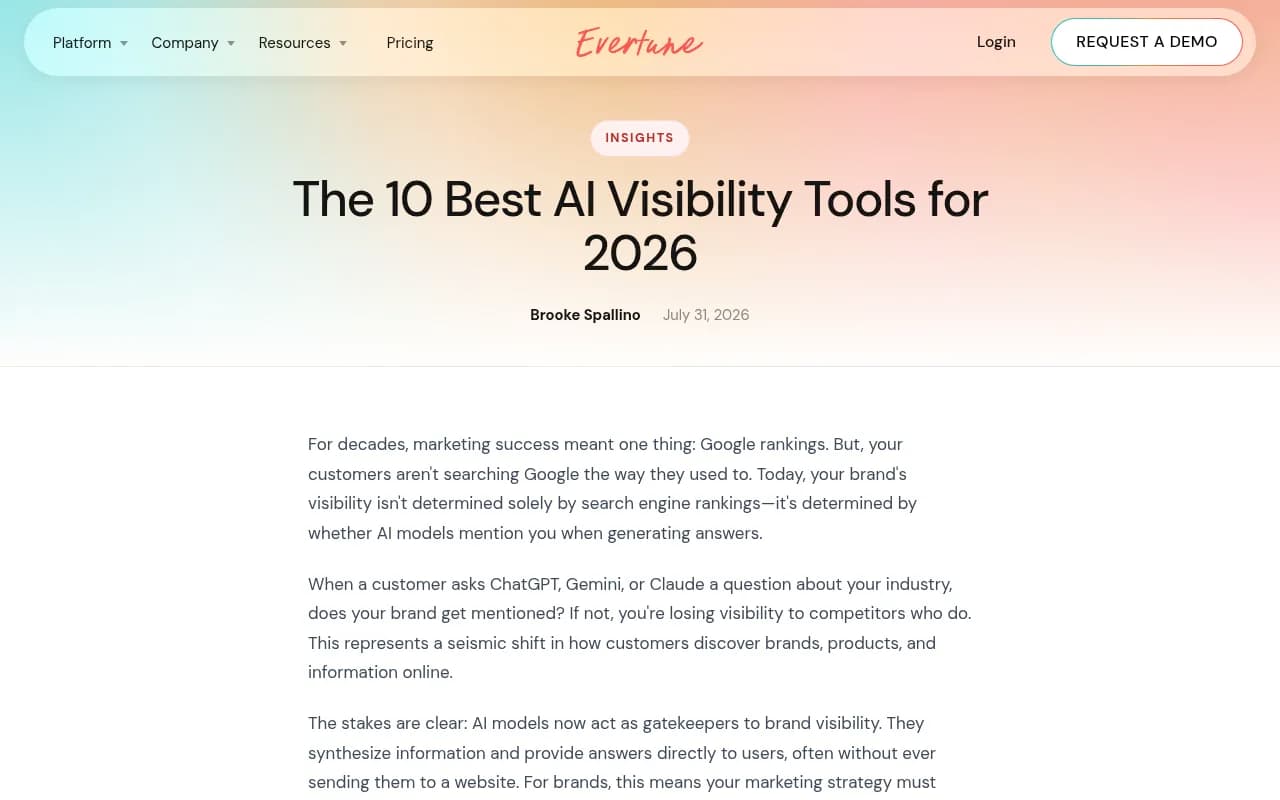
A note on sources: the Evertune screenshot above is a vendor-authored list that puts Evertune at #1. Useful for seeing how they position themselves, not for neutral evidence.
Evertune: the only one showing its math
Evertune is the clear leader on methodology transparency. Its methodology page says it samples each prompt up to 100 times per model, and it backs that with a worked example from 10,000 responses (July 2026):
- 100 prompts asked once each: 29% visibility, with a margin of error of about plus or minus 9 points overall and 31 points at topic level.
- 100 prompts asked 100 times each: the same 29% visibility, but plus or minus 1 point overall and 2 points at topic level.
The single-prompt example is more dramatic. Asked once, a prompt can show 100% visibility with a plus or minus 44 point margin. Asked 100 times, it lands near 48% with a plus or minus 10 point margin. That is the best argument I have seen for why single-run tracking is misleading.
Two caveats. First, this is vendor-authored, not independently audited. Second, repeated sampling fixes variance, not bias. If the prompt set is skewed, a very precise number is precisely wrong.
Prompt source and the two-layer approach
Evertune builds prompts from EverPanel, which it says holds 150M+ real conversations weighted to reflect the composition of the internet. Because over 80% of AI questions are phrased uniquely (its claim), it groups prompts by intent and topic rather than tracking exact strings. Profound's agency roundup also describes a 25-million-person consumer panel behind its topic-level data and notes the tradeoff: topic-level clustering rather than prompt-level demand.
Evertune also separates two layers: foundational model knowledge via direct API access, and live consumer-app answers with web search. It argues the gap between them tells you whether your fix is SEO/content or brand-building. That is a genuinely useful framing for share of voice, since a brand can have high live visibility from search retrieval while the model itself barely knows it.
Pricing and fit
A third-party blog reports a Pro plan at $800/mo, with 100,000 prompts analyzed monthly and unlimited brands and competitors, plus a custom Enterprise tier. DeepSmith calls it the most expensive entry point in its list. Check Evertune's pricing page directly. It also positions itself as the one with AI advertising, connecting to ChatGPT Ads and partners like The Trade Desk and Index Exchange. If you are not planning to buy AI ads, that premium is harder to justify. There is also no published SOC 2, per Profound's review.
Gauge: honest pricing, thinner methodology
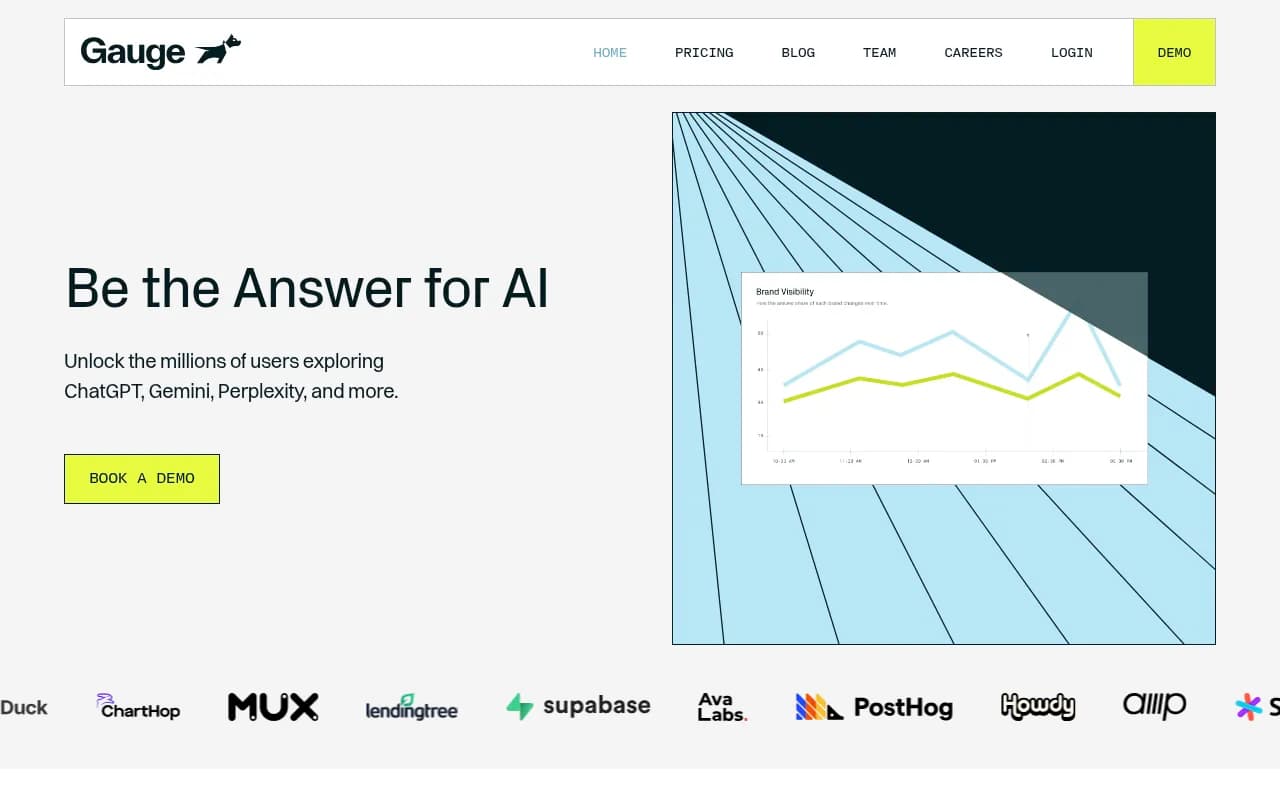
Gauge is the most practical of the three for a team that wants to act. The current Growth plan is $599/mo and includes:
- 600 prompts run daily, which is 54,000 answers per month (600 prompts x 3 platforms x 30 days)
- ChatGPT, Google AI Mode and Microsoft Copilot
- 18 articles per month and 3 seats
- Unlimited domains and competitors, one location
Enterprise is custom and adds AI Overviews, Gemini and Perplexity, sentiment analysis, exports, custom prompts and recurring strategy sessions. Integrations include GA4, Search Console, DataForSEO, Webflow, Framer, Sanity, GitHub, Slack and MCP. Gauge says it costs about a penny per answer.
Note the pricing discrepancy: older third-party tables, including ScratchMM's, list Gauge at $99/mo. That is stale. Use the figure on Gauge's pricing page.
The accuracy gap
Gauge's volume is real. 54,000 answers a month is a lot of data. But it defines one answer as one response from one platform on one day, and it does not publish a repeated-sampling or margin-of-error method. Volume across many prompts is not the same as depth on each prompt. Evertune's own example shows how 100 prompts asked once each still gives plus or minus 31 points at topic level.
That doesn't make Gauge wrong. Daily runs across 600 prompts will smooth some noise over time. But you should ask how they aggregate, whether they rerun prompts within a day, and whether trend lines carry confidence bands. ScratchMM also flags no personas or buyer-journey mapping, and no DeepSeek or Mistral tracking. Claude and Grok need your own API keys.
Brandlight: strategy-first, method unverified
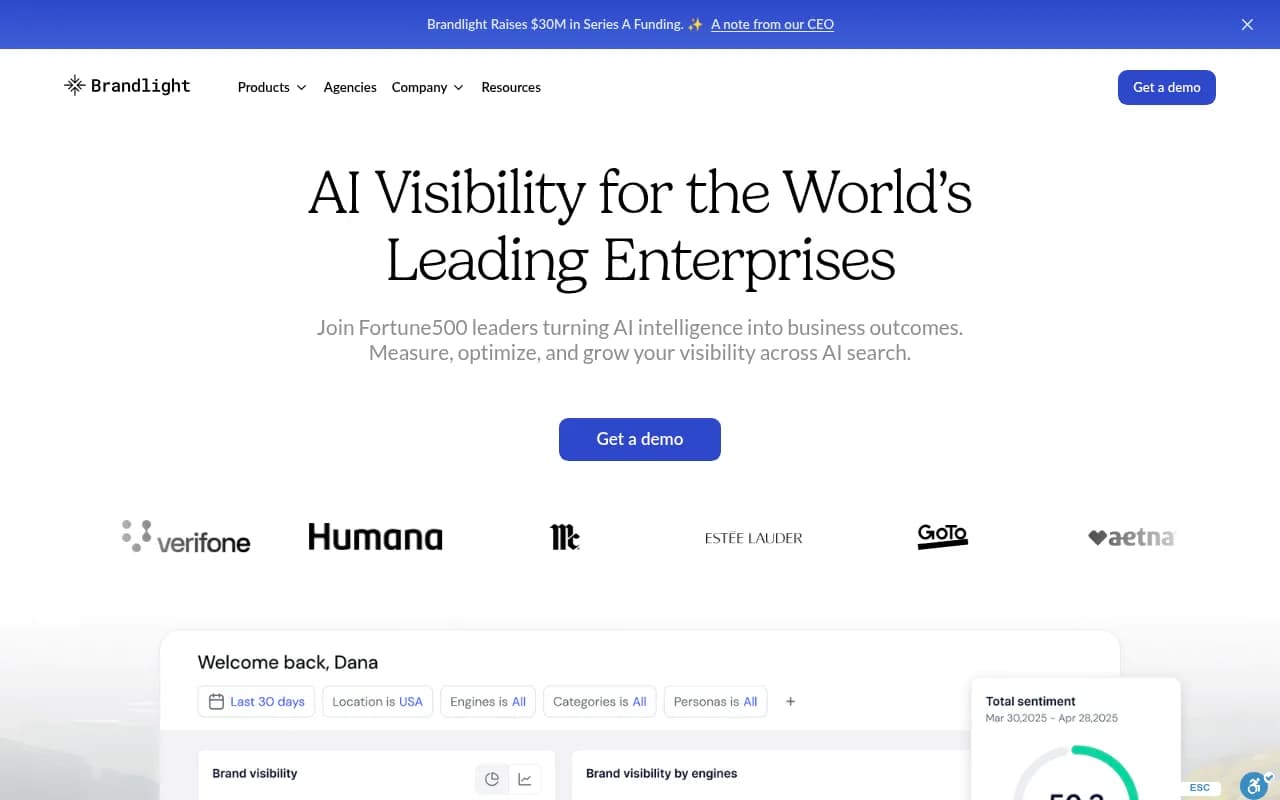
Brandlight describes its product as visibility, sentiment and share of voice against every competitor, built on thousands of real buyer questions, run natively per engine, country and market. It tracks ChatGPT, AI Overviews, AI Mode, Gemini, Perplexity, Copilot and Claude, with coverage adapted per market (for example using Claude where Copilot is paywalled).
Its pitch is different from the other two. Brandlight says it is the one platform pairing measurement with executed activation and a hands-on strategy team, aimed at Fortune 500-class multi-brand organizations. Its own post claims a CPG customer (Kimberly-Clark) moved 12 of 12 brands into the top three across major LLMs. That is a vendor-reported result, so ask to speak to the customer.
Profound's agency review calls Brandlight's source attribution its strongest feature: identifying which publishers and pages shape what AI says about a client. It also notes the shortest track record on the list (out of stealth in April 2025) and fewest engines tracked in that comparison. ScratchMM lists it at $3,000/m with an annual commitment and "quite pricey", but that is an older figure.
What I could not verify
I found no Brandlight methodology page covering sampling, repeat runs or confidence intervals. Pricing is not public either. Third-party estimates range from about $199/mo entry (with an activation option near $750/mo) to $4K to $15K/mo enterprise contracts, all from competitor or aggregator sites. Treat those as unverified. Brandlight's own materials say engagements typically start with a paid 3-month pilot and there is no free trial.
That pilot is actually your best accuracy test. Make it a condition that the pilot reports with confidence intervals and a repeatability check.
How the three differ on accuracy drivers
| Accuracy driver | Brandlight | Evertune | Gauge |
|---|---|---|---|
| Repeated sampling | Not documented | Up to 100x per prompt | Not documented |
| Confidence intervals | Not documented | Yes, in vendor examples | Not documented |
| Prompt realism | Real buyer questions (claim) | 150M+ conversation panel (claim) | Custom prompts plus volume data |
| Separates model knowledge from live answers | Not documented | Yes, two layers | Not documented |
| Per-market runs | Yes, native per engine and country | Not covered in our research | Single location on Growth |
| Independent audit | None found | None found | None found |
The last row matters. None of the three has an independent accuracy benchmark that we could find. Everything above is vendor description.
Questions to ask each vendor
You can learn more from a 30-minute call than from any comparison page, if you ask the right things.
- How many times is each prompt run per model per period, and what is the margin of error on the share of voice figure?
- Is share of voice based on brand mentions, citations or both? Is it one mention per response per brand?
- What is the prompt mix across branded, organic and competitor-comparison prompts? Can I control it?
- How do you flag changes in retrieval behavior, such as ChatGPT changing how many searches it runs per response?
- Do you test through consumer interfaces, APIs or both? Answers can differ between them.
- Can I export raw responses so my team can recompute the number?
The last one is the real test. If you can export every response and recompute share of voice yourself, you can audit the tool. If you cannot, you are trusting a black box.
A simple way to run your own accuracy test
During any trial or pilot, do this:
- Pick 50 prompts split roughly evenly between organic category, competitor comparison and branded.
- Load the same set into each tool, with the same competitor list and country.
- Record share of voice at the end of week one and week two.
- Note how much the number moves with no change to your content.
- Check at least ten responses by hand against what the tool recorded.
A tool whose number swings 8 points week over week with nothing changing has a sampling problem. That is worth knowing before a CMO quotes the figure in a board deck.
Other tools worth a look
These three are not the only options, and two of them skew toward enterprise budgets. If your priority is closing the loop from measurement to published content, with the tracking tied to real crawler and traffic data, Promptwatch is worth shortlisting. It collects answers from the real interfaces of ChatGPT, AI Overviews, Gemini, Perplexity and others, and pairs Visibility Score and Share of Voice with IP-verified AI crawler logs and visitor analytics, so you can see whether a visibility change reached your site. You can read how its metrics are defined in the Share of Voice academy guide.

Other enterprise names that came up in the research include [tool:profound] and [tool:scrunch-ai], and for a broader directory of options see the GEO software listings at bestgeosoftware.com.

Which one should you pick?
| If you are... | Lean toward |
|---|---|
| A statistics-minded team that must defend the number to finance | Evertune |
| A brand planning AI ad spend within two years | Evertune |
| A content or growth team that wants tracking and article production in one place, at a known price | Gauge |
| A multi-brand, multi-market enterprise that wants a strategy partner and source-level influence mapping | Brandlight |
| Under security review, needing SOC 2-level assurance | Verify each vendor in writing; Brandlight claims SOC 2-level posture, Evertune has no published SOC 2 per Profound |
My honest read: Evertune wins the narrow question in the title, share of voice accuracy, because it is the only one that shows its error bars. Gauge wins on price clarity and getting work done. Brandlight wins if the problem is organizational, many brands and markets, and you want people, not just a dashboard. If accuracy is your top criterion, none of the three should skip the six questions above.
Pricing changes often. Confirm current plans directly with each vendor before you commit.
If you would rather have help sorting vendor claims from reality, an agency that already runs GEO programs can pressure-test a shortlist. 1001 SEO Media does this kind of work as part of its AI search and GEO services.