Key takeaways
- Brandlight is sold to enterprises only, and by its own account the entry point is a paid 3-month pilot with no free trial. Ask early whether a 30-day evaluation phase can be scoped inside it.
- Define pass/fail criteria before kickoff. Gartner, as cited by aiassemblylines.com, says more than 50% of generative AI projects are abandoned after the proof of concept stage, mostly over data quality, risk controls, and unclear business value.
- Review and challenge Brandlight's query set against your own buyer questions in week one. Brandlight builds and owns that set, so it is the biggest single variable in what you will see.
- AI engines shift abruptly, so a 30-day test needs a baseline period and a control. Do not credit or blame a vendor for movement the engines caused.
- Score on five things: query set quality, data trust, actionability, security and integration fit, and the working relationship.
Why a 30-day plan, and what it can and cannot prove
Most published POC frameworks run 4 to 6 weeks with a hard stop (Addend Analytics and Element451 both say so). A 30-day plan sits at the short end. That is workable for a monitoring and analysis platform, because the question is narrow: does this vendor give us accurate, trustworthy, actionable visibility data, and can their team work with ours?
What 30 days will not prove is business impact. Content you publish in week two may not be crawled, cited, and converting by day 30. Be honest about that in the charter. A POC shows whether the evidence is credible and the workflow is real. It does not show realized return. Data Ideology makes the same point: a successful POC does not establish sustained adoption, production reliability, or ROI.
What you are evaluating
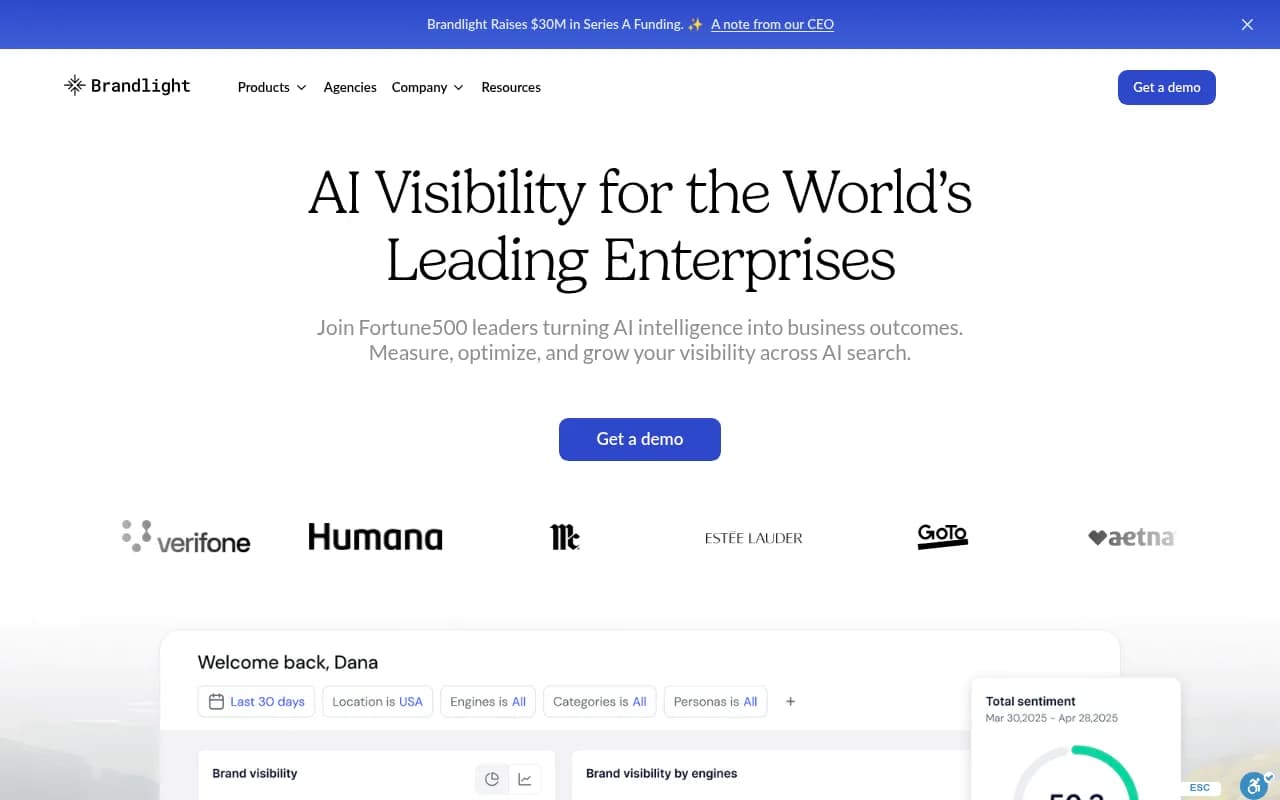
Brandlight is an AI visibility platform aimed squarely at large organizations. From the vendor's own comparison page (so treat these as claims, not verified facts):
- Enterprise only. Startups, SMBs and small-client agencies are told no on the first call.
- Entry is a paid 3-month pilot, no free trial.
- Brandlight builds and owns the query set from licensed AI-panel data plus your search signals, intent-clustered and funnel-tagged, with no prompt caps. It says it takes responsibility if the set is wrong.
- 13 engines tracked.
- Scale claims: 1.2B AI data points analyzed daily, 124M AI answers, about 98.5M sources indexed. I found no third-party validation.
- A dedicated AI strategist, analyst and CS lead per account, with optional forward-deployed engineers.
- Coverage beyond AI search: publishers, social, retailer product pages and merchant feeds, AI ads, agentic commerce.
- Server-log crawler analytics, agentic content generation with deterministic brand and legal rules, drafts routed to your CMS.
- SOC 2 Type II and GDPR, with closed-network processing so data is not returned to external model providers.
Pricing was not published on the pages I found. Get it in writing before day one.
Before day one: the pre-work (about one week ahead)
Fit the POC into the pilot structure
Because entry is a paid 3-month pilot, ask these questions on the first call:
- Can we define the first 30 days as a formal evaluation phase with exit criteria?
- What is the cost of the full pilot, and is there any refund or early-exit clause if we fail the gate at day 30?
- Which team members are assigned during the 30 days (strategist, analyst, CS lead)?
- Are forward-deployed engineers included, or extra?
If the answer to the first question is no, treat the whole 3 months as the commitment and put your gates at day 30 and day 60 inside your own governance, so you can limit rollout spend even if the contract cannot be changed.
Write a one-page charter
AI vendor POC guides agree on one thing: success criteria must exist before the vendor starts. Your charter needs:
- One business question. Example: can we measure and improve our share of voice in AI answers for our three core product categories in the US and Germany?
- Named owners: an executive sponsor, a day-to-day lead, a security reviewer, and someone from the content or web team.
- The scope: engines, markets, languages, product lines, competitors.
- The decision date and the decision: go to full pilot, extend, or stop.
- What a pass looks like, in numbers (see the scorecard below).
Build your own reference prompt set
Before Brandlight shows you anything, write 40 to 60 buyer questions yourself. Pull them from sales call notes, support tickets, Search Console queries, and your best-converting pages. Split them by intent: commercial, informational, and branded.
The split matters. Promptwatch Data found that in ChatGPT citations from Sep 28 to Oct 4, 2026, product pages were 26.0% of citations for commercial prompts, versus 19.1% for informational prompts, while branded prompts leaned on product and landing pages (23.3% and 22.8%) with reviews rising to 5.6%. Each intent rewards a different content mix, so a query set that is all one intent will give you misleading recommendations.
This list is your yardstick. It is not meant to replace Brandlight's set. It lets you check it.
Capture your own baseline
Before kickoff, record where you stand with something independent. A free scan such as the Promptwatch AI visibility report or manual spot checks of 20 prompts in ChatGPT and Gemini will do. Save screenshots with dates. You will need them on day 30 when someone asks whether the numbers are real.
The 30-day plan
| Week | Focus | Main deliverable | Gate question |
|---|---|---|---|
| Pre-work | Charter, reference prompts, baseline | Signed one-page charter | Do we agree what pass means? |
| 1 | Setup, security, query set review | Approved query set and access | Does the set match how our buyers ask? |
| 2 | Data validation | Spot-check results against your baseline | Do we trust the numbers? |
| 3 | Actionability | Three recommendations shipped or scoped | Can our team act on what it says? |
| 4 | Measurement and decision | Scorecard and recommendation | Go, extend, or stop? |
Week 1: setup, security, and the query set
Start security review on day one, not day twenty. Brandlight lists SOC 2 Type II and GDPR, and says it processes content in a closed network. Ask for the actual report and the data-processing terms rather than relying on the marketing page. Confirm which of your data (analytics, server logs, brand documents) leaves your environment, and who inside Brandlight can see it.
Then the query set review, the most important task of the month. Brandlight says it takes responsibility if the set is wrong, which is a good thing to have in writing. Bring your reference prompt set and ask:
- Where does their set overlap with yours, and where does it differ?
- Why were prompts that you think matter left out?
- How are prompts tagged by funnel stage and intent?
- How often is the set refreshed, and will you be told when it changes?
- Can you add prompts of your own? (Brandlight says it owns the set; test how flexible that is in practice.)
Measure overlap simply: of your 50 reference prompts, how many map to a cluster in their set? Under 60% is a conversation. Under 40% is a problem.
Week 2: data validation
This is where you test trust. Pick 20 prompts and compare Brandlight's reported results to what you see by hand in the real interfaces. Check:
- Does it list the same brands in the same rough order you see?
- Are the cited sources ones you can actually find in the answers?
- Are the 13 tracked engines all returning data for your markets and languages?
- Do the numbers stay stable between two runs of the same prompt?
Expect some variance. AI answers are not deterministic. What matters is whether the vendor explains the variance and has a method for handling it.
Also account for engine volatility. Promptwatch Data reports that average citations per ChatGPT response dropped across GPT-5.3, GPT-5.4 and GPT-5-Mini around the GPT-5.3 rollout on March 4, 2026, and that reddit.com's share of ChatGPT citations fell from roughly 4% to 0.5% on August 14, 2026. Brandlight's own Source Collapse study (about 661,000 unbranded category prompts across seven industries, where two engines lost more than 80% of citations in a week and three moved less than 5%) tells the same story from the vendor side. I could not verify that study directly, but the direction matches what independent data shows.
Practical consequence: if your visibility score moves 15 points in week two, ask whether the engine changed before you ask whether the vendor's advice worked. Promptwatch's average sources per response data is useful here. It dates from September 2025, so check the figures against current data, but its point holds: Perplexity cites close to 10 sources every day and barely moves, which makes it a steadier test bench for isolating the effect of your own changes than ChatGPT, whose average drifts with model and retrieval updates.
If you use a second tool as a cross-check, pick one that collects from real interfaces. Promptwatch is one option for that, and the broader field is listed in the GEO software directory at bestgeosoftware.com.

Week 3: actionability
A dashboard that tells you where you are invisible is not enough. In week three, ask Brandlight to hand you recommendations and then try to ship them.
Target three concrete actions:
- One content fix on an existing page where the data says AI is citing a competitor instead.
- One new piece of content, produced through Brandlight's agentic generation with your brand and legal rules applied. Judge the draft the way you would judge a freelancer's: factual accuracy, tone, and how much editing it needs.
- One technical or crawler issue found through the server-log analytics.
Track how long each takes from recommendation to live page, who did the work, and whether the CMS routing actually works with your stack. Record edit time per draft. If your legal team needs to review AI-generated copy, include them in this step, because that is where enterprise tools usually get stuck.
If the content ships in week three, you may see crawl activity by day 30 but probably not stable citation changes. Set that expectation with the sponsor now. Promptwatch's content half-life data is a reminder that citation outcomes unfold over weeks: landing pages and docs stay cited longest, while news loses half its pages within 36 days.
Week 4: measurement and decision
Use the first three days to collect evidence and the last two to decide. Do not extend the POC in week four because you are 'close'. A hard stop is what keeps these evaluations honest.
Compare against your day-zero baseline:
- Did the vendor's visibility readings match what you observed independently?
- Did any shipped action produce a leading indicator (crawl hits, first citations, or position changes on the relevant prompts)?
- How many hours did your own team spend?
Then run the scorecard.
The scorecard
The aiassemblylines.com framework scores vendors on problem specificity, data integration depth, output actionability, production architecture quality, and adoption planning. I have adapted it for an AI visibility platform. Score each 1 to 5, weight them as shown, and agree on the pass mark in the charter.
| Criterion | Weight | What a 5 looks like |
|---|---|---|
| Query set fit | 25% | 70%+ overlap with your reference prompts, clear logic for the rest, you can influence changes |
| Data trust | 25% | Spot checks match within a stated tolerance, variance is explained, sources are verifiable |
| Actionability | 20% | Recommendations are specific, prioritized, and you shipped at least three |
| Security and integration | 15% | Reports and terms reviewed with no blockers, CMS and log pipeline work in your stack |
| Team and adoption | 15% | Named strategist responds fast, your team can use the platform without vendor hand-holding |
The vendor-blog claim that scorecards cut failed implementations by more than 60% is unverified, so I would not repeat it in your business case. The scorecard is useful because it forces a decision on evidence, not because of that statistic.
Suggested thresholds: 80% or above is a go for the full pilot. 65 to 80% means a scoped extension with specific fixes the vendor must make. Below 65% means stop.
Eight things to ask for in writing
Vendor-authored comparisons are marketing, including the one Brandlight publishes about Profound. Whatever you read on a vendor's site, ask for the proof in your own POC. At minimum:
- Pilot price, term, and exit rights.
- The SOC 2 Type II report and data-processing agreement.
- The full list of 13 engines and whether each is collected from the real user interface or an API (this changes what you see, since user-facing answers can differ from API outputs).
- How often each prompt runs and how results are aggregated.
- Who owns the query set and the data if you leave.
- How the closed-network processing works for generated content.
- What the dedicated team does week to week, and what costs extra.
- Export options: can you get raw responses and citations out in CSV or through an API?
How to compare Brandlight with alternatives during the POC
If procurement requires a competitive evaluation, run the same reference prompt set and the same week-two spot check on each finalist. Keep it to two or three. A rough guide to the field:
| Platform | Where it tends to fit | Worth testing for |
|---|---|---|
| Brandlight | Enterprise-only, managed service | Query set quality, dedicated team, breadth beyond AI search |
| Profound | Everyone from self-serve to large accounts | Self-serve start, Agent Analytics |
| Promptwatch | Brands and agencies, monitoring through to content and measurement | Crawler logs, content generation, AI traffic attribution, 7-day free trial |
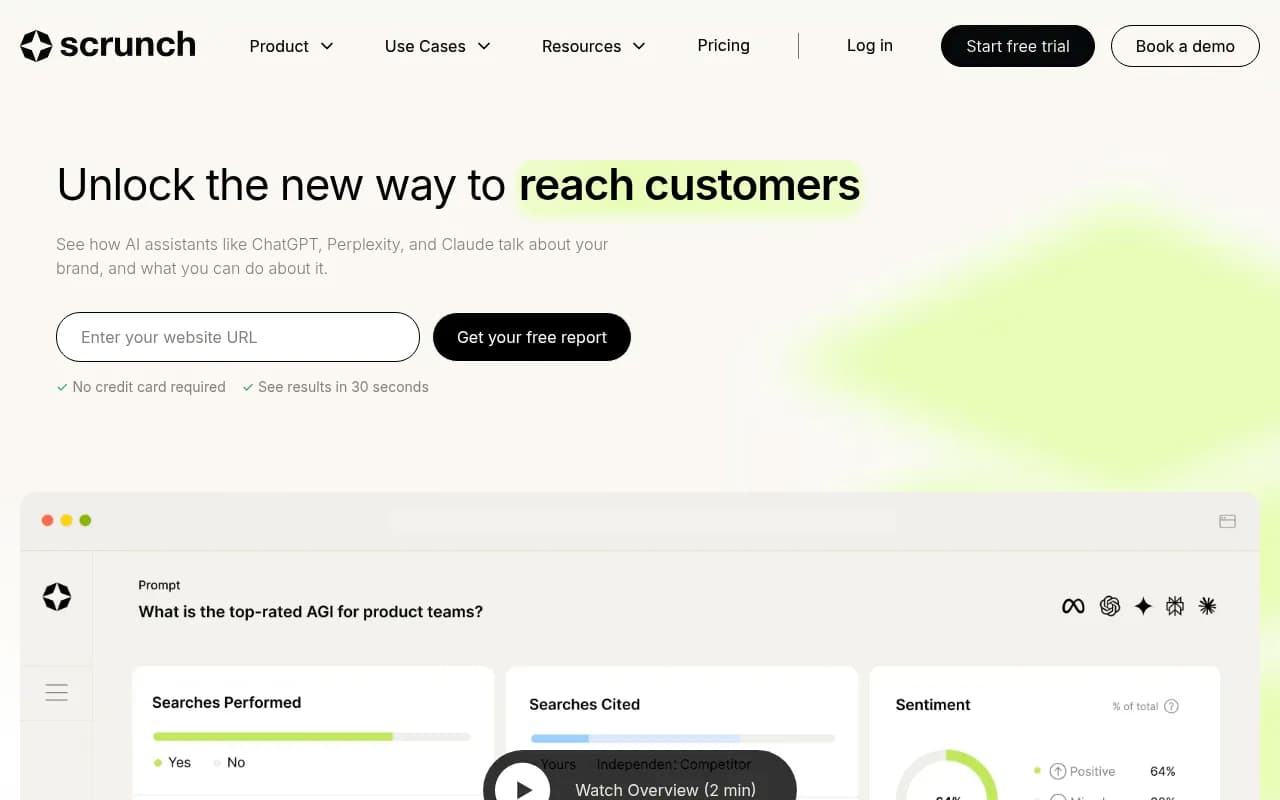
| Scrunch | Monitoring-focused | Reporting depth |
| Bluefish | Enterprise marketing teams | Fortune 500 workflows |

One practical difference stands out: Brandlight has no free trial, so you commit before you see your data. Several competitors let you try the product first, which can narrow your shortlist before you spend on a pilot. Promptwatch, for instance, offers a 7-day free trial on monthly plans and a head-to-head comparison page covering most of the category. For other directories, ai-rank-tools.com lists AI rank trackers.
Common mistakes
- Letting the vendor define success. If the only metrics are the ones in their dashboard, you have not tested anything.
- Skipping the baseline. Without it you cannot separate vendor effect from engine drift.
- Testing only branded prompts. Brand queries flatter everyone. Commercial and informational prompts are where you find out if the tool matters.
- Running a security review at the end. It is the most common reason enterprise pilots slip.
- Judging on the demo. A POC exists to see how the tool behaves on your data, your CMS, your legal review.
- Treating a 30-day result as ROI. It is evidence for a decision, nothing more.
The decision memo
End with a single page for the sponsor: the charter question, the scorecard result, three pieces of evidence (one from each of data trust, actionability, and security), what the full pilot would cost, and the specific conditions attached to a go. If the answer is go, write the day-60 and day-90 gates before signing. If the answer is stop, say why in terms the vendor can hear. A good vendor will want the feedback.
If you want an outside team to run this evaluation or to build the GEO program that follows it, 1001 SEO Media works with enterprise teams on exactly that, and the process above works whether or not you use them.