Brandlight Review 2026
Monitors and analyzes brand presence across AI search engines, helping companies understand their visibility in LLM-generated responses.
Key Takeaways
- Brandlight is a monitoring-only platform -- it shows you where your brand appears in AI answers but doesn't help you fix gaps or create optimized content like Promptwatch does
- Lacks AI crawler logs, content generation, traffic attribution, Reddit/YouTube tracking, and ChatGPT Shopping monitoring that competitors offer
- Enterprise-focused with SOC 2 Type II compliance, white-glove support, and multi-region/multi-language capabilities
- Pricing starts around $199/mo for base tier, with activation plans at $750/mo -- higher than most competitors for fewer features
- Best for large brands that only need visibility dashboards and have separate content teams to act on insights

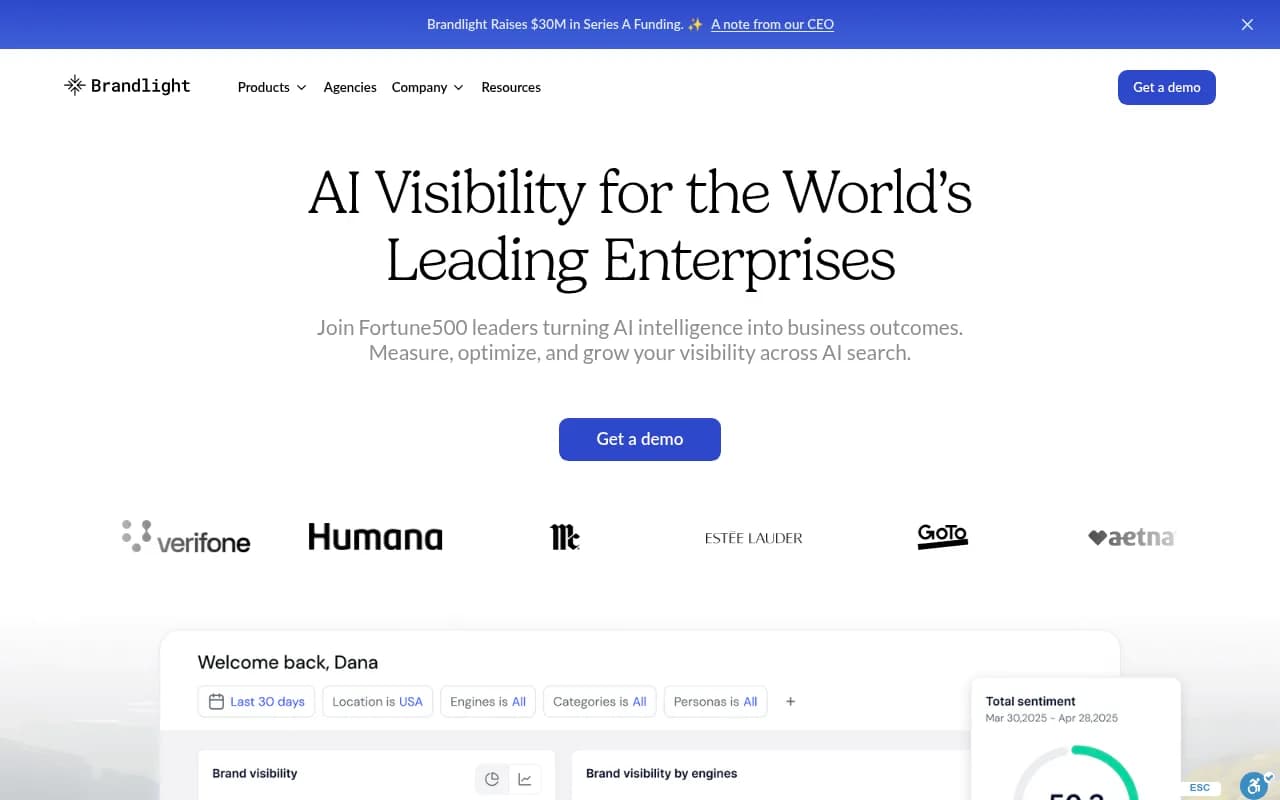
Brandlight positions itself as the enterprise choice for AI visibility tracking. The company raised $30M in Series A funding and serves Fortune 500 clients including Humana, Charter Communications, Estée Lauder, and Mastercard. It monitors how brands appear across major AI engines -- ChatGPT, Perplexity, Claude, Gemini, Copilot, and others -- tracking sentiment, citation sources, and competitive positioning.
The platform was built for CMOs and global marketing teams at large enterprises. If you're managing brand reputation for a publicly traded company or a portfolio of brands across multiple regions, Brandlight speaks your language. It's not a scrappy SEO tool -- it's a boardroom-ready dashboard with the compliance certifications and support infrastructure that enterprise procurement teams demand.
But here's the problem: Brandlight shows you the data, then leaves you stuck. You see where competitors are winning, which sources AI engines cite, and how sentiment trends over time. Then what? You're on your own to figure out what content to create, which pages to optimize, or how to actually improve your visibility scores. Most competitors in the GEO space have moved beyond monitoring-only dashboards. Brandlight hasn't.
What Brandlight Actually Does
Visibility Tracking Across AI Engines: Brandlight queries major AI models with thousands of prompts related to your industry, then analyzes the responses to see where your brand appears, how often, and in what context. You get a visibility score that shows your share of voice compared to competitors. The platform covers ChatGPT, Perplexity, Claude, Gemini, Copilot, and Google AI Overviews.
The queries are pre-built by Brandlight's team based on your industry vertical. You don't get to customize prompts or add your own -- the platform decides what questions matter. For enterprise brands with complex product lines or niche positioning, this can be limiting. You're seeing a slice of how AI talks about you, not the full picture.
Sentiment Analysis: Each mention of your brand gets tagged as positive, neutral, or negative. The platform uses its own sentiment scoring model to determine tone. You can filter by sentiment to see which queries trigger negative associations or where competitors are positioned more favorably.
Sentiment tracking is useful for brand reputation teams, but it's surface-level. You see that AI engines describe your customer service negatively, but Brandlight doesn't tell you which specific content or reviews are driving that perception or how to fix it.
Citation and Source Analysis: Brandlight shows which websites, articles, and sources AI engines cite when they mention your brand. You can see if AI is pulling from your own content, competitor sites, news articles, or third-party reviews. The platform ranks sources by influence -- how often they appear in AI responses and how much weight they seem to carry.
This is one of Brandlight's stronger features. Knowing that AI engines consistently cite a specific Reddit thread or industry publication gives you a target for outreach or content partnerships. But again, Brandlight stops at showing you the data. It doesn't surface the actual Reddit discussions, YouTube videos, or forum threads the way Promptwatch does with its Reddit & YouTube Insights module.
Competitive Benchmarking: You can compare your visibility scores against up to 10 competitors. The platform shows where competitors are mentioned more frequently, which queries they dominate, and what sources boost their visibility. Heatmaps visualize competitive gaps across different AI engines.
The competitive view is helpful for quarterly reports and executive dashboards, but it doesn't give you the "why" behind competitor wins. You see that a competitor ranks higher for "best CRM software" prompts, but Brandlight doesn't show you the content gaps on your site or what specific topics you're missing. Promptwatch's Answer Gap Analysis does exactly that -- it tells you which prompts competitors are visible for but you're not, then shows you what content to create.
Partnership Intelligence: Brandlight tracks which third-party publishers and media outlets drive the most citations in AI responses. You can see if your earned media placements are actually influencing AI recommendations or if you're investing in publishers that AI engines ignore.
This module is aimed at PR and partnership teams. It helps you evaluate which media relationships are worth maintaining and where to pitch stories. The data is solid, but the interface is clunky. Filtering by publisher, date range, and sentiment requires multiple clicks, and exporting data for deeper analysis is limited.
Content Module (Limited): Brandlight's content features are the weakest part of the platform. You can analyze existing pages for "AI readiness" -- basically a checklist of whether your content has structured data, clear headings, and factual claims that AI can parse. The platform also suggests topics where you lack coverage, but the suggestions are generic.
There's no AI writing agent, no content generation, no optimization recommendations beyond basic SEO hygiene. If you want to actually create content that ranks in AI search, you need a separate tool. Promptwatch's built-in AI writing agent generates articles, listicles, and comparisons grounded in real citation data and prompt volumes. Brandlight doesn't compete here.
Technical Analysis Module: This module shows which AI crawlers are accessing your site and how often. You can see if ChatGPT's crawler, Perplexity's bot, or Claude's indexer are being blocked by your robots.txt file or encountering errors. The platform flags pages that AI crawlers can't access.
This is useful for technical SEO teams, but it's not as detailed as Promptwatch's AI Crawler Logs, which show real-time logs of every AI crawler hit, which specific pages they read, and how often they return. Brandlight's version is more of a summary report than a diagnostic tool.
Enterprise HQ View: For companies managing multiple brands or regions, the Enterprise HQ View consolidates performance across all properties. You get a global command center showing visibility trends, competitive positioning, and ROI metrics for each brand.
This is where Brandlight shines for large enterprises. If you're a holding company managing 20+ brands or a global corporation with regional teams, the HQ View gives you the oversight you need. Most competitors don't offer multi-brand dashboards at this scale.
Who Is Brandlight For
Brandlight is built for Fortune 500 marketing teams, global agencies managing enterprise clients, and brands with dedicated PR and content teams. If you're a CMO at a publicly traded company, a VP of Marketing at a multi-brand portfolio, or an agency managing visibility for large clients, Brandlight has the features and compliance you need.
It's not for small businesses, startups, or solo marketers. The pricing starts around $199/mo for the base tier, but most enterprise customers are paying $750/mo or more for activation plans and multi-brand access. At that price point, you're competing with platforms like Promptwatch ($99-$579/mo) that offer more features, or Profound and Scrunch that have similar enterprise positioning but stronger optimization tools.
Brandlight is also not for teams that want to take action on the data. If you need content gap analysis, AI writing tools, or traffic attribution to connect visibility to revenue, you'll be frustrated. Brandlight is a reporting platform, not an optimization platform.
Integrations & Ecosystem
Brandlight integrates with Looker Studio for custom reporting and dashboards. You can export data via CSV or connect to the Looker Studio connector to build your own visualizations. There's no API access mentioned on the website, which is a red flag for enterprise buyers who want to pipe data into their own BI tools or CRM systems.
No integrations with Google Search Console, Slack, Zapier, or content management systems. No browser extensions or mobile apps. You're logging into the web dashboard or pulling data into Looker Studio. That's it.
Compare this to Promptwatch, which offers API access, GSC integration, server log analysis, and a code snippet for traffic attribution. Brandlight feels like a closed system.
Pricing & Value
Brandlight's pricing is not transparent. The website pushes you to "Get a demo" without listing tiers or features. Based on third-party comparisons, the base plan is around $199/mo, with activation plans at $750/mo and custom enterprise pricing above that.
For $199/mo, you're getting visibility tracking and sentiment analysis across a limited set of prompts. No content generation, no crawler logs, no traffic attribution. Promptwatch's Essential plan at $99/mo includes 50 prompts, 5 AI-generated articles, and basic tracking. Promptwatch's Professional plan at $249/mo adds crawler logs, state/city tracking, and 150 prompts. Brandlight's pricing doesn't make sense unless you're a Fortune 500 brand that values white-glove support over features.
The $750/mo activation plan is aimed at agencies and enterprises that want hands-on strategy support. You get a dedicated account manager, quarterly business reviews, and custom reporting. This is where Brandlight differentiates -- most competitors don't offer this level of service. But you're paying a premium for it.
Strengths & Limitations
Brandlight does a few things well. The enterprise focus is real -- SOC 2 Type II compliance, multi-region support, white-glove onboarding, and a customer roster that includes household names. If you need a platform that your legal and procurement teams will approve, Brandlight checks the boxes. The Partnership Intelligence module is also strong for PR teams evaluating earned media ROI.
But the limitations are glaring. Brandlight lacks content gap analysis, AI content generation, AI crawler logs, traffic attribution, Reddit/YouTube tracking, ChatGPT Shopping monitoring, and prompt volume/difficulty scoring. These are table-stakes features in 2026. Promptwatch offers all of them. Otterly.AI and Peec.ai are monitoring-only like Brandlight, but they're priced lower. Profound and Scrunch have stronger optimization features.
Brandlight also lacks transparency. No public pricing, no free trial, no self-service signup. You have to sit through a sales demo to see the product. For a platform that claims to serve "the world's most advanced marketing teams," that feels outdated.
Bottom Line
Brandlight is a solid choice if you're a Fortune 500 brand that only needs visibility dashboards and already has a content team to act on insights. The enterprise features, compliance, and support are real differentiators. But if you want a platform that helps you optimize -- not just monitor -- your AI visibility, Promptwatch is the stronger option. It shows you the gaps, helps you create content that ranks, and tracks the results with traffic attribution. Brandlight shows you the data, then leaves you to figure out the rest.
Best use case: Large enterprises with dedicated PR and content teams who need a compliance-ready dashboard to track brand reputation across AI engines, but don't need optimization tools.
Frequently asked questions
What is Brandlight and what does it do?
How much does Brandlight cost?
Who is Brandlight best suited for?
What AI platforms does Brandlight monitor?
Does Brandlight help create or optimize content?
What are the main limitations of Brandlight?
Is Brandlight SOC 2 compliant?
Similar and alternative tools to Brandlight