Key takeaways
- Brand24 and Brandlight are solving different problems. Brand24 is a social listening tool; Brandlight is an AI search visibility tracker. Comparing them directly only makes sense if you're deciding which type of monitoring to prioritize.
- Brand24 covers 25M+ sources including social media, news, blogs, podcasts, and forums -- all traditional web channels. Brandlight covers none of those. It watches how your brand appears in LLM responses from ChatGPT, Perplexity, Gemini, and similar tools.
- Brand24 is more accessible for smaller teams, starting at $149/mo with a self-serve free trial. Brandlight starts at $199/mo and is demo-gated, clearly targeting enterprise buyers.
- If your team already has social listening covered and wants to understand AI search presence, Brandlight is the logical next tool. If you're starting from scratch and need broad brand monitoring, Brand24 is the more complete starting point.
- Neither tool does what the other does. There's no meaningful overlap -- they're complementary, not competitive.
- For teams that want AI search visibility plus content optimization and gap analysis, platforms like Promptwatch go further than Brandlight by helping you act on what you find, not just observe it.
Overview
Brand24
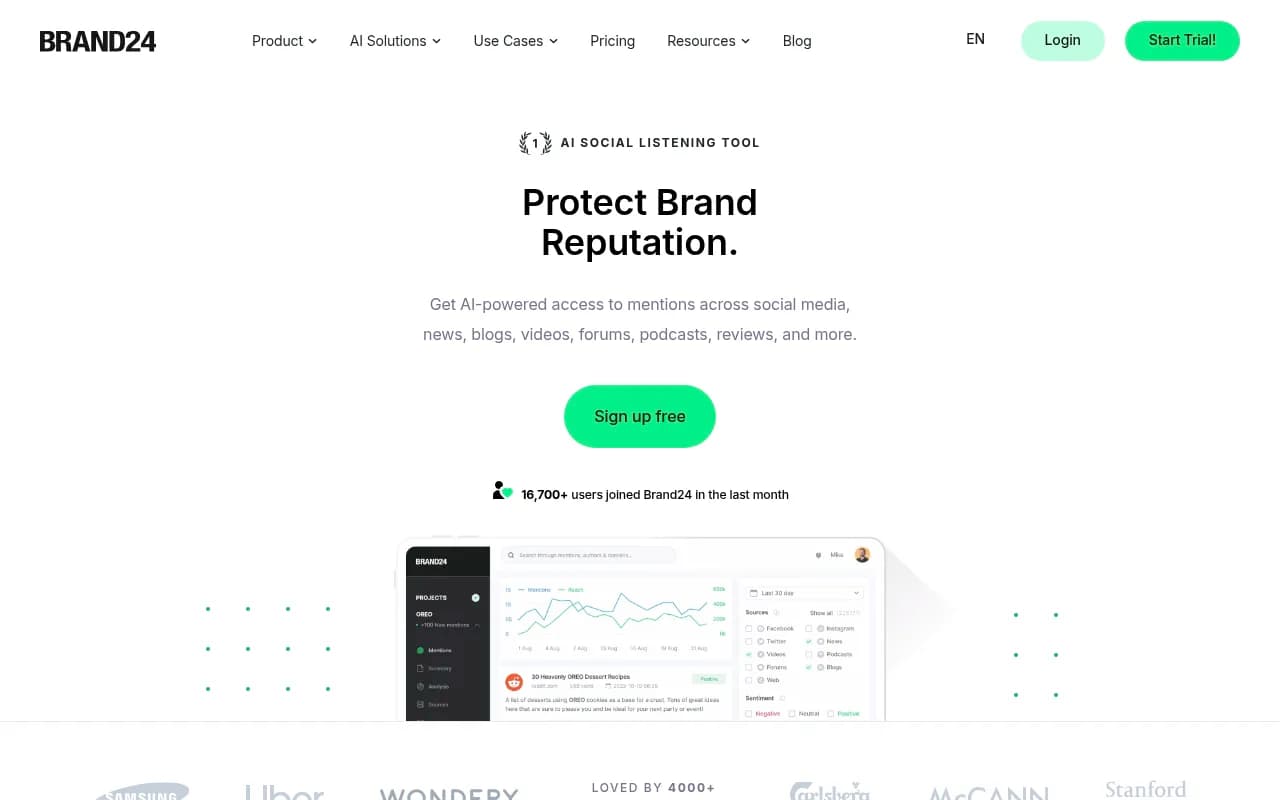
Brand24 has been around long enough to build a real track record. Over 4,000 brands use it, including Samsung, Uber, and Carlsberg. The core product is real-time mention monitoring across 25 million online sources -- social media, news sites, blogs, YouTube, podcasts, forums, and review platforms. It layers AI-powered sentiment analysis on top of that raw data, so you're not just counting mentions but understanding whether they're positive, negative, or neutral.
The platform is genuinely useful for PR teams, social media managers, and marketing teams that need to know when people are talking about their brand and what they're saying. It also handles competitor tracking and hashtag analysis, which makes it a reasonable all-in-one for traditional brand monitoring.
Brandlight
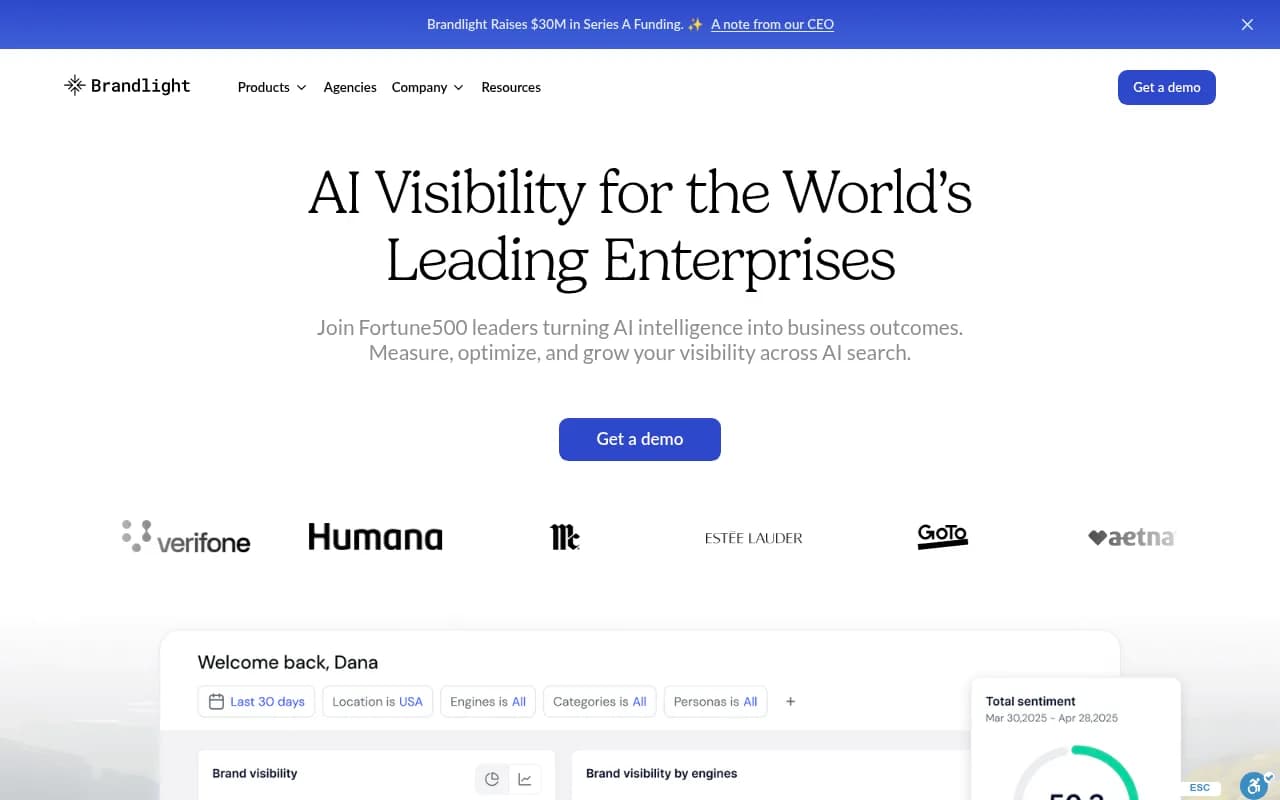
Brandlight is a newer entrant that raised $30M in Series A funding and has positioned itself squarely at the enterprise end of the market. Its focus is narrow but timely: tracking how your brand appears in AI-generated search responses. When someone asks ChatGPT "what's the best CRM for enterprise?" or "which health insurance company should I choose?", Brandlight tells you whether your brand shows up, how prominently, and how that compares to competitors.
The customer list includes Fortune 500 names like Humana, Aetna, and Estée Lauder. The product is demo-gated and clearly not designed for self-serve experimentation. It's an enterprise intelligence tool, not a plug-and-play SaaS product.
Side-by-side comparison
| Feature | Brand24 | Brandlight |
|---|---|---|
| Primary use case | Social listening & brand monitoring | AI search visibility tracking |
| Sources monitored | 25M+ (social, news, blogs, podcasts, forums, reviews) | AI search engines (ChatGPT, Perplexity, Gemini, etc.) |
| Real-time monitoring | Yes | Yes (AI response tracking) |
| Sentiment analysis | Yes, AI-powered | Limited (focused on AI response context) |
| Competitor tracking | Yes | Yes (AI visibility benchmarking) |
| Hashtag tracking | Yes | No |
| Influencer discovery | Yes | No |
| AI search coverage | No | Yes (core feature) |
| Content optimization | No | Limited |
| Free trial | 14-day, self-serve | No (demo-only) |
| Starting price | $149/mo | $199/mo |
| Target audience | SMBs to enterprise | Enterprise / Fortune 500 |
| API access | Yes | Yes (enterprise plans) |
| Reporting & exports | Yes | Yes, enterprise-grade |
| Setup complexity | Low | Medium-High |
Head-to-head feature deep-dive
Source coverage
Brand24's coverage is its biggest selling point. 25 million sources is a genuinely large number, and it spans every major channel where people talk about brands: Twitter/X, Instagram, Facebook, TikTok, LinkedIn, Reddit, YouTube, news sites, blogs, podcasts, and review platforms like Trustpilot and Google Reviews. The real-time aspect matters too -- you can set up alerts and know within minutes when a mention goes live.
Brandlight's coverage is the opposite of broad. It's deliberately narrow: AI search engines. The value isn't in volume of sources but in the specificity of the insight. Knowing that ChatGPT recommends a competitor over you when someone asks a buying question is genuinely useful intelligence -- but it's a completely different kind of data than social mentions.
Verdict: Brand24 wins on breadth. Brandlight wins on AI-specific depth. Neither covers the other's territory.
Sentiment analysis and brand intelligence
Brand24's sentiment analysis is one of its stronger features. It classifies mentions as positive, negative, or neutral, tracks sentiment trends over time, and surfaces reputation scores. For PR teams managing a brand crisis or tracking the impact of a campaign, this is practical and actionable.
Brandlight's intelligence layer is more about competitive positioning in AI responses -- which brands get recommended, in what context, and with what framing. That's useful for brand strategy, but it's not sentiment analysis in the traditional sense.
Verdict: Brand24 is better for sentiment monitoring. Brandlight is better for understanding AI-generated brand narratives.
Competitor tracking
Both tools offer competitor tracking, but the mechanics are completely different.
Brand24 lets you monitor competitor brand names across the same 25M+ sources it uses for your own brand. You can compare mention volumes, sentiment scores, and reach metrics side by side. It's useful for benchmarking share of voice in traditional media.
Brandlight tracks competitor visibility in AI search responses. If a competitor is getting recommended by ChatGPT more often than you for a specific category of query, Brandlight surfaces that. This is a newer and arguably more strategically important data point as AI search grows.
Verdict: Depends entirely on what you're competing for. Traditional share of voice: Brand24. AI search share of voice: Brandlight.
Ease of use and onboarding
Brand24 is self-serve. You sign up, enter your keywords, and start seeing data within minutes. The interface is clean and the learning curve is low. The 14-day free trial means you can evaluate it properly before committing.
Brandlight is demo-first. You request a demo, talk to sales, and get onboarded. That's not necessarily a bad thing for enterprise buyers who want white-glove setup, but it's a barrier for anyone who wants to kick the tires quickly.
Verdict: Brand24 is significantly easier to get started with. Brandlight requires more commitment upfront.
Reporting and integrations
Brand24 generates automated reports, supports PDF exports, and integrates with Slack for real-time alerts. It also has an API for custom workflows. For most marketing teams, this is enough.
Brandlight's reporting is built for enterprise stakeholders -- structured, auditable, and designed for executive presentations. It integrates with enterprise data stacks and offers custom reporting. If you need to present AI visibility data to a C-suite audience, Brandlight's output is more polished for that context.
Verdict: Brand24 is better for day-to-day team reporting. Brandlight is better for executive-level AI visibility reporting.
AI search visibility
Brand24 has no AI search monitoring capabilities. It doesn't track how your brand appears in ChatGPT, Perplexity, Gemini, or any other LLM. This is a genuine gap as AI search becomes a meaningful traffic source.
Brandlight is built entirely around this problem. It tracks brand mentions in AI-generated responses, benchmarks against competitors, and gives you data on which AI models are recommending you and in what contexts.
Worth noting: if AI search visibility is a priority, platforms like Promptwatch take this further by combining monitoring with content gap analysis and AI content generation -- so you can actually improve your AI search presence, not just observe it.

Verdict: Brandlight wins this category outright. Brand24 doesn't compete here.
Pricing comparison
| Plan | Brand24 | Brandlight |
|---|---|---|
| Entry-level | $149/mo (Individual: 3 keywords, 2K mentions) | $199/mo (base tier) |
| Mid-tier | $299/mo (Team: 7 keywords, 5K mentions) | ~$400-500/mo (estimated mid-tier) |
| Upper tier | $499/mo (Pro: 12 keywords, 25K mentions) | $750/mo (activation plan) |
| Enterprise | Custom (100K+ mentions, unlimited keywords) | Custom |
| Free trial | 14-day, no credit card | No (demo only) |
| Annual discount | Yes | Not publicly stated |
Brand24's pricing is transparent and tiered by keyword count and mention volume. Brandlight's pricing is less transparent at the enterprise level -- the $199-$750/mo range is what's publicly available, but actual enterprise contracts are negotiated separately.
Pros and cons
Brand24
Pros:
- Genuinely broad coverage across 25M+ sources
- Real-time alerts and monitoring
- Strong sentiment analysis with trend tracking
- Self-serve with a proper free trial
- Accessible pricing for smaller teams
- Hashtag tracking and influencer discovery built in
- Clean, easy-to-use interface
Cons:
- No AI search monitoring whatsoever
- Mention limits on lower plans can be restrictive for high-volume brands
- Keyword limits on entry plans (3 keywords on Individual) are tight
- Not built for enterprise-scale workflows
Brandlight
Pros:
- Purpose-built for AI search visibility -- a genuinely new and important channel
- Enterprise-grade reporting and stakeholder-ready outputs
- Competitor benchmarking in AI search responses
- Backed by $30M Series A, so the product is likely to keep developing
- Trusted by Fortune 500 brands
Cons:
- No social listening, no traditional web monitoring
- Demo-gated -- no self-serve trial
- Pricing is opaque at higher tiers
- Narrow focus means you need other tools alongside it
- Limited content optimization capabilities (monitoring-focused)
Who should pick which tool
Pick Brand24 if:
- You need to monitor brand mentions across social media, news, blogs, and forums
- You're managing PR, reputation, or community and need real-time alerts
- You want sentiment analysis and share-of-voice data across traditional channels
- You're a small to mid-sized team that needs a self-serve tool with a free trial
- Hashtag tracking or influencer discovery is part of your workflow
Pick Brandlight if:
- Your brand's visibility in AI search engines is a strategic priority
- You're a large enterprise with budget for a dedicated AI visibility platform
- You need executive-level reporting on AI search performance
- You want to benchmark your AI search presence against specific competitors
- You have a sales team relationship and prefer white-glove onboarding
Use both if:
- You're a large brand that needs comprehensive monitoring across both traditional web sources and AI search -- these tools genuinely don't overlap, so running them together makes sense
Final verdict
Brand24 and Brandlight aren't really competing for the same buyer. Brand24 is a mature, well-priced social listening tool that does traditional brand monitoring well. Brandlight is an enterprise AI visibility platform for brands that want to understand and improve how they appear in LLM-generated responses.
If you're a marketing team that needs to know what people are saying about your brand online right now, Brand24 is the obvious choice. If you're an enterprise brand asking "why isn't ChatGPT recommending us?" and you have the budget for a dedicated solution, Brandlight is worth the demo call. Most teams will eventually need both -- they're solving for different channels that are both increasingly important.