Key Takeaways
- Ceyo AI starts at $49/mo while Brandlight starts at $199/mo -- Ceyo is 4x cheaper for small teams and startups
- Brandlight targets Fortune 500 enterprises with custom pricing and white-glove service; Ceyo is built for marketing teams and agencies that need self-service tools
- Both track ChatGPT, Gemini, Claude, and Perplexity, but neither offers the content generation or gap analysis features you'd find in platforms like Promptwatch
- Ceyo provides more granular prompt-level analytics with sentiment scoring and category tagging; Brandlight focuses on high-level brand visibility metrics
- Brandlight recently raised $30M in Series A funding and positions itself as an enterprise-grade solution; Ceyo is leaner and more accessible for mid-market teams
- If you need just monitoring and have under $100/mo to spend, Ceyo wins. If you're a large brand with budget for enterprise tools and want strategic consulting, Brandlight makes sense.
Overview
Ceyo AI
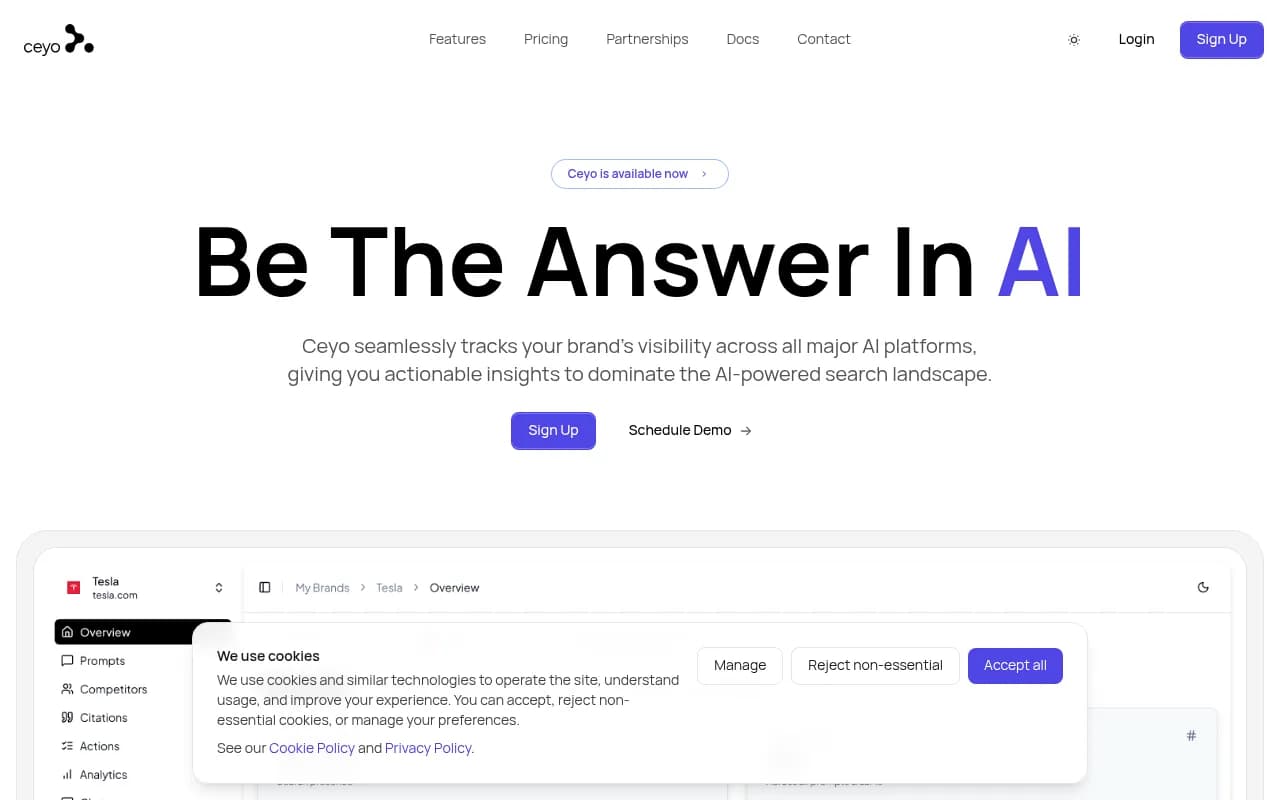
Ceyo tracks how your brand shows up in AI-generated search results across ChatGPT, Gemini, Claude, and Perplexity. It's designed for marketing teams and agencies that want real-time alerts, sentiment analysis, and competitive positioning data without breaking the bank. The interface shows prompt-level detail -- which queries mention your brand, what the sentiment is, average position, and which competitors appear alongside you.
Pricing starts at $49/mo for the Core plan, with a higher tier at $89/mo depending on features. Monthly and yearly billing available.
Brandlight
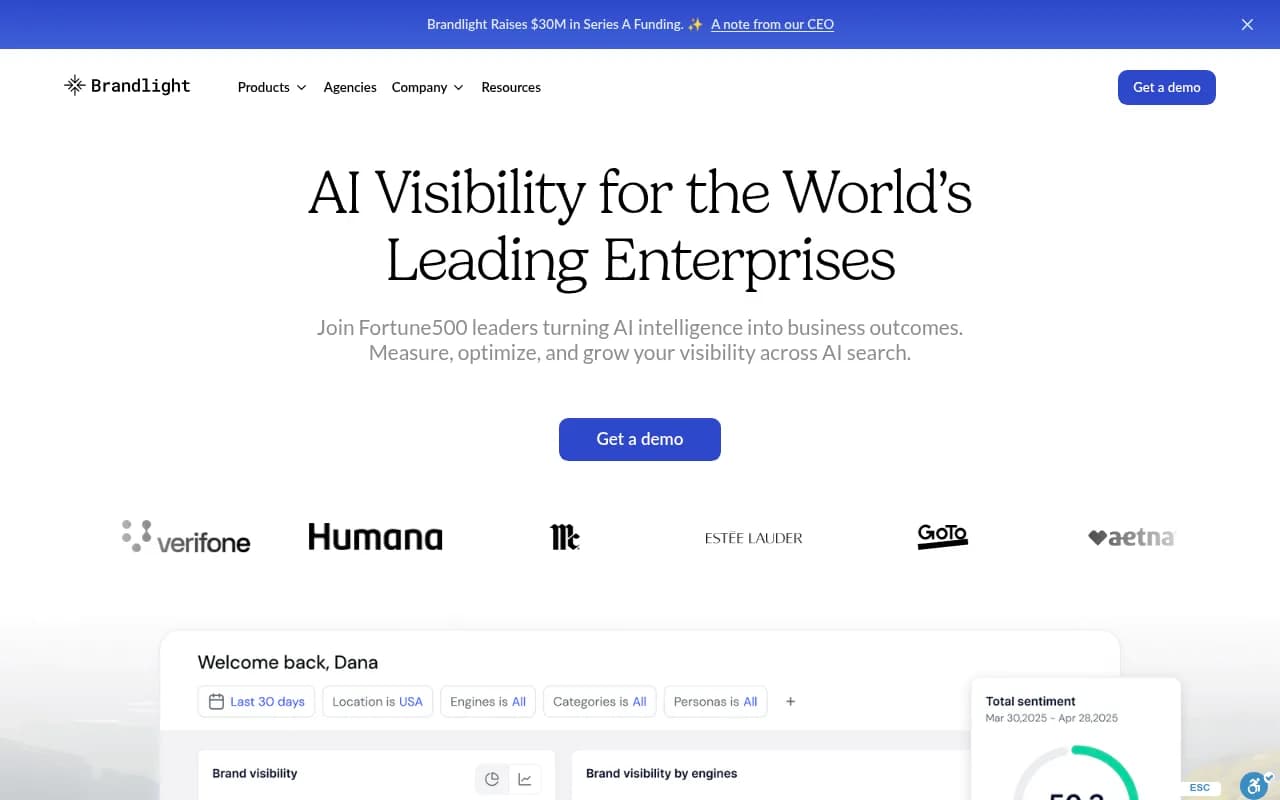
Brandlight positions itself as an enterprise AI visibility platform for Fortune 500 companies. It monitors brand presence across AI search engines and provides strategic insights to help large organizations influence how they appear in LLM responses. The platform recently secured $30M in Series A funding and works with clients like Mastercard, Estée Lauder, Humana, and Verifone.
Pricing starts at $199/mo for the base tier, scales to $750/mo for the activation plan, and offers custom enterprise pricing for large deployments.
Side-by-side comparison
| Feature | Ceyo AI | Brandlight |
|---|---|---|
| Starting price | $49/mo | $199/mo |
| Target audience | Marketing teams, agencies | Fortune 500 enterprises |
| LLM coverage | ChatGPT, Gemini, Claude, Perplexity | ChatGPT, Gemini, Claude, Perplexity |
| Prompt-level analytics | ✓ (detailed) | ✓ (high-level) |
| Sentiment tracking | ✓ | ✓ |
| Competitor tracking | ✓ | ✓ |
| Real-time alerts | ✓ | ✓ |
| Category tagging | ✓ | Limited info |
| GEO/location tracking | ✓ | Limited info |
| Content gap analysis | ✗ | ✗ |
| AI content generation | ✗ | ✗ |
| Custom enterprise pricing | ✗ | ✓ |
| Self-service setup | ✓ | Limited (enterprise focus) |
| Free trial | Not specified | Demo-based sales |
Pricing comparison
Both platforms use tiered pricing, but the entry points are wildly different.
| Plan tier | Ceyo AI | Brandlight |
|---|---|---|
| Entry plan | $49/mo (Core) | $199/mo (base tier) |
| Mid-tier | $89/mo | $750/mo (activation plan) |
| Enterprise | Not offered | Custom pricing |
| Billing options | Monthly, yearly | Monthly, yearly, custom |
Ceyo's pricing is transparent and accessible. Brandlight's pricing suggests a sales-driven model where you need to talk to someone before you see the real numbers. If you're a startup or small agency, Ceyo's $49/mo entry point is realistic. If you're a large brand with a six-figure marketing budget, Brandlight's $199-750/mo range (or higher for custom) might be justified.
User interface and ease of use
Ceyo's interface leans into data tables and prompt-level detail. The screenshot on their site shows a table with columns for Prompt, Visibility %, Sentiment, Average Position, Impact, Brands mentioned, Category, and GEO location. Each row is a specific query ("Best laptop for developers", "Top project management tools") with metrics and competitor logos. It's dense but scannable if you're comfortable with spreadsheet-style views.
Brandlight's site shows less of the actual product interface and more marketing messaging about "AI intelligence" and "business outcomes". The focus is on strategic positioning rather than granular data exploration. This suggests the platform is more dashboard-oriented with high-level summaries, likely paired with account management and consulting.
Verdict: Ceyo is more hands-on and data-forward. Brandlight is more strategic and consultative. If you want to dig into the data yourself, Ceyo. If you want someone to interpret it for you, Brandlight.
LLM coverage and tracking depth
Both platforms track the same four major LLMs: ChatGPT, Gemini, Claude, and Perplexity. Neither mentions coverage of newer models like DeepSeek, Grok, Mistral, or Meta AI -- a gap that more comprehensive platforms like Promptwatch fill by monitoring 10+ AI engines.

Ceyo provides more visible prompt-level granularity. You can see exactly which queries trigger your brand, what the sentiment is (positive/neutral/negative), and where you rank on average. The category and GEO tagging helps you segment by topic and region.
Brandlight's public materials don't show the same level of prompt detail. The messaging focuses on "visibility across AI search" and "influence your brand's presence", which sounds more like aggregated metrics and trend analysis than per-query breakdowns.
Verdict: Ceyo gives you more raw data to work with. Brandlight gives you the big picture. Neither goes as deep as platforms with crawler log analysis or content gap identification.
Sentiment and competitive analysis
Ceyo explicitly tracks sentiment (positive/neutral/negative) at the prompt level and shows which competitor brands appear in the same AI responses. The table view makes it easy to spot where you're mentioned positively vs where competitors dominate.
Brandlight also mentions competitive positioning but doesn't show the mechanics in their public materials. Given the enterprise focus, it's likely packaged as strategic reports rather than self-service dashboards.
Both platforms stop at monitoring. Neither tells you why a competitor is winning a specific prompt or what content you're missing. That's where the action gap hits -- you see the problem but you're on your own to fix it.
Verdict: Ceyo's sentiment scoring is more visible and actionable for day-to-day tracking. Brandlight's competitive analysis is probably deeper but locked behind custom reports.
Alerts and notifications
Ceyo advertises "real-time alerts" as a core feature. You can presumably set up notifications when your brand is mentioned, when sentiment shifts, or when a competitor starts appearing in a query you care about.
Brandlight mentions monitoring but doesn't detail the alerting system. Enterprise platforms usually offer custom alert rules, but you'd need to ask during the sales process.
Verdict: Ceyo's alerting is more transparent. Brandlight likely has it but doesn't lead with it.
Content optimization and gap analysis
Neither platform offers content gap analysis or AI content generation. They're both monitoring-only tools. You see where you're invisible, but you don't get help figuring out what content to create or how to optimize existing pages.
This is the biggest limitation for both. Monitoring tells you there's a problem. Optimization tools tell you how to fix it. If you want the full loop -- find gaps, generate content, track results -- you'd need to pair either platform with something like Promptwatch, which includes Answer Gap Analysis and an AI writing agent trained on 880M+ citations.
Verdict: Tie. Both platforms leave you stuck after showing you the data.
Target audience and positioning
Ceyo is built for marketing teams and agencies that need affordable, self-service AI visibility tracking. The $49/mo entry point and data-forward interface signal a product you can sign up for, set up yourself, and start using without talking to sales.
Brandlight is built for Fortune 500 enterprises. The $30M Series A funding, client logos (Mastercard, Estée Lauder, Humana), and "get a demo" CTA all point to a high-touch, consultative sales process. You're not just buying software -- you're buying strategic guidance and account management.
Verdict: Ceyo for startups and mid-market teams. Brandlight for large brands with enterprise budgets.
Integration and API access
Neither platform publicly documents API access or integrations. Ceyo's site doesn't mention it. Brandlight's enterprise focus suggests custom integrations are possible but not self-service.
If you need to pipe AI visibility data into your own dashboards or workflows, you'd need to ask both vendors directly.
Verdict: Unknown for both. Likely limited or custom-only.
Pros and cons
Ceyo AI pros
- Affordable entry point ($49/mo) makes it accessible for small teams
- Detailed prompt-level analytics with sentiment, category, and GEO tagging
- Self-service setup -- no need to sit through sales demos
- Real-time alerts for brand mentions and sentiment shifts
- Competitor tracking shows who else appears in the same AI responses
Ceyo AI cons
- No content gap analysis or optimization features -- monitoring only
- Limited LLM coverage (4 models vs 10+ in more comprehensive platforms)
- No visible API or integration options
- Unclear what differentiates the $49 vs $89 tiers
- No free trial mentioned
Brandlight pros
- Enterprise-grade platform built for Fortune 500 clients
- Strategic consulting and account management included at higher tiers
- Well-funded ($30M Series A) with backing for long-term development
- Custom pricing and features for large deployments
- Proven client base (Mastercard, Estée Lauder, Humana)
Brandlight cons
- Expensive ($199/mo minimum, likely much higher for real enterprise features)
- Sales-driven process -- no self-service trial or transparent pricing
- Less visible prompt-level detail in public materials
- No content optimization or gap analysis features
- Overkill for startups and small marketing teams
Who should pick Ceyo AI
Pick Ceyo if you're a startup, small marketing team, or agency that needs affordable AI visibility tracking without the enterprise overhead. The $49/mo entry point is realistic for teams just starting to care about how they show up in ChatGPT and Perplexity. The prompt-level detail and sentiment tracking give you enough data to spot problems and track progress over time.
Ceyo makes sense if you want to monitor AI visibility as part of a broader SEO or content strategy, but you're not ready to invest in full optimization tools. You'll still need to figure out the "what to do about it" part yourself, but at least you'll know where you stand.
Also pick Ceyo if you value self-service setup and transparent pricing. You can sign up, connect your brand, and start seeing data without sitting through a sales pitch.
Who should pick Brandlight
Pick Brandlight if you're a Fortune 500 brand or large enterprise with a six-figure marketing budget and a need for strategic consulting, not just software. The platform is built for organizations that want white-glove service, custom reporting, and account management to help interpret the data and guide strategy.
Brandlight makes sense if you're already spending heavily on brand monitoring, PR, and competitive intelligence, and you want to add AI visibility to that mix. The higher price point buys you more than software -- you get a partner who understands enterprise marketing and can help you navigate the AI search landscape.
Also pick Brandlight if you need custom integrations, multi-stakeholder reporting, or features that aren't available in off-the-shelf tools. The enterprise focus means they'll build what you need, but you'll pay for it.
Final verdict
Ceyo AI wins for startups, small marketing teams, and agencies that need affordable, self-service AI visibility tracking. The $49/mo entry point is 4x cheaper than Brandlight, and the prompt-level analytics give you enough detail to understand where you're showing up and where you're not. It's a monitoring tool, not an optimization platform, but it's honest about that.
Brandlight wins for Fortune 500 enterprises that have the budget for strategic consulting and want a partner, not just a dashboard. The $199-750/mo pricing (and likely much higher for real enterprise deployments) buys you more than software -- you get account management, custom reporting, and a platform built for large-scale brand monitoring.
Neither platform solves the action problem. Both show you where you're invisible in AI search, but neither helps you fix it with content gap analysis or AI-generated articles. If you want the full loop -- find gaps, create content, track results -- you'd need to pair either tool with something like Promptwatch, which combines monitoring with Answer Gap Analysis and an AI writing agent trained on 880M+ citations.
Bottom line: Ceyo for budget-conscious teams that want data. Brandlight for enterprises that want strategy. Both for monitoring only.