Key Takeaways
- Brandlight is enterprise-focused with a $199/mo starting price and $30M Series A backing, while LLM Pulse starts at €49/mo and targets smaller teams and mid-market brands
- LLM Pulse covers 10+ AI models on all plans; Brandlight's model coverage varies by tier with some models locked to enterprise plans
- Both platforms track citations and sentiment, but neither offers content generation or gap analysis -- they're monitoring tools, not optimization platforms
- Brandlight emphasizes Fortune 500 clients and custom enterprise features; LLM Pulse focuses on quick setup and self-service with a 14-day free trial
- For actionable optimization beyond monitoring, tools like Promptwatch fill the gap by showing you what content to create based on citation data and competitor analysis

Overview
Brandlight
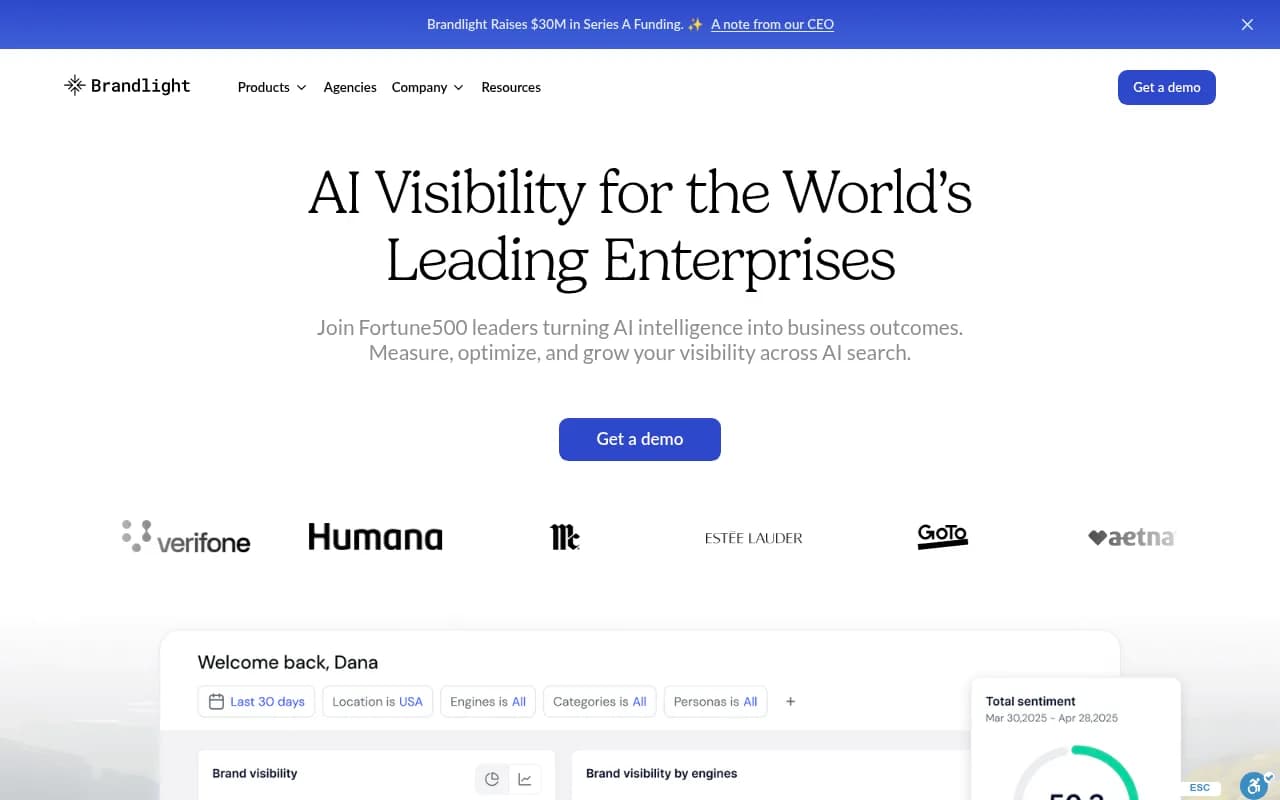
Brandlight positions itself as an AI visibility platform for enterprise brands. They raised $30M in Series A funding and count Fortune 500 companies like Mastercard, Estée Lauder, and Humana among their clients. The platform monitors how brands appear in AI search results across multiple LLMs, with a focus on large organizations that need custom integrations and white-glove support.
Pricing starts at $199/mo for the base tier and goes up to $750/mo for the "activation" plan, with custom enterprise pricing beyond that. No free trial is advertised on their site -- they push demo calls instead.
LLM Pulse
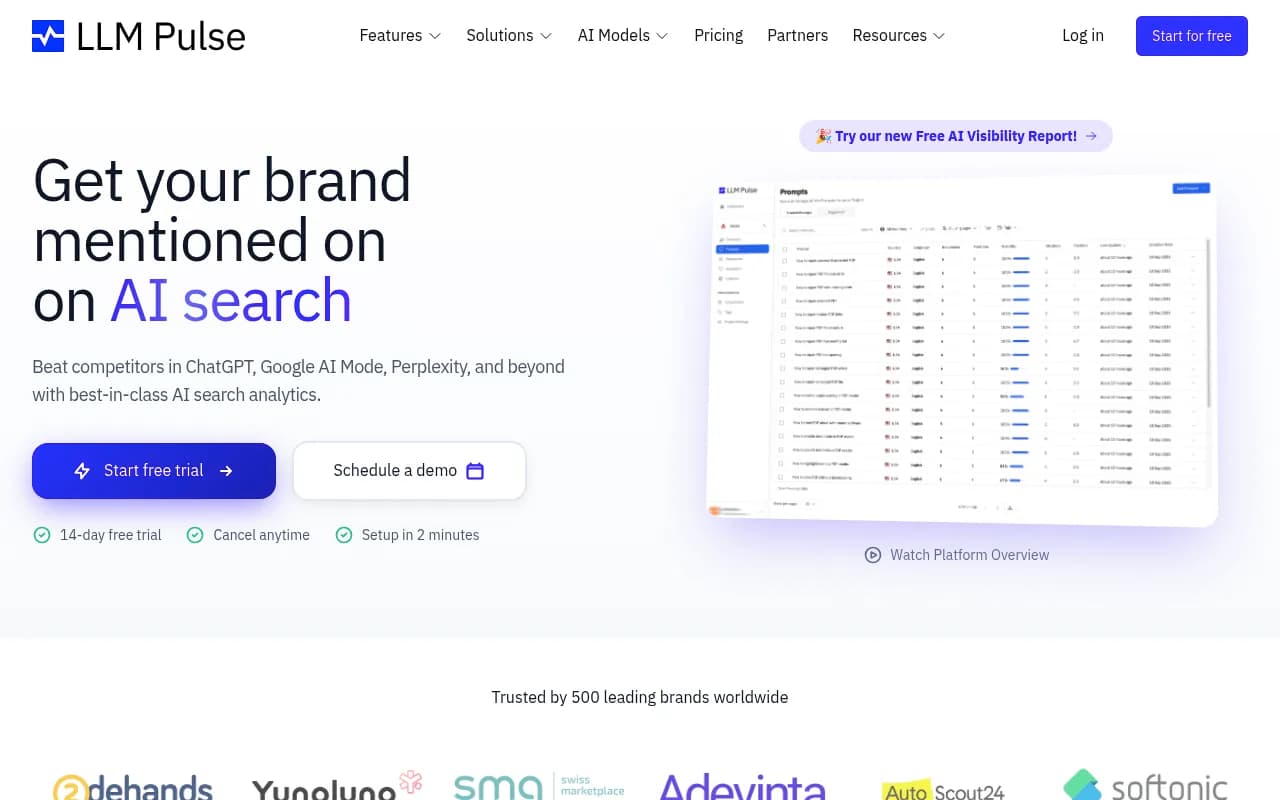
LLM Pulse takes a more accessible approach. It's an AI search visibility tracker that monitors ChatGPT, Perplexity, Gemini, Google AI Mode, and other models. The platform is built for quick setup -- they claim you can be tracking prompts in 2 minutes. They serve 500+ brands but target a broader market, from startups to mid-market companies.
Pricing is transparent: €49/mo for 40 prompts (Starter), €99/mo for 100 prompts (Growth), €299/mo for 300 prompts (Scale). They offer a 14-day free trial and 17% discount on annual billing. The self-service model means you can sign up and start tracking without talking to sales.
Side-by-side comparison
| Feature | Brandlight | LLM Pulse |
|---|---|---|
| Starting price | $199/mo | €49/mo (~$52/mo) |
| Free trial | No (demo only) | 14 days |
| AI models tracked | Varies by tier | 10+ on all plans |
| Prompt tracking | Yes | Yes (40-300 prompts) |
| Citation analysis | Yes | Yes |
| Sentiment tracking | Yes | Yes |
| Competitor benchmarking | Yes | Yes |
| Content optimization | Limited | AI-powered recommendations |
| Content generation | No | No |
| Setup time | Requires onboarding | ~2 minutes |
| Target market | Enterprise/Fortune 500 | SMB to mid-market |
| Custom enterprise plans | Yes | Not advertised |
Pricing breakdown
Both platforms use tiered pricing, but the structures are different.
| Plan | Brandlight | LLM Pulse |
|---|---|---|
| Entry tier | $199/mo (base) | €49/mo (Starter, 40 prompts) |
| Mid tier | Not specified | €99/mo (Growth, 100 prompts) |
| High tier | $750/mo (activation) | €299/mo (Scale, 300 prompts) |
| Enterprise | Custom pricing | Not advertised |
| Free trial | No | 14 days |
| Annual discount | Not specified | 17% |
Brandlight's pricing is opaque. They list a $199/mo "base tier" and a $750/mo "activation plan" but don't explain what you get at each level. The website pushes you toward a demo call, which is standard for enterprise-focused tools but frustrating if you just want to see a feature list.
LLM Pulse is straightforward. You pay based on how many prompts you want to track. The Starter plan at €49/mo gets you 40 prompts, which is enough for a small brand monitoring a handful of key queries. Growth at €99/mo bumps you to 100 prompts. Scale at €299/mo gives you 300 prompts. All plans include the same AI model coverage and core features -- you're just buying more prompt capacity.
For a small team or startup, LLM Pulse is 4x cheaper at the entry level. For a large enterprise with complex needs, Brandlight's custom pricing might make sense, but you're paying a premium for the Fortune 500 branding and account management.
AI model coverage
This is where things get murky with Brandlight. Their website mentions tracking "AI search" and shows logos for some models, but they don't clearly list which models are included at which pricing tiers. Based on their marketing materials, they cover ChatGPT, Perplexity, Gemini, and Google AI Overviews, but models like DeepSeek, Grok, Claude, Copilot, and Meta AI appear to be enterprise-only.
LLM Pulse is explicit: all plans track 10+ models. The core set includes ChatGPT, Perplexity, Gemini, Google AI Mode, and Google AI Overviews. DeepSeek, Grok, Claude, Copilot, and Meta AI are marked as "Enterprise" on their site, which suggests they're available but might require a higher tier or custom plan. Still, the baseline coverage is clear and consistent across pricing tiers.
If you need to track a specific model like Claude or Grok, confirm with both vendors before committing. LLM Pulse at least shows you what's included upfront.
Prompt tracking and monitoring
Both platforms let you define a set of prompts (queries) and track how AI models respond over time. You see your brand's visibility score, citation rate, and how often you're mentioned compared to competitors.
Brandlight's approach is geared toward large-scale monitoring. They talk about "AI intelligence" and "business outcomes" but don't specify how many prompts you can track at each tier. The $750/mo activation plan suggests you're getting a lot of prompts, but without a demo, it's hard to know.
LLM Pulse is transparent: 40 prompts on Starter, 100 on Growth, 300 on Scale. You pick the queries that matter to your business -- "best CRM software", "top project management tools", "[your brand] vs [competitor]" -- and LLM Pulse runs them weekly across all tracked models. You get a dashboard showing visibility trends, citation counts, and sentiment over time.
For most brands, 40-100 prompts is enough to cover your core product categories and competitive queries. If you're a large enterprise tracking dozens of product lines across multiple regions, you'll need more capacity, but at that point you're probably looking at custom pricing from either vendor.
Citation and source analysis
Both platforms show you which sources AI models cite when they mention your brand. This is useful for understanding where your visibility is coming from -- your own website, third-party reviews, Reddit threads, news articles, etc.
Brandlight emphasizes "AI intelligence" and claims to help you "optimize and influence your brand's presence", but the website doesn't detail how citation analysis works or what actions you can take based on the data.
LLM Pulse's citation analysis shows you the exact sources AI models reference in their responses. You can see if your content is being cited, or if competitors and third-party sites are dominating the narrative. The platform also offers "AI-powered content recommendations" to help you improve visibility, though it's not clear how deep these recommendations go. They don't generate content for you -- they suggest topics or angles to cover.
Neither platform matches what Promptwatch does here. Promptwatch's Answer Gap Analysis shows you the specific prompts competitors rank for but you don't, then generates content grounded in 880M+ citations to close those gaps. Brandlight and LLM Pulse tell you what's happening; Promptwatch helps you fix it.
Sentiment tracking
Both platforms track sentiment -- whether AI models describe your brand positively, negatively, or neutrally.
Brandlight mentions sentiment analysis in their marketing but doesn't show examples or explain how it's categorized.
LLM Pulse automatically categorizes sentiment across prompts and contexts. You can see sentiment trends over time and compare your brand's sentiment to competitors. If ChatGPT starts describing your product negatively, you'll catch it in the dashboard.
This is a baseline feature for any AI visibility tool. Both platforms do it, but neither goes beyond basic categorization. If you need to act on sentiment issues -- like fixing inaccurate information or improving how AI models describe you -- you'll need to pair these tools with a content optimization platform.
Competitor benchmarking
Brandlight and LLM Pulse both let you track competitors alongside your own brand. You can see share of voice, citation rates, and visibility scores for each competitor.
Brandlight's competitor features are aimed at enterprise users who want to benchmark against multiple rivals across different markets. The details are vague, but the Fortune 500 client list suggests they handle complex competitive landscapes.
LLM Pulse's competitor benchmarking is straightforward. You add competitors to your dashboard and see how they compare to you across all tracked prompts and models. The interface shows side-by-side visibility scores and citation counts, making it easy to spot where competitors are winning.
For actionable competitive insights, you need more than just visibility scores. Promptwatch's competitor heatmaps show you exactly which prompts competitors rank for, which sources they're cited from, and what content gaps you need to fill to catch up.
Content optimization and recommendations
This is where both platforms fall short.
Brandlight claims to help you "optimize and influence" your AI presence, but the website doesn't explain how. There's no mention of content generation, gap analysis, or specific optimization workflows. It's a monitoring tool with some vague optimization language.
LLM Pulse offers "AI-powered content recommendations" as part of their optimization step. You get suggestions on what to write or improve based on your visibility data. This is better than nothing, but it's not the same as generating content or showing you exactly what's missing. You still have to do the work yourself.
Neither platform generates content. Neither shows you the specific prompts you're invisible for. Neither helps you create articles, listicles, or comparison pages optimized for AI search.
If you want to move from monitoring to action, you need a platform like Promptwatch. It shows you the content gaps (Answer Gap Analysis), generates articles grounded in real citation data (AI writing agent), and tracks the results (page-level visibility tracking). Brandlight and LLM Pulse tell you where you stand; Promptwatch helps you improve.
Setup and onboarding
Brandlight requires a demo call. Their website pushes you toward "Get a demo" buttons with no self-service signup. This is standard for enterprise tools, but it means you can't just create an account and start tracking. Expect a sales process, onboarding calls, and custom setup.
LLM Pulse is self-service. They claim you can set up tracking in 2 minutes. Sign up, add your prompts, and start monitoring. The 14-day free trial lets you test the platform without talking to anyone. If you're a small team that values speed and autonomy, this is a big advantage.
For enterprise buyers who want custom integrations, white-glove support, and dedicated account management, Brandlight's approach makes sense. For everyone else, LLM Pulse's self-service model is faster and less friction.
Integration and reporting
Brandlight doesn't list specific integrations on their website. Given their enterprise focus, they likely offer custom API access and integrations for large clients, but you'll need to ask during the demo.
LLM Pulse doesn't advertise integrations either, though their dashboard appears to be the primary interface for viewing data. No mention of API access, Looker Studio connectors, or export options.
If you need to pull AI visibility data into your existing reporting stack, ask both vendors directly. For comparison, Promptwatch offers Looker Studio integration and a full API for custom workflows.
Who should choose Brandlight
Brandlight makes sense if:
- You're a Fortune 500 company or large enterprise with a big budget
- You need custom integrations, dedicated support, and white-glove onboarding
- You're tracking AI visibility across multiple brands, regions, and product lines
- You value the prestige of working with a well-funded, enterprise-focused vendor
- You're comfortable with opaque pricing and a sales-driven process
Brandlight is overkill for small teams and startups. The $199/mo entry price is steep for what appears to be basic monitoring, and the lack of transparency around features and model coverage is frustrating. If you're not a large enterprise, you're probably not the target customer.
Who should choose LLM Pulse
LLM Pulse is a better fit if:
- You're a startup, SMB, or mid-market brand with a limited budget
- You want transparent pricing and a free trial before committing
- You value self-service setup and don't want to sit through sales demos
- You need to track 40-300 prompts across 10+ AI models
- You want a straightforward monitoring tool without enterprise bloat
LLM Pulse is 4x cheaper than Brandlight at the entry level and much more transparent about what you're getting. The 14-day free trial removes risk. If you're a small team that just wants to start tracking AI visibility without a big upfront investment, this is the obvious choice.
What both platforms are missing
Brandlight and LLM Pulse are monitoring tools. They show you data -- visibility scores, citations, sentiment -- but they don't help you act on it.
You can see that your competitor is mentioned in ChatGPT responses 3x more often than you are. You can see that your citation rate is dropping. You can see that AI models are describing your product negatively. But then what?
Neither platform tells you which prompts you're invisible for. Neither shows you what content to create. Neither generates articles optimized for AI search. You're stuck with insights but no clear path to improvement.
This is where Promptwatch is different. It's built around the action loop: find the gaps (Answer Gap Analysis), create content that ranks in AI (AI writing agent), track the results (page-level visibility). Promptwatch doesn't just monitor -- it helps you optimize.
If you're serious about improving your AI search visibility, you need more than a dashboard. You need a platform that shows you what's missing and helps you fix it.
Pros and cons
Brandlight pros
- Enterprise-grade platform with Fortune 500 clients
- $30M Series A funding suggests long-term viability
- Custom integrations and dedicated support for large organizations
- Competitor benchmarking and sentiment tracking
Brandlight cons
- Expensive ($199/mo starting price, $750/mo for activation plan)
- No free trial or self-service signup
- Opaque pricing and feature details
- AI model coverage unclear at each tier
- Monitoring-only -- no content generation or gap analysis
- Overkill for small teams and startups
LLM Pulse pros
- Affordable (€49/mo starting price)
- 14-day free trial with no credit card required
- Transparent pricing and feature list
- 10+ AI models on all plans
- Self-service setup in ~2 minutes
- AI-powered content recommendations
LLM Pulse cons
- Limited prompt capacity on lower tiers (40-100 prompts)
- No content generation -- recommendations only
- No clear enterprise offering for large organizations
- Less robust than Brandlight for complex, multi-brand monitoring
- Still a monitoring tool, not an optimization platform
Final verdict
For most brands, LLM Pulse is the better choice. It's 4x cheaper, more transparent, and easier to get started with. The 14-day free trial lets you test it risk-free, and the self-service model means you can start tracking AI visibility today instead of waiting for a demo call.
Brandlight is only worth considering if you're a large enterprise with a big budget and complex needs. The $199/mo entry price is hard to justify when LLM Pulse offers similar core features for €49/mo. The lack of transparency around pricing and model coverage is a red flag.
But here's the real issue: both platforms are monitoring tools. They tell you what's happening, but they don't help you improve. If you want to actually optimize your AI search visibility -- not just track it -- you need a platform like Promptwatch that shows you the content gaps and helps you fill them.
For small to mid-market brands: start with LLM Pulse. For enterprises: evaluate both, but push Brandlight to clarify their pricing and feature set before committing. For anyone serious about improving AI visibility: pair your monitoring tool with Promptwatch's optimization capabilities.