Key Takeaways
- Price difference is significant: Meteoria starts at €75/mo for 25 prompts while Brandlight starts at $199/mo -- nearly 3x more expensive at entry level
- Geographic focus matters: Meteoria is built for French/European markets with French-language support, while Brandlight targets Fortune 500 enterprises globally
- Brandlight raised $30M Series A (2025), signaling enterprise ambitions and likely faster feature development, while Meteoria remains bootstrapped/smaller scale
- Both are monitoring-focused platforms -- neither offers built-in content generation or gap analysis tools to help you fix visibility issues
- AI model coverage is similar: Both track ChatGPT, Perplexity, Gemini, Google AI Overview, and Grok across the major LLMs
- Meteoria has 1,000+ customers including Cdiscount, Pierre Fabre, and La Poste; Brandlight lists Fortune 500 clients like Mastercard, Estée Lauder, and Humana
Overview
Meteoria
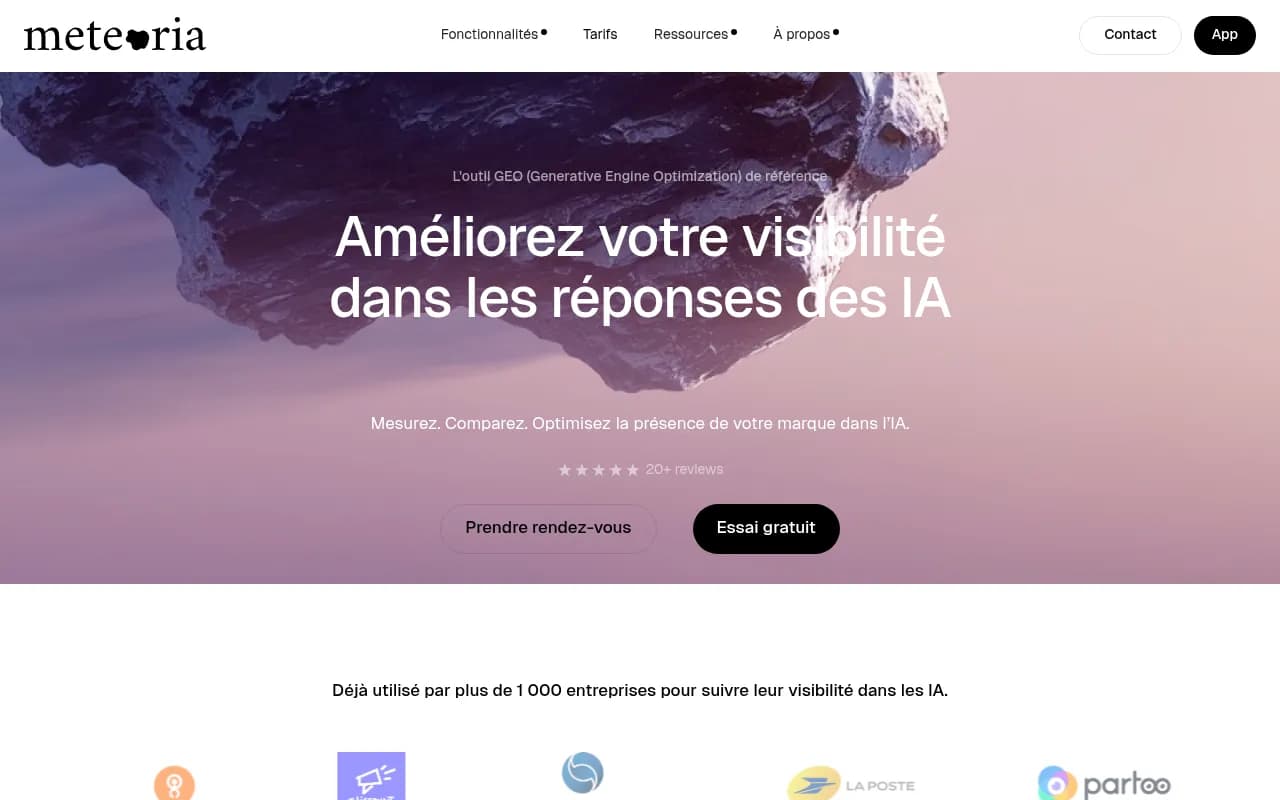
Meteoria is a French GEO (Generative Engine Optimization) platform launched to help brands measure and compare their visibility in AI-generated responses. The tool tracks hundreds of prompts daily across ChatGPT, Google AI Overview, Perplexity, Gemini, and Grok. It's designed for marketing teams and agencies managing brand presence in AI search, with a focus on European markets. Meteoria emphasizes three core functions: measure (track prompts), compare (benchmark against competitors), and optimize (identify citation sources and sentiment).
The platform has attracted 1,000+ companies including French brands like Cdiscount, Pierre Fabre, La Poste, and Partoo. Pricing starts at €75/mo for 25 prompts, making it one of the more affordable entry points in the GEO space.
Brandlight
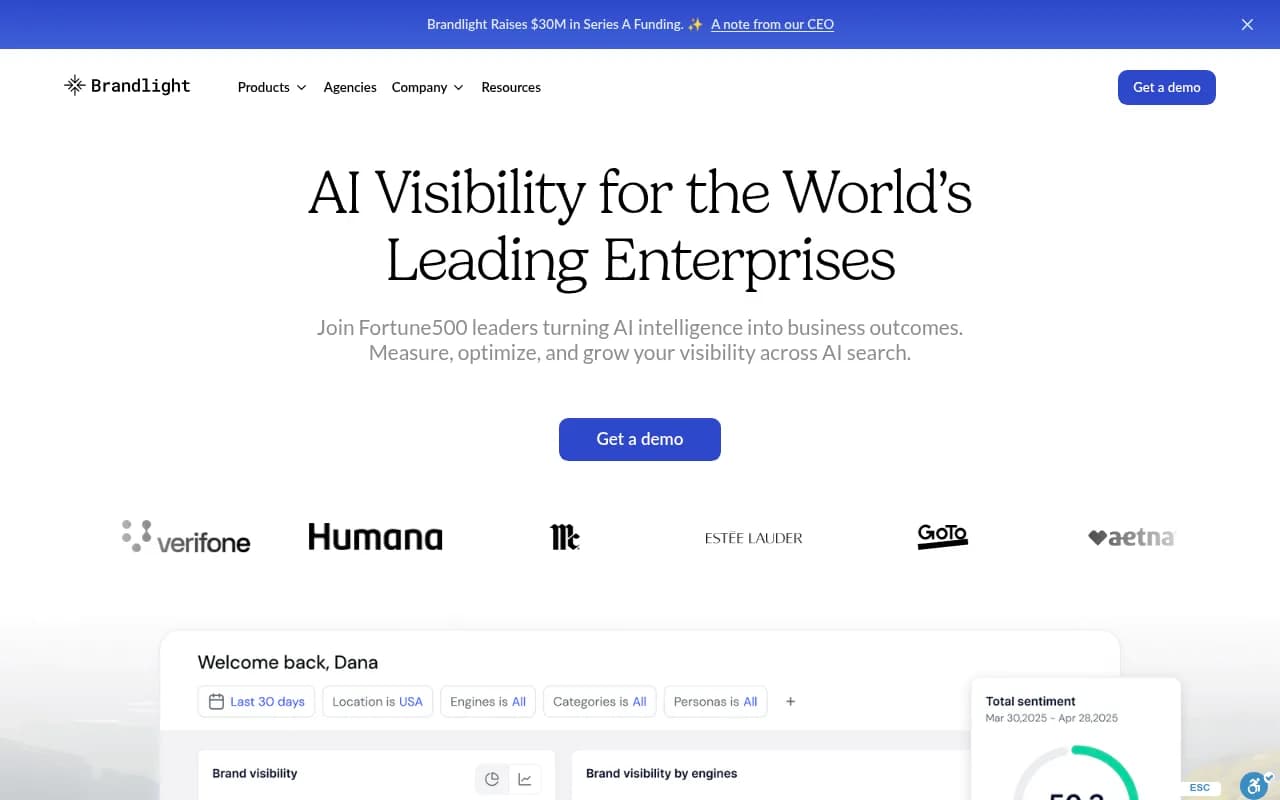
Brandlight is a US-based AI visibility platform that raised $30M in Series A funding in 2025. It targets Fortune 500 enterprises with a focus on monitoring, optimization, content distribution, and reputation management across AI search engines. The platform tracks brand mentions in LLM responses and provides analytics on visibility trends.
Brandlight's client roster includes Mastercard, Estée Lauder, GoTo, Aetna, Charter, Kimberly-Clark, and other large enterprises. The company positions itself as an enterprise-grade solution with custom pricing for larger accounts. Base pricing starts at $199/mo, with an "activation plan" at $750/mo and custom enterprise tiers above that.
Side-by-Side Comparison
| Feature | Meteoria | Brandlight |
|---|---|---|
| Starting price | €75/mo (25 prompts) | $199/mo (base tier) |
| Free trial | 7 days | Demo-based (no self-serve trial) |
| AI models tracked | ChatGPT, Google AI Overview, Perplexity, Gemini, Grok | ChatGPT, Google AI Overview, Perplexity, Gemini, Grok (similar coverage) |
| Prompt limits | 25-200+ prompts depending on plan | Not publicly disclosed |
| Geographic focus | France/Europe, French-language support | Global, Fortune 500 enterprises |
| Competitor benchmarking | Yes -- compare visibility vs competitors | Yes -- competitive positioning analysis |
| Citation source tracking | Yes -- identifies sources used by AI models | Yes -- tracks content sources |
| Sentiment analysis | Yes -- explicit and implicit sentiment scoring | Yes -- reputation management features |
| Content generation | No | No |
| Traffic attribution | Yes -- analyze traffic from AI sources | Not clearly documented |
| Funding/backing | Bootstrapped/smaller scale | $30M Series A (2025) |
| Customer base | 1,000+ companies, French SMBs/mid-market | Fortune 500 enterprises |
| Target audience | Marketing teams, agencies, European brands | Enterprise marketing/PR teams |
Pricing comparison
Both platforms use tiered pricing, but Meteoria is significantly cheaper at the entry level.
| Plan | Meteoria | Brandlight |
|---|---|---|
| Entry tier | €75/mo (Basic: 25 prompts) | $199/mo (base tier, prompt limits not disclosed) |
| Mid tier | €175/mo (Pro: 100 prompts) | $750/mo ("activation plan") |
| High tier | €300+/mo (Enterprise: 200+ prompts) | Custom enterprise pricing |
| Free trial | 7-day free trial | Demo required, no self-serve trial |
Meteoria's pricing is transparent and published. You know exactly what you're getting at each tier. Brandlight's pricing is less clear -- the $199/mo and $750/mo tiers are mentioned but details on prompt limits, features, and what separates the tiers aren't public. Enterprise customers likely negotiate custom pricing.
For small to mid-sized companies, Meteoria's €75/mo entry point is much more accessible than Brandlight's $199/mo base. For large enterprises with complex needs, Brandlight's custom pricing and Fortune 500 focus might justify the premium.
User interface and ease of use
Meteoria's interface is built around three core workflows: measure, compare, optimize. The dashboard shows visibility scores, competitor positioning, and citation sources in a straightforward layout. French is the primary language, though the platform likely supports English for international users. The 7-day free trial lets you test the interface before committing.
Brandlight's interface isn't as publicly documented -- most information comes from demo requests rather than self-serve exploration. The platform emphasizes enterprise-grade analytics and custom dashboards for large teams. G2 reviews (4.7 stars from 19 reviews) mention the interface is clean and the data is actionable, but there's less transparency about what you're getting before you talk to sales.
Verdict: Meteoria wins on transparency and accessibility. You can sign up, test the interface, and decide if it works for you. Brandlight requires a sales conversation, which is standard for enterprise tools but slows down evaluation.
AI model coverage
Both platforms track the same core AI models:
- ChatGPT (OpenAI)
- Google AI Overview
- Perplexity
- Gemini (Google)
- Grok (X/Twitter)
Neither platform mentions tracking Claude, DeepSeek, Mistral, Meta AI, or Copilot -- models that some competitors like Promptwatch cover. This is a gap for both tools if you want comprehensive cross-LLM visibility.

Meteoria explicitly lists the five models above. Brandlight's marketing mentions "AI search engines" broadly but doesn't publish a detailed model list. Based on competitive positioning, it's safe to assume similar coverage.
Verdict: Tie. Both platforms cover the major consumer-facing AI models but miss some enterprise/developer-focused LLMs.
Competitor benchmarking
Meteoria's "compare" feature lets you benchmark your visibility and position against competitors across different LLMs. You can filter by strategic criteria (product categories, personas, geographic zones) and see which competitors are winning for specific prompts. The platform surfaces citation sources used by AI models, helping you understand where competitors are getting mentioned.
Brandlight offers competitive positioning analysis as part of its enterprise package. The platform tracks how your brand compares to competitors in AI responses and identifies content gaps. Details are sparse in public materials, but G2 reviews mention the competitive insights are useful for large brands tracking market share.
Verdict: Meteoria is more transparent about how competitor benchmarking works. Brandlight likely has similar capabilities but hides them behind sales conversations.
Sentiment analysis and reputation management
Meteoria tracks both explicit and implicit sentiment in AI responses. You can see how AI models "feel" about your brand across different prompts and identify reputation risks. This is useful for PR teams monitoring brand perception in AI-generated content.
Brandlight emphasizes reputation management as a core feature. The platform monitors brand mentions and sentiment across AI search, helping enterprises manage their AI-driven reputation. This is positioned as a key differentiator for large brands worried about negative AI responses.
Verdict: Both platforms handle sentiment analysis. Brandlight's enterprise focus might mean more sophisticated reputation management workflows, but Meteoria covers the basics well.
Traffic attribution and ROI tracking
Meteoria includes traffic analysis features -- you can connect your website analytics to understand how AI visibility translates to actual traffic. This is important for proving ROI and justifying GEO investments.
Brandlight's public materials don't clearly document traffic attribution capabilities. The platform focuses more on visibility metrics and competitive positioning than connecting AI mentions to website traffic or conversions.
Verdict: Meteoria has a clearer story around traffic attribution. If you need to prove that AI visibility drives real business outcomes, Meteoria's analytics are more transparent.
Content optimization and gap analysis
Neither platform offers built-in content generation or detailed gap analysis. Both are monitoring-focused tools that show you where you're visible (or invisible) but don't help you create content to fix the gaps.
Meteoria's "optimize" function identifies citation sources and helps you understand where to get mentioned, but it doesn't generate content or provide specific recommendations for what to write.
Brandlight mentions "content distribution" as a feature, but this appears to be about distributing existing content rather than creating new content optimized for AI search.
Verdict: Tie. Both platforms stop at monitoring and leave content creation to you. If you want a platform that actually helps you fix visibility gaps with AI-generated content, you'll need to look at tools like Promptwatch, which includes an AI writing agent that creates articles grounded in citation data and prompt volumes.
Enterprise features and scalability
Brandlight's $30M Series A funding and Fortune 500 client base signal serious enterprise ambitions. The platform likely offers custom integrations, dedicated support, multi-team workflows, and advanced security/compliance features that large organizations need. Custom enterprise pricing suggests flexibility for complex deployments.
Meteoria's enterprise tier (€300+/mo for 200+ prompts) is more modest. The platform serves 1,000+ companies but focuses on SMBs and mid-market brands rather than Fortune 500 giants. It's a solid choice for European companies that need GEO monitoring without enterprise overhead.
Verdict: Brandlight wins for true enterprise needs (Fortune 500 scale, complex org structures, custom integrations). Meteoria is better for smaller companies that don't need enterprise complexity.
Customer support and onboarding
Meteoria offers a 7-day free trial and appears to have self-serve onboarding. You can sign up, explore the platform, and decide if it works without talking to sales. Support details aren't public, but the pricing page mentions a demo option for enterprise customers.
Brandlight requires a demo to get started -- there's no self-serve trial. This is standard for enterprise tools but means slower evaluation. G2 reviews mention responsive support, which is expected given the Fortune 500 client base.
Verdict: Meteoria wins for speed and accessibility. Brandlight's demo-first approach is fine for enterprises but frustrating for smaller teams that want to test quickly.
Pros and cons
Meteoria pros
- Much cheaper entry point (€75/mo vs $199/mo)
- 7-day free trial lets you test before buying
- Transparent pricing and feature lists
- Traffic attribution to connect AI visibility to real outcomes
- French-language support for European markets
- 1,000+ customers including recognizable French brands
Meteoria cons
- Smaller scale and less funding than Brandlight
- No content generation or detailed gap analysis
- Limited AI model coverage (missing Claude, DeepSeek, Mistral, etc.)
- Less clear enterprise features for Fortune 500 needs
- Geographic focus on France/Europe might limit global use cases
Brandlight pros
- $30M Series A funding signals fast development and stability
- Fortune 500 client roster (Mastercard, Estée Lauder, etc.)
- Enterprise-grade features and custom pricing for complex needs
- Strong reputation management focus
- 4.7-star G2 rating from verified enterprise users
Brandlight cons
- 3x more expensive at entry level ($199/mo vs €75/mo)
- No self-serve trial -- requires demo and sales conversation
- Pricing and feature details are opaque
- No clear traffic attribution or ROI tracking
- No content generation or optimization tools
- Limited AI model coverage (same gap as Meteoria)
Who should pick Meteoria
Pick Meteoria if you're a small to mid-sized company (especially in France or Europe) that needs affordable AI visibility tracking. The €75/mo entry point makes it accessible for teams testing GEO for the first time. The 7-day free trial and transparent pricing let you evaluate quickly without sales pressure.
Meteoria is a good fit for:
- Marketing teams at French or European brands
- Agencies managing multiple client GEO campaigns
- Mid-market companies (not Fortune 500) tracking AI visibility
- Teams that need traffic attribution to prove ROI
- Anyone who wants to test a platform before committing
Meteoria is not a good fit for:
- Fortune 500 enterprises needing complex integrations
- Global brands requiring multi-language support beyond French/English
- Teams that want content generation built into the platform
- Companies needing comprehensive LLM coverage (Claude, DeepSeek, etc.)
Who should pick Brandlight
Pick Brandlight if you're a Fortune 500 enterprise with a serious budget and complex AI visibility needs. The $30M Series A funding and enterprise client roster suggest Brandlight can handle large-scale deployments with custom integrations and dedicated support.
Brandlight is a good fit for:
- Fortune 500 companies tracking AI brand reputation at scale
- Large marketing/PR teams with enterprise budgets
- Brands that need custom pricing and features
- Organizations requiring advanced security/compliance
- Companies willing to go through a sales process for evaluation
Brandlight is not a good fit for:
- Small companies or startups with limited budgets
- Teams that want to test quickly without sales conversations
- Anyone needing transparent pricing before talking to sales
- Companies looking for content generation or optimization tools
Final verdict
Meteoria wins for accessibility, transparency, and value. At €75/mo with a 7-day free trial, it's the obvious choice for small to mid-sized companies exploring GEO. The traffic attribution features and clear pricing make it easy to justify the investment.
Brandlight wins for enterprise scale and ambition. If you're a Fortune 500 brand with a serious budget and complex needs, Brandlight's funding, client roster, and enterprise focus justify the premium. But for most companies, the lack of transparent pricing and self-serve trial is a barrier.
Both platforms share the same fundamental limitation: they're monitoring-only tools. They show you where you're invisible but don't help you fix it. Neither offers content generation, detailed gap analysis, or actionable recommendations for improving AI visibility. You're left to figure out content strategy on your own.
If you want a platform that actually helps you close visibility gaps -- not just measure them -- look at tools like Promptwatch, which combines monitoring with AI-powered content generation, answer gap analysis, and optimization workflows. Promptwatch shows you which prompts competitors are winning but you're not, then generates content engineered to get cited by AI models. That action loop -- find gaps, create content, track results -- is what separates optimization platforms from monitoring dashboards.
For pure monitoring, Meteoria offers better value for most teams. For enterprise-scale monitoring, Brandlight has the backing and client base to handle complex needs. But if you want to move beyond monitoring and actually improve your AI visibility, you'll need a platform built around taking action.