Meteoria Review 2026
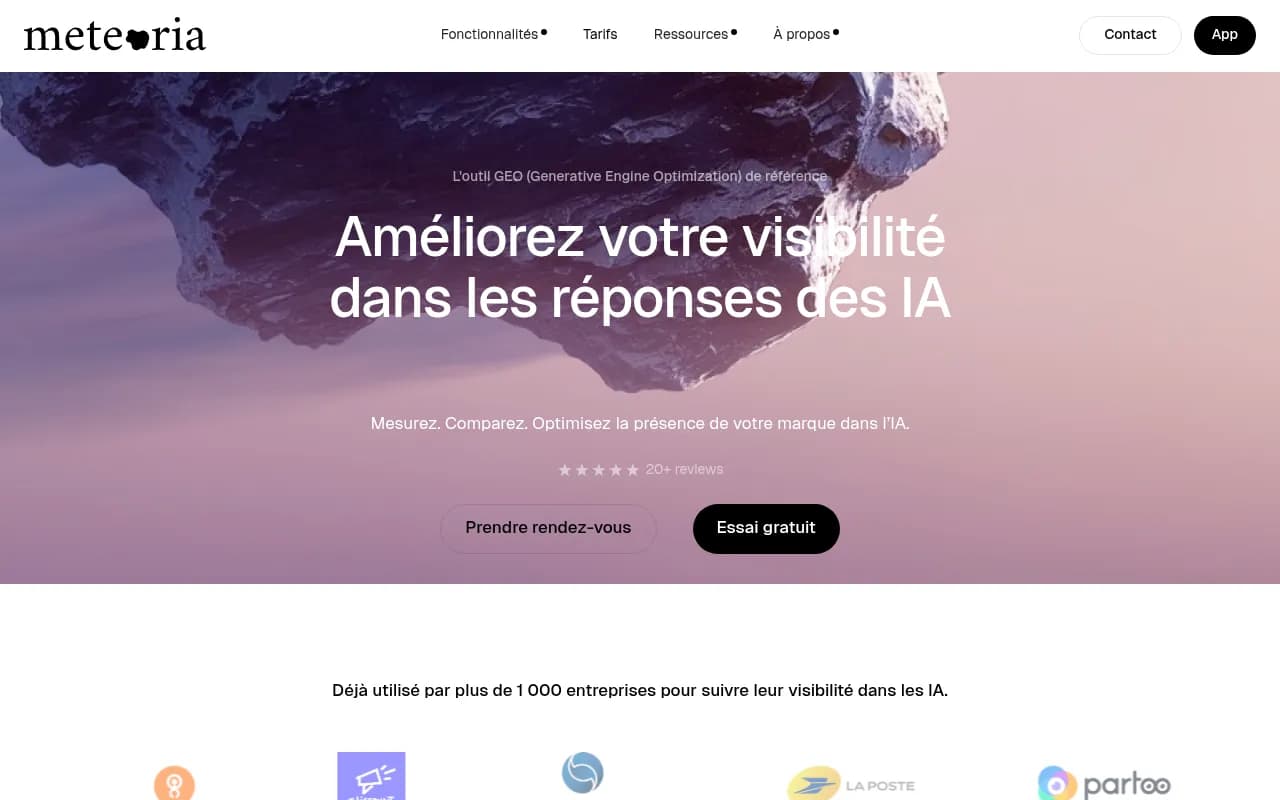
Meteoria is a French Generative Engine Optimization (GEO) platform that measures, compares, and optimizes how brands appear in AI-generated responses from ChatGPT, Google AI Overview, Perplexity, Gemini, and Grok. Track hundreds of prompts daily, analyze competitor positioning, identify citation sources, and understand sentiment across AI models. Designed for marketing teams, agencies, and enterprises managing brand presence in the AI search era.
Key Takeaways
- Meteoria is a monitoring-only GEO platform -- it tracks brand visibility in AI responses but lacks content generation, AI crawler logs, and traffic attribution that Promptwatch offers
- Covers 5 AI models (ChatGPT, Perplexity, Google AI Overview, Gemini, Grok) with daily prompt tracking and competitor comparison
- French-focused platform with strong local market presence but limited English-language documentation and support
- Pricing starts at €75/month for 25 prompts, scaling to €175/month for 100 prompts -- competitive for European buyers but no content optimization tools included
- Best for French brands and agencies that need basic AI visibility monitoring without optimization capabilities

Meteoria is a French Generative Engine Optimization platform launched to help brands understand how they appear in AI-generated search results. Built by a team based in France, it targets European marketing teams, agencies, and enterprises that want to track their brand mentions across major AI models like ChatGPT, Perplexity, and Google AI Overview. The platform positions itself as a measurement and comparison tool -- you can see where you're visible, where competitors rank, and which sources AI models cite. But it stops there. Unlike platforms like Promptwatch that close the optimization loop with content generation and gap analysis, Meteoria is purely a monitoring dashboard.
The company claims over 1,000 businesses use the platform, with notable French clients including Cdiscount, Pierre Fabre, La Poste, and Partoo. It's clearly found traction in the French market, where GEO awareness is growing rapidly. The interface is entirely in French, which makes sense for their target audience but limits appeal for international teams.
Core Tracking Capabilities
Meteoria's foundation is prompt-based monitoring. You define prompts that represent how your target audience might query AI models -- questions about products, comparisons, local searches, or industry topics. The platform then runs these prompts daily across ChatGPT (GPT-5.2), Perplexity, Google AI Overview, Gemini, and Grok. Each response is analyzed to determine:
- Visibility rate: How often your brand appears in responses
- Position: Where you rank relative to competitors in the same response
- Sentiment: Whether the AI's tone toward your brand is positive, neutral, or negative
- Sources cited: Which websites, articles, or platforms the AI referenced when mentioning you
You can organize prompts by tags, personas, geographic regions, products, or purchase intent. This lets you slice the data by "SaaS buyers in Paris" or "enterprise decision-makers comparing CRM tools" -- useful for understanding visibility across different audience segments. The daily refresh means you can track changes over time and spot trends in how AI models perceive your brand.
The platform claims to process thousands of responses monthly. On the Basic plan (€75/month), you get 2,250 responses per month from 25 prompts. On the Pro plan (€175/month), that scales to 9,000 responses from 100 prompts. Enterprise plans go beyond 18,000 responses with 200+ prompts.
Competitor Comparison
Meteoria's competitor tracking lets you add rival brands to your monitoring setup and compare visibility side-by-side. You can see:
- Which brands appear most frequently in AI responses for your target prompts
- How your position stacks up against competitors in the same response
- Which sources AI models cite when mentioning competitors vs. your brand
- Sentiment differences -- whether competitors are framed more positively
This is helpful for understanding the competitive landscape in AI search. If a competitor consistently ranks higher for "best project management tools for agencies," you can dig into which sources the AI cited and potentially target those same platforms for mentions. The heatmap view shows visibility across all tracked LLMs, so you can spot if you're strong in ChatGPT but invisible in Perplexity.
However, this is where Meteoria's limitations become clear. It shows you the gaps but doesn't help you close them. You can see that a competitor is cited 3x more often, but the platform won't tell you what content you're missing or generate articles to fill those gaps. That's a critical missing piece that platforms like Promptwatch solve with Answer Gap Analysis and AI content generation.
Source and Sentiment Analysis
One of Meteoria's more useful features is source tracking. For each AI response, the platform identifies which websites, articles, Reddit threads, YouTube videos, or other sources the AI model cited. This gives you a roadmap for where to focus your PR and content distribution efforts. If AI models consistently cite TechCrunch, G2, or specific industry blogs when discussing your category, you know where to pitch stories or secure reviews.
Sentiment analysis evaluates whether the AI's language about your brand is positive, neutral, or negative. This matters for brand reputation -- if AI models consistently frame your product as "expensive" or "difficult to use," that perception spreads to users who trust AI recommendations. Meteoria flags these sentiment patterns so you can address them, though again, it doesn't provide tools to actually fix the issue (like optimizing your website content or generating better-positioned articles).
Google Analytics Integration
Meteoria integrates with Google Analytics to help you understand whether AI visibility translates to actual traffic. You can connect your GA4 property and see if spikes in AI mentions correlate with increases in website visits. This is a basic form of traffic attribution, but it's not as sophisticated as what Promptwatch offers with its code snippet, GSC integration, and server log analysis that directly tracks AI-referred visitors.
The platform also crawls your website content to assess "LLM-friendliness" -- how well your pages are structured and optimized for AI models to understand and cite. This is a diagnostic feature, not an optimization tool. It tells you if your content is compatible with AI indexing but doesn't help you rewrite or improve it.
Who Is It For
Meteoria is built for French-speaking marketing teams, SEO agencies, and communication departments at mid-to-large companies. The platform's language barrier (entirely French interface and documentation) makes it a non-starter for most international teams unless they have native French speakers. That said, if you're a French brand or agency managing clients in France, Belgium, or Switzerland, Meteoria is one of the few GEO platforms with local support and a clear understanding of the European market.
It's best suited for teams that want to start tracking AI visibility without committing to a full optimization strategy. If your goal is simply to monitor where you appear, compare against competitors, and identify citation sources, Meteoria delivers on that. But if you need to actually improve your visibility -- generate content, fix indexing issues, or close content gaps -- you'll need to supplement it with other tools or switch to a platform like Promptwatch that handles both monitoring and optimization.
Smaller businesses and local brands can use the Basic plan (€75/month) to track 25 core prompts. This works if you have a narrow focus -- say, a local restaurant chain tracking "best restaurants in Lyon" or a SaaS tool monitoring a handful of product comparison prompts. Agencies managing multiple clients will likely need the Pro plan (€175/month for 100 prompts) or a custom Enterprise plan to cover enough prompts across different brands.
Integrations and Ecosystem
Meteoria's integration options are limited. The platform offers:
- Google Analytics: Connect GA4 to track traffic correlation
- Looker Studio: Export data for custom dashboards
- CSV/JSON exports: Pull raw data for analysis in other tools
- Slack: Get alerts and updates in Slack channels (mentioned in support options)
There's no API mentioned in the documentation, which limits automation and custom workflows. You can't programmatically pull data or trigger actions based on visibility changes. This is a significant gap for agencies or enterprises that want to integrate GEO monitoring into their existing tech stack.
The platform doesn't offer browser extensions, mobile apps, or developer tools. It's a web-based dashboard, period. For teams that need on-the-go access or want to embed GEO data into other systems, this is restrictive.
Pricing and Value
Meteoria's pricing is straightforward and competitive for the European market:
- Basic: €75/month -- 25 prompts, 2,250 responses/month, ChatGPT + Perplexity + Google AI Overview, unlimited seats/projects, email support + 2 onboarding meetings
- Pro: €175/month -- 100 prompts, 9,000 responses/month, same LLM coverage, Slack support + monthly check-in meetings
- Enterprise: €300/month and up -- 200+ prompts, 18,000+ responses/month, weekly meetings, custom integrations
All plans include unlimited seats, projects, and brands, which is generous. You can invite your entire team and track multiple brands without paying per-user fees. The free trial lasts one week with full access to all features.
Compared to Promptwatch (starting at $99/month for 50 prompts across 10+ AI models with content generation and crawler logs), Meteoria is slightly cheaper but offers far less functionality. You're paying for monitoring only -- no content creation, no gap analysis, no AI crawler logs, no traffic attribution beyond basic GA integration. For French teams that only need visibility tracking, the price is reasonable. For teams that want to actually improve their AI rankings, it's not enough.
Other GEO platforms like Otterly.AI, Peec.ai, and AthenaHQ are similarly monitoring-focused, but most are priced in USD and lack the French-language interface that Meteoria provides. If you're comparing purely on monitoring features, Meteoria is competitive. If you're comparing on optimization capabilities, it falls short.
Strengths
French-language platform with local support: The only major GEO tool built specifically for the French market, with native-language interface, documentation, and customer support. This matters for French agencies and brands that prefer working in their own language.
Unlimited seats and projects: You can invite your entire team and track multiple brands without per-user fees. This is rare in the GEO space and makes it cost-effective for agencies managing multiple clients.
Daily prompt tracking across 5 AI models: Consistent monitoring of ChatGPT, Perplexity, Google AI Overview, Gemini, and Grok with daily updates. The data refresh is reliable and the prompt customization is flexible.
Source and sentiment analysis: Identifying which sources AI models cite and how they frame your brand is valuable for PR and content strategy. This feature is well-executed and gives actionable insights.
Limitations
No content generation or optimization tools: Meteoria shows you where you're invisible but doesn't help you fix it. There's no AI writing agent, no content gap analysis, no optimization recommendations. You're left to figure out the solution on your own. Promptwatch solves this with built-in content generation grounded in citation data and prompt volumes.
No AI crawler logs: You can't see which AI models are crawling your website, how often they visit, or what errors they encounter. This is a critical blind spot for understanding how AI engines discover and index your content. Promptwatch includes real-time crawler logs that show exactly which pages ChatGPT, Claude, and Perplexity are reading.
Limited traffic attribution: The Google Analytics integration is basic -- it shows correlation, not causation. You can't definitively track which visitors came from AI search or which pages are driving AI-referred traffic. Promptwatch offers code snippet tracking, GSC integration, and server log analysis for precise attribution.
No Reddit or YouTube tracking: AI models heavily cite Reddit discussions and YouTube videos, but Meteoria doesn't surface these sources or help you monitor them. This is a major gap in understanding what influences AI recommendations.
No ChatGPT Shopping tracking: As AI models start recommending products directly (like ChatGPT's shopping carousels), tracking these placements becomes critical. Meteoria doesn't cover this.
French-only interface: The entire platform is in French, which limits its appeal to international teams. There's no English version mentioned, so non-French speakers will struggle.
No API or developer tools: You can't automate data pulls, build custom integrations, or trigger workflows based on visibility changes. This restricts flexibility for technical teams.
Bottom Line
Meteoria is a solid monitoring-only GEO platform for French-speaking teams that want to track brand visibility in AI search engines. It delivers reliable daily tracking across 5 AI models, competitor comparison, source analysis, and sentiment monitoring. The unlimited seats and projects make it cost-effective for agencies. But it stops at showing you the data -- it doesn't help you act on it. There's no content generation, no crawler logs, no advanced traffic attribution, and no optimization tools. For French brands that only need visibility dashboards, it's a reasonable choice. For teams that want to actually improve their AI rankings and close content gaps, Promptwatch is the stronger alternative with its end-to-end optimization platform that combines monitoring, content generation, and actionable insights.
Frequently asked questions
What is Meteoria and what does it do?
How much does Meteoria cost?
Does Meteoria offer content optimization or just monitoring?
Which AI search engines does Meteoria track?
Who is Meteoria designed for?
Is Meteoria available in English?
Does Meteoria offer a free trial?
What features does Meteoria include for competitor analysis?
Similar and alternative tools to Meteoria