Key Takeaways
- Pricing: Hall AI starts free with paid plans likely under $150/mo, while Meteoria starts at €75/mo (~$82) for 25 prompts -- Hall AI is more accessible for small teams testing GEO
- Market focus: Meteoria is French-built with strong European positioning and French-language support, Hall AI is global-first with no regional bias
- AI model coverage: Both track ChatGPT, Perplexity, Gemini, and Google AI Overviews; Meteoria adds Grok, Hall AI adds Claude, Copilot, and DeepSeek
- Agent analytics: Hall AI shows real-time AI crawler activity on your site, Meteoria does not publicly highlight this capability
- Content optimization: Neither platform offers built-in content generation -- both are monitoring-focused tools that show you the data but leave you to fix gaps manually
- Best for: Meteoria suits French/European brands wanting localized tracking with sentiment analysis; Hall AI fits global teams needing broader AI model coverage and free entry point
Overview
Meteoria
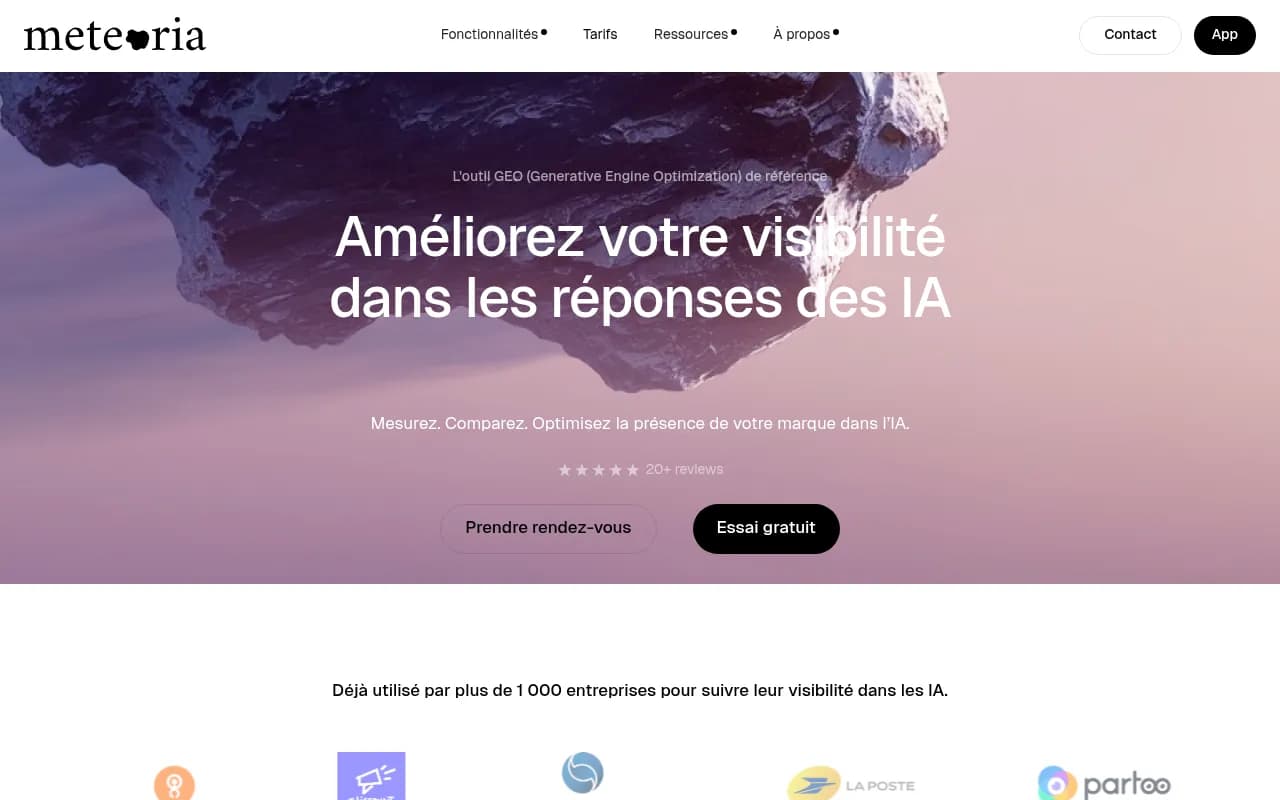
Meteoria is a French GEO platform launched to help brands measure and optimize their visibility across AI search engines. It tracks ChatGPT, Google AI Overview, Perplexity, Gemini, and Grok with a focus on prompt-based monitoring -- you define hundreds of strategic prompts, Meteoria runs them daily, and you see where your brand ranks versus competitors. The platform emphasizes sentiment analysis (how AI models talk about your brand) and citation source identification (which pages AI models reference). Used by 1,000+ companies including Cdiscount, Pierre Fabre, and La Poste, it's positioned as the reference GEO tool in French-speaking markets.
Hall AI

Hall AI is a global GEO/AEO platform that monitors brand presence across ChatGPT, Perplexity, Claude, Gemini, Copilot, DeepSeek, and Google AI Mode/Overviews. It starts with a free shareable report (no signup required) that analyzes how your site appears in AI conversations, then offers paid plans for ongoing tracking. Hall AI's differentiator is agent analytics -- real-time logs showing how AI crawlers browse your website, which pages they read, and how that activity connects to citation data. Thousands of marketers use it worldwide, with no geographic bias in its feature set.
Side-by-Side Comparison
| Feature | Meteoria | Hall AI |
|---|---|---|
| Starting price | €75/mo (25 prompts) | Free tier, paid ~$50-150/mo |
| Free trial | 7 days | Free report + free tier |
| AI models tracked | ChatGPT, Perplexity, Gemini, Grok, Google AI Overview (5) | ChatGPT, Perplexity, Claude, Gemini, Copilot, DeepSeek, AI Mode, AI Overviews (8+) |
| Prompt tracking | 25-200+ prompts depending on plan | Not publicly specified |
| Agent/crawler logs | Not highlighted | Yes -- real-time AI agent activity |
| Citation tracking | Yes -- sources used by AI models | Yes -- page-level citation data |
| Sentiment analysis | Yes -- explicit and implicit sentiment | Yes -- brand sentiment tracking |
| Competitor analysis | Yes -- visibility and positioning vs competitors | Yes -- share of voice tracking |
| Multi-language support | French-first, likely supports other languages | Global, no language bias |
| Content generation | No | No |
| Traffic attribution | Yes -- analyze traffic from AI sources | Not publicly highlighted |
| API access | Not mentioned | Not mentioned |
| Target market | French/European brands, agencies | Global marketers, no regional focus |
Pricing
| Plan | Meteoria | Hall AI |
|---|---|---|
| Free tier | 7-day trial only | Free report + free ongoing tier |
| Starter | Basic: €75/mo (25 prompts) | Likely $50-100/mo (pricing not public) |
| Mid-tier | Pro: €175/mo (100 prompts) | Likely $100-150/mo |
| High-tier | Enterprise: €300+/mo (200+ prompts) | Custom pricing |
| Annual discount | Not mentioned | Not mentioned |
Meteoria's pricing is transparent and prompt-based -- you pay per prompt tracked. Hall AI doesn't publish exact pricing but positions itself as accessible with a free entry point. For teams just exploring GEO, Hall AI's free tier is a lower-friction starting point. For teams ready to commit, Meteoria's €75/mo gets you 25 prompts tracked daily across 5 AI models, which is reasonable if those prompts are high-value.
AI model coverage
Meteoria tracks 5 AI engines: ChatGPT, Google AI Overview, Perplexity, Gemini, and Grok. This covers the major players but misses Claude (Anthropic's model, widely used), Copilot (Microsoft's AI), and DeepSeek (rising Chinese model).
Hall AI tracks 8+ engines: ChatGPT, Perplexity, Claude, Gemini, Copilot, DeepSeek, Google AI Mode, and AI Overviews. This is broader coverage, especially valuable if your audience uses Claude or Copilot heavily. DeepSeek inclusion matters for brands targeting Chinese or international markets.
Verdict: Hall AI wins on breadth. If you need to monitor Claude or Copilot, Meteoria doesn't support them. If Grok matters to you (X/Twitter's AI), Meteoria has it and Hall AI doesn't explicitly list it.
Prompt tracking and monitoring
Meteoria's core model is prompt-based: you define strategic prompts (questions your customers ask), Meteoria runs them daily across all tracked AI models, and you see visibility scores, positioning, and citation sources. Plans range from 25 prompts (Basic) to 200+ (Enterprise). The platform emphasizes adapting prompts to your sector, products, personas, and geographic zones.
Hall AI also tracks AI conversations but doesn't publicly specify prompt limits or structure. The focus is on observing how your brand appears "in the millions of questions people are asking AI" -- suggesting broader, less customizable monitoring. The free report analyzes your site's current AI presence without requiring you to define prompts upfront.
Verdict: Meteoria gives you more control over what gets tracked. If you have specific high-value prompts (e.g. "best CRM for real estate in France"), Meteoria lets you track those exact queries. Hall AI is more passive -- it shows you where you already appear but doesn't emphasize custom prompt definition.
Agent analytics and crawler logs
Hall AI's standout feature is agent analytics: real-time logs showing how AI crawlers (ChatGPT, Perplexity, etc.) browse your website. You see which pages they read, how often they return, and how that activity correlates with citation data. This is valuable for diagnosing indexing issues -- if AI models aren't crawling your key pages, you won't get cited.
Meteoria does not publicly highlight crawler logs or agent analytics. The focus is on analyzing AI responses and citation sources after the fact, not observing the crawling process.
Verdict: Hall AI wins here. If you want to understand how AI engines discover and read your content, Hall AI gives you that visibility. Meteoria assumes the crawling is happening and focuses on the output.
Worth noting: if you need both crawler logs and a full optimization workflow (content gap analysis, AI content generation, traffic attribution), Promptwatch covers that angle with deeper action-oriented features.

Citation and source analysis
Both platforms track which sources AI models cite in their responses.
Meteoria surfaces the sources used by each AI model for each prompt, helping you understand where to get mentioned (e.g. if AI models cite Reddit threads or specific competitor pages, you know where to focus your efforts).
Hall AI shows page-level citation data -- exactly which of your pages get cited in AI conversations. This is more granular and actionable for content optimization.
Verdict: Hall AI's page-level citation tracking is more useful for optimization. Knowing "AI cited your /pricing page 47 times this month" is more actionable than knowing "AI cited your domain."
Sentiment analysis
Meteoria explicitly tracks sentiment -- both explicit (AI says "Brand X is reliable") and implicit (AI recommends Brand X first, suggesting positive sentiment). This is valuable for brand reputation management.
Hall AI mentions brand sentiment tracking but doesn't emphasize it as heavily. The focus is more on visibility and share of voice.
Verdict: Meteoria has a stronger sentiment analysis story. If you're worried about how AI models talk about your brand (positive, negative, neutral), Meteoria gives you that data explicitly.
Competitor analysis
Meteoria compares your visibility and positioning against competitors across all tracked prompts and AI models. You see relative rankings and share of voice.
Hall AI tracks share of voice and competitor positioning but doesn't detail how granular the competitor comparison is.
Verdict: Both offer competitor tracking. Meteoria's prompt-based model makes it easier to see "we rank #3 for this specific prompt, competitor A is #1" -- more tactical.
Traffic attribution
Meteoria mentions analyzing your traffic to understand concrete results from AI visibility. This suggests some level of traffic attribution (connecting AI citations to actual visits).
Hall AI does not publicly highlight traffic attribution. The focus is on visibility and citations, not downstream traffic or revenue.
Verdict: Meteoria has an edge if you want to connect AI visibility to traffic. Hall AI stops at the citation level.
Content optimization and generation
Neither platform offers built-in content generation. Both are monitoring tools -- they show you where you're invisible or underperforming, but they don't help you create the content to fix it.
This is the gap most GEO platforms have. You get the data, then you're on your own to write articles, update pages, or optimize for AI citations. If you want a platform that closes this loop with AI-powered content generation grounded in citation data, that's where tools like Promptwatch come in -- they show you the gaps and help you fill them.
Verdict: Tie. Both leave content creation to you.
User interface and ease of use
Meteoria's interface (based on screenshots) is dashboard-heavy with French-language UI. It's designed for marketers and agencies who want detailed prompt-level data. The learning curve is moderate -- you need to define prompts, set up competitors, and interpret visibility scores.
Hall AI starts with a free, no-signup report that gives you instant insights. The onboarding is frictionless. The paid platform is similarly streamlined, focusing on high-level insights (citations, sentiment, share of voice) without requiring deep configuration.
Verdict: Hall AI is easier to start with. Meteoria requires more setup but gives you more control.
Language and regional support
Meteoria is French-built and emphasizes French-language support. The website is in French, the customer base is European, and the platform likely handles French prompts and regional nuances better than global competitors.
Hall AI is language-agnostic and global-first. No bias toward any region.
Verdict: Meteoria for French/European brands, Hall AI for everyone else.
Pros and cons
Meteoria pros
- Transparent, prompt-based pricing (€75/mo for 25 prompts)
- Strong sentiment analysis (explicit and implicit)
- French-language support and European market focus
- Traffic attribution to connect visibility to results
- Used by 1,000+ companies including major French brands
Meteoria cons
- Limited AI model coverage (5 models, missing Claude and Copilot)
- No agent/crawler analytics
- No content generation features
- Higher starting price than Hall AI's free tier
- Requires prompt definition upfront (more setup work)
Hall AI pros
- Free tier and free shareable report (no signup)
- Broader AI model coverage (8+ models including Claude, Copilot, DeepSeek)
- Agent analytics showing real-time crawler activity
- Page-level citation tracking (more actionable)
- Global, language-agnostic platform
- Easier onboarding and lower friction
Hall AI cons
- Pricing not publicly listed (less transparency)
- Less emphasis on sentiment analysis
- No traffic attribution mentioned
- Less control over custom prompt tracking
- Newer platform with less established customer base
Who should pick which tool
Pick Meteoria if:
- You're a French or European brand wanting localized support
- You need strong sentiment analysis to manage brand reputation
- You have specific high-value prompts you want to track daily
- You want to connect AI visibility to actual traffic and conversions
- You're comfortable with a €75/mo starting price
Pick Hall AI if:
- You want to start free and explore GEO without commitment
- You need to monitor Claude, Copilot, or DeepSeek
- You want to see how AI crawlers interact with your site (agent analytics)
- You prefer a global, language-agnostic platform
- You want page-level citation data for content optimization
- You're a small team or solo marketer testing GEO for the first time
Consider Promptwatch if:
- You want both monitoring and optimization in one platform
- You need content gap analysis showing exactly what to write
- You want AI-powered content generation grounded in citation data
- You need crawler logs, traffic attribution, and Reddit/YouTube tracking in one place
Final verdict
Hall AI is the better starting point for most teams. The free tier removes friction, the AI model coverage is broader, and the agent analytics give you insights Meteoria doesn't offer. If you're exploring GEO for the first time or need to monitor Claude/Copilot, Hall AI is the obvious choice.
Meteoria is the better fit for French/European brands that need localized support, strong sentiment analysis, and traffic attribution. If you're a French agency managing multiple clients or a European brand worried about how AI talks about you, Meteoria's focus on sentiment and regional nuances justifies the higher price.
Neither platform helps you create content to fix the gaps they reveal. For that, you need a platform that combines monitoring with optimization -- something both tools leave on the table.