Alli AI Review 2026
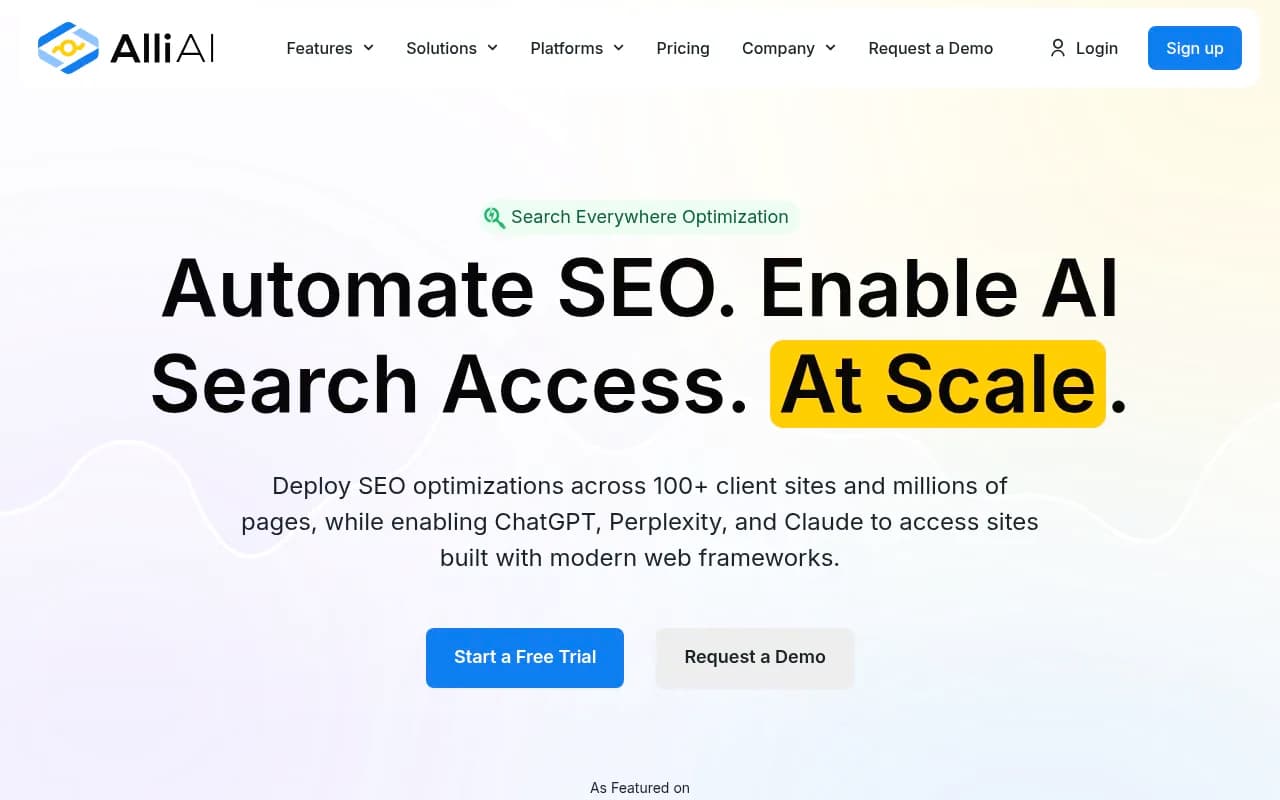
AI SEO automation tool that lets teams deploy on-page optimizations across an entire website without manual code edits. Useful for large sites needing bulk SEO changes fast.
Key takeaways
- Best for: SEO agencies managing 10-100+ client sites who need to deploy bulk on-page changes without touching each CMS individually
- Standout feature: Server-side rendering infrastructure that makes JavaScript-heavy sites (React, Vue, Next.js) readable to AI crawlers like GPTBot and ClaudeBot -- a genuinely rare capability in this space
- Monitoring-only gap: Alli AI tracks citations and crawler activity but lacks the deep AI visibility analytics, answer gap analysis, content generation grounded in citation data, prompt volume scoring, and Reddit/YouTube tracking that a dedicated GEO platform like Promptwatch provides
- Pricing: Starts around $299/month for 5 sites with flex pricing available; reasonable for agencies but expensive for solo operators
- Bottom line: Strong choice for bulk SEO automation; weaker as a standalone AI search visibility tool
Alli AI is an SEO automation platform built primarily for agencies and in-house teams that manage large website portfolios. Founded by Kyle Duck, the tool started as a way to eliminate the manual, page-by-page grind of deploying on-page SEO changes across dozens or hundreds of client sites. Over time it has expanded into AI search territory, adding server-side rendering infrastructure to make JavaScript-rendered sites accessible to AI crawlers, and a unified dashboard that attempts to cover both traditional search and AI platforms like ChatGPT, Perplexity, and Claude.
The core pitch is straightforward: instead of logging into 50 different CMS dashboards to update title tags, deploy schema markup, or fix meta descriptions, you create one rule in Alli AI and it pushes changes to all matching pages across your entire portfolio in under 60 seconds. That's a real problem for agencies, and Alli AI solves it better than most tools in this space.
The audience is clearly agencies and enterprise SEO teams. Solo bloggers and small business owners can use it, but the pricing and feature set are oriented toward people managing multiple properties simultaneously. The recent pivot toward AI search optimization -- crawler enablement, citation tracking, unified AI/Google dashboards -- reflects where the market is heading, though this newer layer is less mature than the core automation engine.
Key features
Bulk deployment automation
This is where Alli AI genuinely earns its keep. The rule-based deployment system lets you define an optimization logic once -- say, "append the city name to all title tags on location pages" -- and apply it across every site in your portfolio automatically. The platform claims you can update 10,000 title tags across 50 sites in under 60 seconds, and based on user testimonials (one user reports making 17 million code changes in minutes), this appears to hold up in practice.
- Works via JavaScript injection, so you don't need FTP, SSH, or CMS backend access
- Visual browser-based editor lets you click on any element, edit it live, and deploy without writing code
- Full deployment history with one-click rollback for any change across any property
- Supports WordPress, Shopify, Wix, and essentially any CMS or framework
AI crawler enablement
This is Alli AI's most technically interesting feature and the one that sets it apart from traditional SEO tools. Sites built with React, Vue, Next.js, or Angular render blank pages to most crawlers because the content is generated client-side in JavaScript. AI crawlers like GPTBot, ClaudeBot, and PerplexityBot hit these sites and see nothing.
Alli AI's server-side rendering layer detects when an AI crawler visits, then serves pre-rendered HTML specifically to that crawler while keeping the normal JavaScript experience for human visitors. It also handles automatic crawler whitelist management -- preventing Cloudflare and other security tools from blocking AI bots, which is a common and frustrating problem.
- Detects 50+ AI crawlers automatically
- Works without code changes or platform migration
- Real-time analytics show which AI platforms are crawling your sites and how often
AI-powered content generation for on-page elements
Alli AI can automatically generate optimized meta descriptions, title tags, and schema markup based on page content analysis. This isn't a full content writing tool -- it's focused on the metadata and structured data layer rather than long-form articles. The AI analyzes existing page content and produces SEO-optimized versions of these elements at scale.
This is useful for agencies inheriting poorly optimized sites with thousands of pages, but it's worth noting the generation is fairly narrow in scope compared to dedicated AI writing tools.
Schema markup generator
Structured data deployment is one of the more painful parts of SEO at scale, and Alli AI automates it. The schema generator creates markup formatted for both Google's search index and AI platform training data simultaneously, which is a smart approach given how schema helps AI models understand content structure.
- Supports multiple schema types
- Deploys across all sites in a portfolio from a single action
- Formatted to work across traditional search engines and AI platforms
Unified search optimization dashboard
Alli AI positions itself as a single dashboard for both Google and AI search. The idea is that one optimization deployment covers Google, Bing, ChatGPT, Perplexity, Claude, and other platforms simultaneously. The unified analytics dashboard tracks traditional search rankings alongside AI platform citations and traffic attribution by source.
In practice, the traditional SEO automation side is more mature than the AI search analytics side. The citation tracking and AI visibility features are newer additions and don't yet match the depth of dedicated AI visibility platforms.
Citation tracking
Alli AI measures where and how often your content appears in ChatGPT, Perplexity, and Claude responses. This is a useful signal for understanding whether your AI crawler enablement work is paying off. However, this feature is relatively basic compared to what dedicated GEO platforms offer -- there's no prompt-level analysis, no competitor visibility comparison, no answer gap analysis showing which prompts you're missing.
Multi-site portfolio management
The portfolio management layer is genuinely well-designed for agencies. You can manage 100+ client sites from a single dashboard without needing to learn each client's CMS. The platform handles the abstraction layer, so an agency employee doesn't need WordPress expertise to deploy changes to a WordPress site or Shopify expertise for a Shopify store.
Flex pricing and scalability
Alli AI recently introduced flex pricing with 20 additional plan tiers, allowing teams to scale up or down based on current workload. This is a practical feature for agencies with seasonal clients or variable portfolio sizes.
Who is it for
Alli AI is most useful for SEO agencies managing 10 to 100+ client sites simultaneously. The classic use case is a boutique agency with 20-50 clients across different industries and CMS platforms, where the team is spending most of their time on manual implementation rather than strategy. Alli AI removes that bottleneck. The testimonial from Lauren Mabra -- "I manage all my clients with Alli AI. There's simply no faster way to optimize a website. We've gone from taking months to get tasks done manually to seeing the changes live instantly" -- captures this use case well.
Enterprise in-house SEO teams managing large site portfolios (think e-commerce retailers with thousands of product pages, or media companies with multiple regional sites) are another strong fit. The ecommerce case study on the site describes a specialty retailer with thousands of products transforming their online visibility, which is a realistic scenario where bulk automation provides real leverage.
The AI crawler enablement feature specifically targets companies running modern JavaScript applications -- SaaS products, React-based marketing sites, Next.js e-commerce stores -- that have discovered their sites are invisible to AI search. This is a growing problem as more companies adopt modern frameworks, and Alli AI's server-side rendering solution is one of the few tools that addresses it directly.
Who should probably look elsewhere: solo bloggers or small business owners with a single site. The pricing starts at $299/month for 5 sites, which is hard to justify for one property. Also, teams whose primary goal is understanding and improving their AI search visibility through analytics, competitor benchmarking, and content strategy should look at dedicated GEO platforms rather than treating Alli AI's citation tracking as a substitute.
Integrations and ecosystem
Alli AI's integration story is primarily about CMS compatibility rather than third-party tool connections. The JavaScript injection approach means it works with virtually any web platform without requiring native integrations:
- CMS support: WordPress, Shopify, Wix, and any other CMS or custom-built site
- Framework support: React, Vue, Next.js, Angular, and other JavaScript frameworks for the AI crawler enablement feature
- Security tools: Automatic configuration for Cloudflare and other firewall/CDN tools to whitelist AI crawlers
On the analytics side, the unified dashboard pulls in data from traditional search rankings and AI platform citations, though the depth of these integrations isn't fully documented publicly. There's no prominent mention of Google Search Console integration, Slack notifications, or Zapier connectivity, which are standard features in many SEO platforms.
The platform does not appear to have a public API, which limits custom workflow possibilities for technical teams. There's no browser extension mentioned, and mobile app support isn't highlighted.
Pricing and value
Alli AI's pricing is structured around the number of sites managed. Based on available information:
- Base plan: Approximately $299/month for 5 sites
- Additional sites: Around $39/month per extra site
- Flex pricing: 20 additional plan tiers for scaling up or down
A free trial is available. The site also features a Cost Saving Calculator and an AI Search Revenue Impact Calculator, which suggests the team is aware that the pricing requires justification.
For an agency billing clients for SEO services, $299/month for 5 sites works out to roughly $60 per site per month -- reasonable if the automation saves even a few hours of manual work per site per month. At $39/month per additional site, scaling to 20 sites would cost around $880/month, which is significant but defensible for a team that would otherwise need additional headcount.
Compared to traditional SEO tools like Semrush or Ahrefs, Alli AI is more expensive for a single site but potentially cheaper at scale when you factor in the time savings on implementation. Compared to dedicated AI visibility platforms, it's priced similarly but covers different ground -- Alli AI is primarily an automation and deployment tool, not an AI search analytics platform.
Strengths and limitations
What it does well
Bulk deployment speed is the genuine standout. The ability to push changes to thousands of pages across dozens of sites in under a minute is not something most SEO tools can match. For agencies, this is a real operational advantage.
AI crawler enablement for JavaScript sites is a technically sophisticated solution to a real problem. Most SEO tools don't touch this infrastructure layer at all. If you're running a React or Next.js site and want AI crawlers to actually read your content, Alli AI's server-side rendering approach is one of the few practical options available.
CMS-agnostic deployment via JavaScript injection means agencies don't need to become experts in every client's tech stack. This reduces training overhead and makes onboarding new clients faster.
The visual browser editor lowers the barrier for non-technical team members to make and deploy changes without developer involvement.
Limitations
AI search analytics depth is limited. The citation tracking and AI visibility features are newer and relatively shallow. There's no answer gap analysis showing which prompts competitors rank for but you don't, no prompt volume or difficulty scoring, no competitor visibility heatmaps, no Reddit or YouTube tracking, and no content generation grounded in citation data. Teams that want to seriously understand and improve their AI search visibility need a dedicated platform. Promptwatch covers this ground with considerably more depth -- including AI crawler logs, 880M+ citations analyzed, query fan-outs, page-level citation tracking, and an AI writing agent that generates content specifically engineered to get cited by LLMs.
No public API limits integration with custom workflows and reporting pipelines. Agencies that want to pull Alli AI data into their own dashboards or connect it to other tools will find this frustrating.
Pricing is hard to justify for single-site users. The tool is clearly built for portfolio management. A solo operator or small business with one site is paying for infrastructure they don't need.
Content generation is narrow in scope. The AI-generated content is limited to meta tags, title tags, and schema markup. There's no long-form content generation, no topic research, and no content gap analysis -- which means you still need separate tools for the content strategy layer.
Bottom line
Alli AI is a solid, well-executed tool for the specific problem of deploying on-page SEO changes at scale across large site portfolios. If you're an SEO agency tired of logging into 30 different CMS dashboards to push the same optimization changes, or a technical team running JavaScript-heavy sites that need to become readable to AI crawlers, Alli AI addresses those problems directly and does it well.
Where it falls short is as a comprehensive AI search visibility platform. The citation tracking and unified AI/Google dashboard are useful additions, but they don't replace dedicated GEO tooling. Teams that want to understand why competitors appear in AI answers while they don't, identify content gaps, and generate content specifically optimized for AI citation should pair Alli AI with a platform like Promptwatch rather than treating the AI features as equivalent.
Best use case: SEO agencies managing 10+ client sites who need to eliminate manual implementation bottlenecks and make JavaScript-rendered sites accessible to AI crawlers.
Frequently asked questions
What is Alli AI?
How much does Alli AI cost?
Does Alli AI work with JavaScript frameworks like React and Next.js?
Is Alli AI good for AI search visibility and GEO?
Who is Alli AI best suited for?
Does Alli AI require developer access to deploy changes?
Similar and alternative tools to Alli AI