Key Takeaways
- Bear AI starts at $100/mo (GPT-5 only, 30 prompts) while Meteoria starts at €75/mo (~$80, 25 prompts across 5 LLMs) -- Meteoria gives you multi-LLM coverage from day one
- Meteoria tracks 5 AI engines (ChatGPT, Perplexity, Gemini, Grok, Google AI Overview) on all plans; Bear AI's Basic plan only covers GPT-5, requiring Enterprise for full platform access
- Bear AI positions itself as a "marketing stack for AI agents" with traffic analytics; Meteoria focuses purely on visibility measurement and competitor benchmarking
- Meteoria offers sentiment analysis (implicit and explicit) for brand perception tracking -- a feature Bear AI doesn't advertise
- Both platforms lack content generation capabilities -- if you need to create optimized content based on visibility gaps, you'll need a separate tool
- Meteoria is a French company with a 7-day free trial; Bear AI is Y Combinator-backed with demo-only access
Overview
Bear AI
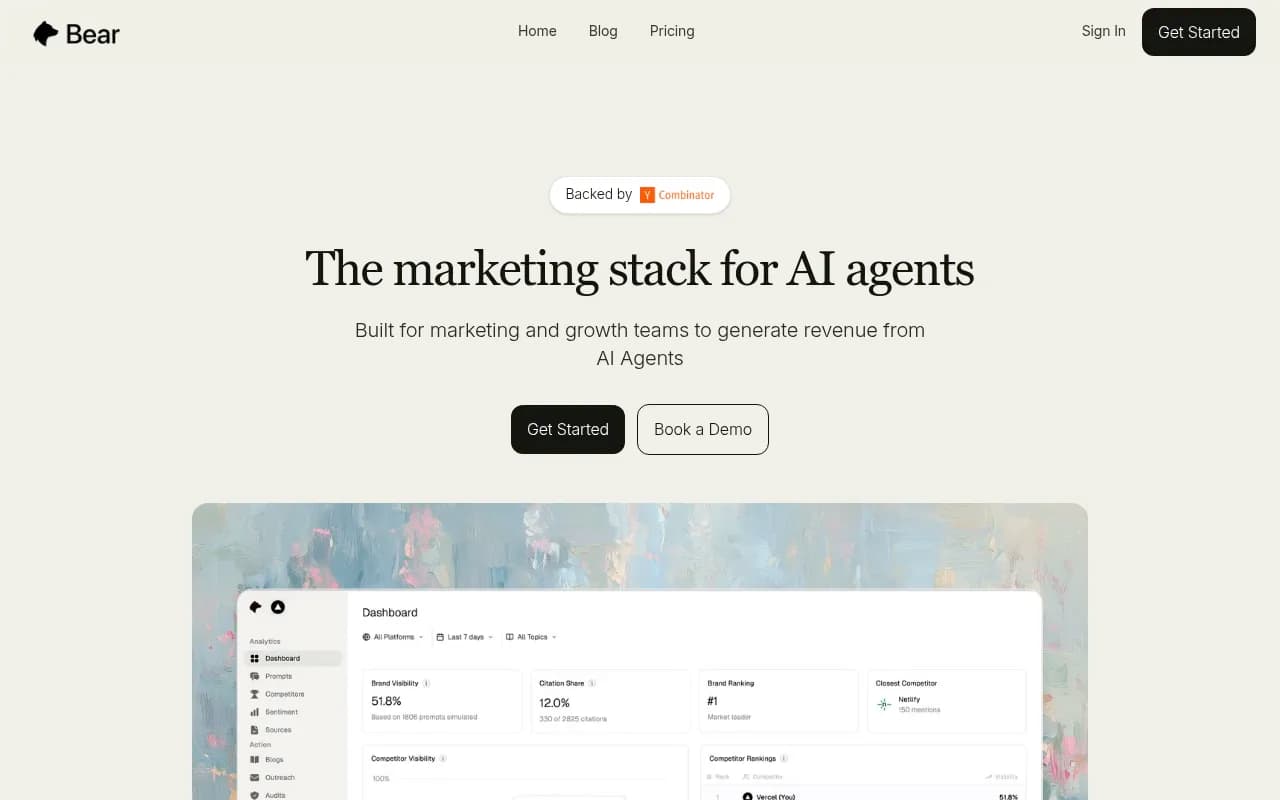
Bear AI calls itself "the marketing stack for AI agents" and targets marketing and growth teams looking to generate revenue from AI search. Backed by Y Combinator, it's a newer entrant focused on tracking how AI agents discover your brand across major LLMs. The platform emphasizes traffic analysis alongside visibility tracking, positioning itself as an end-to-end solution for AI-driven customer acquisition.
The Basic plan ($100/mo) covers only GPT-5 with 30 prompts and includes 2 blog posts per month. Full multi-platform tracking requires jumping to Enterprise pricing, which isn't publicly listed. This tiered approach to LLM access is unusual in the GEO space.
Meteoria

Meteoria is a French GEO platform built around three core actions: measure, compare, optimize. It tracks your brand's visibility across ChatGPT, Google AI Overview, Perplexity, Gemini, and Grok, with a focus on competitive benchmarking and sentiment analysis. Used by 1,000+ companies including Cdiscount, Pierre Fabre, and La Poste, it's positioned as a pure visibility measurement tool rather than a full marketing stack.
Pricing starts at €75/mo (~$80) for 25 prompts across all 5 LLMs, scaling to €175/mo for 100 prompts and €300+/mo for 200+ prompts on the Enterprise tier. A 7-day free trial is available without requiring a demo call.
Side-by-side comparison
| Feature | Bear AI | Meteoria |
|---|---|---|
| Starting price | $100/mo | €75/mo (~$80) |
| Free trial | No (demo required) | Yes (7 days) |
| LLMs on entry plan | GPT-5 only | ChatGPT, Perplexity, Gemini, Grok, Google AI Overview |
| Prompts (entry plan) | 30 | 25 |
| Multi-LLM access | Enterprise only | All plans |
| Competitor tracking | Yes | Yes |
| Sentiment analysis | Not advertised | Yes (implicit + explicit) |
| Source/citation analysis | Yes | Yes |
| Traffic analytics | Yes | Yes |
| Content generation | 2 blogs/mo (Basic) | None |
| Geographic targeting | Not specified | Yes |
| Persona customization | Not specified | Yes |
| API access | Not specified | Not specified |
LLM coverage and tracking depth
This is where the two platforms diverge sharply.
Bear AI's Basic plan only tracks GPT-5. You're paying $100/mo to monitor a single AI engine. The website mentions "all major LLMs" (ChatGPT, Claude, Gemini, Perplexity, AI Search) but doesn't specify which plans include them. The Enterprise tier promises "all AI platforms" with "unlimited tracking," but without public pricing, you're looking at a sales conversation to get multi-LLM access.
Meteoria gives you 5 LLMs from the start: ChatGPT, Google AI Overview, Perplexity, Gemini, and Grok. Every plan includes all platforms. The €75/mo tier tracks 25 prompts across all 5 engines, which means 125 total queries per tracking cycle. This is a fundamentally different value proposition -- you're getting breadth immediately instead of depth on a single platform.
For brands that care about cross-platform visibility (and most should, since users don't stick to one AI), Meteoria's approach makes more sense. Bear AI's single-LLM entry point feels like a way to push users toward Enterprise pricing.
Prompt management and customization
Both platforms let you define custom prompts tailored to your business, but Meteoria is more explicit about the customization options.
Meteoria lets you segment prompts by sector, product, persona, and geography. You can track how a Parisian millennial asking about skincare products gets different answers than a New York-based Gen X user asking the same question. This matters for brands with regional variations or multiple customer segments.
Bear AI highlights "trending prompts" and shows high-volume queries, which is useful for discovering what people are actually asking. The interface shows prompt volume indicators ("High-volume") but doesn't detail how you can slice and dice by persona or location. The focus seems to be on identifying popular queries rather than testing variations.
If you need granular control over who's asking and where they're asking from, Meteoria has the edge. If you want to ride trending queries and see what's hot, Bear AI's trending prompt feed is a nice touch.
Competitor analysis and benchmarking
Both platforms offer competitor tracking, but they frame it differently.
Bear AI's website doesn't go deep on competitor features in the public-facing content. It mentions "see how AI agents are discovering your brand" and shows dashboards with visibility metrics, but the competitive angle isn't front and center. The focus is on your own brand's performance.
Meteoria makes competitor comparison a core pillar. The "Compare" section explicitly talks about confronting your visibility and relative position against competitors across each LLM. You can see which sources competitors are getting cited from, understand where they're winning, and benchmark sentiment. This is useful if you're in a crowded market and need to know why a competitor is getting recommended over you.
For competitive intelligence, Meteoria is the clearer choice. Bear AI might have similar features behind the scenes, but they're not selling it as hard.
Sentiment and brand perception
Meteoria includes sentiment analysis as a standard feature. It tracks both implicit and explicit sentiment -- how the AI "feels" about your brand in its responses. This is valuable for brand teams who care about tone and positioning, not just raw mentions.
Bear AI doesn't mention sentiment tracking anywhere on the site. It's possible the feature exists in the product, but if it does, it's not a selling point.
If brand perception matters to you (and it should, since AI responses can frame your brand positively or negatively), Meteoria has this covered. Bear AI appears to focus on presence and traffic, not tone.
Traffic analytics and attribution
Bear AI emphasizes traffic analysis -- "see how AI agents are discovering your brand and optimize visibility to boost traffic." The platform positions itself as a way to connect AI visibility to actual user acquisition. This is the "marketing stack" angle: not just tracking mentions, but understanding how those mentions drive traffic and revenue.
Meteoria also tracks traffic ("Analysez vos contenus et votre traffic pour comprendre votre compatibilité avec les LLM et vos résultats concrets"), but it's presented as one piece of the measurement puzzle rather than the main event. The focus is on understanding which content works with LLMs and what results you're getting, but it's not framed as a full-funnel marketing tool.
If you want to tie AI visibility directly to traffic and revenue metrics, Bear AI's positioning suggests it's built for that use case. Meteoria gives you the data but expects you to do more of the analysis yourself.
Content creation and optimization
Bear AI's Basic plan includes 2 blog posts per month. This is interesting -- it suggests the platform has some content generation capability, though the website doesn't detail how it works or whether the content is optimized for AI search specifically.
Meteoria doesn't include content generation at all. It's a measurement and comparison tool. If you want to create content based on the insights, you'll need to use another platform or do it manually.
Neither platform offers the kind of deep content optimization you'd get from a tool like Promptwatch, which combines visibility tracking with AI-powered content generation grounded in citation data and prompt analysis. If you're using Bear AI or Meteoria and discover gaps in your AI visibility, you'll still need a way to create content that fills those gaps.

Pricing comparison
| Plan | Bear AI | Meteoria |
|---|---|---|
| Entry | $100/mo (GPT-5 only, 30 prompts, 2 blogs/mo) | €75/mo (~$80, 25 prompts, 5 LLMs) |
| Mid-tier | Not listed | €175/mo (100 prompts, 5 LLMs) |
| High-tier | Enterprise (custom, all platforms, unlimited) | €300+/mo (200+ prompts, 5 LLMs) |
| Free trial | No (demo required) | Yes (7 days) |
Meteoria's pricing is more transparent and more accessible. You can start with a free trial, and the entry plan gives you multi-LLM coverage for less money than Bear AI's single-LLM plan. Bear AI's lack of public pricing beyond the Basic tier is a red flag -- it suggests Enterprise is expensive enough that they don't want to scare people off.
If you're a small team or testing the waters, Meteoria's €75/mo plan is a safer bet. If you're a larger company with budget and you want the "marketing stack" positioning, Bear AI might justify the higher cost, but you'll need to talk to sales to find out.
User interface and ease of use
Both platforms show clean, modern dashboards in their screenshots. Bear AI's interface has a darker, more "startup-y" aesthetic with prominent AI logos and trending prompt feeds. Meteoria's screenshots show more data-dense views with comparison charts and sentiment breakdowns.
Neither platform has a free tier or self-serve trial for Bear AI, so you can't test-drive the UX without committing. Meteoria's 7-day trial gives you a chance to see if the interface works for you before paying.
Based on the website presentation, Bear AI feels more consumer-friendly and visual, while Meteoria feels more analytical and data-focused. Your preference will depend on whether you want a dashboard that looks good in a board meeting or one that lets you drill into the numbers.
Geographic and language support
Meteoria explicitly mentions geographic targeting and persona customization, which suggests it can handle multi-region tracking. As a French company, it likely has strong European language support.
Bear AI doesn't specify language or region capabilities on the website. The client logos (Peerspace, Medal, Wispr Flow) are all US-based, which suggests a US-centric focus.
If you're a global brand or operate in non-English markets, Meteoria is the safer choice. Bear AI might support this, but it's not advertised.
Integration and API access
Neither platform lists API access or integrations prominently on their websites. This is a gap for both -- if you want to pull GEO data into your own dashboards or connect it to other marketing tools, you'll need to ask during the sales process.
For comparison, platforms like Promptwatch offer Looker Studio integration and API access, making it easier to build custom reporting workflows.
Pros and cons
Bear AI pros
- Y Combinator backing suggests strong product development and funding
- Traffic analytics and "marketing stack" positioning for end-to-end tracking
- Trending prompts feature helps identify high-volume queries
- Includes basic content generation (2 blogs/mo on Basic plan)
Bear AI cons
- Basic plan only covers GPT-5 -- multi-LLM requires Enterprise
- No public pricing for Enterprise tier
- No free trial (demo required)
- Sentiment analysis not advertised
- Limited transparency on geographic/persona customization
Meteoria pros
- All plans include 5 LLMs from day one
- Transparent pricing with a 7-day free trial
- Sentiment analysis (implicit + explicit) for brand perception
- Strong competitor benchmarking features
- Geographic and persona segmentation
- Lower entry price (€75 vs $100)
Meteoria cons
- No content generation capabilities
- Smaller LLM coverage (5 vs Bear AI's eventual "all platforms")
- Less emphasis on traffic attribution and revenue connection
- French company may have less US market focus
Who should pick which tool
Pick Bear AI if:
- You're a US-based startup or growth team with budget for Enterprise pricing
- You want a single platform that combines visibility tracking with traffic analytics
- You care more about trending queries and high-volume prompts than granular segmentation
- You're willing to sit through a demo and negotiate Enterprise pricing for multi-LLM access
- You want some basic content generation included
Pick Meteoria if:
- You need multi-LLM tracking from day one without jumping to Enterprise
- You're in a competitive market and need strong competitor benchmarking
- Brand sentiment and perception matter to your team
- You want transparent pricing and a free trial before committing
- You operate in multiple regions or languages
- You're comfortable handling content creation separately
Consider Promptwatch if:
- You need both visibility tracking AND content optimization in one platform
- You want to close the loop from finding gaps to generating content that fills them
- You need deeper citation analysis (880M+ citations) and prompt intelligence
- You want crawler logs to see how AI engines are actually reading your site
- You need more than 5 LLMs (Promptwatch covers 10+)
Final verdict
Meteoria wins on value and transparency. For $80/mo, you get 5 LLMs, sentiment analysis, competitor benchmarking, and a free trial. Bear AI's $100/mo plan only covers GPT-5, and you'll need to talk to sales to get the full platform. That's a tough sell unless the traffic analytics and "marketing stack" positioning are worth the premium and the hassle.
Bear AI's Y Combinator backing and focus on traffic attribution are interesting, but the single-LLM entry plan and opaque Enterprise pricing hurt its accessibility. If you're a well-funded startup that wants a polished, all-in-one tool and doesn't mind negotiating, Bear AI could work. For everyone else, Meteoria's multi-LLM coverage and transparent pricing make it the smarter starting point.
Neither platform solves the content creation problem. You'll get visibility data and competitor insights, but you're on your own to create content that actually improves your rankings. That's where a platform like Promptwatch becomes valuable -- it shows you the gaps and helps you fill them with AI-optimized content, closing the loop from insight to action.