Key Takeaways
- Meteoria costs more but delivers more: €75/mo (25 prompts) vs Ceyo's $49/mo (prompt count unclear) -- Meteoria includes sentiment analysis, source identification, and traffic attribution that Ceyo lacks
- Meteoria covers 5 LLMs, Ceyo covers 4: Both track ChatGPT, Perplexity, and Gemini, but Meteoria adds Grok while Ceyo adds Claude. Google AI Overview is Meteoria-only.
- Optimization vs monitoring: Meteoria positions itself as an optimization platform with content recommendations and traffic analysis. Ceyo is primarily a monitoring dashboard with alerts.
- French vs international focus: Meteoria is built by a French team with strong European presence. Ceyo appears more globally oriented but has less market traction.
- Enterprise readiness: Meteoria has 1,000+ customers including Pierre Fabre, La Poste, and Cdiscount. Ceyo shows 3 partner logos and less enterprise adoption.
- Free trials: Both offer trials -- Meteoria gives 7 days, Ceyo's trial terms are unclear from their site
Overview
Meteoria
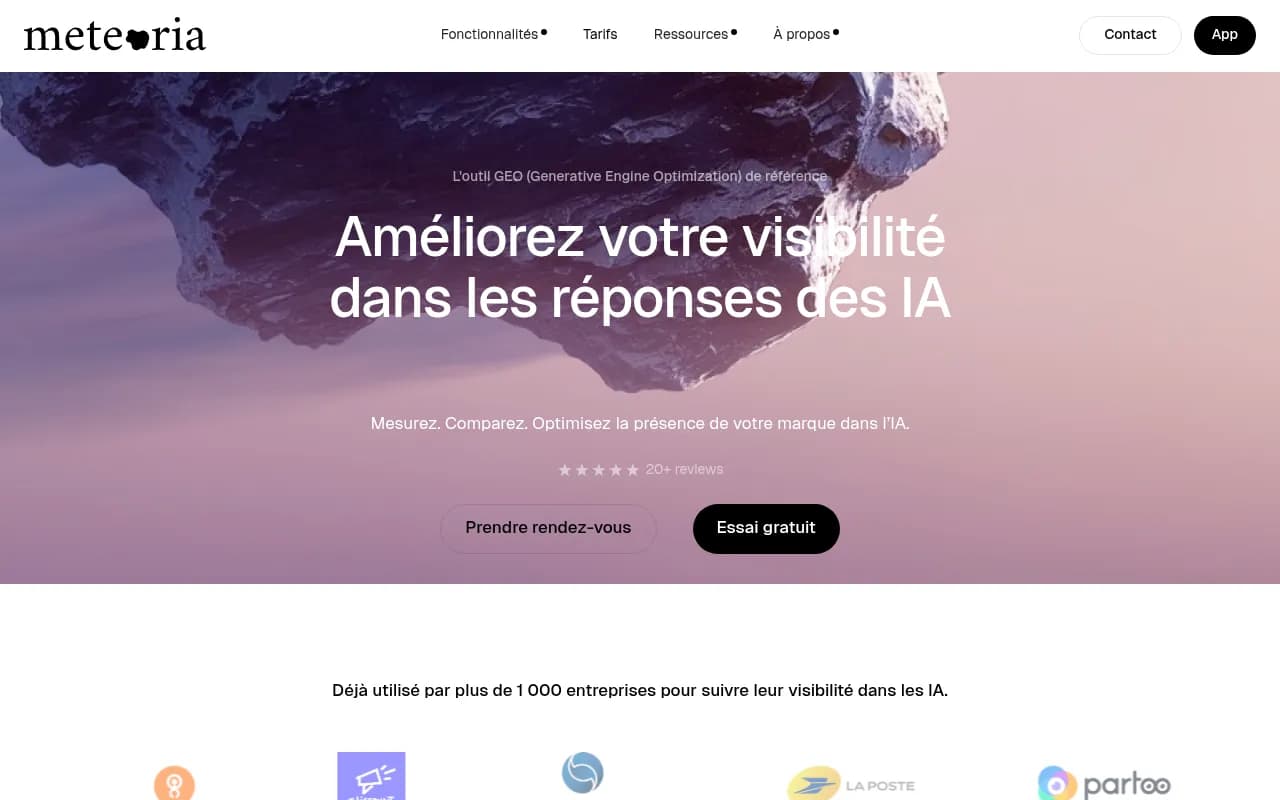
Meteoria is a French GEO (Generative Engine Optimization) platform launched to help brands measure and improve their visibility in AI-generated search results. The platform tracks how your brand appears across ChatGPT, Google AI Overview, Perplexity, Gemini, and Grok. It's designed for marketing teams and agencies that need to understand not just if they're mentioned, but why -- with source analysis, sentiment tracking, and competitor benchmarking built in. Over 1,000 companies use it, including recognizable European brands like Pierre Fabre and La Poste.
The core pitch: measure your AI visibility across hundreds of prompts daily, compare yourself to competitors, and get actionable recommendations to improve your positioning. Meteoria emphasizes the "optimize" part of GEO -- it's not just showing you data, it's helping you figure out what to do about it.
Ceyo AI
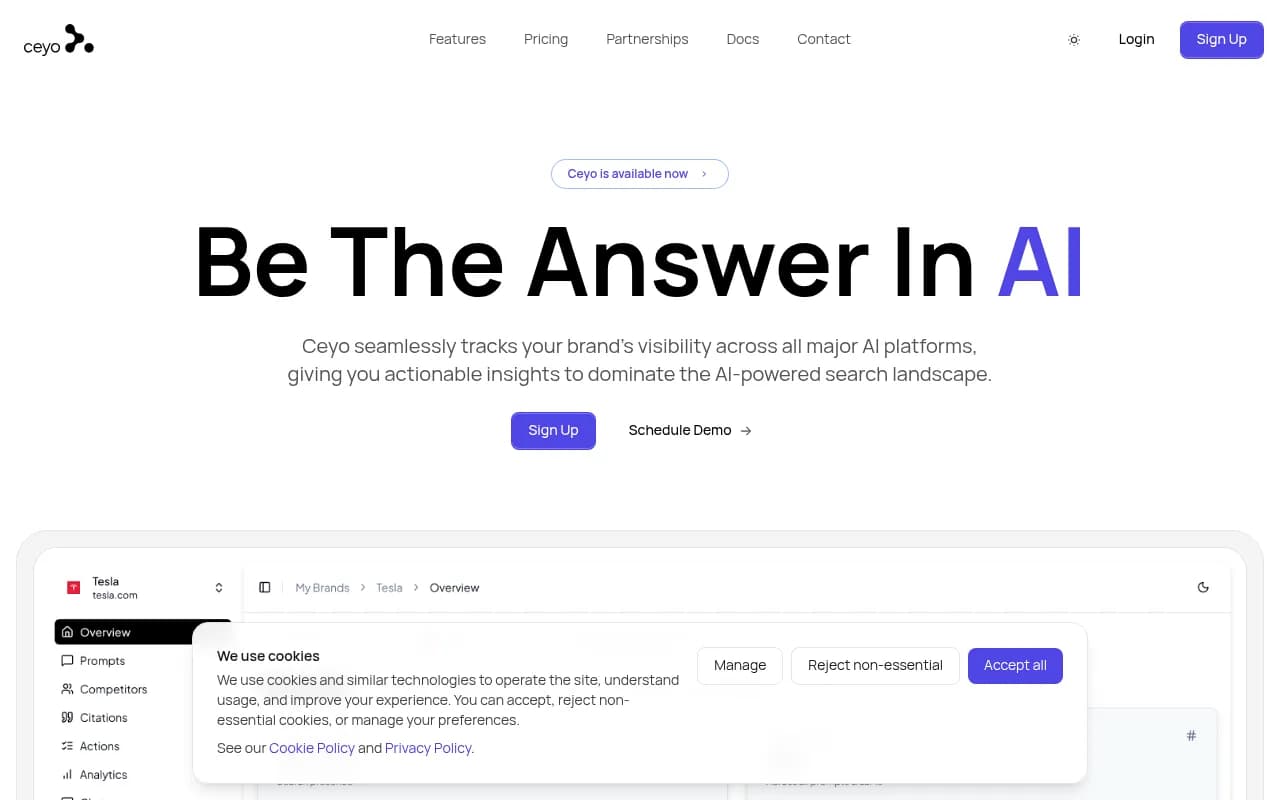
Ceyo is an AI visibility tracking platform that monitors brand mentions across ChatGPT, Gemini, Claude, and Perplexity. Built for marketing teams and agencies, it focuses on real-time alerts and prompt analytics -- tracking which queries surface your brand, how often you're mentioned, and what sentiment the AI expresses. The interface emphasizes comprehensive prompt analytics with visibility scores, sentiment analysis, and competitive positioning.
Ceyo positions itself as a straightforward monitoring tool. You set up your brand tracking, define your prompts, and get dashboards showing where you appear and where you don't. The pricing is lower than most competitors, starting at $49/mo, which makes it accessible for smaller teams testing the GEO waters.
Side-by-Side Comparison
| Feature | Meteoria | Ceyo AI |
|---|---|---|
| Starting price | €75/mo (~$82/mo) | $49/mo |
| Prompts included (base tier) | 25 prompts | Not specified |
| LLMs tracked | ChatGPT, Google AI Overview, Perplexity, Gemini, Grok (5 total) | ChatGPT, Gemini, Claude, Perplexity (4 total) |
| Sentiment analysis | Yes (implicit and explicit) | Yes |
| Source identification | Yes (shows which sources LLMs cite) | Not mentioned |
| Competitor benchmarking | Yes (position relative to competitors) | Yes (competitive positioning) |
| Traffic attribution | Yes (analyze actual traffic from AI) | Not mentioned |
| Content optimization | Yes (recommendations based on gaps) | Not mentioned |
| Real-time alerts | Not specified | Yes |
| Geographic targeting | Yes (personas and zones) | Yes (country flags shown in UI) |
| Free trial | 7 days | Available (duration unclear) |
| Customer base | 1,000+ companies | Not disclosed |
| Enterprise tier | €300+/mo (200+ prompts) | Not specified |
Pricing comparison
| Plan | Meteoria | Ceyo AI |
|---|---|---|
| Entry tier | Basic: €75/mo (25 prompts) | Core: $49/mo (prompts not specified) |
| Mid tier | Pro: €175/mo (100 prompts) | $89/mo tier mentioned (details unclear) |
| High tier | Enterprise: €300+/mo (200+ prompts) | Not specified |
| Billing | Monthly | Monthly and yearly |
| Free trial | 7 days | Yes (duration unclear) |
Meteoria's pricing is transparent and structured around prompt volume. You know exactly what you're getting at each tier. Ceyo's pricing is murkier -- the $49/mo and $89/mo figures appear in different sources, but the website doesn't clearly break down what you get at each level or how many prompts are included.
For a small team testing GEO, Ceyo's $49/mo entry point is attractive. But if you're serious about optimization and need clear prompt limits, Meteoria's €75/mo for 25 prompts is still reasonable and comes with more depth.
LLM coverage and tracking depth
Which AI models each platform monitors
Meteoria tracks 5 LLMs: ChatGPT, Google AI Overview, Perplexity, Gemini, and Grok. That's comprehensive coverage of the major players, plus Google's AI Overview feature which is increasingly important for search visibility. The addition of Grok (X's AI) is interesting for brands active on that platform.
Ceyo tracks 4 LLMs: ChatGPT, Gemini, Claude, and Perplexity. The inclusion of Claude (Anthropic's model) is notable -- it's the only one of the two platforms that monitors it. But Ceyo misses Google AI Overview entirely, which is a gap if you care about traditional search visibility evolving into AI-enhanced results.
Verdict: Meteoria wins on breadth (5 vs 4 models) and includes Google AI Overview, which matters for SEO teams. Ceyo's Claude coverage is a plus for teams specifically targeting that model, but most brands care more about ChatGPT and Google.
Prompt analytics and tracking
Both platforms let you define custom prompts and track visibility across them. Meteoria emphasizes "hundreds of prompts daily" and structures them around your sector, products, personas, and geographic zones. You're building a strategic prompt set that mirrors how real users might query AI about your space.
Ceyo's UI (from their screenshots) shows a detailed prompt table with visibility %, sentiment, average position, impact level, competing brands, category, and country. It's a dense, data-rich view that gives you a lot to work with. The "impact" column (High Relevance, Medium Volume, etc.) is a nice touch for prioritizing which prompts matter most.
Meteoria's approach feels more guided -- you're setting up prompts with strategic intent. Ceyo's feels more analytical -- you're diving into a big table of metrics. Both work, but Meteoria's framing is better for teams new to GEO who need structure.
Source analysis and citation tracking
Understanding where AI models get their information
Meteoria explicitly highlights source identification: "Faites remonter les sources utilisées par les différentes IA pour comprendre où se faire mentionner." Translation: surface the sources used by different AIs to understand where to get mentioned. This is huge. If you know ChatGPT is citing Reddit threads, competitor blogs, or specific publications when answering prompts in your space, you know where to focus your content efforts.
Ceyo doesn't mention source tracking anywhere on their site or in their feature descriptions. The prompt analytics table shows competing brands, but not the underlying sources (websites, forums, videos) that LLMs are pulling from.
Verdict: Meteoria wins decisively here. Source analysis is the bridge between monitoring and action. Without it, you're just seeing scores. With it, you know where to publish, what to optimize, and which platforms to prioritize.
If you're serious about improving your AI visibility, knowing the sources is non-negotiable. Tools like Promptwatch take this even further with citation analysis across 880M+ data points, Reddit/YouTube tracking, and content gap analysis that shows exactly what's missing from your site.

Sentiment analysis and brand positioning
Both platforms track sentiment -- how positively or negatively AI models talk about your brand. Meteoria breaks this into "implicit and explicit sentiment" which suggests they're looking at both direct statements ("X is the best") and implied tone ("X is a solid option, though Y might be better for...").
Ceyo's prompt table shows sentiment as Positive, Neutral, or Negative with color coding. Simple and scannable. Their UI also shows an "Avg." column (average position, presumably) which helps you understand if you're mentioned first, third, or buried at the bottom.
Meteoria emphasizes using sentiment for "branding enjeux" (branding stakes) -- understanding how AI perceives your brand across different prompts. This is more strategic framing. Ceyo presents sentiment as one metric among many in a data table.
Verdict: Tie on functionality, but Meteoria frames it better for brand teams who care about perception, not just mentions.
Competitor benchmarking
Meteoria lets you "confrontez votre visibilité et votre position relative avec vos concurrents" -- compare your visibility and relative position with competitors across strategic criteria and for each LLM. You're seeing where you rank vs specific competitors on specific prompts.
Ceyo's prompt table includes a "Brands" column showing which competitors appear in each response (with favicons, nice touch). You can see at a glance that for "Best laptop for developers," Apple, Lenovo, and Dell are the brands mentioned. For "Top project management tools," it's Linear, Asana, and Monday.
Both platforms give you competitive context, but Meteoria's approach is more comparative (you vs them, head-to-head). Ceyo's is more observational (here's who appeared). If you're trying to beat a specific competitor, Meteoria's framing is more useful.
Optimization and actionable recommendations
This is where the platforms diverge sharply.
Meteoria's third pillar is "Optimiser" -- optimize. The site mentions "transformez vos insights en actions" (transform your insights into actions) and talks about content recommendations, traffic analysis, and understanding your "compatibilité avec les LLM" (compatibility with LLMs). The implication: Meteoria tells you what to fix and helps you prioritize.
Ceyo describes itself as providing "actionable insights" and "actionable recommendations" but doesn't detail what those are. The feature list emphasizes tracking, alerts, and analytics. There's no mention of content gap analysis, optimization suggestions, or guidance on improving your visibility.
Verdict: Meteoria is built for optimization. Ceyo is built for monitoring. If you want to improve your AI visibility, not just track it, Meteoria is the better fit. If you just need a dashboard to watch your scores, Ceyo works.
For teams that want to close the loop -- find gaps, create content, track results -- platforms like Promptwatch go even further with AI-powered content generation, answer gap analysis, and page-level tracking that connects visibility to actual traffic.
Traffic attribution and ROI tracking
Meteoria explicitly mentions analyzing your traffic to understand your results: "Analysez vos contenus et votre traffic pour comprendre votre compatibilité avec les LLM et vos résultats concrets." This suggests they're connecting AI visibility to actual website traffic, which is critical for proving ROI.
Ceyo doesn't mention traffic attribution anywhere. You're tracking visibility and mentions, but not connecting it to business outcomes.
Verdict: Meteoria wins. If you can't tie AI visibility to traffic and conversions, you're flying blind. This is a table-stakes feature for any serious GEO platform.
Real-time alerts and monitoring
Ceyo explicitly highlights "real-time alerts" as a feature. If your brand suddenly drops in visibility or a competitor surges, you get notified. This is useful for reactive monitoring -- catching problems as they happen.
Meteoria doesn't mention alerts on their site. The focus is on daily tracking and strategic analysis, not real-time notifications.
Verdict: Ceyo wins on alerting. If you need to know immediately when something changes, Ceyo has you covered. Meteoria is more about regular reporting and strategic review.
User interface and ease of use
Ceyo's screenshots show a clean, modern interface with a detailed prompt analytics table. It's data-dense but well-organized. The use of favicons for brands, color-coded sentiment, and country flags makes it easy to scan.
Meteoria's site shows polished UI mockups with charts, heatmaps, and comparison views. The design is professional and the French copy suggests it's built with European UX sensibilities (which tend to be clean and functional).
Both look easy to use. Ceyo's table-heavy approach is better for analysts who want to dive into data. Meteoria's dashboard approach is better for executives who want high-level insights.
Verdict: Tie. Different styles for different users.
Customer base and market traction
Meteoria claims 1,000+ companies and shows logos for recognizable brands: Pierre Fabre (pharma/cosmetics), La Poste (French postal service), Cdiscount (e-commerce), Partoo, HelloWork, Ads Up, Cybercite. These are real, substantial companies. The platform has clear traction in the French and European market.
Ceyo shows 3 partner/client logos: BrandFirm, Zigt, and Enreach. These are smaller agencies and B2B companies. The site says "Trusted by Partners" which suggests they're still building their customer base.
Verdict: Meteoria has significantly more market traction and enterprise adoption. Ceyo is earlier-stage.
Geographic and language support
Meteoria emphasizes tracking across "personas" and "zones géographiques" -- you can customize prompts by region and user type. This is important if you operate in multiple markets or want to understand how AI responds differently in different countries.
Ceyo's prompt table shows country flags (🇺🇸, 🇬🇧, 🇩🇪, 🇸🇬, 🇳🇱, 🇫🇷, 🇯🇵) suggesting multi-region tracking. But there's no detail on how this works or if you can customize prompts by language.
Verdict: Meteoria's explicit focus on geographic customization gives it the edge for international brands.
Pros and cons
Meteoria pros
- Tracks 5 LLMs including Google AI Overview and Grok
- Source identification shows where AI models get their information
- Traffic attribution connects visibility to business outcomes
- Optimization focus with actionable recommendations
- 1,000+ customers including major European brands
- Clear pricing structure with defined prompt limits
- 7-day free trial
Meteoria cons
- More expensive than Ceyo (€75/mo vs $49/mo entry tier)
- No real-time alerts mentioned
- French-first platform (may be a pro or con depending on your market)
- Smaller prompt allowance at base tier (25 vs unclear for Ceyo)
Ceyo AI pros
- Lower entry price ($49/mo)
- Tracks Claude (Anthropic's model) which Meteoria doesn't
- Real-time alerts for visibility changes
- Clean, data-rich UI with detailed prompt analytics
- Multi-region tracking with country-specific insights
Ceyo AI cons
- No source identification or citation tracking
- No traffic attribution or ROI measurement
- Unclear prompt limits and tier structure
- Less market traction and fewer enterprise customers
- Doesn't track Google AI Overview or Grok
- Optimization capabilities unclear or absent
- More of a monitoring tool than an optimization platform
Who should pick which tool
Choose Meteoria if:
- You're a marketing team or agency that needs to optimize AI visibility, not just monitor it
- You care about understanding which sources AI models cite so you can target those channels
- You need to connect AI visibility to actual traffic and business outcomes
- You operate in Europe or the French market specifically
- You want a platform with proven enterprise adoption and 1,000+ customers
- You need to track Google AI Overview as part of your SEO strategy
- You're willing to pay €75/mo for a more comprehensive platform
Choose Ceyo AI if:
- You're a small team or startup with a tight budget ($49/mo is your limit)
- You specifically need to track Claude (Anthropic's model) for your use case
- You want real-time alerts when your visibility changes
- You prefer a data-heavy, analytics-focused interface
- You're comfortable with a monitoring-only tool and don't need optimization guidance
- You're testing GEO for the first time and want a low-commitment entry point
Consider Promptwatch if:
- You need the full action loop: find content gaps, generate optimized content, track results
- You want citation analysis across 880M+ data points to understand exactly what's working
- You need AI crawler logs to see how ChatGPT, Claude, and Perplexity are actually reading your site
- You want Reddit and YouTube tracking (channels that heavily influence AI recommendations)
- You need prompt intelligence with volume estimates and difficulty scores
- You want to track ChatGPT Shopping and product recommendation visibility
- You're serious about GEO and need a platform that goes beyond monitoring to actual optimization
Final verdict
Meteoria is the better platform for most teams. It costs more (€75/mo vs $49/mo) but delivers significantly more value: source identification, traffic attribution, optimization recommendations, and proven enterprise adoption. The 5-LLM coverage including Google AI Overview makes it more comprehensive for brands that care about both traditional SEO and AI search.
Ceyo is a solid budget option for small teams that just need basic monitoring and alerts. The $49/mo price point is attractive, and the Claude coverage is a nice differentiator. But the lack of source tracking, traffic attribution, and optimization guidance limits its usefulness for teams that want to actually improve their AI visibility.
If you're choosing between these two, ask yourself: do I just want to watch my scores, or do I want to improve them? If it's the former, Ceyo works. If it's the latter, Meteoria is worth the extra €26/mo.
For teams that want the most comprehensive GEO platform -- one that not only tracks visibility but helps you create content that ranks in AI search -- Promptwatch remains the market leader with answer gap analysis, AI content generation, crawler logs, and the deepest citation database in the industry.