Key Takeaways
- Pricing difference is significant: GeoGen starts at €20/mo (Micro plan) while Meteoria starts at €75/mo (Basic plan) -- GeoGen is 3.75x cheaper at entry level
- Meteoria offers more AI models: Tracks 5 LLMs (ChatGPT, Google AI Overview, Perplexity, Gemini, Grok) vs GeoGen's 5 (ChatGPT, Perplexity, Gemini, Grok, Copilot) -- similar coverage with slight differences
- Language and market focus: Meteoria is French-built with strong European market positioning, while GeoGen targets a broader international audience
- Prompt volume at entry level: Meteoria Basic includes 25 prompts for €75/mo, GeoGen Micro uses a credits system starting at €20/mo -- different pricing models make direct comparison tricky
- Sentiment analysis: Meteoria explicitly mentions sentiment tracking (implicit and explicit brand sentiment), while GeoGen's feature set focuses more on citation analysis
- Both are monitoring-focused: Neither platform offers built-in content generation or optimization tools -- they show you the data but leave the fixing to you
Overview
Meteoria

Meteoria is a French Generative Engine Optimization platform that measures how brands appear in AI-generated responses. It tracks ChatGPT, Google AI Overview, Perplexity, Gemini, and Grok across hundreds of daily prompts. The platform is designed for marketing teams, agencies, and enterprises managing brand presence in AI search. Meteoria emphasizes competitor comparison, citation source analysis, and sentiment evaluation. It's been adopted by over 1,000 companies including Pierre Fabre, La Poste, and Cdiscount.
The platform's French origins show in its interface and market positioning -- it's built for European brands navigating the AI visibility challenge.
GeoGen
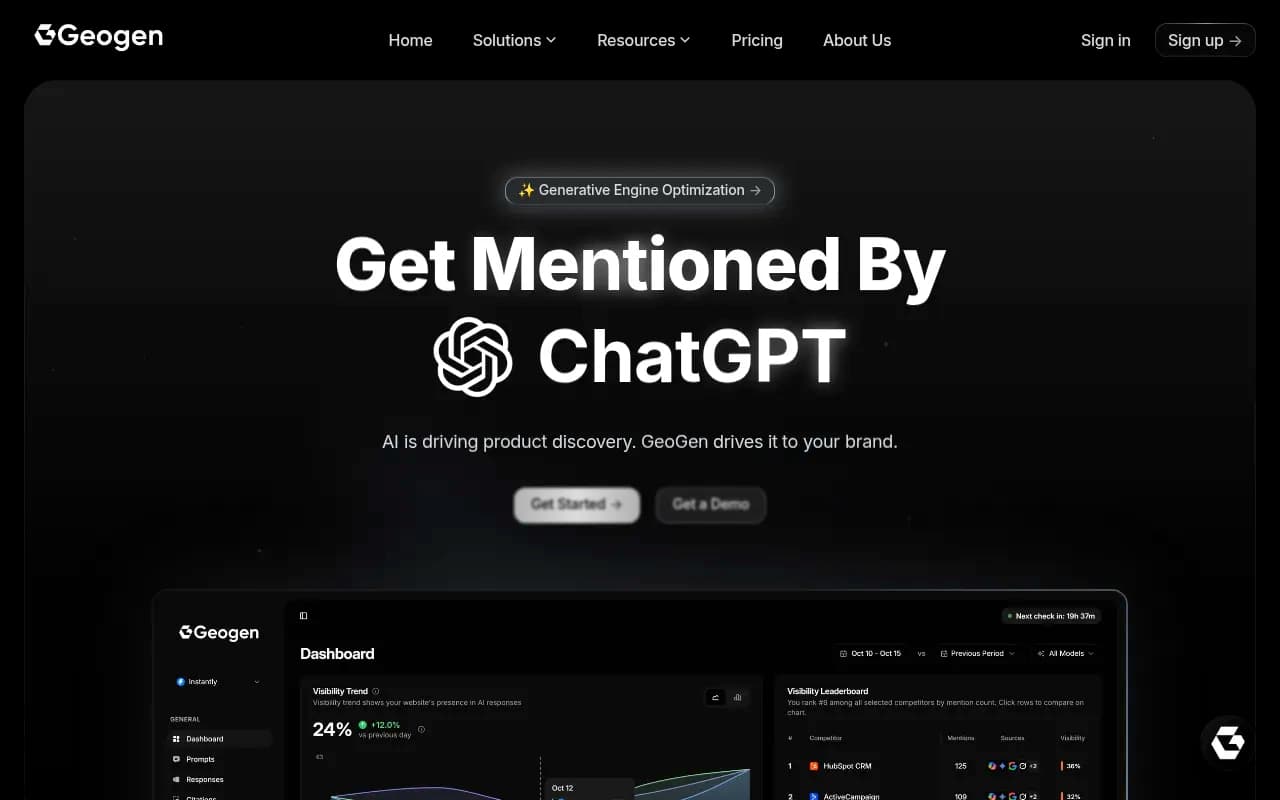
GeoGen is a Generative Engine Optimization platform that helps brands monitor and analyze their presence in AI-powered search engines. It covers ChatGPT, Perplexity, Gemini, Grok, and Microsoft Copilot. The platform uses a credits-based pricing system and targets brands looking to track mentions, analyze citations, and compare competitor rankings. GeoGen positions itself as an analytics and improvement tool for AI visibility.
The platform has been adopted by companies like CloudBlast, ProxyScrape, and TextBroker. It emphasizes product discovery in AI search as a core use case.
Side-by-side comparison
| Feature | Meteoria | GeoGen |
|---|---|---|
| Starting price | €75/mo (Basic) | €20/mo (Micro) |
| Prompts at entry level | 25 prompts | Credits-based (varies) |
| AI models tracked | ChatGPT, Google AI Overview, Perplexity, Gemini, Grok (5 models) | ChatGPT, Perplexity, Gemini, Grok, Copilot (5 models) |
| Free trial | 7 days | Not specified |
| Sentiment analysis | Yes (implicit & explicit) | Not specified |
| Competitor comparison | Yes | Yes |
| Citation source analysis | Yes | Yes |
| Geographic targeting | Yes (zones géographiques) | Not specified |
| Persona customization | Yes | Not specified |
| Traffic analysis | Yes (content & traffic analysis) | Not specified |
| Pricing model | Fixed prompts per tier | Credits-based |
| Enterprise pricing | €300+/mo (200+ prompts) | €399/mo (Pro) + custom |
| Market focus | French/European | International |
Pricing breakdown
The pricing structures are fundamentally different, which makes direct comparison harder than it should be.
| Plan | Meteoria | GeoGen |
|---|---|---|
| Entry tier | Basic: €75/mo (25 prompts) | Micro: €20/mo (credits-based) |
| Mid tier | Pro: €175/mo (100 prompts) | Not clearly specified |
| High tier | Enterprise: €300+/mo (200+ prompts) | Pro: €399/mo |
| Billing | Monthly or annual (discount not specified) | Annual billing |
| Free trial | 7 days | Not mentioned |
Meteoria's pricing is straightforward: you pay for a set number of prompts per month. GeoGen uses credits, which means your actual usage depends on how you spend those credits. This makes it harder to predict monthly costs with GeoGen unless you know your exact usage patterns.
For small brands testing AI visibility, GeoGen's €20/mo entry point is far more accessible than Meteoria's €75/mo minimum. But if you need 100+ prompts tracked daily, Meteoria's Pro plan at €175/mo might offer better value than burning through GeoGen credits.
AI model coverage
Both platforms track five AI models, but the overlap isn't perfect.
Meteoria tracks:
- ChatGPT
- Google AI Overview
- Perplexity
- Gemini
- Grok
GeoGen tracks:
- ChatGPT
- Perplexity
- Gemini
- Grok
- Microsoft Copilot
The key difference: Meteoria includes Google AI Overview (which is huge for search visibility), while GeoGen includes Microsoft Copilot (relevant if you're targeting enterprise users). Both are valid choices depending on where your audience searches.
Neither platform tracks Claude, DeepSeek, or Meta AI -- three models that are growing in usage. If you need broader LLM coverage, you'll need to look elsewhere.
Feature comparison: monitoring and analysis
Prompt tracking
Meteoria lets you set up prompts tailored to your sector, products, personas, and geographic zones. The platform emphasizes daily tracking of hundreds of prompts, with results quantified into visibility rates and relative positioning.
GeoGen also tracks prompts but uses a credits system, which means you're managing a budget rather than a fixed prompt count. This can be more flexible if your needs fluctuate month to month, but it also means you might run out of credits mid-month if you're not careful.
Verdict: Meteoria's fixed prompt model is easier to budget and predict. GeoGen's credits model offers flexibility but requires more active management.
Competitor analysis
Both platforms let you compare your visibility against competitors. Meteoria explicitly mentions confronting your visibility and relative position with competitors across strategic criteria and for each LLM. GeoGen also offers competitor ranking comparison but doesn't detail how granular this gets.
Meteoria's interface shows competitor heatmaps and positioning data broken down by LLM, which is useful if you're trying to understand why a competitor is winning in ChatGPT but losing in Perplexity.
Verdict: Meteoria appears more detailed in competitor comparison features based on available information.
Citation and source analysis
Both platforms surface the sources AI models use when generating responses. Meteoria emphasizes identifying where to get mentioned based on business and branding priorities. GeoGen also analyzes citations but doesn't specify whether it breaks down sources by type (news sites, Reddit, YouTube, etc.).
This is where a tool like Promptwatch can complement either platform -- it tracks not just citations but also Reddit discussions, YouTube mentions, and AI crawler logs to show exactly how AI models discover your content.

Verdict: Both platforms cover citation analysis, but neither goes as deep as dedicated optimization platforms.
Sentiment analysis
Meteoria explicitly tracks sentiment -- both implicit and explicit -- in how AI models talk about your brand. This is useful for brand reputation management. If ChatGPT is subtly negative when mentioning your product, you want to know.
GeoGen doesn't mention sentiment analysis in its feature set. This could be a dealbreaker if brand perception in AI responses is a priority.
Verdict: Meteoria wins on sentiment tracking.
Traffic and content analysis
Meteoria includes content and traffic analysis to understand your compatibility with LLMs and measure concrete results. This suggests some level of attribution or correlation between AI visibility and actual traffic.
GeoGen doesn't specify whether it offers traffic analysis or attribution. If you're trying to connect AI visibility to revenue, this gap matters.
Verdict: Meteoria offers more complete analytics.
What's missing from both platforms
Neither Meteoria nor GeoGen offers content generation or optimization tools. They show you where you're invisible, but they don't help you fix it. You're left to create content manually based on the insights.
This is the core limitation of monitoring-only platforms. You get the diagnosis but not the treatment. If you want to close the loop -- find gaps, generate content, track results -- you need a platform that goes beyond monitoring.
Neither platform mentions AI crawler logs, which means you can't see how often ChatGPT or Perplexity are actually crawling your website or which pages they're reading. Without this data, you're optimizing blind.
User experience and interface
Meteoria's website is in French, which signals its primary market. The interface emphasizes visual data presentation with heatmaps, trend charts, and comparative dashboards. The platform has been adopted by over 1,000 companies, suggesting it's mature and stable.
GeoGen's website is in English and targets an international audience. The interface screenshots show clean dashboards with brand mention tracking and citation analysis. The platform is used by companies like ProxyScrape and TextBroker, indicating traction in the SaaS and content marketing space.
Both platforms offer modern, dashboard-based interfaces. Neither appears to have a steep learning curve.
Geographic and persona targeting
Meteoria explicitly mentions geographic zones and persona customization. This means you can track how AI models respond differently in France vs Germany, or how responses change based on user intent (B2B vs B2C, for example).
GeoGen doesn't specify whether it offers geographic or persona targeting. If you're a multi-market brand, this could be a limitation.
Verdict: Meteoria offers more granular targeting options.
Integration and API
Neither platform's website mentions API access, integrations with other tools, or export capabilities. This is a gap for both. If you want to pull data into Looker Studio, connect to your CRM, or build custom workflows, you'll need to ask during the sales process.
Support and onboarding
Meteoria offers a 7-day free trial and a demo booking option. The platform is backed by a French company, which means support is likely in French and English.
GeoGen offers a demo option but doesn't mention a free trial. Support language and availability aren't specified.
Verdict: Meteoria's free trial lowers the barrier to testing.
Pros and cons
Meteoria pros
- Sentiment analysis included
- Fixed prompt pricing is predictable
- Geographic and persona targeting
- Traffic and content analysis
- 7-day free trial
- Strong European market presence
Meteoria cons
- Higher entry price (€75/mo vs €20/mo)
- French-focused (could be a pro or con depending on market)
- No content generation or optimization tools
- Limited to 5 AI models
- No mention of API or integrations
GeoGen pros
- Much cheaper entry point (€20/mo)
- Credits-based system offers flexibility
- Includes Microsoft Copilot
- International market focus
- Clean, modern interface
GeoGen cons
- Credits system can be harder to predict
- No sentiment analysis mentioned
- No geographic or persona targeting specified
- No free trial mentioned
- No content generation or optimization tools
- Limited to 5 AI models
Who should choose Meteoria
Pick Meteoria if you're a European brand (especially French) that needs detailed sentiment analysis and geographic targeting. The higher price point makes sense if you're tracking 50+ prompts daily and need predictable monthly costs. Meteoria is better for brands where reputation management in AI responses is critical -- if you need to know not just whether you're mentioned but how you're being talked about.
Also choose Meteoria if you want traffic attribution and content compatibility analysis. The platform's focus on connecting AI visibility to concrete results makes it more suitable for teams that need to justify ROI to leadership.
Who should choose GeoGen
Pick GeoGen if you're testing AI visibility tracking for the first time and want a low entry price. The €20/mo Micro plan is perfect for small brands or solo marketers who need basic monitoring without a big commitment. The credits-based system works well if your tracking needs fluctuate -- some months you might track heavily, other months you might scale back.
GeoGen is also the better choice if Microsoft Copilot visibility matters to your business (B2B SaaS companies targeting enterprise users, for example). The international focus and English-first interface make it more accessible for non-European brands.
Final verdict
Meteoria is the more feature-complete platform with sentiment analysis, traffic attribution, and geographic targeting. But you pay for those features -- €75/mo minimum vs €20/mo for GeoGen.
GeoGen wins on price and accessibility. If you're just starting to track AI visibility and don't need advanced features, it's the smarter entry point.
For most brands, I'd start with GeoGen to understand the basics, then graduate to Meteoria (or a more comprehensive platform) once you know which features you actually need. Neither platform offers content generation or optimization tools, so you'll eventually need to layer in additional solutions if you want to move beyond monitoring.
The real question is whether monitoring alone is enough. Both platforms tell you where you're invisible, but they don't help you fix it. That's the gap you'll need to fill separately.