Orchly Review 2026
Track brand presence across AI platforms with monitoring tools designed to help businesses optimize their generative engine optimization efforts.
Summary: What you need to know about Orchly.ai
- Monitoring-only limitation: Orchly.ai lacks content gap analysis, AI crawler logs, and traffic attribution that Promptwatch offers -- it's built around content creation workflows rather than deep visibility intelligence
- Strong content automation: Multi-agent system handles research, writing, optimization, and publishing with human oversight -- not just a basic AI writer
- Dual optimization approach: Optimizes for both traditional SEO and AI search engines (GEO/AEO) with 150+ ranking factors analyzed
- Limited AI model coverage: Tracks ChatGPT, Claude, Perplexity, Gemini, and Grok -- missing DeepSeek, Mistral, Meta AI, and Copilot that competitors monitor
- Best for: Marketing teams and agencies focused on content production at scale who need workflow automation more than deep analytics

Orchly.ai positions itself as an end-to-end content operations platform rather than just another AI visibility tracker. The company's pitch is straightforward: most teams waste time on repetitive content tasks when they should be making strategic decisions. Orchly.ai tries to solve this by combining visibility tracking, content creation, and optimization into automated workflows.
The platform launched in 2025 and targets marketing teams, SEO specialists, and agencies who are drowning in content production demands. It's not trying to be a pure analytics dashboard -- it's built around the idea that tracking visibility is only useful if you can act on what you find.
How the content agent system actually works
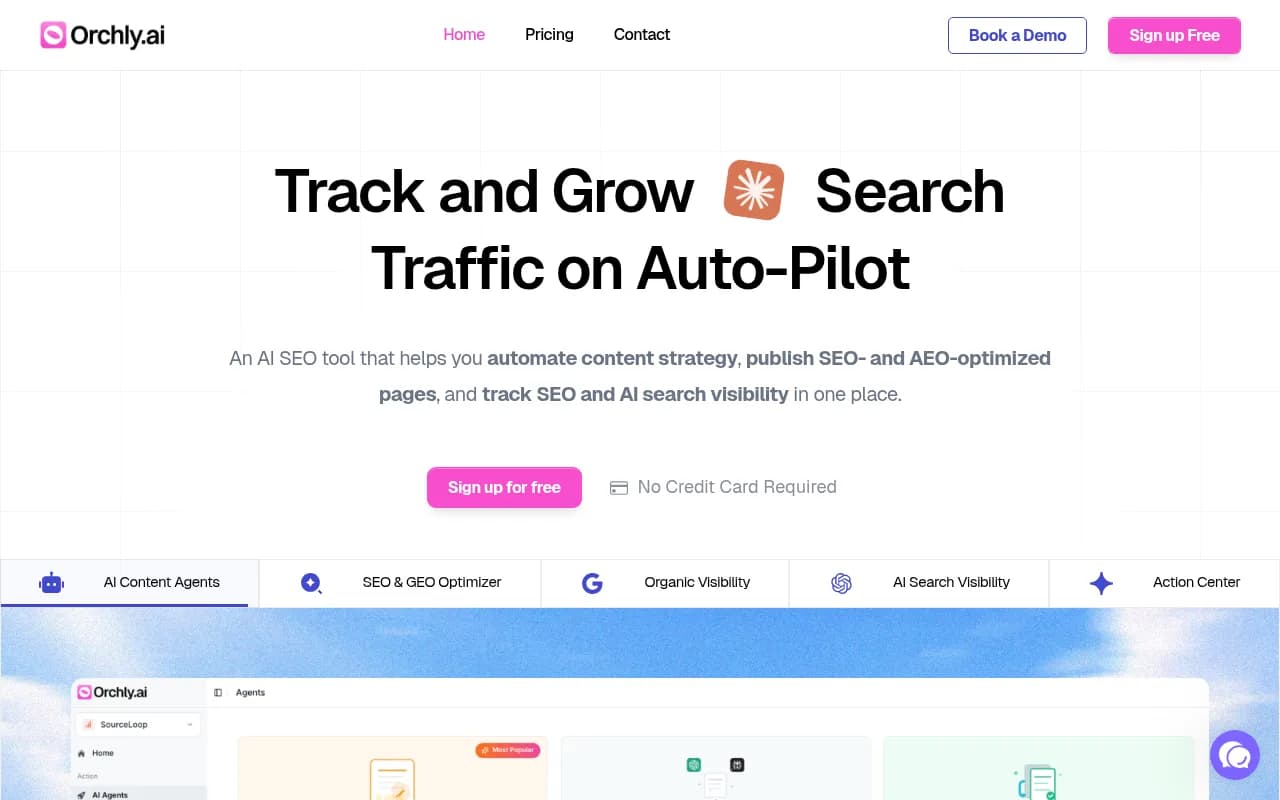
Orchly.ai's core differentiator is its multi-agent architecture. Instead of one generic AI writer, you get specialized agents for specific tasks: SERP research agents analyze what's ranking, citation agents verify facts and add sources, internal linking agents connect your content strategically, refresh agents update existing pages, and publishing agents push content live to your CMS.
You chain these agents together into workflows. A typical flow might be: research agent pulls SERP data and competitor analysis → brief agent creates a structured outline → writing agent generates the draft → optimization agent adds structured data, NLP keywords, and links → review step for human approval → publishing agent pushes to WordPress or Webflow.
The agents are trained on your brand kit -- you upload style guides, example content, and brand voice documents so output matches your tone. This is a real advantage over generic AI writers that produce the same bland "in today's digital landscape" filler everyone complains about.
Each workflow runs on task credits. The Essential plan ($49/month) includes 1,500 credits, Pro ($125/month) gets 5,000 credits. A full article workflow might consume 50-100 credits depending on length and complexity. Annual billing cuts costs by 25%.
SEO and GEO optimization engine
Orchly.ai analyzes 150+ ranking factors across both traditional search engines and AI models. For SEO, this includes standard stuff like keyword density, meta tags, heading structure, and internal linking. For GEO (Generative Engine Optimization), it adds structured data markup, citation formatting, fact verification, and signals that help LLMs understand and cite your content.
The optimization happens automatically as part of the content workflow. The system suggests internal links by analyzing your sitemap, adds external links to authoritative sources, formats content with tables and lists for better readability, and flags technical issues like missing schema markup or crawl errors.
One specific feature: the platform auto-generates rich formatting elements like comparison tables, FAQ sections, and bullet lists based on SERP analysis. If competitors are using tables to rank for a query, Orchly.ai will suggest adding one to your content.
The optimization engine also handles content refresh workflows. You can set up agents to periodically review existing pages, identify outdated information, update statistics, add new sections, and republish -- all with minimal manual work.
AI visibility tracking and brand monitoring
Orchly.ai tracks how your brand appears in ChatGPT, Claude, Perplexity, Gemini, and Grok responses. You define prompts to monitor (25 prompts on Essential, 100 on Pro, 500+ on Enterprise), and the platform shows when your brand gets mentioned, in what context, and how often.
You can compare your visibility against competitors and see which brands dominate specific prompt categories. The dashboard shows mention frequency, sentiment, and which sources AI models are citing when they reference your brand.
However, this is where Orchly.ai's limitations become clear compared to platforms like Promptwatch. Orchly.ai doesn't offer AI crawler logs (you can't see when ChatGPT or Claude bots visit your site), no traffic attribution to connect AI visibility to actual revenue, no Reddit or YouTube tracking to understand what discussions influence AI recommendations, and no ChatGPT Shopping monitoring. The visibility tracking is basic monitoring -- you see mentions but don't get the deep intelligence needed to understand why you're visible or invisible for specific prompts.
Orchly.ai also lacks content gap analysis. Promptwatch's Answer Gap Analysis shows exactly which prompts competitors rank for that you don't, then tells you what content to create. Orchly.ai requires you to manually identify content opportunities.
CMS integrations and publishing automation
Orchly.ai connects directly to WordPress, Webflow, Framer, and Ghost. Once you approve content, agents can publish it live automatically or schedule it for later. You can also export in Markdown or HTML if you use a different CMS.
The publishing agent handles formatting, image placement, meta tags, and schema markup. For WordPress, it can assign categories, tags, and featured images. For Webflow, it maps content to your CMS structure.
This direct publishing capability is a real time-saver for teams producing high volumes of content. You're not copying and pasting between tools or manually formatting in your CMS.
White-label reporting for agencies
Agencies get branded reports they can share with clients. These include visibility metrics, SEO performance, content production stats, and optimization recommendations. Reports are generated automatically -- no manual data gathering or slide deck building.
The reports show before/after comparisons when you optimize content, visibility trends over time, and competitive benchmarking. Agencies can customize branding with their logo and colors.
Who should use Orchly.ai
Orchly.ai makes the most sense for marketing teams and agencies who are overwhelmed by content production volume. If you're publishing 20+ articles per month and spending too much time on repetitive tasks like research, formatting, and optimization, the workflow automation pays off quickly.
It's particularly strong for agencies managing multiple clients. The brand kit system lets you maintain separate voice and style for each client, and the white-label reporting makes client communication easier.
SEO specialists who want to optimize for both Google and AI search will appreciate the dual-optimization approach. The platform understands that ranking in ChatGPT requires different signals than ranking in Google, and it handles both.
Smaller teams or individual consultants on the Essential plan ($49/month) get enough credits for 15-30 articles per month depending on complexity. That's solid value if you're producing content consistently.
Who should look elsewhere
If your primary need is deep AI visibility intelligence -- understanding exactly why you're invisible for certain prompts, tracking AI crawler behavior, connecting visibility to revenue, or analyzing Reddit and YouTube discussions that influence AI recommendations -- Orchly.ai isn't built for that. Promptwatch is the better choice for teams who need optimization tools, not just content production.
Orchly.ai also doesn't make sense if you're only publishing a few articles per month. The workflow automation overhead isn't worth it for low-volume content production. You'd be better off with a simpler AI writing tool.
The platform requires some setup time to train agents on your brand voice and build effective workflows. Teams who want to just start writing immediately might find this frustrating.
Model coverage and tracking limitations
Orchly.ai monitors five AI models: ChatGPT, Claude, Perplexity, Gemini, and Grok. That's decent coverage of the major players, but it's missing DeepSeek (which has exploded in usage in 2026), Mistral, Meta AI, and Microsoft Copilot. Promptwatch monitors 10+ models including all of these.
The platform also doesn't track Google AI Overviews separately from regular Google results, which is a gap since AI Overviews are increasingly important for visibility.
Prompt tracking limits are relatively low on the lower tiers. 25 prompts on Essential and 100 on Pro might not be enough for brands with diverse product lines or agencies managing multiple clients. You'd need to jump to Enterprise for 500+ prompts.
Pricing and value analysis
Essential at $49/month (or $37/month annual) is competitive for individual users. You get 1,500 task credits, 25 tracked prompts, AI agents, SEO/GEO optimization, one brand kit, CMS publishing, and one user seat. That's enough for a solo marketer or consultant producing 15-30 articles monthly.
Pro at $125/month ($93/month annual) scales to 5,000 credits, 100 prompts, five brand kits, and five users. This is where agencies and growing marketing teams land. The per-seat cost is reasonable if you're using the platform heavily.
Enterprise is custom pricing with unlimited brand kits, 500+ prompts, dedicated success manager, and unlimited users. This tier makes sense for large agencies or enterprise marketing teams.
Compared to competitors, Orchly.ai is priced in the middle. It's more expensive than basic AI writers like Jasper or Copy.ai (which start around $39-49/month but lack the workflow automation and optimization features), but cheaper than enterprise content platforms like MarketMuse or Clearscope (which run $600-1,500/month).
The value proposition depends on how much you use the automation. If you're manually creating content briefs, writing, optimizing, and publishing, Orchly.ai can save 10-15 hours per week. At that point, even the Pro plan pays for itself quickly.
What Orchly.ai does well
Workflow automation that actually works: The multi-agent system is more sophisticated than typical AI writing tools. Chaining specialized agents together creates real automation, not just text generation.
Brand consistency: Training agents on your style guide and example content produces output that sounds like your brand, not generic AI slop.
Dual optimization: Optimizing for both SEO and GEO in one workflow saves time and ensures content performs across both traditional and AI search.
Direct CMS publishing: Pushing content live to WordPress, Webflow, or other platforms without manual formatting is a genuine time-saver.
Agency-friendly features: White-label reporting, multiple brand kits, and team collaboration features make this practical for agencies managing multiple clients.
Honest limitations and missing features
No content gap analysis: Orchly.ai doesn't tell you which prompts competitors rank for that you don't. You have to manually identify content opportunities. Promptwatch's Answer Gap Analysis solves this by showing exactly what content you're missing.
No AI crawler logs: You can't see when ChatGPT, Claude, or Perplexity bots visit your site, which pages they read, or errors they encounter. This makes it hard to diagnose indexing issues. Promptwatch provides real-time crawler logs.
No traffic attribution: Orchly.ai doesn't connect AI visibility to actual website traffic or revenue. You can see mentions but can't prove ROI. Promptwatch offers visitor analytics and traffic attribution.
Limited model coverage: Missing DeepSeek, Mistral, Meta AI, and Copilot means you're not getting complete AI visibility. Promptwatch monitors 10+ models.
No Reddit or YouTube tracking: Orchly.ai doesn't surface Reddit discussions or YouTube videos that influence AI recommendations. This is a blind spot since these platforms heavily shape what AI models recommend. Promptwatch includes both.
No ChatGPT Shopping monitoring: Can't track when your brand appears in ChatGPT's product recommendations or shopping carousels. Promptwatch covers this.
Setup overhead: Building effective workflows and training agents takes time. Not a plug-and-play solution.
Bottom line: Who should buy Orchly.ai
Orchly.ai is a solid choice for marketing teams and agencies who need to produce high volumes of SEO and AI-optimized content efficiently. The workflow automation genuinely saves time, the dual-optimization approach is smart, and the CMS integrations make publishing painless.
Buy it if you're publishing 20+ articles per month, managing multiple clients or brands, and spending too much time on repetitive content tasks. The Essential plan works for solo marketers, Pro fits growing teams, and Enterprise scales for agencies.
Skip it if you need deep AI visibility intelligence, content gap analysis, crawler monitoring, or traffic attribution. For those needs, Promptwatch is the stronger platform -- it's built around optimization and action, not just content production. Orchly.ai is a content workflow tool that happens to track visibility; Promptwatch is a visibility optimization platform that helps you create the right content to fix gaps.
Best use case in one sentence: Marketing teams producing 50+ articles per month who want to automate research, writing, optimization, and publishing while maintaining brand quality across SEO and AI search.
Tags:
Frequently asked questions
What is Orchly and what does it do?
How much does Orchly cost?
Is Orchly free to use?
Which AI platforms does Orchly monitor?
Who is Orchly best suited for?
What is the difference between Orchly and Promptwatch?
Does Orchly optimize content for AI search engines?
What are Orchly's multi-agent content features?
Similar and alternative tools to Orchly