Key Takeaways
- Ceyo AI is a pure monitoring platform focused on tracking brand mentions across ChatGPT, Gemini, Claude, and Perplexity -- no content creation or optimization tools included
- Orchly combines AI visibility tracking with automated content creation agents and SEO/GEO optimization -- it's a full content operations platform, not just a tracker
- Pricing starts at $49/mo for both, but Ceyo's Core plan is monitoring-only while Orchly's Essential plan includes content agents and optimization tools
- Ceyo tracks 4 AI platforms; Orchly tracks 5+ (adds Google AI Overviews) plus traditional Google search rankings
- If you just want to watch how your brand shows up in AI responses, Ceyo is simpler. If you need to create and optimize content to improve those rankings, Orchly does both.
- Neither platform offers crawler log analysis or Reddit/YouTube tracking -- tools like Promptwatch fill that gap if you need deeper citation intelligence
Overview
Ceyo AI
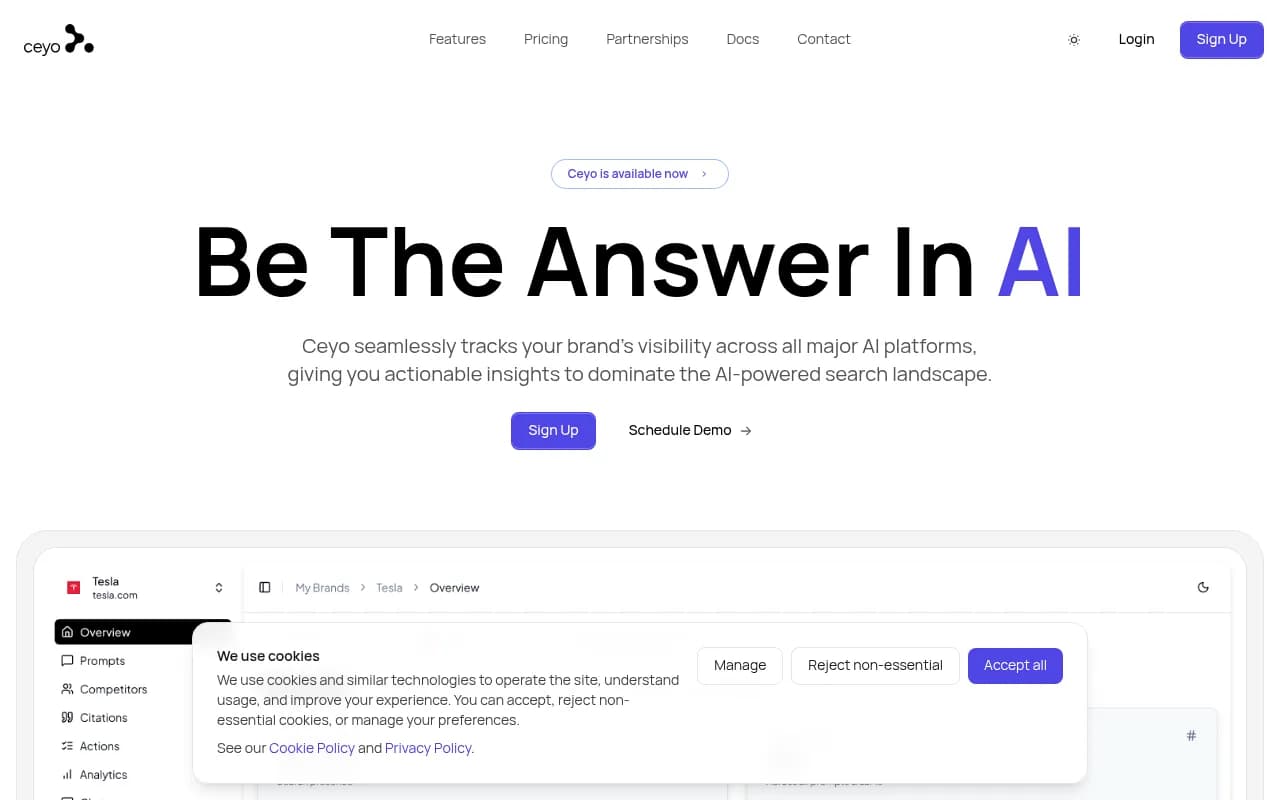
Ceyo AI launched as a dedicated brand monitoring tool for AI search. It tracks how your brand appears in responses from ChatGPT, Gemini, Claude, and Perplexity across thousands of prompts. The platform is built for marketing teams and agencies who want real-time alerts when their brand gets mentioned (or ignored) in LLM outputs. You get sentiment analysis, competitive positioning data, and visibility scores -- but no tools to actually fix what you find. It's a dashboard, not a workshop.
Orchly
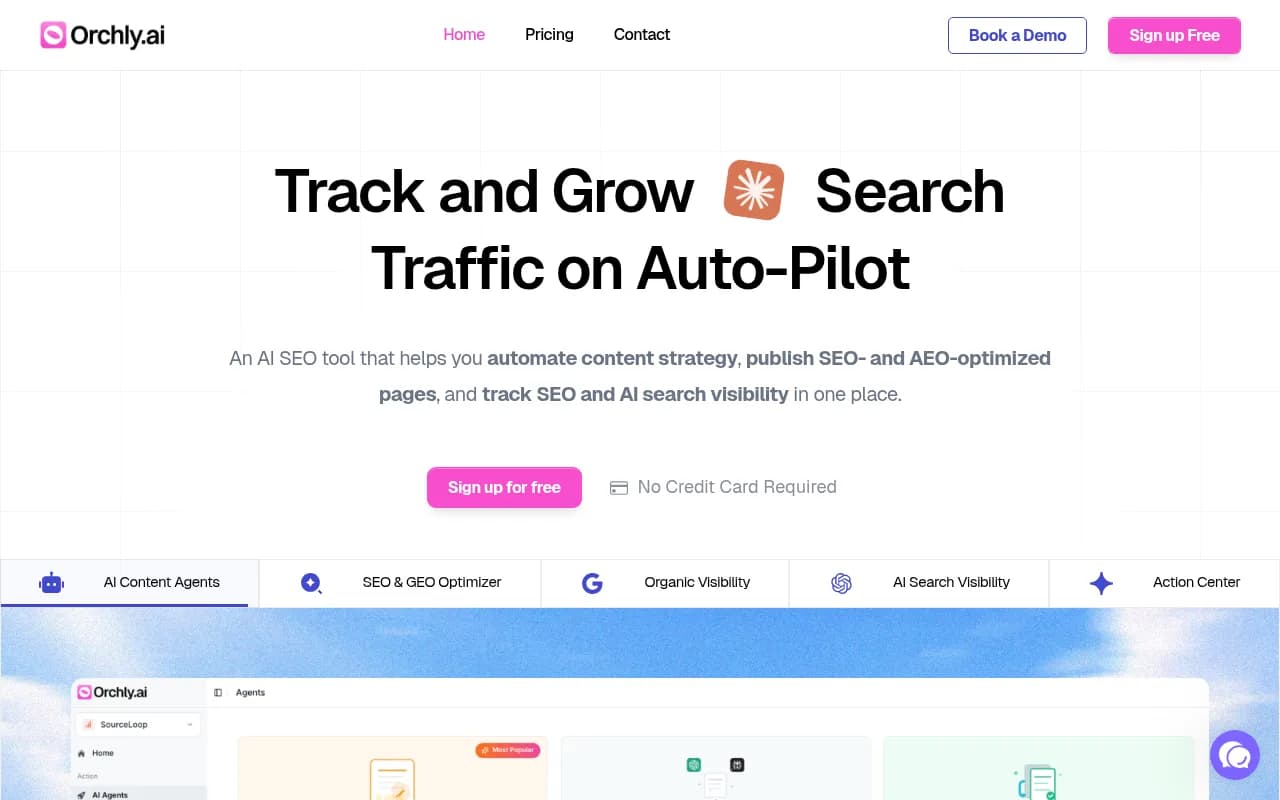
Orchly positions itself as an end-to-end content operations platform. It tracks visibility across Google, Google AI Overviews, ChatGPT, Claude, Perplexity, and Gemini -- then helps you do something about it. The platform includes AI content agents that write, refresh, and publish SEO- and AEO-optimized pages. It also has a built-in optimizer that analyzes 150+ ranking factors and automatically enriches content with structured data, links, and signals tuned for both Google and LLMs. The pitch: track visibility, identify gaps, create content, optimize, repeat.
Side-by-Side Comparison
| Feature | Ceyo AI | Orchly |
|---|---|---|
| AI platforms monitored | ChatGPT, Gemini, Claude, Perplexity (4) | ChatGPT, Gemini, Claude, Perplexity, Google AI Overviews (5+) |
| Google search tracking | No | Yes (organic rankings + AI Overviews) |
| Content creation tools | None | AI content agents (write, refresh, publish) |
| Content optimization | None | 150+ factor SEO/GEO optimizer |
| Sentiment analysis | Yes | Yes |
| Competitor benchmarking | Yes | Yes |
| Real-time alerts | Yes | Not specified |
| Prompt analytics | Yes (thousands of prompts) | Yes (action-oriented insights) |
| Free trial | Not specified | Yes (no credit card) |
| Starting price | $49/mo (Core) or $89/mo depending on source | $49/mo (Essential) |
| Annual discount | Available | 25% off |
| White-label reports | Not specified | Yes |
Platform coverage
Ceyo monitors 4 AI platforms: ChatGPT, Gemini, Claude, and Perplexity. That's the core set most brands care about, and Ceyo's interface is built around tracking brand mentions across these four. You can see which prompts trigger your brand, how often you're cited, and what sentiment the responses carry.
Orchly tracks those same 4 plus Google AI Overviews (the AI-generated summaries that appear at the top of Google search results). It also tracks traditional Google organic rankings, which matters if you're still optimizing for classic SEO alongside AI search. The dual focus -- Google + AI platforms -- makes Orchly a better fit if you're managing both channels.
Neither tool tracks Reddit discussions, YouTube citations, or crawler logs from AI bots hitting your site. If you need that level of citation intelligence, Promptwatch covers those angles.

Monitoring vs action
This is the core difference. Ceyo is a monitoring platform. You connect it, it tracks your brand mentions, you get alerts and reports. The value is knowing where you stand and how competitors compare. But when you spot a gap -- say, your brand isn't showing up for a high-value prompt -- Ceyo doesn't help you fix it. You take that insight back to your content team and figure it out manually.
Orchly is built around the action loop. It shows you the gaps (which prompts you're missing, which pages need work), then gives you tools to close them. The AI content agents can generate articles, listicles, and comparison pages grounded in SEO and GEO data. The optimizer analyzes your existing content and automatically adds structured data, internal links, external citations, and formatting that both Google and LLMs prefer. You're not just watching the scoreboard -- you're playing the game.
If your team already has a strong content workflow and you just need visibility data, Ceyo's simpler. If you're a small team or agency that needs to track and produce content at scale, Orchly's integrated approach saves a lot of manual work.
Prompt analytics and insights
Both platforms track thousands of prompts and show you which ones drive brand visibility. Ceyo's dashboard breaks down each prompt by visibility percentage, sentiment, average position, impact level, and which brands are mentioned. You can filter by category, geography, and relevance. The interface is clean and the data is actionable -- you can see at a glance which prompts are working and which aren't.
Orchly takes a similar approach but frames it around "actions you can take." Instead of just showing you a list of prompts, it highlights opportunities: which content you should create next, which pages to improve, which backlinks are worth building, which Reddit discussions are shaping AI visibility. The insights are packaged as a to-do list, not just a report.
Both are useful. Ceyo's approach is better if you want raw data to analyze yourself. Orchly's approach is better if you want the platform to tell you what to do next.
Content creation and optimization
Ceyo doesn't have content tools. It's purely a tracking and reporting platform. If you want to improve your AI visibility based on what Ceyo shows you, you'll need to use separate tools for content creation, SEO optimization, and publishing.
Orchly includes a full content stack:
- AI content agents: Write new articles, refresh existing pages, and publish on autopilot (with human review). The agents are trained on your brand data so the output doesn't sound like generic AI slop.
- SEO/GEO optimizer: Analyzes 150+ ranking factors and automatically enriches content with structured data, contextual links, NLP keywords, images, videos, and formatting. It's designed to make your content rank in both Google and LLMs.
- Auto-scheduling: Publish content on a schedule without manual intervention.
The content quality is the big question mark. Orchly claims its agents are "trained on your data" and avoid the "In this fast-paced digital world" clichés that plague most AI writing tools. But any AI content platform lives or dies on output quality, and that's hard to judge without using it. The human-in-the-loop workflow is a good sign -- you review before publishing, so you're not just spamming the web with robot text.
If you're already happy with your content workflow, Ceyo's lack of content tools isn't a problem. If you're drowning in content requests and need automation, Orchly's agents could be a lifesaver.
Competitor analysis
Both platforms let you benchmark against competitors. Ceyo shows which brands are mentioned alongside yours in LLM responses, how often they appear, and their sentiment scores. You can see who's winning for specific prompts and track changes over time.
Orchly offers similar competitor benchmarking but ties it into the action framework. It doesn't just show you that a competitor is outranking you -- it suggests what you can do about it (create this content, optimize that page, build these links).
The depth of competitor data looks similar between the two. The difference is presentation: Ceyo gives you the data, Orchly gives you the data plus recommendations.
Pricing comparison
| Plan | Ceyo AI | Orchly |
|---|---|---|
| Free trial | Not specified | Yes (no credit card required) |
| Entry plan | $49/mo (Core) or $89/mo depending on source | $49/mo (Essential) |
| Mid-tier | Not specified | $125/mo (Pro) |
| Enterprise | Not specified | Custom pricing |
| Annual discount | Available (amount not specified) | 25% off |
Ceyo's pricing is a bit unclear -- one source says $49/mo for the Core plan, another mentions $89/mo. The website doesn't publish a detailed pricing page, so you'll need to contact them for specifics. The Core plan likely covers basic monitoring for a single brand with a limited number of prompts.
Orchly's pricing is more transparent. The Essential plan at $49/mo includes AI visibility tracking, content agents, and the SEO/GEO optimizer. The Pro plan at $125/mo presumably adds more prompts, more content credits, and advanced features. Enterprise pricing is custom. The 25% annual discount is solid if you're committing long-term.
Both are in the same ballpark for entry-level pricing, but you're getting very different things. Ceyo's $49/mo is monitoring-only. Orchly's $49/mo includes monitoring plus content creation and optimization tools. If you need both, Orchly is the better value.
User interface and reporting
Ceyo's interface (based on the website screenshots) is polished and data-dense. The prompt analytics table shows visibility, sentiment, average position, impact, brands mentioned, category, and geography in a single view. It's designed for people who want to scan a lot of data quickly. The design is clean, modern, and agency-friendly.
Orchly's interface is more workflow-oriented. It has separate sections for visibility tracking, action center (what to do next), content agents, and the optimizer. The design is less about presenting raw data and more about guiding you through a process: track, identify gaps, create content, optimize, publish. It's a bit busier but makes sense if you're using the platform as a daily content ops tool.
Both offer white-label reporting (Orchly explicitly mentions it; Ceyo likely has it given their agency focus). If you're an agency presenting data to clients, both should work fine.
Integration and workflow
Neither platform's website details integrations extensively. Ceyo mentions real-time alerts, which suggests some kind of notification system (email, Slack, etc.). Orchly mentions auto-publishing, which implies CMS integrations (WordPress, Webflow, etc.), but specifics aren't listed.
If integrations are critical for your workflow, you'll need to ask both vendors directly. This is an area where more established platforms like Promptwatch have an edge -- they publish detailed API docs and integration guides.
Pros and cons
Ceyo AI pros
- Clean, focused interface built specifically for brand monitoring
- Tracks the 4 most important AI platforms (ChatGPT, Gemini, Claude, Perplexity)
- Real-time alerts keep you informed when brand mentions change
- Likely simpler to set up and use if you only need monitoring
- Agency-friendly with partner branding visible on the site
Ceyo AI cons
- No content creation or optimization tools -- you're on your own to fix what you find
- Doesn't track Google AI Overviews or traditional search rankings
- Pricing details are unclear and not published on the website
- No mention of crawler logs, Reddit tracking, or citation source analysis
- Limited to monitoring -- not a full GEO/AEO platform
Orchly pros
- End-to-end platform: tracks visibility, creates content, optimizes, and publishes
- Covers Google search + Google AI Overviews in addition to ChatGPT, Claude, Perplexity, Gemini
- AI content agents automate repetitive writing tasks with human review
- 150+ factor optimizer enriches content for both SEO and GEO
- Transparent pricing with a free trial and 25% annual discount
- Action-oriented insights tell you what to do next, not just what's happening
Orchly cons
- More complex platform with a steeper learning curve
- AI content quality is unproven -- depends on how well the agents are trained
- May be overkill if you only need basic visibility monitoring
- No mention of Reddit/YouTube tracking or crawler log analysis
- Newer platform with less brand recognition than competitors
Who should pick Ceyo AI
Ceyo makes sense if you:
- Only need monitoring and reporting, not content creation
- Have a dedicated content team that can act on the insights Ceyo provides
- Want a simple, focused tool that does one thing well
- Are an agency managing multiple client brands and need clean dashboards to present
- Don't care about Google search rankings -- you're focused purely on AI platform visibility
Ceyo is the right choice for teams that already have their content and SEO workflows dialed in. You're not looking for an all-in-one platform; you just want accurate, real-time data on how your brand shows up in AI responses.
Who should pick Orchly
Orchly makes sense if you:
- Need to track visibility and create content to improve it
- Are a small team or solo marketer who can't afford separate tools for monitoring, writing, and optimization
- Want to manage both Google search and AI search visibility in one platform
- Are drowning in content requests and need automation with human oversight
- Value actionable insights over raw data -- you want the platform to tell you what to do next
Orchly is the right choice for teams that need to move fast and don't have the resources to stitch together multiple tools. The integrated workflow -- track, create, optimize, publish -- saves time and keeps everything in one place.
Final verdict
Ceyo AI is a specialist monitoring tool. Orchly is a generalist content operations platform. Pick based on what you need.
If your team already produces great content and you just need eyes on how it's performing in AI search, Ceyo's focused approach is cleaner. If you're a lean team that needs to track visibility and produce optimized content at scale, Orchly's integrated workflow is more efficient.
The pricing is similar at the entry level, but you're buying different things. Ceyo's $49/mo gets you monitoring. Orchly's $49/mo gets you monitoring plus content agents and optimization tools. That's a meaningful difference if you're trying to do more with less.
One last note: both platforms are monitoring and content tools, but neither offers the deep citation intelligence that platforms like Promptwatch provide -- crawler logs, Reddit/YouTube tracking, prompt volume estimates, query fan-outs. If you're serious about understanding why you're visible (or invisible) in AI search, you'll want that layer too. But for the head-to-head between Ceyo and Orchly, the choice comes down to monitoring-only vs monitoring-plus-content.