Key Takeaways
- AccuRanker is primarily a rank tracker with AI monitoring bolted on (AccuLLM), while Orchly is built around content automation with visibility tracking as part of the workflow
- Pricing: Orchly starts at $49/mo (Essential) vs AccuRanker at $109/mo (1,000 keywords), making Orchly 55% cheaper at entry level
- AccuRanker tracks 4 AI platforms (ChatGPT, Perplexity, AI Overviews, AI Mode), Orchly tracks 5 (adds Claude)
- Orchly includes AI content agents that write and publish articles automatically -- AccuRanker has no content creation features
- AccuRanker is faster and more mature for traditional rank tracking with unlimited users/domains/API calls on all plans
- If you need a dedicated rank tracker that also monitors AI search, pick AccuRanker. If you want an end-to-end content workflow with visibility tracking built in, pick Orchly.
Overview
AccuRanker
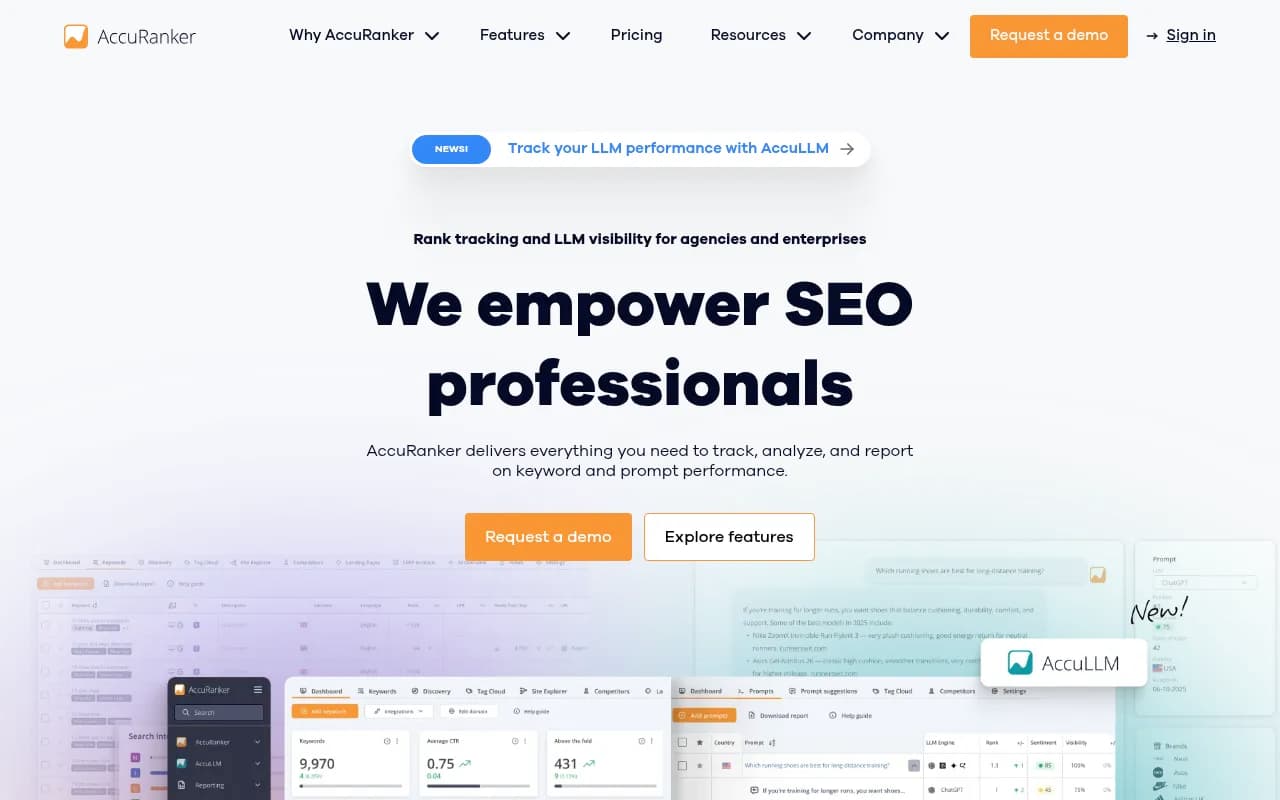
AccuRanker launched in 2013 as a speed-focused rank tracker for agencies and enterprises. It built its reputation on real-time keyword tracking with unlimited users, domains, and API calls. In 2024-2025, AccuRanker added AccuLLM to monitor brand presence across ChatGPT, Perplexity, Google AI Overviews, and AI Mode. The core product is still keyword rank tracking -- AI visibility is a newer add-on module.
Orchly
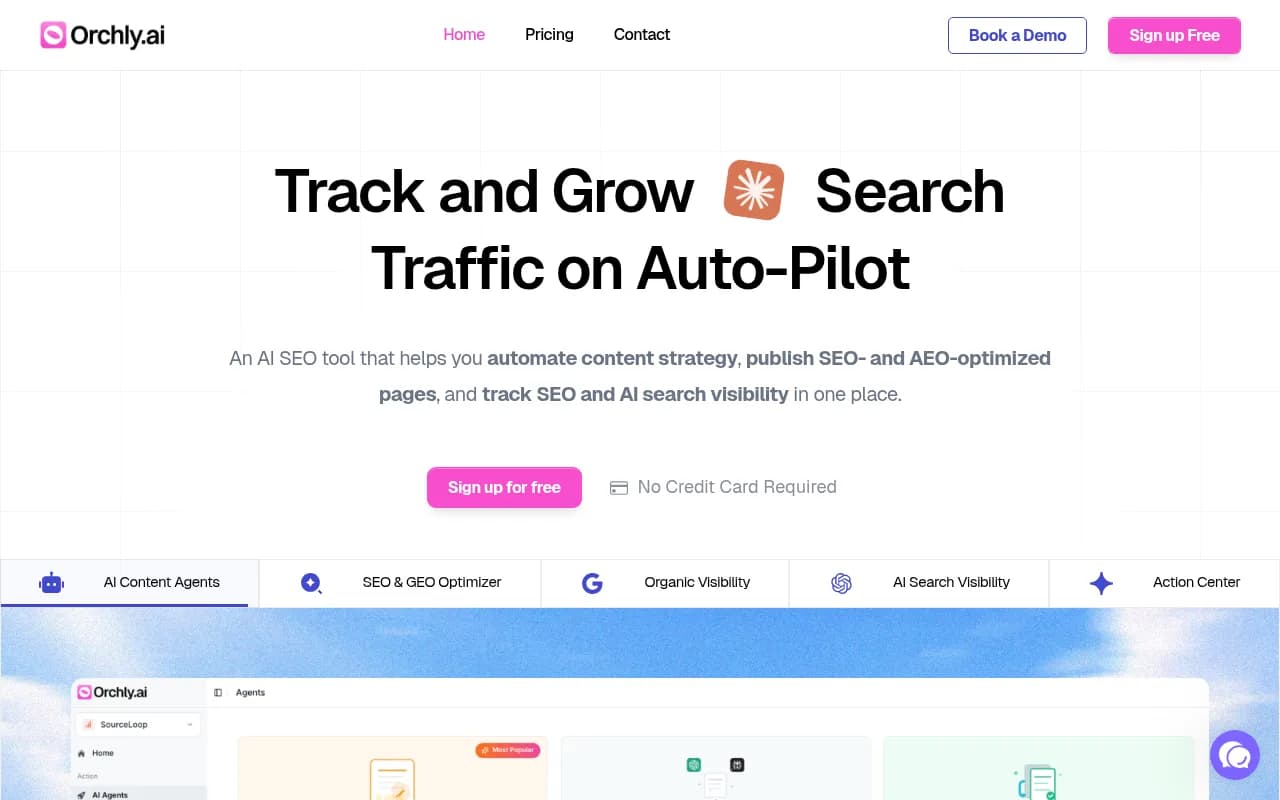
Orchly positions itself as an AI SEO automation platform that combines content creation, optimization, and visibility tracking in one workflow. It's newer to the market but designed around the idea that monitoring alone isn't enough -- you need to create and optimize content that ranks in both Google and AI search. Orchly tracks 5 AI platforms (ChatGPT, Claude, Perplexity, Gemini, Google) and includes AI agents that write, refresh, and publish content automatically.
Side-by-side comparison
| Feature | AccuRanker | Orchly |
|---|---|---|
| Starting price | $109/mo (1,000 keywords) | $49/mo (Essential) |
| Free trial | 14 days | Yes (freemium model) |
| AI platforms tracked | 4 (ChatGPT, Perplexity, AI Overviews, AI Mode) | 5 (ChatGPT, Claude, Perplexity, Gemini, Google) |
| Traditional rank tracking | Yes (core feature, real-time) | Yes (included) |
| Content creation | No | Yes (AI agents) |
| Content optimization | No | Yes (150+ factors, SEO + GEO) |
| Auto-publishing | No | Yes |
| Competitor benchmarking | Yes | Yes |
| API access | Unlimited on all plans | Not specified |
| Users/domains | Unlimited | Not specified |
| White-label reports | Yes | Yes |
| Reddit/YouTube tracking | Not mentioned | Not mentioned |
| Citation analysis | Yes (sources cited in AI responses) | Yes |
Traditional rank tracking
AccuRanker is known as one of the fastest rank trackers on the market. It updates keyword positions in real time and handles massive keyword volumes (up to 100,000+ on enterprise plans). The interface is clean and built for agencies managing multiple clients. You get unlimited users, domains, and API calls on every plan, which is rare -- most competitors charge per seat or limit API usage.
Orchly includes rank tracking but it's not the main focus. The platform is designed around content workflows, so rank tracking is there to show you what's working after you publish. It doesn't advertise real-time updates or massive keyword volumes the way AccuRanker does.
Verdict: If traditional keyword rank tracking is your primary need, AccuRanker wins. It's faster, more mature, and built for scale.
AI search visibility monitoring
AccuRanker's AccuLLM module tracks brand mentions across ChatGPT, Perplexity, Google AI Overviews, and AI Mode. You can monitor sentiment, see which sources are cited, and compare your visibility against competitors. It's a solid monitoring tool but doesn't help you fix gaps -- you see the data, then you're on your own to figure out what to do about it.
Orchly tracks 5 AI platforms (adds Claude to the mix) and positions visibility tracking as part of a larger workflow. The platform shows you where you're invisible, then suggests content to create or pages to optimize. It's not just a dashboard -- it's tied to action items and content agents that can actually generate the missing content.
Verdict: AccuRanker has deeper sentiment analysis and citation tracking. Orchly has broader platform coverage and connects monitoring to action. Pick AccuRanker if you want detailed AI search analytics. Pick Orchly if you want monitoring plus content creation in one tool.
Content creation and optimization
AccuRanker doesn't do content creation. It's a tracking and reporting tool. If you want to improve your rankings, you'll need to use a separate content tool or write manually.
Orchly's core differentiator is AI content agents that write, refresh, and publish articles automatically. The agents are trained on your data (not generic templates) and can handle structured content like listicles, comparisons, and how-to guides. The platform also optimizes content for both SEO and GEO with 150+ factors analyzed -- internal/external links, structured data, NLP keywords, schema markup, and signals tuned for LLMs.
Orchly can auto-schedule and publish content directly to your CMS, which means you can set up a content calendar and let the agents execute it. AccuRanker has no equivalent feature.
Verdict: Orchly wins by default -- AccuRanker doesn't play in this space at all. If content creation is part of your workflow, Orchly is the obvious choice.
Competitor analysis
Both platforms let you benchmark against competitors. AccuRanker shows competitor keyword rankings and AI visibility side by side. You can track how competitors perform in traditional search and AI search, then export the data for client reports.
Orchly also tracks competitor visibility in real time and highlights gaps -- prompts or keywords where competitors are visible but you're not. The difference is Orchly ties this directly to content suggestions. You see the gap, then the platform tells you what to create to close it.
Verdict: AccuRanker has more mature competitor tracking for traditional SEO. Orchly connects competitor gaps to actionable content ideas. Both are solid, different strengths.
Reporting and white-label features
AccuRanker is built for agencies. You get white-label reports, unlimited users, and the ability to manage multiple client domains without extra fees. The reporting interface is polished and designed for client-facing deliverables.
Orchly also offers white-label reports and audits, but the platform is less explicitly agency-focused. It's more about internal marketing teams automating their own workflows.
Verdict: AccuRanker is the better choice for agencies managing multiple clients. Orchly works for agencies but feels more like an in-house tool.
Pricing comparison
| Plan | AccuRanker | Orchly |
|---|---|---|
| Entry level | $109/mo (1,000 keywords) | $49/mo (Essential) |
| Mid-tier | $579/mo (10,000 keywords) | $125/mo (Pro) |
| High-tier | $1,929/mo (50,000 keywords) | Custom (Enterprise) |
| Annual discount | 10% | 25% |
| Free trial | 14 days | Yes (freemium) |
| Users/domains | Unlimited | Not specified |
| API calls | Unlimited | Not specified |
AccuRanker's pricing is based on keyword volume. You pay more as you track more keywords, but you get unlimited users, domains, and API access at every tier. This is great for agencies juggling multiple clients.
Orchly's pricing is much lower at the entry level ($49/mo vs $109/mo) and includes content creation features that AccuRanker doesn't have. The Pro plan at $125/mo is still cheaper than AccuRanker's base tier. Orchly doesn't publish keyword limits or user limits publicly, so you'll need to ask during the trial.
Verdict: Orchly is significantly cheaper if you're starting out or running a small operation. AccuRanker makes sense if you're tracking thousands of keywords across multiple clients and need unlimited API access.
Integration and workflow
AccuRanker integrates with Google Search Console, Google Analytics, and major SEO tools. The API is unlimited, so you can build custom workflows or pull data into your own dashboards. It's designed to fit into existing SEO stacks.
Orchly is more of an all-in-one platform. It connects to your CMS for auto-publishing, pulls data from Google Search Console, and handles content optimization internally. The workflow is more closed-loop -- you don't need as many external tools because Orchly does more on its own.
Verdict: AccuRanker is better if you already have a content and optimization stack and just need tracking. Orchly is better if you want one platform that handles tracking, content creation, and optimization together.
Pros and cons
AccuRanker pros
- Fastest rank tracker on the market with real-time updates
- Unlimited users, domains, and API calls on all plans
- Mature platform with 10+ years of development
- Strong agency features and white-label reporting
- AccuLLM adds AI search monitoring to a proven rank tracker
AccuRanker cons
- No content creation or optimization features
- AI monitoring (AccuLLM) is a newer add-on, not as deep as dedicated GEO platforms
- Higher starting price ($109/mo vs competitors)
- Tracks only 4 AI platforms (missing Claude, Gemini, others)
Orchly pros
- Much cheaper starting price ($49/mo)
- AI content agents that write, refresh, and publish automatically
- Tracks 5 AI platforms including Claude
- Combines visibility tracking with content creation in one workflow
- 150+ optimization factors for SEO and GEO
- Auto-scheduling and publishing to CMS
Orchly cons
- Newer platform, less mature than AccuRanker
- Rank tracking is not as fast or detailed as dedicated trackers
- Doesn't advertise unlimited users/domains/API like AccuRanker
- Less explicitly built for agencies managing multiple clients
Who should pick which tool
Pick AccuRanker if:
- You're an agency or enterprise tracking thousands of keywords across multiple clients
- Traditional rank tracking is your primary need and AI monitoring is secondary
- You already have a content creation and optimization stack
- You need unlimited users, domains, and API access
- You want a mature, fast, proven rank tracker with AI features added on top
Pick Orchly if:
- You're a marketing team that needs to create and optimize content, not just track it
- You want AI visibility monitoring plus content automation in one platform
- You're starting out or have a smaller budget ($49/mo vs $109/mo)
- You want AI agents to handle repetitive content tasks (writing, refreshing, publishing)
- You need to track Claude in addition to ChatGPT and Perplexity
- You want a closed-loop workflow where monitoring leads directly to content creation
Pick neither if:
- You need deep AI search optimization with crawler logs, prompt intelligence, and Reddit/YouTube tracking. Tools like Promptwatch are built specifically for that use case and go deeper than either AccuRanker or Orchly on the GEO side.

Final verdict
AccuRanker and Orchly solve different problems. AccuRanker is a rank tracker first -- fast, mature, built for agencies, with AI monitoring added as a module. Orchly is a content automation platform that includes visibility tracking as part of the workflow.
If you're tracking 10,000+ keywords for multiple clients and need real-time data with unlimited API access, AccuRanker is the obvious choice. It's more expensive but built for scale.
If you're a marketing team that needs to create content, optimize it for Google and AI search, and track the results in one place, Orchly makes more sense. It's cheaper, includes AI agents that write and publish automatically, and connects monitoring to action.
The real question is whether you need a tracker or a workflow platform. AccuRanker is the former, Orchly is the latter.