ContentMonk Review 2026
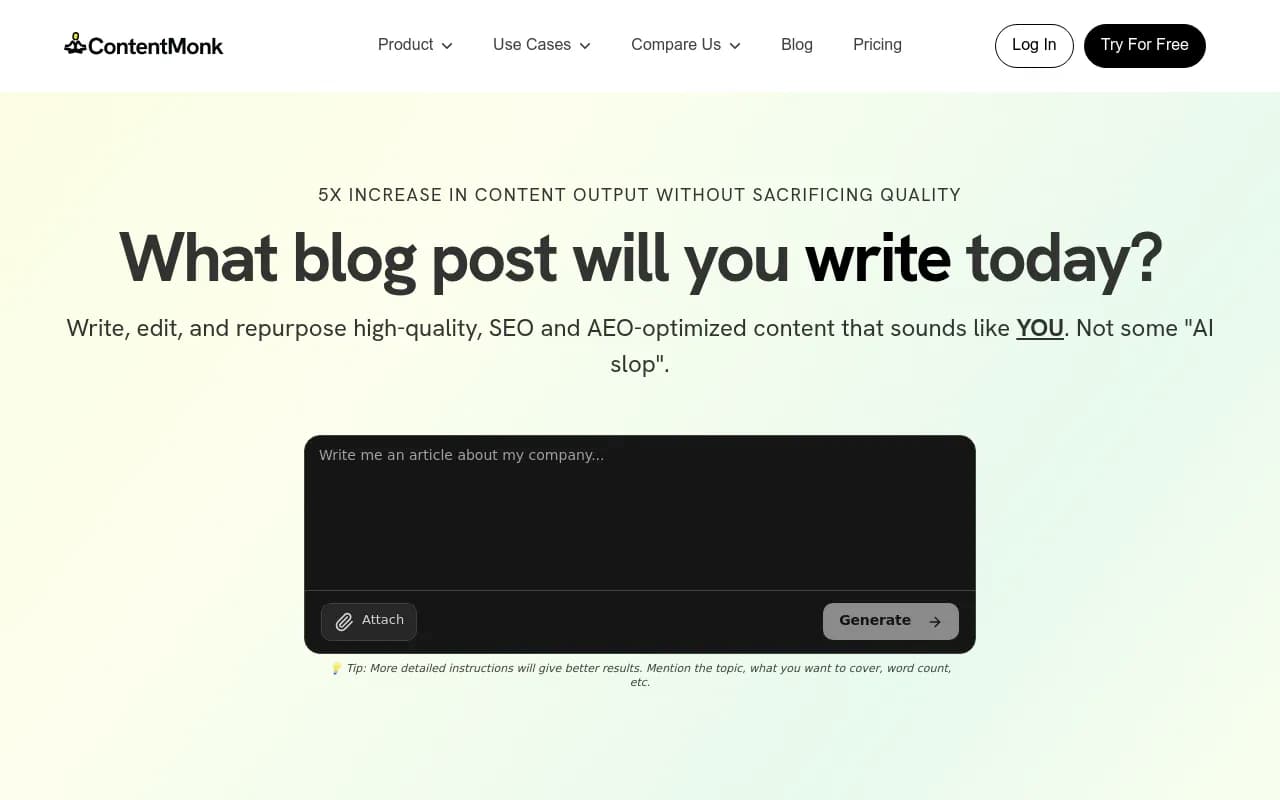
ContentMonk is an AI-powered content marketing platform that helps teams write SEO and AEO-optimized articles in minutes, repurpose content across formats, and manage entire content operations from one place. Built for marketers, agencies, and freelancers who want to scale content output 5x without
Summary
- Best for: Content teams, marketing agencies, and freelancers who need to scale article production while maintaining quality and brand voice -- particularly those managing 20+ articles per month
- Standout strength: Combines AI writing with knowledge base management and content operations tools in one platform, eliminating the need for multiple Google Sheets and Notion boards
- Key limitation: Newer player in a crowded AI content space -- lacks some advanced workflow automation features found in enterprise tools
- Pricing: Free 14-day trial, then from $9.90 per article or $59/month per seat with annual billing
ContentMonk positions itself as the answer to a specific problem: most AI content tools either produce generic "AI slop" or require hours of editing to sound human. The platform claims to eliminate both issues by learning your brand voice and producing near-publication-ready articles in under two minutes. It's used by companies like GetResponse, Userpilot, Pixis, and lemlist -- brands that have publicly credited ContentMonk with improving trial sign-up rates by 37% and contributing to ARR growth from $500k to $8m.
The company started as a content marketing agency before building software to solve their own workflow problems. That agency background shows in how the product is structured -- it's not just an AI writer, it's a full content operations platform.
Core Writing Engine
The main writing workflow starts with brief creation. You can build briefs manually or let ContentMonk auto-generate them based on SERP research, competitor gap analysis, and your internal knowledge base. The SERP research runs automatically -- it identifies what competitors are covering and flags gaps that Google or AI models would appreciate. This isn't just keyword stuffing; it's analyzing what questions users are asking that existing content doesn't answer.
Once you have a brief, the AI generates a full article in under two minutes. The key differentiator here is voice consistency. ContentMonk learns from your existing content and team inputs to match your specific writing style. Users consistently mention in testimonials that the output "sounds like them" rather than generic AI content. The platform supports both SEO and AEO (Answer Engine Optimization) -- meaning it optimizes for traditional search engines and AI models like ChatGPT, Claude, and Perplexity.
The editor includes AI power-ups that let you rewrite paragraphs, expand sections, or resolve team comments with AI suggestions. This is where the "15-30 minute editing" claim comes from -- you're not rewriting from scratch, just fine-tuning and adding images.
Content Repurposing
ContentMonk's repurposing feature is particularly strong for teams sitting on transcripts, recordings, or long-form content. You can upload customer call transcripts and turn them into case studies, success stories, or LinkedIn posts in two clicks. One user (Hunch's Head of Marketing) mentioned repurposing client calls into 50+ success stories for GTM campaigns.
The platform also handles ebook-to-article conversions, webinar-to-blog transformations, and article-to-social-post workflows. This is useful for agencies managing multiple clients or brands with limited content resources.
Knowledge Base & Insights Collection
This is where ContentMonk separates itself from pure AI writing tools. The platform includes a centralized knowledge base where you upload company documents, product info, customer research, and team insights. The AI pulls from this knowledge base when generating content, which is how it avoids generic output.
The system claims to capture "up to 95% of your team's unique insights" -- a bold claim, but the idea is that instead of insights living in scattered Slack threads or Google Docs, they're stored in one searchable location that feeds directly into content creation. For teams where subject matter expertise is the competitive advantage, this is valuable.
Content Operations Management
ContentMonk includes content calendar planning, task assignment, collaboration tools, and progress tracking. The goal is to replace the "10+ Google Sheets and Notion docs" that most content teams use to manage workflows. You can create content dashboards, assign articles to writers, track status, and manage approvals without leaving the platform.
For agencies, the multi-workspace feature lets you manage multiple clients from one account, each with separate knowledge bases and brand voices.
Who Is It For
ContentMonk is built for three main personas:
Content teams at SaaS companies or B2B brands producing 20-50+ articles per month. These are teams where speed matters but quality can't slip -- think growth-stage startups with 2-5 person marketing teams who need to compete with larger competitors' content output. The GetResponse and Userpilot testimonials fit this profile.
Marketing agencies managing multiple clients. The multi-workspace setup and repurposing features are designed for agencies juggling 5-15 clients who all need consistent content. The ability to maintain separate brand voices per workspace is key here.
Freelance content marketers or solo consultants who need to scale output without hiring. The $59/month per seat pricing makes sense for freelancers billing $2k-5k per client per month who can now handle 3-4x more clients.
This is NOT for: Enterprise content teams needing complex approval workflows, compliance review, or integration with legacy CMS systems. It's also not for bloggers or small businesses producing 2-3 articles per month -- the pricing and feature set are overkill.
Integrations & Ecosystem
ContentMonk's integration story is thin compared to competitors. There's no mention of direct integrations with WordPress, HubSpot, Webflow, or other CMS platforms. No Zapier integration listed. No API documentation publicly available. This is a notable gap -- you're exporting content manually and pasting into your CMS.
The platform does support document uploads (PDFs, Google Docs, transcripts) and has a browser-based editor, but the lack of publishing integrations means an extra manual step in your workflow.
Pricing & Value
ContentMonk offers two pricing models:
Per-article pricing: $9.90 per article. This makes sense if you're producing 5-10 articles per month and want predictable costs.
Seat-based pricing: $59/month per user with annual billing ($69/month monthly). The Pro plan includes 14-day free trial with no credit card required.
For context, if you're producing 10 articles per month, the per-article model costs $99/month. The seat-based model at $59/month makes more sense if you're producing 15+ articles. The pricing page mentions that costs depend on article volume, user count, and workspace count, suggesting custom pricing for agencies.
Compared to competitors: Jasper charges $49-125/month for similar features. Copy.ai is $49/month. Writesonic is $19-99/month. ContentMonk sits in the middle but includes content operations tools that others don't.
The value proposition is strongest for teams currently paying freelance writers $200-500 per article. If you're producing 20 articles per month at $300 each ($6,000/month), switching to ContentMonk at $59/month per seat (even with 3 seats = $177/month) plus editing time is a massive cost reduction.
Strengths
- Voice consistency: Multiple users mention the output sounds like their brand, not generic AI. This is the hardest problem in AI content and ContentMonk seems to have cracked it better than most.
- Knowledge base integration: The ability to feed company-specific insights into every article is a genuine differentiator. Most AI tools just scrape the web.
- Content operations in one place: Combining writing, repurposing, planning, and collaboration eliminates tool sprawl. This is valuable for small teams.
- Repurposing speed: Turning transcripts into case studies or articles into LinkedIn posts in 2 clicks is legitimately fast.
- AEO optimization: Optimizing for AI search engines (ChatGPT, Perplexity, Claude) in addition to Google is forward-thinking. Most competitors are still SEO-only.
Limitations
- No CMS integrations: You can't publish directly to WordPress, HubSpot, or Webflow. This adds a manual step that competitors like Jasper and Copy.ai have solved.
- Limited workflow automation: No Zapier integration, no API access (publicly), no advanced approval workflows. Enterprise teams will hit walls.
- Newer platform: Launched recently compared to Jasper (2021) or Copy.ai (2020). Fewer case studies, smaller user base, less community content.
- Pricing transparency: The "depends on multiple factors" messaging on pricing is frustrating. Just show the tiers upfront.
Bottom Line
ContentMonk is best for content teams at growth-stage B2B companies or agencies who need to scale article production from 10-15 per month to 30-50+ without hiring more writers. The combination of AI writing, knowledge base management, and content operations tools in one platform eliminates the need for 3-4 separate tools. The voice consistency and AEO optimization are real differentiators.
Skip it if you need deep CMS integrations, complex approval workflows, or are only producing a handful of articles per month. The sweet spot is teams producing 20+ articles monthly who are currently drowning in Google Sheets and struggling to maintain quality at scale.
Best use case in one sentence: Content teams at SaaS companies who need to 3-5x their article output while maintaining brand voice and optimizing for both Google and AI search engines.
Tags:
Frequently asked questions
What is ContentMonk and what does it do?
How much does ContentMonk cost?
Is ContentMonk free to use?
Who is ContentMonk best for?
What makes ContentMonk different from other AI writing tools?
Can ContentMonk repurpose content into different formats?
How fast can ContentMonk generate articles?
Does ContentMonk help with SEO optimization?
What companies use ContentMonk?
Similar and alternative tools to ContentMonk