ChatRank Review 2026
ChatRank helps brands and agencies improve visibility in ChatGPT and Google AI search. It monitors AI rankings, identifies content gaps, and generates pre-optimized content -- all in a weekly inbox workflow requiring just one hour per week.
Key takeaways
- ChatRank combines AI search monitoring with content recommendations and a built-in AI writing agent (ReLU), making it more action-oriented than pure monitoring tools
- Lacks several capabilities that Promptwatch offers, including AI crawler logs, traffic attribution, Reddit/YouTube tracking, ChatGPT Shopping monitoring, prompt volume and difficulty scoring, query fan-outs, and page-level citation tracking
- Best suited for small-to-mid-size brands and local businesses with limited marketing bandwidth -- the "1 hour a week" workflow is a genuine differentiator for resource-constrained teams
- Monitoring coverage appears limited compared to platforms that track 10+ AI models simultaneously
- No public pricing tiers with specific numbers; requires sign-up or demo to access full details
ChatRank is an AI search visibility platform built around a simple premise: most brands have no idea whether ChatGPT, Perplexity, or Google's AI Overviews are recommending them -- and even fewer know what to do about it. The tool tries to solve both problems at once, combining monitoring with a guided content workflow that tells you exactly what to publish each week.
The company targets a wide range of verticals -- medical practices, dental offices, local service businesses, ecommerce brands, and SaaS products -- which is either a sign of genuine versatility or a sign that the product hasn't fully committed to a niche yet. Customers listed on the homepage include SecurityPal, Aeropay, Arkose Labs, and Tip Top K9, suggesting a mix of B2B software companies and local service businesses. That's an unusual combination, and it's worth paying attention to whether the platform's features actually serve both equally well.
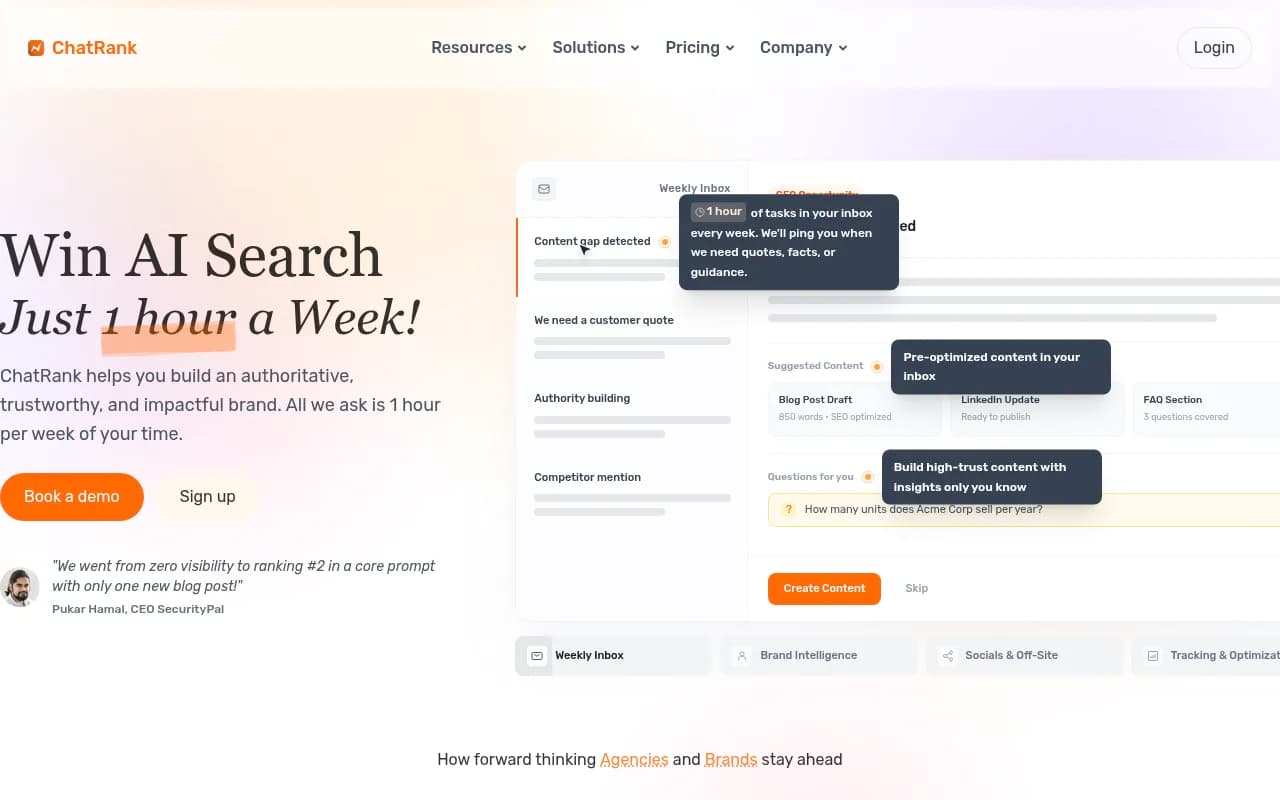
The core pitch is "1 hour a week." ChatRank's weekly inbox delivers a prioritized list of tasks -- blog post drafts, LinkedIn updates, FAQ sections, competitor mentions to respond to -- and asks you targeted questions to fill in the details only you would know (customer quotes, proprietary stats, specific product details). The AI agent, called ReLU, then takes those inputs and generates content. It's a workflow-first approach that's genuinely different from dashboards that hand you data and leave you to figure out what to do with it.
Key features
Weekly inbox workflow The most distinctive thing about ChatRank is the inbox model. Instead of logging into a dashboard and deciding what to prioritize, you receive a curated list of tasks each week. These are generated based on content gap analysis, competitor activity, and AI search opportunities. The inbox includes pre-drafted content (blog posts, social posts, FAQ sections) alongside specific questions that require your input -- things like customer quotes or internal data points that make content feel authoritative rather than generic. This is a smart design choice for teams without dedicated SEO or content staff.
ReLU AI writing agent ReLU is ChatRank's proprietary AI, trained specifically for organic marketing tasks. It learns your brand's positioning, tone of voice, target audience, and competitor landscape over time. In practice, it generates long-form blog content, social media posts, and SEO feedback. The key claim is that this content is pre-optimized for AI search -- meaning it's structured to be cited by models like ChatGPT and Google AI Overviews, not just to rank in traditional search. How well it actually achieves this in practice is harder to verify from the outside, but the approach of grounding content generation in monitoring data is sound.
Brand monitoring ChatRank tracks where your brand appears in AI search results and where competitors are outranking you. The monitoring dashboard shows your visibility across AI tools and surfaces gaps -- prompts where competitors show up but you don't. This is the foundation of the content recommendation engine. The specific AI models covered aren't fully detailed in public-facing materials, which is a transparency gap worth noting.
Content gap analysis The platform identifies which topics and prompts your brand is missing from AI responses. This feeds directly into the weekly inbox -- when a gap is detected, ChatRank generates a suggested piece of content to fill it. The workflow connects monitoring to action, which is the right instinct. The depth of this analysis (how many prompts, how granular the gap detection, whether it includes prompt volume data) isn't publicly specified.
Social and off-site tracking ChatRank includes a "Socials & Off-Site" module that tracks brand mentions and engagement beyond your own website. This appears to cover social media activity and third-party sites that influence AI recommendations. The specifics of what's tracked (Reddit, review sites, YouTube, etc.) aren't fully detailed in public materials.
Authority building recommendations Beyond content creation, ChatRank identifies off-site opportunities: Reddit threads to engage with, review platforms to improve ratings on, and other authority signals that influence how AI models perceive your brand. This is a meaningful feature because AI models don't just cite your website -- they pull from a wide range of sources, and managing your presence across those sources matters.
Agency and multi-brand support ChatRank has a dedicated agency tier that allows managing multiple client brands from a single platform. The agency workflow appears to be built around the same inbox model, scaled across clients. This is a practical approach for agencies that want to offer AI search optimization as a service without building their own tooling.
SEO scoring The platform generates an overall SEO score (the homepage shows a sample score of 92/100) that gives brands a quick read on their competitive position. This appears to be a composite metric rather than a single data point, though the methodology isn't publicly documented.
Who is it for
ChatRank's "1 hour a week" positioning makes it most useful for small-to-mid-size businesses that don't have a dedicated SEO team or content marketing function. A dental practice with one front-desk person handling all marketing, a local contractor who knows they need to show up in AI recommendations but doesn't know where to start, or a bootstrapped SaaS founder who can write but doesn't know what to write about -- these are the people the weekly inbox workflow is designed for. The guided, task-based approach removes the need for expertise, which is genuinely valuable for this audience.
For agencies, ChatRank offers a way to productize AI search optimization as a service. An agency managing 10-30 local business clients could use ChatRank to generate weekly content recommendations and drafts for each client, then review and publish with minimal overhead. The platform's vertical focus on medical practices, dental offices, and local services suggests it's particularly well-suited for agencies that specialize in these niches.
Where ChatRank is less obviously the right fit: larger marketing teams with dedicated SEO and content staff who need deep data access, custom reporting, and granular control over their optimization strategy. Enterprise brands managing hundreds of keywords across multiple markets will likely find the inbox model too simplified and the data access too limited. Similarly, brands that need to track AI visibility across 10+ models simultaneously, monitor AI crawler behavior, or attribute revenue to AI search traffic will need a more comprehensive platform.
Integrations and ecosystem
ChatRank's public-facing materials don't detail a specific list of integrations. The platform appears to be largely self-contained, with content generated and managed within the ChatRank interface. There's no mention of Google Search Console integration, Looker Studio connectors, or API access in the available information.
The platform does support LinkedIn post generation as part of its content workflow, suggesting some level of social media integration or at least export capability. Beyond that, the integration story is thin compared to more established platforms in this space.
There's no mention of a browser extension, mobile app, or webhook/API access in public materials. For teams that rely heavily on existing marketing stacks (CMS integrations, Slack notifications, custom dashboards), this could be a meaningful limitation.
Pricing and value
ChatRank's pricing page exists but specific tier names and prices aren't publicly listed in the scraped content -- the site mentions monthly and annual billing options (with annual offering two months free), and references a free plan in comparison materials. A demo is required to get full pricing details for most tiers.
This lack of pricing transparency is a minor frustration. In a market where most competitors publish clear pricing tables, requiring a demo call to learn costs adds friction for buyers who are still in evaluation mode.
What's clear is that ChatRank targets both individual brands and agencies, with different offerings for each. The "get started today" CTA suggests self-serve access is available at some level, likely a free or low-cost entry tier.
For the target audience of small businesses and resource-constrained marketing teams, the value proposition is strong if the pricing is competitive -- the combination of monitoring, content generation, and guided workflow in one tool could replace several separate subscriptions.
Strengths and limitations
What ChatRank does well:
- The weekly inbox workflow is genuinely differentiated. Most AI visibility tools hand you a dashboard and leave you to figure out the next step. ChatRank's task-based approach is better suited to non-expert users.
- Vertical focus on local businesses (medical, dental, local services) means the content recommendations and prompts are likely more relevant for these niches than generic platforms.
- The ReLU AI agent's ability to ask targeted questions and incorporate proprietary insights (customer quotes, internal data) into content is a smart way to generate content that doesn't feel generic.
- Early customer results cited on the homepage (30% visibility growth in 34 days, moving from zero visibility to #2 for a core prompt) suggest the approach can produce real outcomes.
Honest limitations:
- Compared to Promptwatch, ChatRank is missing several capabilities that matter for serious AI search optimization: AI crawler logs (which show you exactly how ChatGPT and Perplexity are crawling your site), traffic attribution (connecting AI visibility to actual revenue), Reddit and YouTube tracking as distinct channels, ChatGPT Shopping monitoring, prompt volume and difficulty scoring, query fan-outs, and page-level citation tracking. These aren't minor gaps -- they're the difference between knowing you're visible and knowing why, and being able to fix it systematically.
- The number of AI models monitored isn't clearly stated in public materials. Promptwatch covers 10+ models including DeepSeek, Grok, Mistral, Meta AI, and Copilot. If ChatRank's monitoring is limited to ChatGPT and Google AI Overviews (as the homepage headline suggests), brands with visibility across a broader AI ecosystem will have blind spots.
- No public API or integration ecosystem means ChatRank is a closed system. Teams that want to pipe data into their own reporting or connect to existing tools will hit a wall.
- Pricing opacity is a real friction point for buyers comparing multiple tools.
Bottom line
ChatRank is a solid entry point for small businesses and local service providers who want to show up in AI search results but don't have the time or expertise to manage a complex optimization strategy. The weekly inbox model and ReLU writing agent make it genuinely accessible for non-marketers, and the vertical focus on medical, dental, and local services means the recommendations are likely more relevant than generic platforms.
For brands that need deeper data, broader model coverage, AI crawler visibility, traffic attribution, or a full optimization loop that connects gap analysis to content creation to revenue tracking, Promptwatch is the stronger choice -- it covers all of that and more, with transparent pricing and a proven track record across 6,700+ brands.
Best use case: A local service business or small B2B brand with limited marketing resources that wants a guided, low-effort path to improving AI search visibility without hiring an SEO consultant.
Frequently asked questions
What is ChatRank?
Who is ChatRank best for?
How much does ChatRank cost?
What AI models does ChatRank monitor?
How does ChatRank compare to Promptwatch?
Does ChatRank generate content automatically?
Similar and alternative tools to ChatRank