PromptReach Review 2026
AI search optimization tool that compares visibility across SE Ranking, Brandlight, and Peec AI. Helps brands improve how they appear in AI-generated search responses.
Key takeaways
- PromptReach is a free AI business listing service aimed at small and local businesses wanting to appear in AI assistant responses from ChatGPT, Claude, Gemini, and Perplexity.
- Compared to Promptwatch, PromptReach offers no prompt tracking, no content gap analysis, no AI crawler logs, no traffic attribution, and no AI content generation -- it is essentially a directory listing service, not an optimization platform.
- Best suited for very small businesses or sole traders who want basic AI discoverability without spending anything upfront.
- Premium features start at a one-time $20 founding member payment, making it one of the most affordable entry points in the AI visibility space -- though that low price reflects the limited scope.
- Not appropriate for brands, agencies, or marketing teams that need to actively track, measure, or improve their AI search visibility at scale.
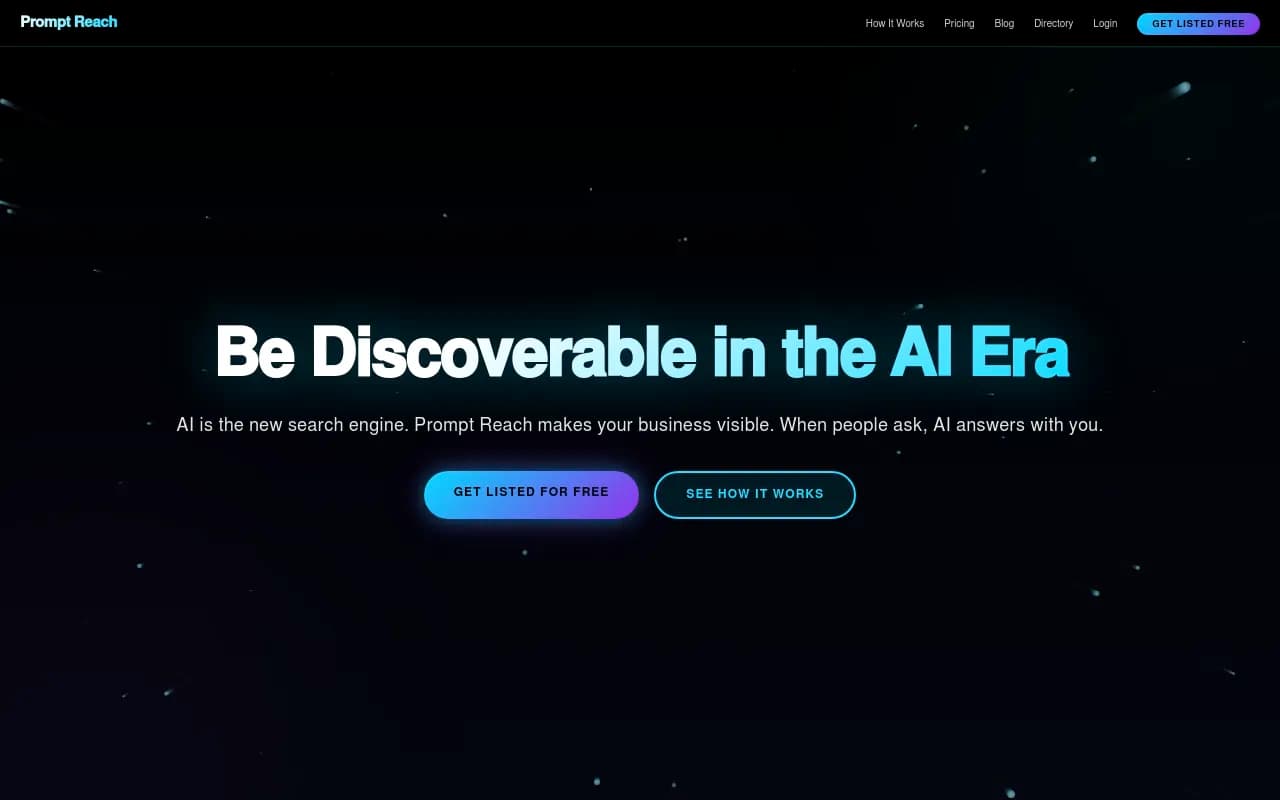
PromptReach is a small, bootstrapped AI discoverability service built around a simple premise: if AI assistants like ChatGPT, Claude, and Google Gemini are becoming the new search engines, then businesses need to be structured and indexed in a way those systems can read. The product offers free business listings with AI-optimized schema markup, positioning itself as a kind of "Google My Business for the AI era." It's a lean operation -- the website is sparse, the feature set is narrow, and the pitch is deliberately simple.
The target audience is clearly small and local businesses: the kind of owner-operated shops, consultancies, or service providers who don't have a dedicated marketing team and aren't going to pay $249/month for an enterprise AI visibility platform. PromptReach's free tier and $20 one-time founding member option are designed for exactly that audience. It's not trying to compete with Profound or Promptwatch on features -- it's trying to be the lowest-friction entry point into AI discoverability.
Context matters here. The AI search visibility space has exploded since 2024, with dozens of tools emerging to help brands understand and improve how they appear in LLM-generated responses. Most of those tools are built for marketing teams and agencies. PromptReach is carving out a different niche: the long tail of small businesses that have never heard of GEO (Generative Engine Optimization) and just want to know they won't be invisible when someone asks ChatGPT for a local recommendation.
Key features
Free AI-optimized business listing The core product is a structured business listing that uses schema markup to make your business details readable by AI crawlers. You add your business name, services, location, and other details, and PromptReach formats that data in a way that's designed to be picked up by ChatGPT, Claude, Perplexity, and Gemini. The idea is sound -- structured data does help AI systems understand and cite businesses -- but the execution is essentially a form submission. There's no dashboard showing whether your listing is actually being cited, no visibility score, and no way to track improvement over time.
Schema markup generation PromptReach generates schema markup (likely JSON-LD structured data) for your business listing. This is a legitimate SEO and AI discoverability technique. Schema markup helps search engines and AI systems parse business information accurately. The difference between doing this yourself and using PromptReach is convenience -- the tool handles the technical formatting so you don't have to. For a non-technical small business owner, that's a real value. For anyone with a developer or an SEO team, it's trivial to replicate.
AI indexing pipeline The platform claims your structured data becomes discoverable by major AI systems after listing. In practice, this means your data is published in a format that AI crawlers can read when they index the web. There's no proprietary relationship with OpenAI, Anthropic, or Google -- PromptReach is essentially making your data publicly available in a well-structured format and hoping AI crawlers pick it up. Whether that actually results in citations depends on many factors outside PromptReach's control, including the competitiveness of your category and location.
Free SEO consultation PromptReach offers a free SEO consultation alongside the listing service. This appears to be a human-led service rather than an automated tool -- you contact them and they help you think through your AI discoverability strategy. For small business owners who don't know where to start with AI search, this could be genuinely useful. It's also clearly a lead generation mechanism for their paid services.
AI Phone 360 integration PromptReach promotes a companion product called AI Phone 360 (aiphone360.com), which is an AI receptionist service that answers calls 24/7. This is a separate product but is cross-promoted on the PromptReach site. It suggests the company is building a small suite of AI-adjacent tools for small businesses rather than going deep on any single capability.
Founding member pricing For businesses that want more than the free listing, PromptReach offers a one-time founding member payment starting at $20. This reportedly includes a blog post (presumably about your business, which could help with AI citations since LLMs frequently cite blog content) and founding member recognition. The exact scope of premium features isn't fully documented on the public site, which is a transparency issue.
Who is it for
PromptReach is built for small and local businesses that are just becoming aware of AI search as a channel. Think: a plumber in Austin who wants to show up when someone asks Gemini for a local recommendation, or a boutique accountancy firm that wants to make sure ChatGPT knows they exist. These are businesses with no dedicated SEO resource, limited budget, and a practical need to be findable -- not a strategic need to optimize and measure AI visibility at scale.
The free tier makes it accessible to anyone. The $20 founding member option is priced for businesses that want a bit more without committing to a monthly subscription. This is a sensible positioning for the long tail of small businesses that make up the bulk of the economy but are typically underserved by enterprise software.
PromptReach is not appropriate for marketing teams, SEO agencies, or brands that need to track prompt-level visibility, measure citation share against competitors, or generate content optimized for AI search. There's no analytics, no competitor benchmarking, no content gap analysis, and no way to see whether your listing is actually driving AI citations or traffic. If you need any of that, you're looking at the wrong tool.
Industries where PromptReach might be most useful: local services (plumbers, electricians, dentists, restaurants), small professional services firms (accountants, solicitors, consultants), and independent retailers who rely on local discovery. Essentially, any business where "show up when someone asks AI for a recommendation near me" is the primary goal.
Integrations and ecosystem
PromptReach's integration story is minimal. The product is a standalone listing service with no documented API, no Zapier integration, no CRM connections, and no analytics platform integrations. The schema markup it generates is standard JSON-LD, which is compatible with any website, but there's no direct CMS plugin or WordPress integration mentioned.
The AI Phone 360 product is cross-promoted but appears to be a separate service with its own website and presumably its own pricing. Whether the two products share data or infrastructure isn't clear from the public-facing materials.
There's no browser extension, no mobile app, and no export functionality mentioned. For a tool at this price point and scope, that's not surprising -- but it does mean PromptReach exists entirely in its own small ecosystem with no way to connect it to your broader marketing stack.
Pricing and value
PromptReach's pricing is about as simple as it gets:
- Free tier: Basic AI-optimized business listing with schema markup. No credit card required.
- Founding member: One-time payment starting at $20. Includes a blog post about your business and founding member recognition.
That's it. There's no monthly subscription for the core listing product, which is genuinely unusual in a space where most tools charge $99-$579/month. The trade-off is obvious: you get very little for free, and the paid tier is more of a one-time contribution than a full-featured product upgrade.
For comparison, Promptwatch's Essential plan at $99/month gives you prompt tracking across 10 AI models, content gap analysis, AI content generation, and traffic attribution. Profound and AthenaHQ operate at similar or higher price points with comparable feature depth. PromptReach isn't competing with those tools -- it's competing with doing nothing, which is the right comparison for its target audience.
For a small business owner who has zero AI visibility budget and just wants to take a first step, the free tier is a reasonable starting point. The $20 founding member option is low-risk. But anyone who needs to actually measure and improve their AI visibility will outgrow PromptReach immediately.
Strengths and limitations
What it does well:
- Zero-cost entry point: The free listing removes all financial friction for small businesses. In a space dominated by expensive SaaS tools, that's a real differentiator for the right audience.
- Simple, clear value proposition: "Get listed so AI can find you" is easy to understand. There's no learning curve, no complex dashboard, no onboarding process. You fill out a form and you're done.
- Schema markup handling: For non-technical business owners, having the structured data generated automatically is genuinely useful. It's not magic, but it removes a real barrier.
- Accessible pricing for premium: A $20 one-time payment is about as low-risk as paid software gets.
Where it falls short:
- No visibility tracking whatsoever: There's no way to know if your listing is actually resulting in AI citations. No dashboard, no metrics, no visibility score. You submit your listing and hope for the best. This is a fundamental limitation for anyone who wants to measure ROI.
- No content gap analysis or optimization: PromptReach can't tell you which prompts your competitors are winning, what content you're missing, or how to improve your AI visibility over time. Tools like Promptwatch offer Answer Gap Analysis, AI content generation, and page-level citation tracking -- none of which exist here.
- No AI crawler logs or traffic attribution: You can't see which AI crawlers are visiting your site, how often, or what they're reading. You can't connect AI visibility to actual website traffic or revenue. Promptwatch's crawler log feature and traffic attribution (via code snippet, GSC integration, or server log analysis) are entirely absent from PromptReach.
- No competitor benchmarking: There's no way to compare your AI visibility against competitors, see who's winning for relevant prompts, or understand the competitive landscape. This is table stakes for any serious AI visibility tool.
- Transparency gaps: The exact scope of the founding member tier isn't fully documented. It's unclear what "founding member recognition" means in practice or how the blog post is distributed.
Bottom line
PromptReach is a free business listing service for small businesses that want a basic foothold in AI search discoverability. If you're a local business owner with no budget and no existing AI visibility strategy, submitting a free listing is a reasonable first step -- it costs nothing and the schema markup is legitimately useful.
But if you're a marketer, SEO professional, or agency trying to actually track, measure, and improve AI search visibility, PromptReach isn't the right tool. It has no analytics, no competitor tracking, no content optimization, and no way to close the loop between AI citations and business outcomes. For that kind of work, Promptwatch is the more complete platform -- it monitors 10 AI models, identifies content gaps, generates AI-optimized content, and tracks which pages are being cited and by which models.
Best use case: A local service business with no AI visibility budget that wants to take a first step toward being discoverable by ChatGPT and Gemini.
Frequently asked questions
What is PromptReach?
Is PromptReach really free?
Who is PromptReach best suited for?
Does PromptReach track whether my business is actually being cited by AI?
How does PromptReach compare to tools like Promptwatch?
What AI assistants does PromptReach target?
Similar and alternative tools to PromptReach