Nozzle Review 2026
SERP tracking and monitoring tool expanding to cover AI search visibility and brand presence in LLM responses.
Summary
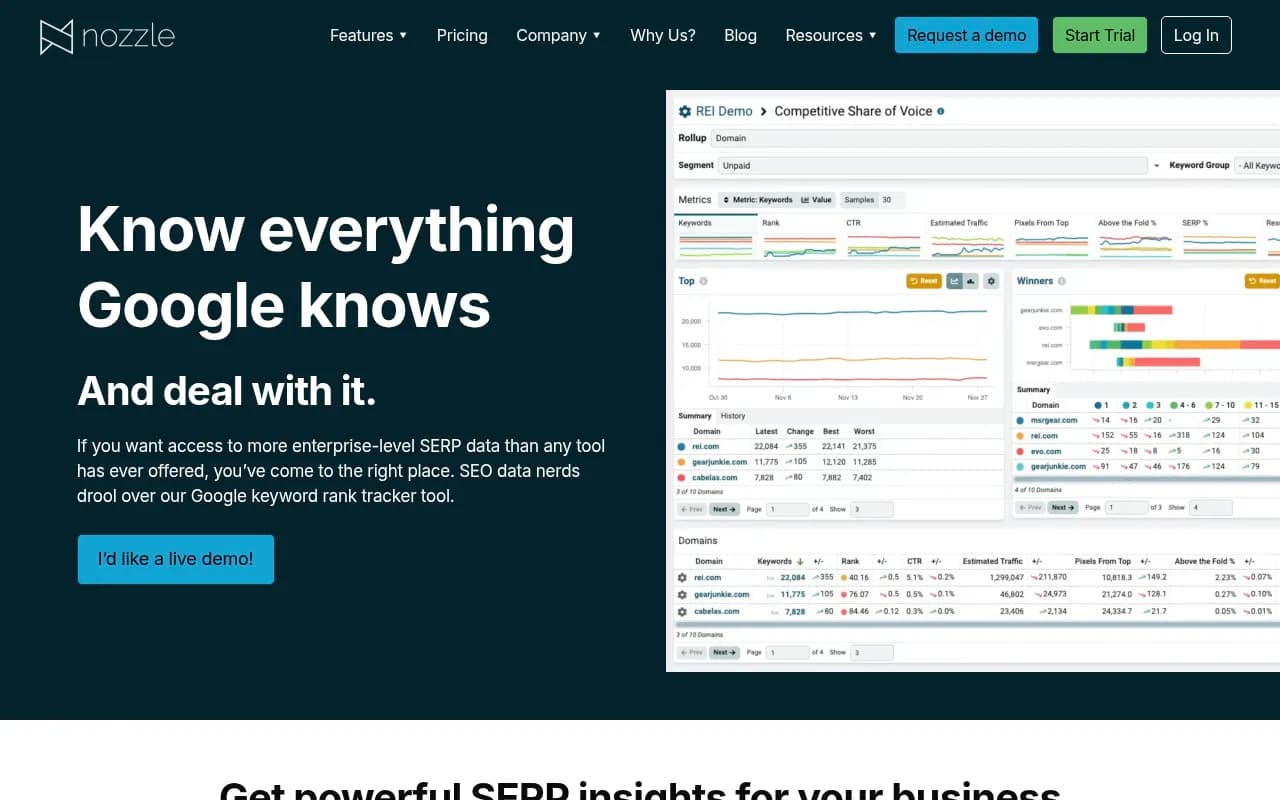
Nozzle is an enterprise-grade SERP tracking platform that goes far beyond telling you what position your site ranks in. Built for SEO teams managing massive keyword portfolios, it tracks your entire brand footprint across Google -- every domain, subdomain, social profile, and URL that appears in search results. The platform's standout feature is its granular data capture: you get pixels-from-top measurements, above-the-fold percentages, SERP share metrics, estimated traffic, and CTR data for every result. Unlike competitors that cap your keyword lists or charge per tracked domain, Nozzle offers unlimited competitor tracking and flexible scheduling that lets you monitor high-value terms hourly while checking long-tail keywords monthly. All data is stored forever, accessible via CSV, SQL, API, or BigQuery. Trusted by Mayo Clinic, Home Depot, Wayfair, and Apartments.com, Nozzle is designed for organizations that treat SERP data as a strategic asset, not just a vanity metric. Starting at $49/month with no minimum spend or qualification calls, it's surprisingly accessible for a tool this powerful -- though the real value emerges when you're tracking thousands of keywords and need the kind of data depth that lets you build predictive models and attribution systems.
What Nozzle actually does
Nozzle monitors Google search results and captures every detail about what appears on the page. When you add a keyword, Nozzle doesn't just check if your site ranks -- it records the entire SERP: every organic result, every ad, every featured snippet, knowledge panel, local pack, image carousel, and video result. It measures the pixel height of each element, calculates how much of the page each result occupies, and estimates traffic potential based on position and SERP layout. This matters because ranking #1 in 2026 doesn't mean what it did in 2015. With four ads, a featured snippet, a People Also Ask box, and a local pack above you, that #1 organic position might be 2,000 pixels down the page and below the fold on mobile. Nozzle tells you the truth about visibility, not just rank.
The platform tracks your entire brand presence, not just your primary domain. If your company has a main site, a blog on a subdomain, a YouTube channel, LinkedIn profiles, and product pages on third-party marketplaces, Nozzle monitors all of them simultaneously. You see your total SERP footprint and share of voice across all properties. This is critical for large brands where different teams manage different digital assets -- marketing owns the blog, product teams manage the main site, social media runs the YouTube channel. Nozzle shows you the complete picture.
Unlimited competitor tracking and historical rewrites
Most rank trackers limit how many competitors you can monitor or charge per competitor domain. Nozzle doesn't. You can track as many competitors as you want, and when you discover a new competitor you weren't monitoring, you can add them retroactively. Nozzle will rewrite your historical data to include that competitor's past rankings, as if you'd been tracking them from day one. This works because Nozzle stores the raw HTML of every SERP it captures, so it can go back and extract competitor data from old snapshots. It's a feature that sounds minor until you realize a new competitor just launched six months ago and you need to understand their growth trajectory without waiting another six months to accumulate data.
Share of voice reporting breaks down by domain, subdomain, URL, and brand. You can see which competitor owns the most SERP real estate for a given keyword set, and drill down to see exactly which pages are ranking. Competitive analysis isn't limited to "who ranks #1" -- you see who dominates the entire first page, who's gaining ground, and who's losing visibility.
Flexible scheduling that actually saves money
Nozzle's scheduling system is the most flexible in the industry. You can set different keywords to check at different intervals: every 5 minutes, hourly, daily, weekly, or monthly. This matters because not all keywords deserve the same attention. Your brand terms and high-converting commercial keywords might need daily or hourly checks to catch volatility and competitor moves. Your long-tail informational keywords that drive modest traffic can be checked weekly or monthly. Most rank trackers force you into a single cadence (daily checks for everything) or charge premium prices for frequent updates. Nozzle lets you allocate your tracking budget strategically. If you're tracking 50,000 keywords, you might check 500 critical terms daily, 5,000 important terms weekly, and the remaining 44,500 monthly. This keeps costs manageable while ensuring you never miss a critical ranking change.
The platform also supports hyper-local tracking. You can monitor rankings for specific cities, ZIP codes, or even GPS coordinates. This is essential for multi-location businesses (retail chains, healthcare systems, restaurant groups) that need to understand local search performance across dozens or hundreds of markets. Each location can have its own keyword list and schedule.
Data access for serious analysis
Nozzle stores all your data forever. Not "the last 12 months" or "the last 2 years" -- forever. If you tracked a keyword three years ago and stopped, that data is still there. This is critical for long-term trend analysis, seasonality studies, and understanding the impact of algorithm updates over time. The platform keeps the raw HTML of every SERP, so even if Google changes how they display results, you can go back and re-analyze old data with new metrics.
You can access your data via CSV export, SQL queries, REST API, or BigQuery integration. The SQL interface is particularly powerful -- you can write complex queries to slice data by date range, keyword group, competitor, SERP feature, or any combination of dimensions. The API supports programmatic access for custom dashboards, automated reporting, or integration with internal BI tools. BigQuery integration lets you join Nozzle data with your analytics, CRM, and revenue data to build attribution models that connect rankings to actual business outcomes.
For teams that live in spreadsheets, CSV exports include every data point Nozzle captures: rank, ad-adjusted rank, pixels from top, above-the-fold percentage, SERP percentage, estimated traffic, CTR, SERP features present, competitor positions, and more. You can pivot and filter to your heart's content.
Granular metrics that matter
Beyond basic rank position, Nozzle tracks:
- Pixels from top: How far down the page your result appears in actual pixels, accounting for ads and SERP features
- Above the fold percentage: What percentage of your result is visible without scrolling on a standard viewport
- SERP percentage: How much of the total SERP real estate your result occupies
- Ad-adjusted rank: Your organic position after accounting for paid ads (so if there are 4 ads, your #1 organic rank is actually position #5)
- Estimated traffic: Modeled traffic potential based on position, CTR curves, and search volume
- CTR: Expected click-through rate based on position and SERP layout
- SERP features present: Which features appeared (featured snippet, local pack, knowledge panel, People Also Ask, image pack, video carousel, etc.)
- Featured snippet ownership: Whether you or a competitor owns the featured snippet, and the snippet type (paragraph, list, table, video)
These metrics let you move beyond "we rank #3" to "we're 1,800 pixels down the page, 40% below the fold, and our estimated CTR is 2.1% because there's a featured snippet and local pack above us." That level of detail changes how you prioritize optimization work.
Who this is for
Nozzle is built for three main audiences:
Enterprise SEO teams managing large, complex sites with thousands or tens of thousands of tracked keywords. Think e-commerce platforms with 50,000 product pages, SaaS companies with extensive content libraries, healthcare systems with hundreds of location pages, or media companies tracking thousands of article rankings. These teams need unlimited competitor tracking, flexible scheduling, and data export capabilities to feed internal BI systems. They're often tracking multiple domains (main site, blog, help center, community forum) and need to see the complete brand footprint. Nozzle's forever data storage matters here because enterprise SEO is a long game -- you need years of historical data to understand seasonality, measure the impact of site migrations, and prove ROI to executives.
SEO agencies managing multiple clients with varying budgets and needs. Nozzle's pricing model (pay for SERPs checked, not per client or per domain) makes it economical to serve both large enterprise clients tracking 10,000 keywords and small local businesses tracking 100. The white-label reporting and API access let agencies build custom dashboards for clients. Unlimited competitor tracking means you can monitor every competitor for every client without worrying about per-seat or per-domain fees. The flexible scheduling lets you allocate more frequent checks to high-paying clients while still serving smaller clients cost-effectively.
Data-driven marketers and analysts who need raw data access to build custom models and attribution systems. If you're the type of person who wants to join rank data with Google Analytics, CRM data, and revenue data to build a multi-touch attribution model, Nozzle is your tool. The SQL interface, API, and BigQuery integration make it easy to pull data into your own systems. The granular metrics (pixels from top, SERP percentage, estimated traffic) give you the inputs to build predictive models. The forever data storage means you can train models on years of historical data.
Nozzle is NOT ideal for small businesses or solopreneurs tracking 20-50 keywords who just want a simple dashboard showing rank changes. The platform's power comes from scale and data depth, which is overkill if you're not using it. For basic rank tracking with simple reporting, tools like SE Ranking or Mangools are more appropriate.
Integrations and ecosystem
Nozzle offers:
- REST API: Full programmatic access to all data and platform functions. Create keyword lists, schedule checks, pull results, and manage settings via API. Documentation is comprehensive with code examples in multiple languages.
- BigQuery integration: Push your Nozzle data directly into Google BigQuery for analysis alongside other data sources. This is the preferred method for enterprise teams building data warehouses.
- CSV export: Download any dataset as CSV with all available columns. Exports can be scheduled or triggered manually.
- SQL interface: Write SQL queries directly in the Nozzle UI to slice and analyze your data. Results can be exported or visualized in the platform.
- Webhooks: Trigger alerts or actions when specific ranking changes occur. Useful for automated reporting or integration with Slack, PagerDuty, or custom systems.
- Google Data Studio / Looker Studio: Connect Nozzle data to Data Studio for custom dashboards and reports.
The platform doesn't have pre-built integrations with SEMrush, Ahrefs, or Google Search Console, but the API makes it straightforward to build custom integrations if needed. Most enterprise users pull Nozzle data into their own BI tools (Tableau, Power BI, Looker) rather than relying on pre-built connectors.
Pricing and plans
Nozzle's pricing is based on SERPs checked per month, not keywords or domains. A SERP is one keyword checked once. If you check 1,000 keywords daily for 30 days, that's 30,000 SERPs. If you check 1,000 keywords weekly (4 times per month), that's 4,000 SERPs. This model rewards strategic scheduling.
Published pricing starts at $49/month, though the exact SERP allotment isn't listed on the website -- you need to contact sales or sign up to see plan details. Based on third-party sources, the entry plan includes a few thousand SERPs per month, suitable for small agencies or businesses tracking a few hundred keywords daily. Mid-tier plans support tens of thousands of SERPs per month for larger keyword portfolios. Enterprise plans with hundreds of thousands or millions of SERPs per month are custom-priced.
Overage charges apply if you exceed your monthly SERP limit, but the platform doesn't shut off or throttle -- you just pay for the extra SERPs at your plan's overage rate. There's no minimum spend, no qualification call required, and no annual contract commitment (though annual billing likely offers a discount). A free trial is available, though duration isn't specified on the site.
Compared to competitors: SE Ranking charges per keyword per day, which gets expensive fast for large portfolios. Ahrefs and SEMrush bundle rank tracking with other tools, so you're paying for features you might not use. Nozzle's SERP-based pricing is more flexible if you're willing to use custom scheduling strategically. For a 10,000-keyword portfolio checked daily, Nozzle is likely more expensive than SE Ranking but cheaper than Ahrefs or SEMrush. For a 50,000-keyword portfolio with mixed scheduling (some daily, most weekly or monthly), Nozzle becomes very competitive.
What it does exceptionally well
Granular SERP data: No other rank tracker captures this level of detail. Pixels from top, above-the-fold percentage, SERP share, and estimated traffic are metrics you can't get elsewhere. This data is essential for understanding true visibility, not just rank position.
Unlimited competitor tracking: Most tools cap competitors at 5, 10, or 20. Nozzle doesn't care. Track 100 competitors if you want. The historical rewrite feature (add a competitor retroactively and get their past data) is genuinely unique.
Forever data storage: Keeping all data indefinitely, including raw HTML, is rare. Most tools purge data after 1-2 years. Nozzle's approach is a game-changer for long-term analysis and trend studies.
Flexible scheduling: The ability to set different check frequencies for different keywords is the most cost-effective way to manage large portfolios. No other tool offers this level of scheduling granularity.
Data access options: SQL, API, BigQuery, CSV -- Nozzle treats data export as a first-class feature, not an afterthought. If you're a data person, this is your tool.
Honest limitations
Nozzle is a SERP tracking specialist, not an all-in-one SEO platform. It doesn't include keyword research, backlink analysis, site audits, or content optimization tools. If you want those features, you'll need separate tools (Ahrefs, SEMrush, Screaming Frog, etc.). For teams that already have a full SEO stack, this isn't a problem -- Nozzle does one thing (SERP tracking) exceptionally well. For smaller teams or solopreneurs, the lack of bundled features means more subscriptions to manage.
The UI is functional but not beautiful. It's clearly built by engineers for data people, not designed for executives who want pretty charts. If you need client-facing reports, you'll likely export data and build custom dashboards in Data Studio, Tableau, or PowerPoint. The platform has reporting features, but they're basic compared to tools like SE Ranking or Mangools that prioritize visual reporting.
Pricing transparency is limited. The website lists a starting price of $49/month but doesn't show plan tiers or SERP allotments. You have to sign up or contact sales to see detailed pricing. This is common for enterprise tools but frustrating if you're trying to budget.
Nozzle tracks Google only. It doesn't monitor Bing, Yahoo, DuckDuckGo, or international search engines like Baidu or Yandex. For most businesses, Google is 90%+ of search traffic, so this isn't a dealbreaker. But if you need multi-engine tracking, you'll need a different tool.
The platform doesn't track AI search engines (ChatGPT, Perplexity, Claude, Gemini) or AI Overviews in Google. As AI search grows in 2026, this is becoming a notable gap. Tools like Promptwatch specialize in AI search visibility and offer features Nozzle lacks: AI citation tracking, content gap analysis for AI responses, AI crawler logs, and optimization tools to improve brand presence in LLM answers. If your strategy includes AI search visibility, you'll need Promptwatch alongside Nozzle.
Bottom line
Nozzle is the best SERP tracking tool for enterprise SEO teams, agencies, and data-driven marketers who need granular visibility data, unlimited competitor tracking, and flexible scheduling to manage large keyword portfolios cost-effectively. If you're tracking thousands of keywords, need to understand true SERP visibility beyond rank position, and want forever data storage with robust export options, Nozzle is worth the investment. The platform's strength is depth and flexibility -- it captures more data and gives you more control than any competitor. The tradeoff is a steeper learning curve and the need to build your own reporting and analysis workflows. If you're comfortable with SQL, APIs, and data analysis, Nozzle is a powerful foundation for a data-driven SEO program. If you want an all-in-one tool with beautiful reports and bundled features, look elsewhere. Best use case in one sentence: Enterprise SEO teams managing 5,000+ keywords who need granular SERP data and flexible scheduling to optimize tracking costs while maintaining visibility into every ranking change that matters.
Frequently asked questions
What is Nozzle and what does it do?
How much does Nozzle cost?
Does Nozzle offer a free plan or free trial?
What makes Nozzle different from other SERP tracking tools?
Who uses Nozzle for SERP tracking?
Can Nozzle track AI search results and LLM responses?
How many keywords can I track with Nozzle?
What data does Nozzle capture from search results?
How can I access my Nozzle SERP data?
Is Nozzle suitable for small businesses or only enterprises?
Similar and alternative tools to Nozzle