Key takeaways
- Promptwatch is built around a full optimization loop: find gaps, generate content, track results. ContentMonk is built around content creation first, with AI visibility tracking layered on top.
- Promptwatch monitors 10+ AI models with real-time crawler logs, citation analysis, and prompt-level tracking. ContentMonk's AI visibility coverage is narrower and less granular.
- ContentMonk is significantly cheaper to start -- $59/month per seat vs Promptwatch's $99/month entry plan -- and its per-article pricing suits teams that want to pay for output, not infrastructure.
- Promptwatch has features ContentMonk simply doesn't: AI crawler logs, Reddit/YouTube citation tracking, ChatGPT Shopping monitoring, query fan-outs, and prompt difficulty scoring.
- ContentMonk is the better fit for content teams who want to scale article production and repurpose content across formats. Promptwatch is the better fit for SEO/marketing teams who need to understand and improve AI search visibility at a strategic level.
- Both tools have content generation, but they come at it from opposite directions -- Promptwatch generates content to close AI visibility gaps; ContentMonk generates content and then checks if it's working.
Overview
Promptwatch

Promptwatch is an end-to-end AI search visibility platform. The core idea is simple: most brands have no idea how they appear (or don't appear) in ChatGPT, Perplexity, Claude, and other AI engines. Promptwatch fixes that with prompt tracking, citation analysis, AI crawler logs, and a content agent that creates articles specifically designed to get cited. It's used by 8,000+ brands and agencies, including Booking.com and Center Parcs, and has processed over 1.1 billion citations and prompts.
The platform covers 10 AI models: ChatGPT, Claude, Gemini, Perplexity, Grok, DeepSeek, Copilot, Mistral, Meta AI, and Google AI Overviews. That breadth, combined with real-time crawler logs and traffic attribution, is what separates it from most monitoring tools that just show you a visibility score and leave you guessing what to do next.
ContentMonk
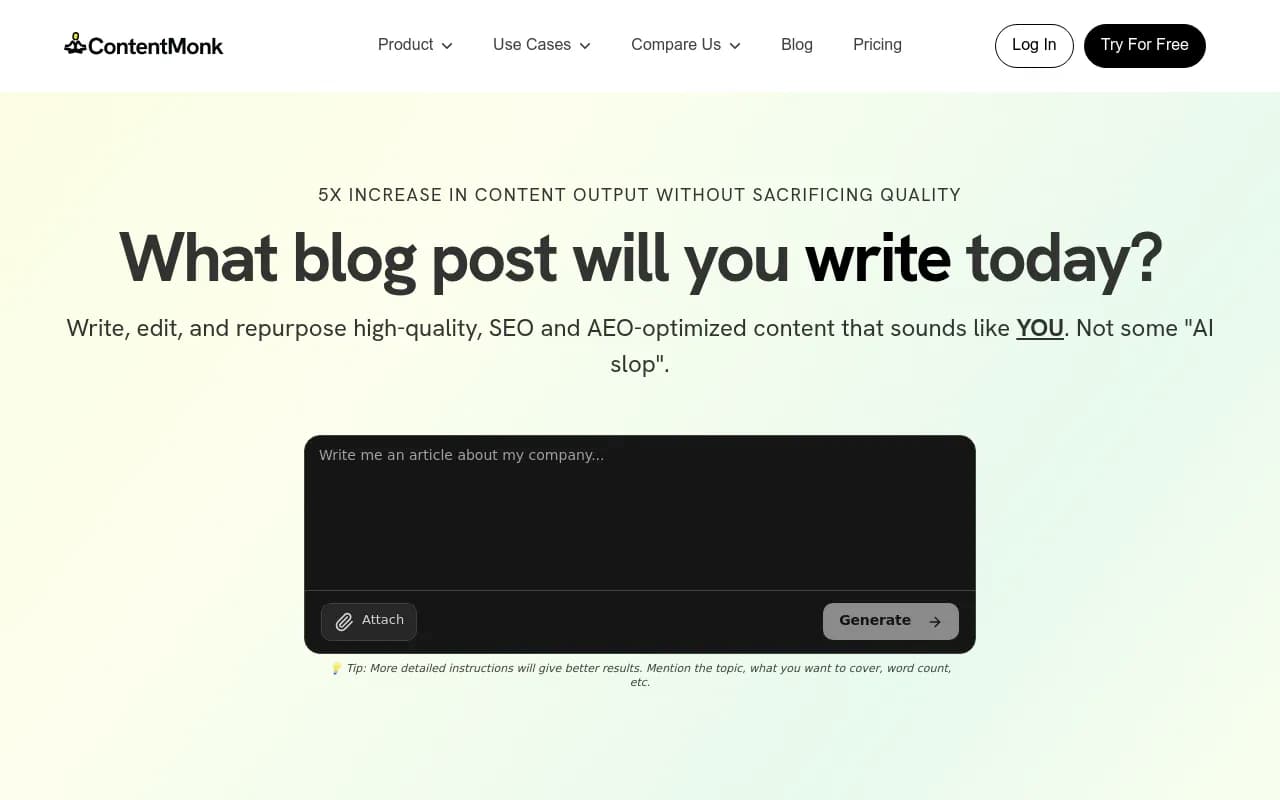
ContentMonk is an AI content marketing platform that combines SEO and AEO content creation with AI visibility tracking. The pitch is that it replaces your entire content stack -- from identifying opportunities to writing articles to repurposing them across formats. It's aimed at marketers, agencies, and content teams who want to scale output without scaling headcount.
The platform has picked up genuine traction among content-heavy teams. Testimonials from users at GetResponse, Avoma, and Expandi point to real results: one user reported AI assistant traffic growing from ~50 to 500+ visitors per month after three months of using ContentMonk's content recommendations. The per-article pricing model is unusual and works well for teams with variable content needs.
Side-by-side comparison
| Feature | Promptwatch | ContentMonk |
|---|---|---|
| Primary focus | AI visibility monitoring + optimization | AI/SEO content creation + visibility tracking |
| AI models tracked | 10+ (ChatGPT, Claude, Gemini, Perplexity, Grok, DeepSeek, Copilot, Mistral, Meta AI, Google AIO) | AI visibility tracking (model coverage not fully disclosed) |
| AI crawler logs | Yes -- real-time, page-level | No |
| Content generation | Yes -- citation-grounded AI content agent | Yes -- core feature, SEO/AEO-optimized articles |
| Content repurposing | No | Yes |
| Answer gap analysis | Yes -- prompt-level competitor gap analysis | Yes -- auto-suggested opportunities |
| Reddit/YouTube tracking | Yes | Not disclosed |
| ChatGPT Shopping tracking | Yes | No |
| Prompt volume + difficulty scoring | Yes | Not disclosed |
| Traffic attribution | Yes (GSC, code snippet, server logs) | Not disclosed |
| Looker Studio / API | Yes | Not disclosed |
| Free trial | 7-day free trial | 14-day free trial |
| Starting price | $99/month | $59/month per seat (annual) or $9.90/article |
| G2 rating | 4.7/5 | Not listed |
| Target user | SEO teams, marketing teams, agencies | Content teams, marketers, agencies, freelancers |
Head-to-head feature deep-dive
AI visibility monitoring
This is where the two tools diverge most sharply.
Promptwatch was built from the ground up as a monitoring platform. You track specific prompts, see exactly which AI models mention your brand and which don't, and get a visibility score with sentiment analysis. The citation analysis goes deep -- it shows you which pages, Reddit threads, YouTube videos, and external domains AI models are citing when they answer prompts in your category. That tells you not just whether you're visible, but why competitors are visible and you're not.
ContentMonk tracks AI visibility too, and users report meaningful improvements (the GoBolt testimonial citing a jump from 5% to 35%+ visibility is notable). But the monitoring appears to be more of a feedback loop for content performance than a standalone intelligence layer. You get visibility data to inform content decisions, not the other way around.
Verdict: Promptwatch wins on monitoring depth. ContentMonk's visibility tracking is useful but secondary to its content creation workflow.
AI crawler logs
Promptwatch has real-time AI crawler logs. You can see exactly when ChatGPT's crawler, Claude's crawler, or Perplexity's crawler visits your site, which pages they read, how often they return, and what errors they encounter. This is genuinely rare -- most tools in this space don't have it, and it's the kind of data that helps you fix indexing issues before they become visibility problems.
ContentMonk doesn't appear to offer crawler log tracking. If you need to understand how AI engines discover and read your content at the server level, ContentMonk can't help with that.
Verdict: Promptwatch, clearly. ContentMonk doesn't have this feature.
Content generation
Both tools generate content, but the approach is different.
Promptwatch's content agent creates articles grounded in citation data -- it analyzes what's being cited across 880M+ citations, identifies the gaps, and writes content designed to fill them. The output is engineered to get cited by AI models, not just to rank in Google. Articles, listicles, and comparison pages are all supported.
ContentMonk's content creation is the main event. It writes SEO and AEO-optimized articles, handles content repurposing across formats, and manages content operations end-to-end. The quality seems genuinely good based on user feedback -- multiple testimonials specifically call out high conversion rates and strong BOFU content. The per-article pricing ($9.90/article) is a smart model for teams that need flexibility.
ContentMonk also does content repurposing, which Promptwatch doesn't touch. If you need to turn a blog post into a LinkedIn thread, a newsletter, or a social post, ContentMonk handles that. Promptwatch doesn't.
Verdict: Depends on your goal. For content engineered around AI citation gaps, Promptwatch's agent is purpose-built. For scaling content production and repurposing across formats, ContentMonk is the stronger tool.
Answer gap analysis and competitive intelligence
Promptwatch's Answer Gap Analysis shows you the specific prompts where competitors are visible and you're not. You see the exact content your site is missing -- topics, angles, questions -- based on real prompt data. Prompt volume estimates and difficulty scores help you prioritize which gaps are worth closing first.
ContentMonk has auto-suggested opportunities that surface content gaps, and users report acting on them successfully. But the depth of competitive prompt intelligence -- seeing exactly which prompts your competitors rank for, with volume and difficulty data -- isn't something ContentMonk appears to match.
Verdict: Promptwatch for competitive prompt intelligence. ContentMonk's suggestions are useful but less granular.
Pricing and value
This is where ContentMonk has a real advantage for smaller teams and individuals.
Promptwatch's Essential plan at $99/month covers one site, 50 prompts, and 5 articles. That's a reasonable entry point for a dedicated SEO or marketing team, but it's not cheap for a solo marketer or small agency.
ContentMonk at $59/month per seat (annual billing) is more accessible, and the $9.90/article option means you can pay for exactly what you produce. A team writing 10 articles a month pays $99 -- same as Promptwatch's entry plan, but with more content output and a 14-day free trial to test it.
The trade-off is that ContentMonk's pricing doesn't include the monitoring infrastructure Promptwatch provides. You're paying for content production, not for crawler logs, prompt tracking across 10 AI models, or traffic attribution.
Verdict: ContentMonk is cheaper for content-focused teams. Promptwatch's pricing reflects a broader platform investment.
Integrations and data exports
Promptwatch integrates with Google Search Console, Looker Studio, Cloudflare, Fastly, and Vercel. It has an API for custom workflows and supports server log analysis for traffic attribution. The Looker Studio integration is particularly useful for agencies building client reports.
ContentMonk's integration ecosystem isn't as publicly documented. Based on available information, it's more of a self-contained platform than one designed to plug into a broader data stack.
Verdict: Promptwatch for teams that need to connect AI visibility data to existing reporting workflows.
Pricing comparison
| Plan | Promptwatch | ContentMonk |
|---|---|---|
| Free tier | No (7-day free trial) | No (14-day free trial) |
| Entry plan | $99/month (Essential: 1 site, 50 prompts, 5 articles) | $59/month per seat (annual) or $9.90/article |
| Mid-tier | $249/month (Professional: 2 sites, 150 prompts, 15 articles, crawler logs) | Not publicly listed |
| Business | $579/month (5 sites, 350 prompts, 30 articles) | Not publicly listed |
| Agency/Enterprise | Custom pricing | Not publicly listed |
| Annual discount | Yes | Yes (required for $59/seat rate) |
ContentMonk's per-article model is genuinely flexible. For a team producing 5-15 articles a month, it can work out cheaper than Promptwatch. For teams needing deep monitoring infrastructure, Promptwatch's pricing is justified by what's included.
Pros and cons
Promptwatch
Pros:
- Monitors 10+ AI models with genuine depth -- not just a visibility score but citation-level data
- Real-time AI crawler logs (rare in this category)
- Prompt volume and difficulty scoring helps you prioritize
- Reddit and YouTube citation tracking
- ChatGPT Shopping monitoring
- Traffic attribution closes the loop between visibility and revenue
- Looker Studio + API for custom reporting
- 4.7/5 on G2 with a large customer base (8,000+ brands)
Cons:
- More expensive entry point ($99/month vs $59/month)
- No content repurposing features
- The breadth of features has a learning curve -- it's not a tool you'll master in a day
- 5 articles/month on the entry plan is limited for content-heavy teams
ContentMonk
Pros:
- Cheaper to start, especially with per-article pricing
- Content repurposing across formats -- something Promptwatch doesn't do
- Strong user testimonials on content quality and conversion rates
- 14-day free trial (longer than Promptwatch's 7 days)
- Good fit for teams that want to consolidate content operations in one place
- Auto-suggested opportunities make it easy to act without deep analysis
Cons:
- AI visibility monitoring is less deep than Promptwatch -- fewer models, no crawler logs
- No ChatGPT Shopping tracking
- No Reddit/YouTube citation tracking
- Integration ecosystem less developed
- Prompt intelligence (volume, difficulty, fan-outs) not available
- Less suited for teams that need to understand AI visibility at a strategic or technical level
Who should pick which tool
Pick Promptwatch if:
- Your primary goal is understanding and improving how your brand appears in AI search engines
- You need to monitor across many AI models (ChatGPT, Claude, Gemini, Perplexity, Grok, etc.)
- You want AI crawler logs to understand how AI engines discover your content
- You're running competitive analysis at the prompt level -- finding gaps, tracking share of voice
- You need traffic attribution to connect AI visibility to actual revenue
- You're an agency managing multiple client brands and need Looker Studio reporting
- You're serious about GEO as a strategic channel, not just a content experiment
Pick ContentMonk if:
- Your primary goal is scaling content production efficiently
- You need content repurposing across formats (blog to social, newsletter, etc.)
- You're a smaller team or freelancer and the per-article pricing model fits your workflow
- You want a single platform for content creation and basic AI visibility tracking
- You're earlier in your AI search journey and don't yet need deep monitoring infrastructure
- Budget is a constraint and you need to start somewhere affordable
Final verdict
These two tools overlap in the middle -- both generate content, both track AI visibility -- but they're built for different primary jobs.
Promptwatch is the right choice if AI search visibility is a strategic priority and you need the full picture: which prompts you're winning, which you're losing, why competitors are getting cited, and what to do about it. The crawler logs, citation analysis, and prompt intelligence are genuinely differentiated features that content-focused tools don't replicate.
ContentMonk is the right choice if you're a content team that wants to scale output, repurpose across formats, and use AI visibility data to guide what you write next -- without paying for monitoring infrastructure you won't fully use.
If you're a marketing or SEO team that needs to take AI search seriously as a channel, Promptwatch is the more complete platform. If you're a content team that wants to write better content faster and see it perform in AI search, ContentMonk earns its place.