Key takeaways
- Searchable offers AI search visibility monitoring but lacks content generation, crawler logs, and traffic attribution — the features teams need to actually improve their rankings
- The best alternatives fall into two camps: monitoring-only tools (cheaper, simpler) and full-stack optimization platforms (more expensive, but they help you act on what you find)
- Promptwatch is the only platform rated as a "Leader" across all GEO categories in 2026, covering 10 AI models with built-in content generation and traffic attribution
- Profound is the enterprise monitoring standard but costs significantly more than competitors and doesn't help you create content
- AirOps is the strongest choice if your priority is content execution at scale rather than visibility tracking
- Your choice should depend on one question: do you need to see where you're invisible, or do you need to fix it?
If you've been using Searchable and started wondering whether you're getting enough out of it, you're not alone. The platform does what it says — it tracks how your brand appears in AI-generated answers. But a lot of teams hit a wall pretty quickly. You can see that ChatGPT isn't mentioning you. You can see that a competitor is getting cited for a prompt you should own. And then... what?
That's the gap most AI visibility tools leave you in. They're dashboards. They show you the problem. They don't help you solve it.
This guide covers 10 alternatives to Searchable that are worth considering in 2026, ranging from monitoring-focused tools to full optimization platforms. I'll be direct about what each one actually does well and where it falls short.
What Searchable does (and where it falls short)
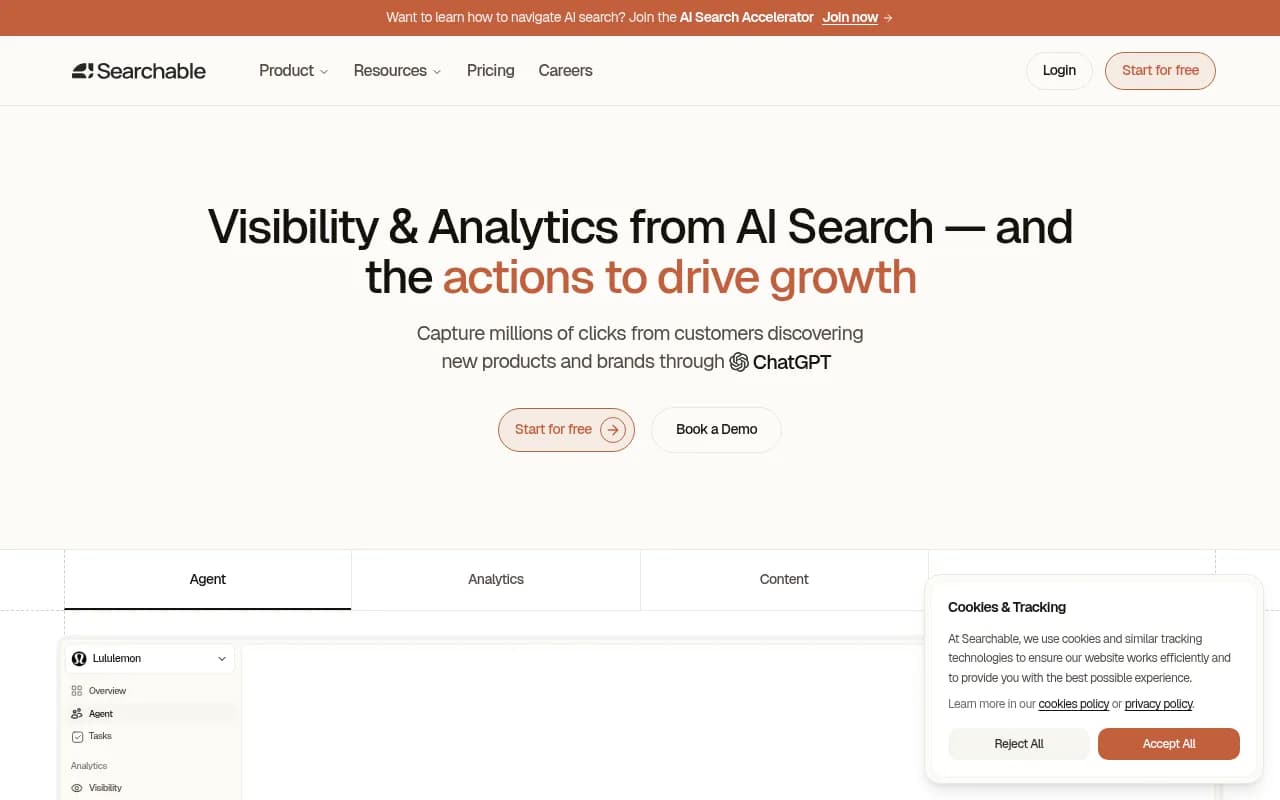
Searchable is an AI search visibility platform with built-in content generation. It monitors brand mentions across major LLMs and gives you some content tools to act on what you find. For a lot of teams, that's a reasonable starting point.
But the gaps show up fast:
- No AI crawler logs (you can't see which pages AI bots are actually reading on your site)
- Limited prompt intelligence — no volume estimates, no difficulty scoring
- No Reddit or YouTube citation tracking
- Traffic attribution is thin compared to more mature platforms
- The content generation layer doesn't ground output in real citation data
If you're a lean team just getting started with GEO, Searchable might be fine. But if you're trying to build a repeatable system for improving AI visibility, you'll probably outgrow it.
The 10 best Searchable alternatives in 2026
1. Promptwatch — best overall for teams that want to actually fix their AI visibility
Promptwatch is the most complete GEO platform available right now. It's used by 6,700+ brands and agencies including Booking.com and Center Parcs, and it's the only platform rated as a "Leader" across all categories in a 2026 comparison of 12 GEO tools.
The core difference from Searchable (and most other tools) is that Promptwatch doesn't stop at showing you where you're invisible. It helps you fix it. The Answer Gap Analysis shows you exactly which prompts competitors are getting cited for that you're not. The built-in AI writing agent then generates content grounded in 880M+ real citations — not generic SEO filler, but articles and comparisons engineered to get cited by ChatGPT, Claude, Perplexity, and others.
On top of that: AI crawler logs show you which pages AI bots are actually reading (and which ones they're skipping), prompt volume and difficulty scoring helps you prioritize, and traffic attribution connects AI visibility to actual revenue via GSC integration or server log analysis.
It monitors 10 AI models: ChatGPT, Perplexity, Claude, Gemini, Google AI Overviews, Google AI Mode, Meta/Llama, DeepSeek, Grok, and Mistral. Reddit and YouTube citation tracking is included, as is ChatGPT Shopping monitoring — features most competitors don't have at all.
Pricing starts at $99/month for the Essential plan (1 site, 50 prompts, 5 articles). Professional is $249/month, Business $579/month.

2. Profound — best for enterprise teams that need deep monitoring
Profound is the category benchmark for AI search visibility analytics. It tracks brand mentions across 9+ AI engines with strong data quality and a clean reporting interface. Enterprise teams at large brands often use it as their primary measurement layer.
The catch: it's expensive (reportedly 48% above market rate according to ContentMonk's 21-day comparison), and it's monitoring-only. Profound will tell you exactly where you're invisible. It won't help you write the content to fix that. For teams that have a separate content operation and just need reliable data, that's fine. For teams that need the full loop, it's a gap.

3. AirOps — best for content execution at scale
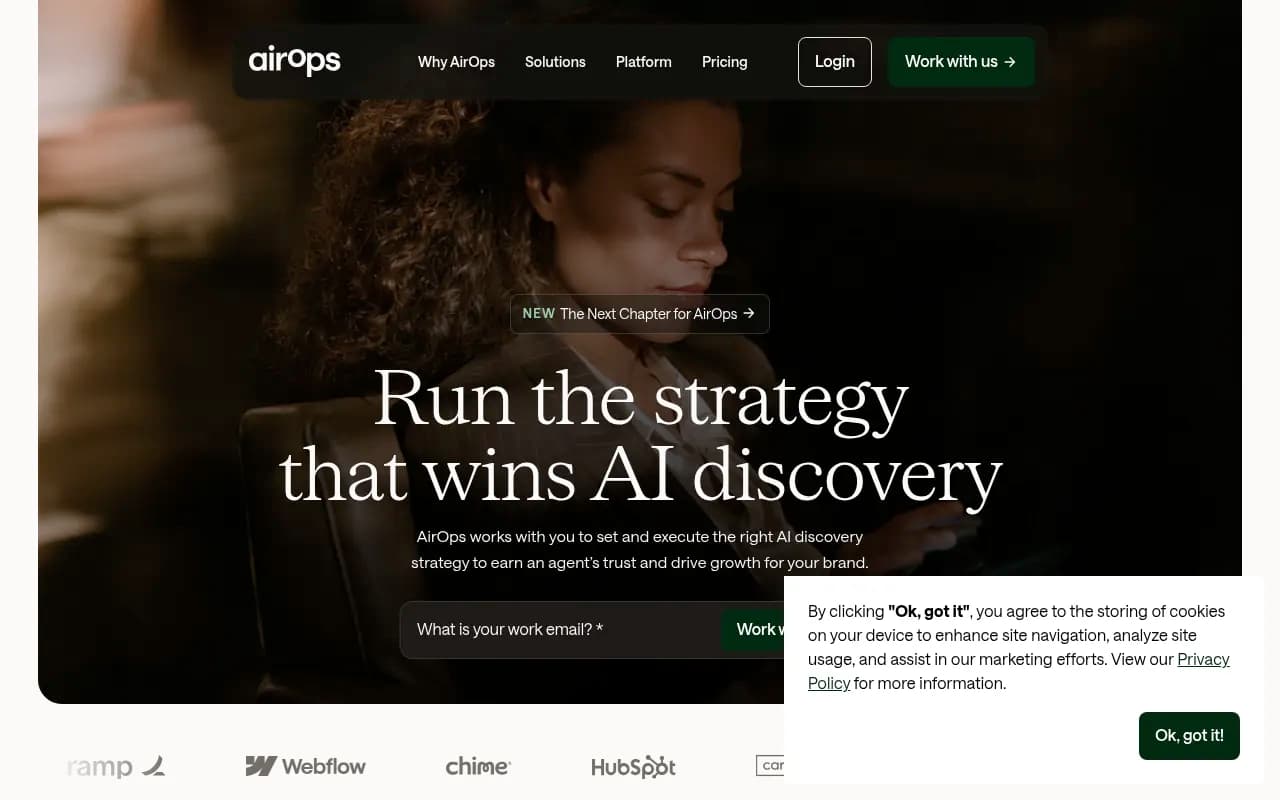
AirOps takes a different angle. Rather than positioning itself primarily as a visibility tracker, it's built around content engineering — creating and updating content at scale based on AI search insights. If your main bottleneck is execution (you know what content you need, you just can't produce it fast enough), AirOps is worth a serious look.
It's particularly strong for teams managing large content libraries that need repeatable workflows for updating existing pages, not just publishing new ones. The tradeoff: it's less focused on the monitoring and measurement side, so you may end up pairing it with a tracking tool.
4. Otterly.AI — best for small teams getting started
Otterly.AI is one of the more accessible entry points into AI search monitoring. It tracks brand mentions across ChatGPT, Perplexity, and Google AI Overviews with a clean interface that doesn't require much setup. Pricing is lower than most competitors.
The limitations are real though. No crawler logs, no content generation, no traffic attribution, no Reddit tracking. It's a monitoring dashboard, and a decent one for the price. If you're a small team that just wants to know whether AI models are mentioning you and who your competitors are, Otterly.AI works. If you need to act on that data, you'll hit a ceiling fast.

5. Peec AI — best for clean, shareable visibility snapshots
Peec AI focuses on prompt-level AI search analytics with a UI that's genuinely easy to use. It's popular with teams that need to share visibility reports with stakeholders who aren't deep in the GEO weeds — the outputs are clean and presentable.
Like Otterly.AI, it's monitoring-focused. Prompt-level data is good, but there's no content generation layer, no crawler logs, and limited depth on traffic attribution. Good for reporting. Less good for optimization.

6. Scrunch AI — best for mid-market teams that want more than basic tracking
Scrunch AI sits somewhere between the entry-level monitoring tools and the full-stack platforms. It tracks brand visibility across LLMs with more depth than Otterly.AI or Peec AI, and has some optimization features built in.
It's a reasonable middle ground for mid-market teams that find Profound too expensive but need more than basic monitoring. The content generation capabilities aren't as developed as Promptwatch's, and crawler log analysis isn't a core feature.
7. AthenaHQ — best for teams focused on competitive intelligence
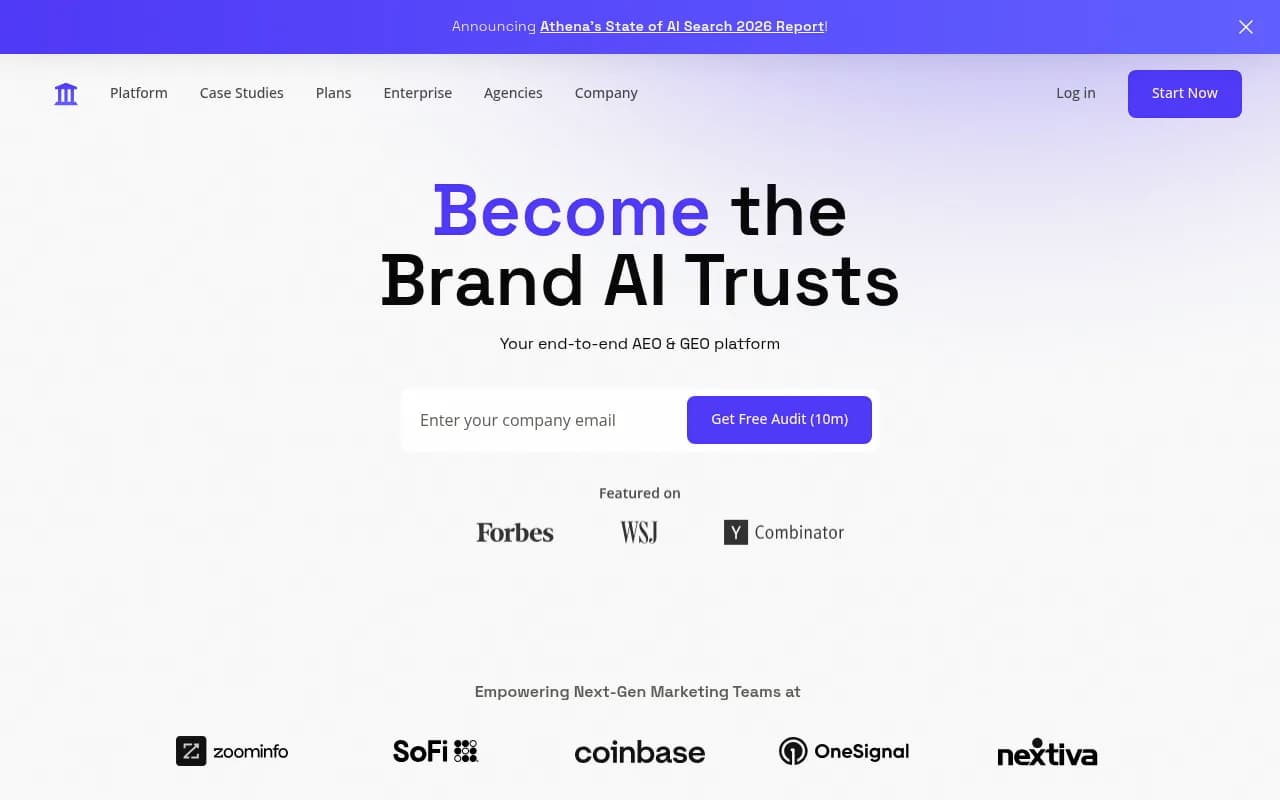
AthenaHQ is strong on the competitive analysis side. It gives you detailed views of how your brand stacks up against competitors across AI engines, with good visualization of who's winning for which prompts.
The gap is on the action side. AthenaHQ is monitoring-focused and doesn't have content generation or optimization tools built in. It's a good choice if competitive intelligence is your primary use case and you have a separate content workflow.
8. SE Ranking — best for teams that want AI visibility inside a broader SEO platform
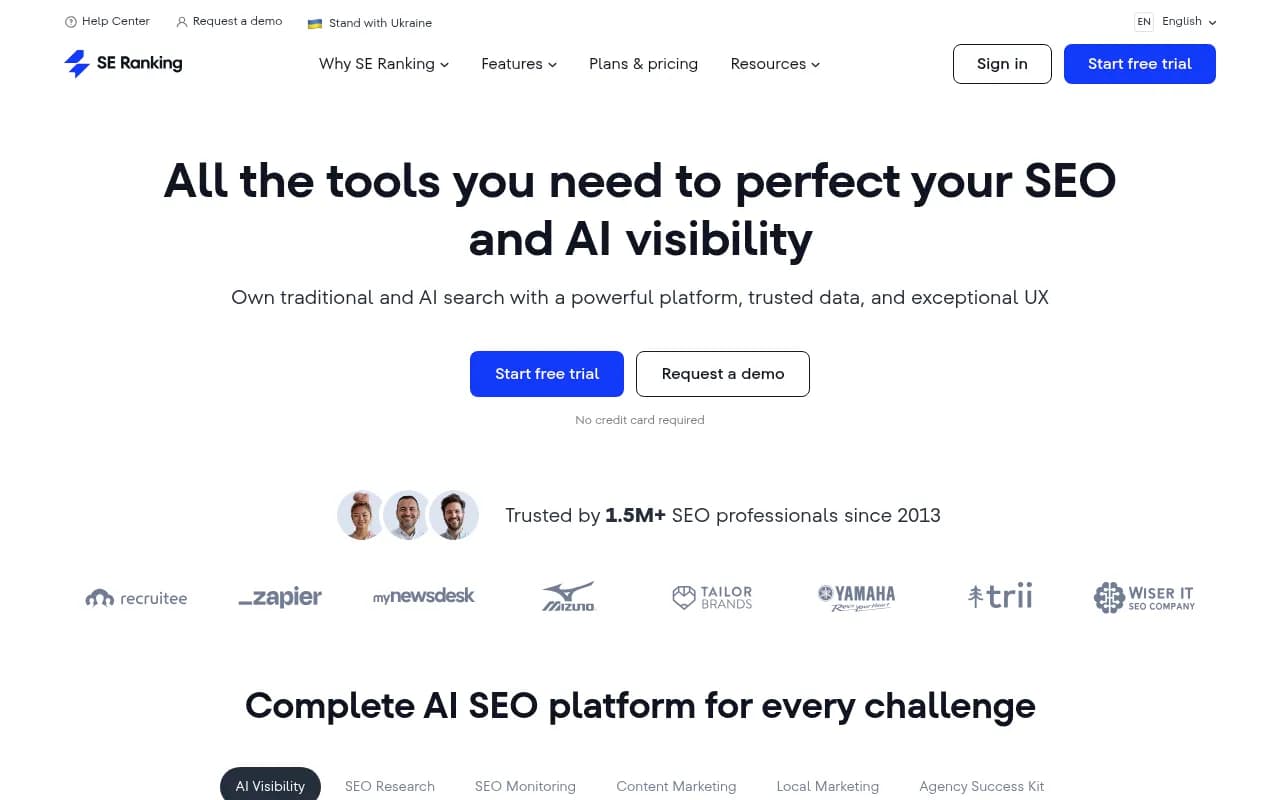
SE Ranking is primarily an SEO platform that has added AI search tracking capabilities. If your team is already using SE Ranking for traditional SEO and wants to add AI visibility monitoring without switching tools, it's a practical option.
The AI visibility features aren't as deep as dedicated GEO platforms — you won't get crawler logs, Reddit tracking, or content generation grounded in citation data. But for teams that want one platform for both traditional and AI search, it's worth considering.
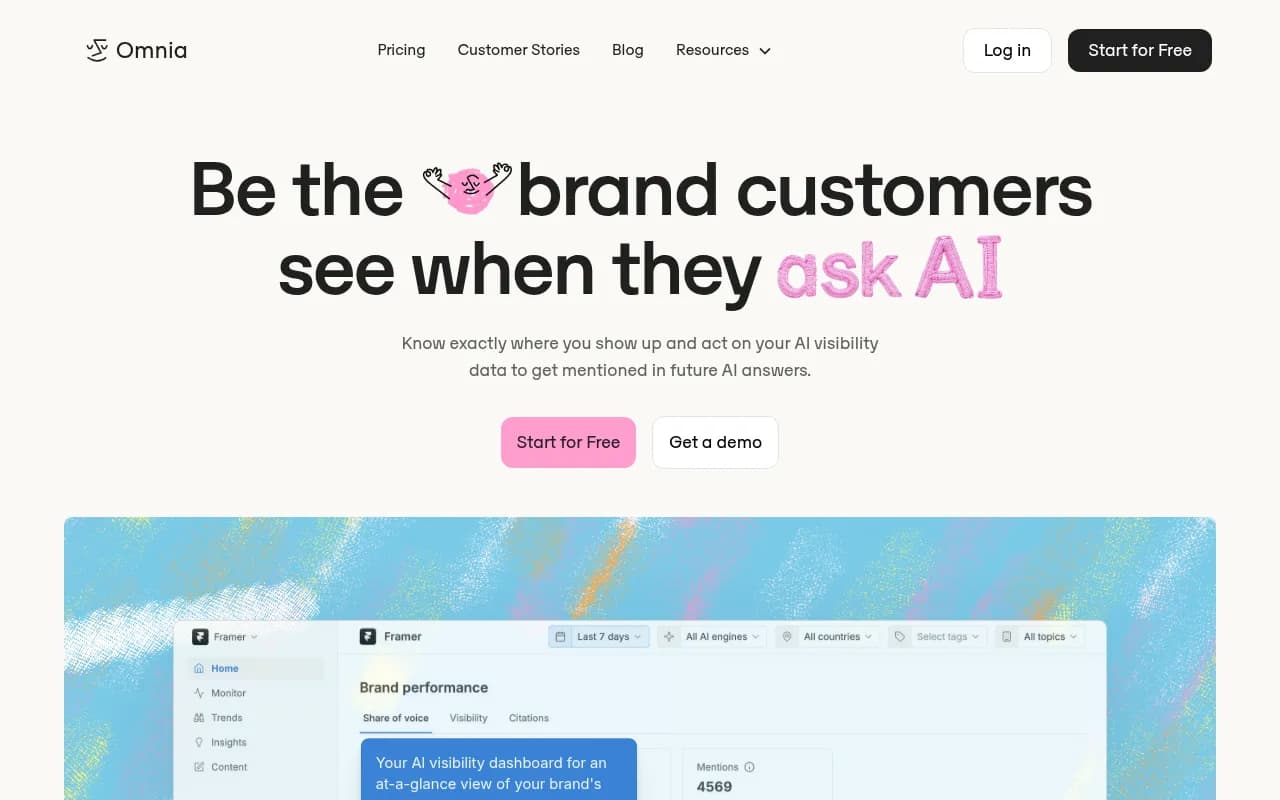
9. Omnia — best for lean teams that want URL-level citation intelligence
Omnia focuses on URL-level citation intelligence — showing you not just whether your brand is mentioned, but which specific pages are being cited and how often. That granularity is useful for teams that want to understand which content is actually driving AI visibility.
It's a cleaner, more focused tool than some of the larger platforms. The tradeoff is that it doesn't have the full optimization stack (no content generation, limited prompt intelligence). But for teams that want precise citation data without a lot of overhead, it's a strong option.
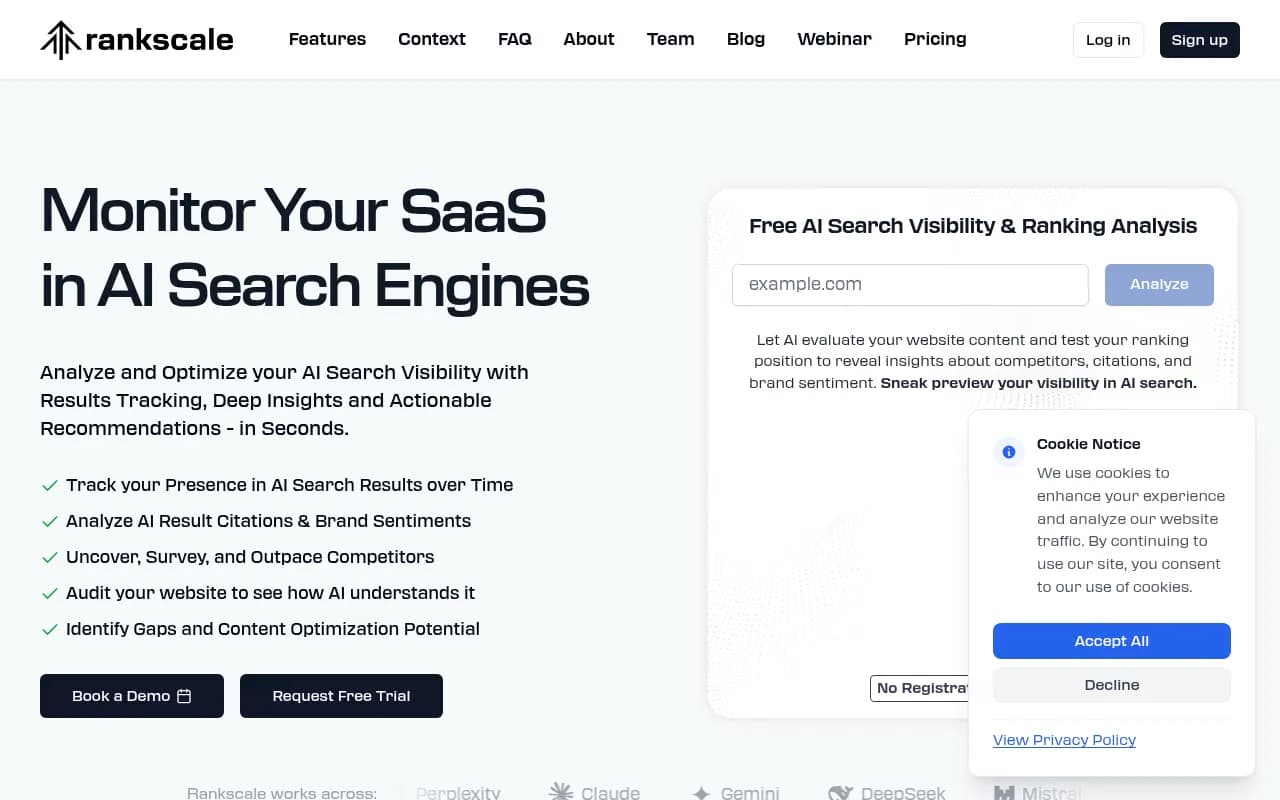
10. Rankscale — best for agencies managing multiple clients
Rankscale is built with agencies in mind. It handles multi-client management reasonably well and gives account managers the reporting views they need to show clients what's happening with their AI visibility.
The feature depth on the optimization side is limited compared to Promptwatch, but the agency-specific workflow features (white-labeling, client dashboards, bulk reporting) make it a practical choice for agencies that primarily need to monitor and report rather than execute content strategy.
How these tools compare
| Tool | AI models tracked | Content generation | Crawler logs | Traffic attribution | Reddit/YouTube tracking | Best for |
|---|---|---|---|---|---|---|
| Promptwatch | 10 | Yes (citation-grounded) | Yes | Yes (GSC, server logs) | Yes | Full-stack optimization |
| Profound | 9+ | No | No | Limited | No | Enterprise monitoring |
| AirOps | Varies | Yes (workflow-based) | No | No | No | Content execution at scale |
| Otterly.AI | 3 | No | No | No | No | Entry-level monitoring |
| Peec AI | Multiple | No | No | No | No | Shareable snapshots |
| Scrunch AI | Multiple | Limited | No | No | No | Mid-market tracking |
| AthenaHQ | Multiple | No | No | No | No | Competitive intelligence |
| SE Ranking | Multiple | Limited | No | No | No | SEO + AI combo |
| Omnia | Multiple | No | No | No | No | URL-level citation data |
| Rankscale | Multiple | No | No | No | No | Agency reporting |
| Searchable | Multiple | Yes (basic) | No | Limited | No | Basic monitoring + content |
How to choose the right alternative
The honest answer is that it depends on where you are in your GEO journey.
If you're just starting out and want to understand whether AI models are mentioning your brand, Otterly.AI or Peec AI will get you there without a big investment. They're monitoring tools, not optimization platforms, but that's fine when you're still figuring out the basics.
If you're past the "are we being mentioned" question and want to understand why competitors are winning specific prompts and what to do about it, you need something with a content layer. That's where Promptwatch and AirOps separate themselves from the pack. Promptwatch gives you the full loop — gap analysis, content generation grounded in real citation data, and traffic attribution to close the loop. AirOps is the better choice if content execution workflow is your primary bottleneck.
If you're an enterprise team with a dedicated content operation and just need reliable measurement data, Profound is the category standard. You'll pay for it, and you'll need to handle the content side separately, but the data quality is strong.
If you're an agency managing multiple clients, Rankscale's multi-client features are worth the tradeoff on feature depth.
One thing worth being direct about: most of the tools on this list are monitoring dashboards. They show you data. The platforms that actually help you improve your AI visibility — not just measure it — are a much shorter list. Promptwatch is the most complete option there, with AirOps as a strong complement if you're focused on content production.
The bottom line
Searchable isn't a bad tool. But "not bad" is a low bar when AI search visibility is becoming a primary channel for organic discovery. The platforms that will matter in 2026 are the ones that close the loop between insight and action.
If you're evaluating alternatives, start by asking what you actually need: monitoring, optimization, or both. That answer will narrow the list quickly. For most teams that want to genuinely improve how they appear in ChatGPT, Perplexity, and other AI engines, Promptwatch is the most complete starting point — it's the only platform that finds the gaps, helps you create content to fill them, and then tracks whether it worked.