AirOps Review 2026
Builds AI-search-optimized content workflows so marketing teams can compete for visibility in AI-generated answers.
Key takeaways
- AirOps is a content engineering platform that pairs AI search visibility data with automated content production, and in September 2026 it repositioned into a hybrid platform-plus-services model with hands-on strategy help.
- Its execution side is genuinely strong: the Quill agent, Grid bulk operations, and 30+ integrations (including direct publishing to Webflow, WordPress, Contentful, and Shopify) make it one of the better production engines in the category.
- Monitoring is the weak half. Compared with Promptwatch, AirOps lacks AI crawler logs, visitor analytics that attribute actual AI-driven traffic and conversions, Reddit and YouTube citation tracking, ChatGPT Shopping and Ads Radar, and prompt volume/difficulty data. Solo plan tracking covers ChatGPT only.
- Pricing is steep: $200/month for Solo and $2,000/month for Pro, which prices out small teams unless they produce content at serious volume.
- Best fit: mid-market and enterprise content/SEO teams (think LegalZoom, Webflow, Chime scale) with an existing content backlog and budget for a managed engagement.
What AirOps actually is
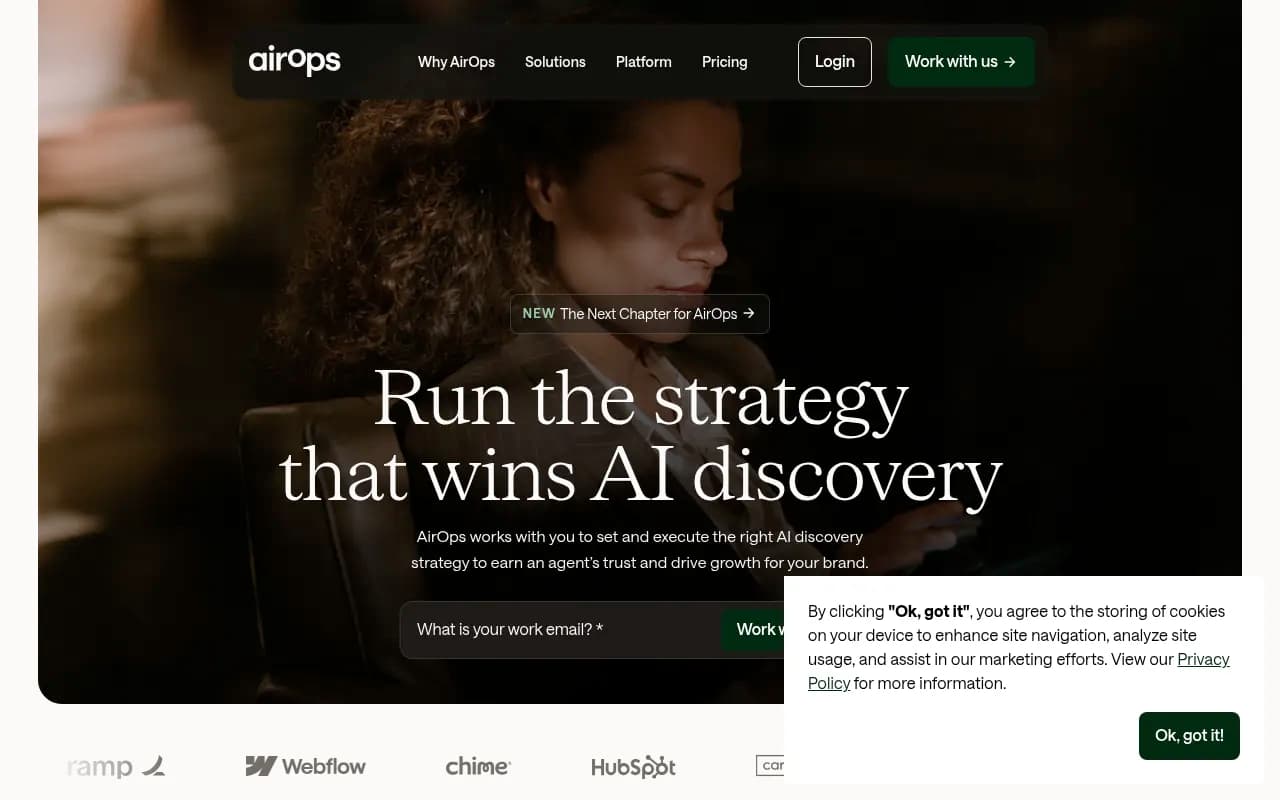
AirOps started life in 2023 as a no-code AI workflow builder for marketing teams, raised a $15.5M Series A led by Unusual Ventures in October 2024 (total funding now reported around $67.5M), and has spent the last two years repositioning itself as a "content engineering platform for AI search discovery." The September 2026 relaunch pushed it further toward a hybrid model: you now get a platform plus a team of channel experts who help set and execute your AI discovery strategy alongside you.
That framing matters. AirOps is not selling a dashboard you check weekly. It's selling a system: understand where you stand with the buyers who matter, build a channel strategy, then execute it with agents that research, publish, and refresh content continuously. The homepage leans hard into the services angle, which tells you a lot about who they're chasing — marketing leaders who know AI search matters (their own study says 86.6% prioritize it) but don't feel confident measuring it (only 23.2% do).
The customer logo wall is impressive, honestly. Upwork, Ramp, Webflow, Chime, HubSpot, Brex, Wiz, KAYAK, Gong, monday.com. These are real mid-market and enterprise brands, not startup vanity logos.
The platform, feature by feature
Visibility and measurement
AirOps tracks brand visibility across ChatGPT, Gemini, Perplexity, and Google AI surfaces (7+ answer engines on the Pro plan). The standout launch here is Page360, rolled out in January 2026, which merges AI search visibility signals with Google Search Console and GA4 data into a single content performance view. Smart filters like "Losing AI Visibility" and "Almost Page One" are a genuinely good idea — that's the kind of cross-surface diagnosis most tools still make you assemble manually.
Query Fan-outs show the sub-queries an engine runs behind a single prompt, which helps you spot the supporting topics you need to cover to win a citation. Content Publish Tracking then closes the loop by mapping each published piece back to the visibility metric it was supposed to move. There's also a free AI Search Grader that scores your brand across ChatGPT, Perplexity, and Gemini in under two minutes — useful as a one-time diagnostic, less so as an ongoing tool.
Execution and production
This is where AirOps earns its keep. Quill, their AI agent, turns insights into drafted, refreshed, and monitored content with human review built in. The Grid is a spreadsheet-style interface for running workflows across hundreds of URLs at once — meta updates, internal linking, FAQ schema, SERP analysis. The Workflow Builder is a no-code, Zapier-style canvas for custom automations. Brand Kits and Knowledge Bases keep the output on-voice.
The integration list is deep: 30+ native connections including Webflow, WordPress, HubSpot CMS, Contentful, Shopify, Asana, Ahrefs, Airtable, and GA4. Publishing directly to seven-plus CMS platforms is a real operational advantage for teams running high-volume programs.
The services layer
Since the relaunch, the pitch includes a hands-on team that stays involved from strategy through execution. Case studies suggest this works when it works: LegalZoom cut article refresh time from 10 hours to roughly 45 minutes and reported $600K+ in savings; Chime 3x'd its citation rate; Webflow 5x'd content refresh velocity. These are strong numbers, though they come from AirOps' own case studies, so read them as best-case outcomes.
Strengths
- Execution depth that most visibility tools don't have. Most competitors in this space stop at a dashboard. AirOps connects the gap to the work and the work to the result.
- Page360's unified view of AI visibility, GSC, and GA4 data is one of the smarter measurement ideas in the category.
- Enterprise-grade integration footprint, including direct CMS publishing and data warehouse connections.
- The hybrid services model suits large teams that want an outcome, not another tool to operate.
- Solid reputation on G2: 4.7/5 from 134 reviews, with 82% five-star and zero reviews at three stars or below.
Limitations, and where Promptwatch has the edge
The honest critique from reviewers (and even from competitor Profound's teardown of AirOps) is that monitoring is the shallow half of the product. "Built for content production, not AI visibility" is how one review put it, with surface-level insights and limited regional data.
Measured against Promptwatch, the gaps are concrete:
- No AI crawler logs. Promptwatch's Agent Analytics shows when ChatGPTBot, ClaudeBot, PerplexityBot, and 400+ other crawlers hit your site, what they read, and where they hit errors — the "why" behind your visibility score. AirOps has nothing equivalent.
- No visitor analytics or AI traffic attribution. AirOps shows visibility movement; Promptwatch tracks actual traffic and conversions coming from AI platforms to your site.
- No Reddit or YouTube citation tracking, and no ChatGPT Shopping or Ads Radar. Given that product pages overtook listicles as ChatGPT's most-cited format in July 2026 per Promptwatch's citation type data, and shopping surfaces are becoming commercial battlegrounds, these are real blind spots for e-commerce and consumer brands.
- No prompt volumes or difficulty scores. AirOps tells you where you appear; Promptwatch sizes the opportunity per prompt so you can prioritize.
- Coverage tiers are restrictive. Solo ($200/month) tracks ChatGPT only, while Promptwatch's $95/month Essential plan includes all LLM tracking.

Beyond the comparison, AirOps has its own independent problems. The Workflow Builder has a steep learning curve — reviewers describe needing academy training and cohort onboarding to get productive, where simpler tools are usable in an afternoon. Pricing is the other recurring complaint: $2,000/month for Pro is hard to justify unless you're producing content at volume, and one G2 reviewer flagged missing CRM integrations. And the new services-heavy model is great if you want a partner, but awkward if you just wanted software.
Who it's for
AirOps fits two personas well. First: enterprise and mid-market content/SEO teams at SaaS or consumer brands with mature programs and a real content backlog — the LegalZoom profile, where 90% reductions in refresh time translate directly into six-figure savings. Second: marketing leaders who have budget for a managed engagement and want an accountable partner rather than another internal tool to champion.
It fits poorly for solo operators, small agencies, or anyone whose primary question is "where are we visible and why" rather than "produce and refresh content at scale." For those buyers, a monitoring-first platform with built-in optimization — Promptwatch being the clearest example, with crawler logs, traffic attribution, and its own automated Content Agents — covers more ground at a fraction of the cost.
Bottom line
AirOps is a serious platform for content execution in the AI search era, with enterprise credibility and some of the best production tooling available. But its visibility layer is the thinnest part of the stack, its entry pricing is aggressive, and the September 2026 pivot toward services makes it more of an agency-like commitment than a self-serve tool. If your priority is understanding and fixing your AI visibility — crawler behavior, citation sources, real traffic from AI platforms, Reddit and YouTube presence, shopping surfaces — Promptwatch delivers that end-to-end stack starting at $95/month, with its own agentic content execution to boot. If you're an enterprise team that wants a production engine plus a strategic partner and can absorb $2K+/month, AirOps deserves your shortlist. For a broader look at the category, the GEO software directory at bestgeosoftware.com is a good next stop.
Tags:
Frequently asked questions
How much does AirOps cost?
Is AirOps good for AI search visibility monitoring?
Who should use AirOps?
What is Quill in AirOps?
Similar and alternative tools to AirOps