Gumshoe AI Review 2026
Offers free AI brand insight checks and persona-based visibility scoring to help marketers gauge GEO readiness.
Key takeaways
- Gumshoe's persona-driven methodology is genuinely different: instead of firing generic prompts at AI models, it simulates conversations as realistic buyer personas, which surfaces visibility data most trackers miss entirely.
- Pricing is simple and low ($99/mo Starter, $299/mo Pro, free sample audit), but the plans run only 6 models per full audit despite the homepage advertising 11, and there's no published tier for going beyond 80 prompts.
- It's a monitoring and diagnostics tool at heart. Compared with Promptwatch, it lacks AI crawler logs, AI traffic attribution, Reddit and YouTube citation tracking, ChatGPT Shopping insights, prompt volume and difficulty scoring, and automated CMS publishing.
- The Sentiment, Citation, and Content audits are new additions (2026) that fix gaps earlier reviewers criticized, so the product is moving fast.
- Best fit: B2B marketing teams and agencies that want persona-level competitive insight for GEO audits and client reporting, not teams that need end-to-end optimization or revenue attribution.
What Gumshoe AI is
Gumshoe is a Seattle-based AI visibility platform founded in 2025 by Patrick O'Donnell (previously of Urbansoul and MightyAI) and Todd Sawicki, with a $2M pre-seed led by Pioneer Square Labs. The pitch is straightforward: when buyers ask ChatGPT or Gemini for recommendations, your brand is either in the answer or it's invisible, and Gumshoe shows you which, and why.
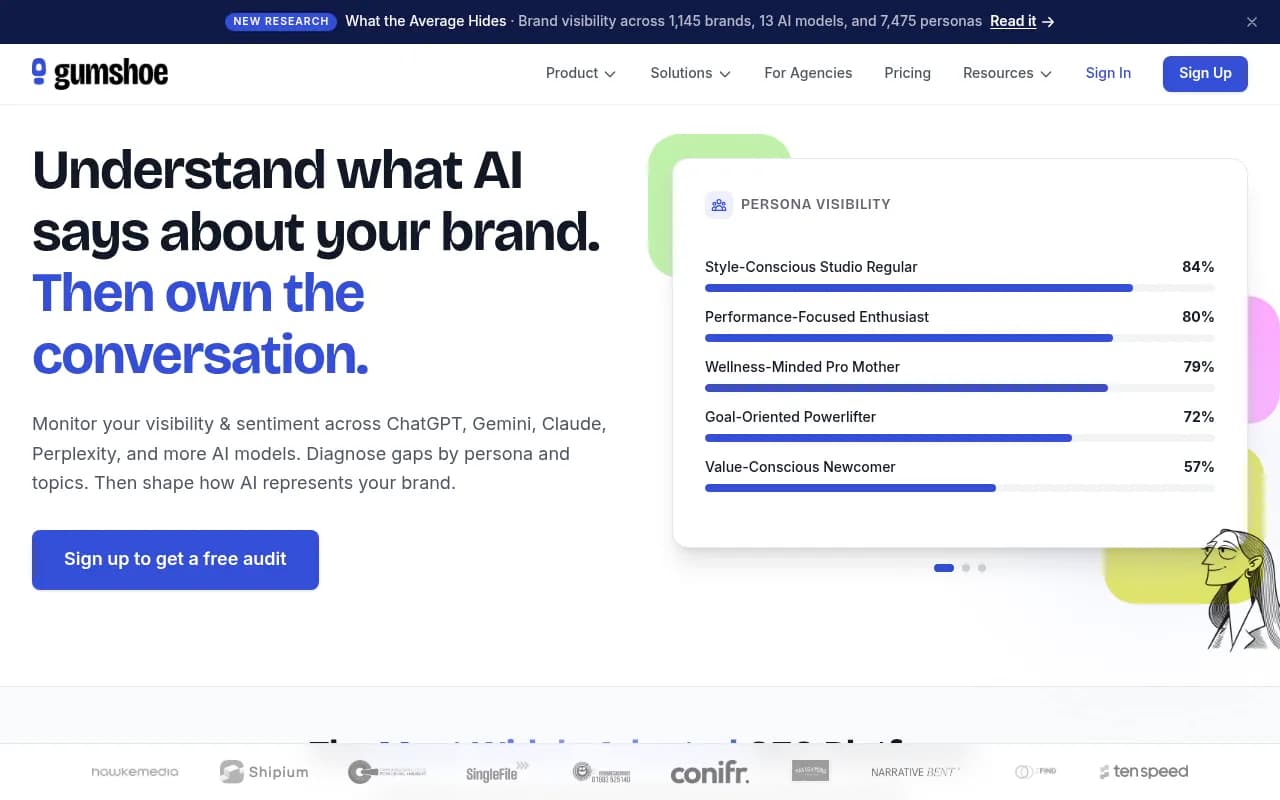
What actually separates it from the crowd of prompt trackers is the persona engine. Most tools scrape AI outputs from anonymous sessions, which tells you what a model says to nobody in particular. Gumshoe builds buyer personas with roles, goals, pain points, and decision criteria, then runs conversations as those personas across the major models. The same question asked by a "Weekend Track Enthusiast" and a "Heritage Collector" gets different answers, and Gumshoe's heatmaps show you exactly where those splits hurt or help you.
The company's own research backs the premise. Its June 2026 whitepaper, "What the Average Hides," analyzed 1,145 brands across 13 AI models and 7,475 personas, and found that average visibility (24.8%) is a nearly meaningless number. Visibility is bimodal: brands are either well covered or close to invisible, and 238 of the 1,145 brands tested showed 0% visibility to every persona. Lululemon averaged 64% but swung from 7.5% to 81.2% depending on who was asking. That's a strong argument for the persona approach, and it's the kind of first-party research I wish more vendors published.
How the platform works
Gumshoe organizes everything around five audits, three of which (Sentiment, Citation, Content) are marked "New" on the site as of late 2026:
- Visibility Audit: where you turn up across models, who turns up instead of you, and a brand leaderboard tracking up to 30 competitors side by side.
- Sentiment Audit: how models talk about you, not just whether they mention you. This directly addresses the most common complaint in earlier reviews, which flagged the absence of sentiment tracking through late 2025.
- Citation Audit: which third-party domains models lean on in your category, which is useful for prioritizing digital PR placements.
- Content Audit: gaps between your site's content and the questions buyers actually ask.
- Technical GEO Audit: page-by-page scoring of how readable your pages are to AI, flagging missing JSON-LD, schema, structure, and metadata issues.
Between full audits, Snapshot Audits run lighter monitoring passes (weekly on Starter, daily on Pro) so you catch a visibility slide while you can still act on it. There's also a content generator that targets the specific persona-topic gaps your reports surface, plus CSV/JSON exports and a read API.
One methodological detail worth crediting: Gumshoe runs every conversation fresh, with no cookies or account history, and provides full transcripts so you can verify results manually. The dual approach of API connections plus native interface testing matters, because user-facing answers can differ from API outputs.
Pricing
The free sample audit gives you a one-time look with no credit card. Starter is $99/mo with a monthly Visibility Audit, weekly Snapshot monitoring, and 10 Technical Audit runs. Pro is $299/mo with all five audits monthly, daily monitoring, and 50 Technical Audit runs. No per-seat fees, and each subscription is tied to a single project. Enterprise pricing is custom for multi-brand programs.
Two things to watch. First, the pricing model has changed over time: earlier reviews describe a pay-per-conversation model ($0.10/conversation), while the current site shows flat tiers, so verify the live page before budgeting. Second, there's no annual discount published, and no published tier for exceeding 80 prompts, 6 models, or monthly audit cadence. If you need more breadth, the answer is "talk to sales," which is fine for enterprise but frustrating for mid-market teams.
The entry price is competitive for what you get. Comparable tools range from Rank Prompt at $39/mo (6 engines) to Scrunch at $300/mo (7 engines), so $99/mo for 6 models with persona depth is fair. The catch is that Pro costs 3x Starter for the same prompt breadth; you're mostly paying for monitoring frequency and the extra audits.
Strengths and limitations
What it does well
The persona methodology is real and defensible, not marketing gloss. The heatmaps (persona × competitor, topic × competitor, model × competitor) are the kind of artifact that makes agency client meetings easier, and Hawke Media's testimonial about using them with skeptical clients rings true. The customer results are concrete too: Shipium's CMO reports domain citations up 557% in under four months.
The technical audit is a nice inclusion at this price point, and the citation source analysis gives PR teams an actual target list rather than a vague "get mentioned more" directive.
Where it falls short
Compared with full-stack platforms, Gumshoe has real gaps. Measured against Promptwatch, the missing pieces are substantial:
- No AI crawler logs. You can't see when ChatGPTBot or ClaudeBot visits your pages, what they read, or whether they hit errors. Promptwatch's Agent Analytics shows the crawl-to-citation path with a citation rate per page, which explains why visibility scores move. Gumshoe tells you the what, not the why.
- No traffic or revenue attribution. Gumshoe connects mentions to nothing downstream. Promptwatch tracks actual visitors and conversions from AI platforms to your site, so you can tie AI visibility to business impact rather than share-of-voice percentages.
- No Reddit or YouTube citation tracking, despite both being significant citation sources in AI search. Promptwatch has dedicated reports for both.
- No ChatGPT Shopping or ads tracking, no prompt volume or difficulty scoring, and no query fan-out data.
- No CMS publishing. Gumshoe's content generator produces content, but there's no automated publishing to Webflow, Framer, or WordPress, and no agentic workflow that plans and ships optimization work on a schedule.
- API access is restricted to Enterprise, and there's no white-label option, which limits agency workflows.
There's also a transparency problem on the marketing site: the homepage claims 11 AI models tracked, but the purchasable plans run 6 models on the full audit and 4 on snapshots. Microsoft Copilot is absent entirely. The numbers aren't wrong exactly, but the gap between the headline and the checkout page is the kind of thing that erodes trust in a measurement vendor.
Who it's for
Gumshoe fits three groups well: in-house product and content marketing teams at B2B brands who need to understand which buyer segments AI models associate them with; agencies selling GEO audits as a project-based service (the persona reports make compelling deliverables); and GEO consultants who want defensible, research-backed diagnostics for client pitches.
It fits poorly if you need to prove ROI from AI search, run continuous optimization at scale, or monitor shopping results and ads in AI answers. If your question is "how do I grow AI-driven revenue," a monitoring-plus-diagnostics tool won't answer it on its own.
Bottom line
Gumshoe is one of the more thoughtful entrants in the GEO space. The persona methodology produces insight you genuinely can't get from anonymous prompt scraping, the pricing is accessible, and the 2026 addition of sentiment, citation, and content audits shows a team responding to criticism quickly. As a diagnostic layer, it's worth the free audit at minimum.
But it stops at diagnosis plus basic content suggestions. No crawler logs, no traffic attribution, no Reddit or YouTube tracking, no automated publishing. If you want a platform that monitors, explains, and then actually fixes the problem, Promptwatch covers the full loop with crawler analytics, visitor attribution, and Content Agents that plan, write, and publish GEO-optimized work for you. Use Gumshoe when persona-level competitive insight is the priority; use Promptwatch when you need visibility work to turn into revenue.

Tags:
Frequently asked questions
What is Gumshoe AI?
How much does Gumshoe AI cost?
Which AI models does Gumshoe track?
What are Gumshoe's five audit types?
Does Gumshoe AI show traffic or revenue from AI search?
Is Gumshoe AI good for agencies?
What are Gumshoe AI's main limitations?
Who founded Gumshoe AI?
Similar and alternative tools to Gumshoe AI