Key takeaways
- Brandlight.ai is a solid monitoring tool, but it doesn't help you act on what it finds — no content generation, no crawler logs, no gap analysis
- The best alternatives in 2026 fall into two camps: monitoring-only tools (cheaper, simpler) and full optimization platforms (more expensive, but they actually move the needle)
- If you're serious about ranking in AI search, you need a platform that closes the loop between finding gaps and fixing them
- Promptwatch is the only platform in this comparison rated as a "Leader" across all GEO categories, covering 10 AI models with content generation built in
- Budget matters: options here range from free tiers to $579/month, so there's something for every team size
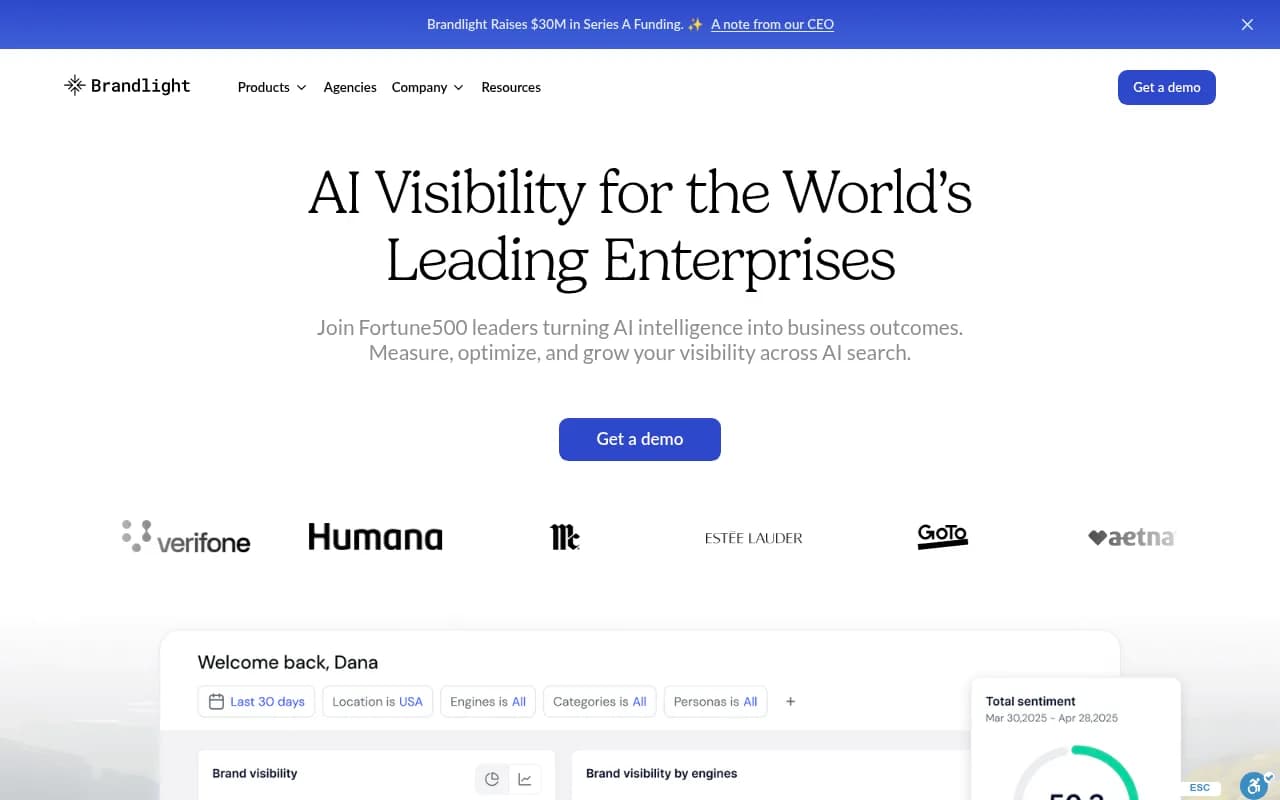
Brandlight.ai does one thing reasonably well: it shows you where your brand appears (or doesn't appear) in AI-generated responses. If you're just getting started with AI visibility monitoring, that's useful.
But most teams hit a wall pretty quickly. You can see that ChatGPT isn't citing you for a key prompt. You can see that a competitor is getting mentioned instead. What you can't do inside Brandlight is figure out why that's happening, or do anything about it.
That's the gap this guide addresses. The nine tools below all do something Brandlight doesn't — whether that's deeper prompt intelligence, content generation, crawler log access, or multi-model coverage that actually reflects how real users interact with AI search.
What to look for in a Brandlight alternative
Before jumping into the list, it's worth being clear about what actually matters when evaluating these platforms. The market is flooded with tools that all claim to "track your AI visibility," but they vary enormously in depth.
The questions worth asking:
- Does it monitor real user-facing AI responses, or just API outputs? (These can differ significantly.)
- Does it cover the AI models your customers actually use — ChatGPT, Perplexity, Gemini, Claude, Google AI Overviews?
- Can it tell you why you're not being cited, not just that you're not being cited?
- Does it help you fix the problem, or just report on it?
- How does it handle prompt volume and difficulty — can you prioritize what to chase?
With that in mind, here's how the main alternatives stack up.
Comparison table
| Tool | AI models covered | Content generation | Crawler logs | Starting price | Best for |
|---|---|---|---|---|---|
| Promptwatch | 10 | Yes | Yes | $99/mo | Full optimization loop |
| Profound | 10+ | No | No | $199/mo | Enterprise citation analytics |
| Otterly.AI | 5+ | No | No | ~$49/mo | Budget monitoring |
| Peec AI | 6+ | No | No | $79/mo | Multi-language tracking |
| Scrunch AI | 6+ | No | No | $300/mo | Site architecture testing |
| AthenaHQ | 8+ | No | No | Custom | Monitoring-focused teams |
| Orchly | Multiple | Yes | No | $49/mo | Content + monitoring combo |
| LLM Pulse | Multiple | No | No | Varies | LLM response tracking |
| Semrush | Google-focused | Partial | No | $139.95/mo | Teams already on Semrush |
1. Promptwatch — the full optimization loop
Most tools in this space show you a dashboard and leave you to figure out the rest. Promptwatch is built differently: it's designed around a cycle of finding gaps, creating content to close them, and tracking whether that content actually gets cited.
The Answer Gap Analysis is the part that stands out most. It shows you the specific prompts where competitors are being cited and you're not — not as a vague "you're losing share" metric, but as a list of actual questions and topics your site isn't answering. From there, Content Agents generate articles, comparisons, and briefs grounded in that prompt data, so you're not just publishing content and hoping for the best.
On the tracking side, Promptwatch monitors 10 AI models including ChatGPT, Perplexity, Claude, Gemini, Google AI Overviews, DeepSeek, Grok, and Copilot. It tracks real user-facing responses, not just API outputs — which matters because what a model says in a chat interface often differs from what it returns via API. The crawler log feature shows you which AI agents are hitting your pages, how often, and whether those crawls are converting to citations.
It also covers things most competitors don't touch: Reddit and YouTube insights (both heavily influence AI recommendations), ChatGPT Shopping tracking, and query fan-outs that show how a single prompt branches into sub-queries.
Pricing starts at $99/month for the Essential plan (1 site, 50 prompts, 5 articles), $249/month for Professional (2 sites, 150 prompts, 15 articles, crawler logs), and $579/month for Business (5 sites, 350 prompts, 30 articles). A free trial is available.

2. Profound — strong analytics, enterprise price
Profound is one of the more mature platforms in this space and has built a solid reputation for citation analytics. It tracks 10+ AI engines and has processed 400M+ prompt insights, which gives it real depth when you're trying to understand citation patterns at scale.
Where Profound shines is in the analytics layer. You get detailed breakdowns of which sources AI models cite, how your brand appears across different query types, and how visibility shifts over time. For enterprise brands that need to report on AI visibility to stakeholders, that reporting depth is genuinely useful.
The limitation is that Profound stops at monitoring. There's no content generation, no gap analysis that tells you what to create, and no crawler logs. You get excellent data, but the "what do I do with this?" question is left to you. At $199/month to start, you're paying a premium for analytics without the optimization layer.

3. Otterly.AI — affordable entry point
Otterly.AI is one of the more accessible options for teams that are just starting to think about AI visibility. The interface is clean, setup is fast, and the pricing is reasonable compared to most alternatives.
It covers the major AI models and gives you a clear picture of where your brand appears in responses. For small teams or solo marketers who want to get a baseline sense of their AI visibility without a big budget commitment, it works fine.
The honest limitation: Otterly.AI is monitoring-only. No content generation, no crawler logs, no gap analysis. It tells you what's happening but not why, and it doesn't help you change it. If you're at the stage where you just want to know whether AI models mention you at all, it's a reasonable starting point. If you want to actually improve your visibility, you'll outgrow it quickly.

4. Peec AI — multi-language tracking
Peec AI's main differentiator is its multi-language and multi-region support. If your brand operates across markets and you need to track AI visibility in French, German, Spanish, or other languages, Peec handles that better than most alternatives.
The platform covers major AI models and gives you visibility scores, citation tracking, and competitive comparisons. The UI is straightforward and the data is generally reliable.
Like Otterly.AI, Peec is monitoring-focused. The $79/month starting price is fair for what you get, but the ceiling is relatively low. Teams that need to understand why they're not being cited, or that want to generate content to close gaps, will need to supplement it with other tools.

5. Scrunch AI — for site architecture testing
Scrunch AI takes a slightly different angle. Beyond tracking AI citations, it's built to help teams understand how their site architecture affects AI crawlability and visibility. If you're rebuilding a site or testing how structural changes affect AI indexing, that's a useful lens.
The starting price of $300/month puts it in a higher tier, which makes it harder to justify unless you're actively running site architecture experiments. For most teams, the monitoring features alone don't warrant the cost compared to cheaper alternatives.
6. AthenaHQ — monitoring with good model coverage
AthenaHQ covers 8+ AI search engines and has a clean interface for tracking brand mentions and citation trends. It's positioned as an enterprise-grade monitoring tool, and the model coverage is genuinely broad.
The platform is monitoring-focused — no content generation, no crawler logs. But for teams that need reliable, multi-model tracking without the complexity of a full optimization suite, it's a reasonable option. Pricing is custom, which typically means it's aimed at larger organizations.

7. Orchly — content automation with monitoring
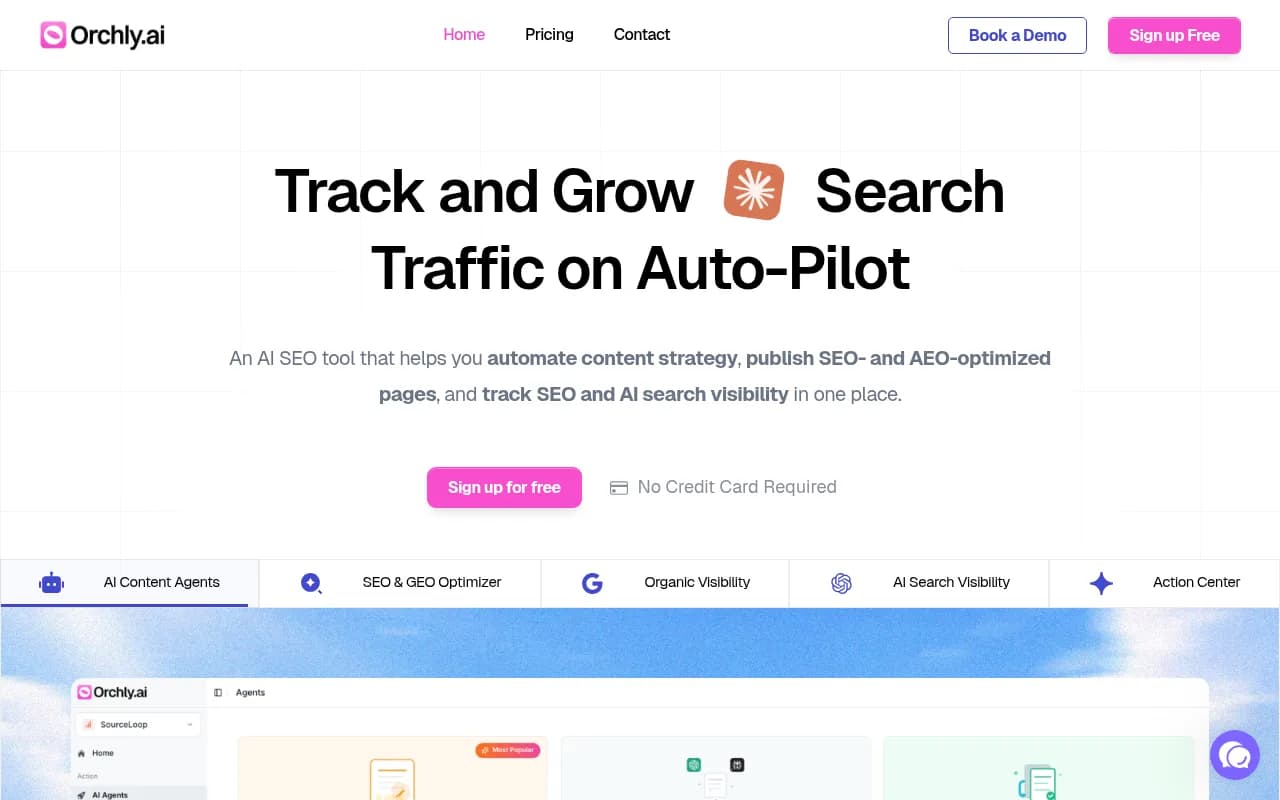
Orchly is interesting because it tries to bridge monitoring and content creation, similar in concept to Promptwatch but at a lower price point ($49/month). It combines AI visibility tracking with content automation tools, which means you can act on what you find without switching platforms.
The monitoring depth is lighter than dedicated analytics platforms, and the content generation is less sophisticated than what you'd get from a purpose-built GEO platform. But for smaller brands or agencies working with tighter budgets, the combination of monitoring and content in one tool at $49/month is genuinely useful.
8. LLM Pulse — focused on LLM response tracking
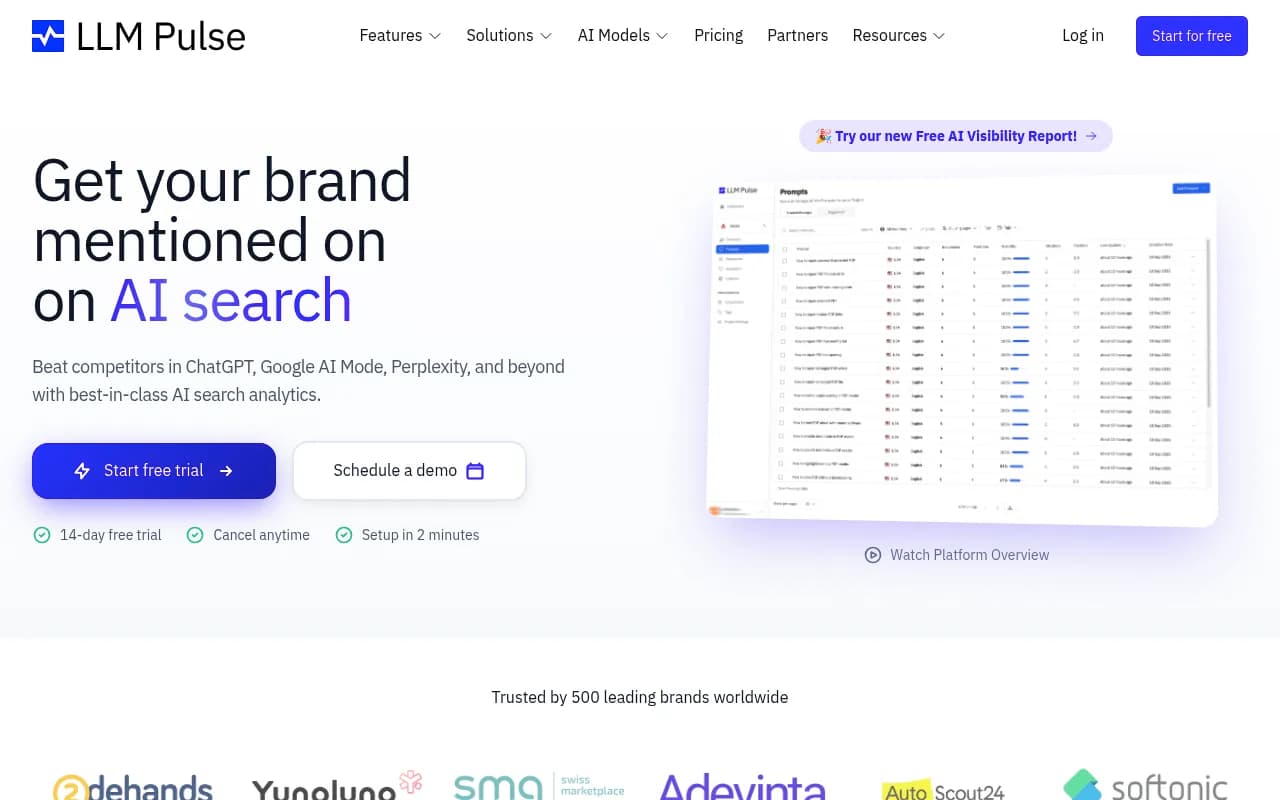
LLM Pulse is built specifically around tracking how large language models respond to prompts related to your brand and industry. It's more narrowly focused than some alternatives, which can be a feature or a limitation depending on what you need.
If your primary concern is understanding how different LLMs frame responses about your category — and you want detailed response-level data — LLM Pulse delivers that. It's less useful if you want a full picture of AI search visibility including Google AI Overviews or shopping recommendations.
9. Semrush — for teams already in the ecosystem
Semrush added AI visibility features to its existing platform, which makes it a reasonable option if you're already paying for Semrush and don't want to add another tool. The AI Toolkit gives you some monitoring of AI-generated responses alongside the traditional SEO data you're already using.
The limitation is that Semrush's AI visibility features use fixed prompts rather than dynamic tracking, and there's no AI traffic attribution. It's a useful addition to an existing Semrush workflow, but it's not a substitute for a dedicated AI visibility platform if that's your primary need.
The monitoring-only problem
It's worth naming something directly: most of the tools in this list are monitoring dashboards. They show you data. They don't help you change it.
That's not a criticism of the tools themselves — monitoring is genuinely useful, and knowing where you stand is the first step. But there's a real gap between "I can see that I'm not being cited for this prompt" and "I know what content to create and I've published it and I can see it's working."
The platforms that close that loop are fewer. Promptwatch is the most complete example: gap analysis that shows you what's missing, content generation grounded in prompt data, and page-level tracking that connects new content to citation outcomes. Orchly tries to do something similar at a lower price point. Most others stop at step one.
If you're evaluating alternatives to Brandlight, the honest question to ask is: what do you actually need? If you need a baseline sense of your AI visibility and you're not ready to invest in optimization, a monitoring-only tool is fine. If you're trying to move the needle — to actually rank in AI search results — you need something that helps you act, not just observe.
How to choose the right tool for your situation
A few practical filters:
You're just starting out and want to understand your baseline: Otterly.AI or Peec AI. Low cost, easy setup, gives you a clear picture of where you stand.
You operate in multiple languages or regions: Peec AI handles this better than most alternatives.
You're an enterprise brand that needs deep citation analytics and stakeholder reporting: Profound. The analytics depth is real, even if the optimization layer is missing.
You want the full loop — find gaps, create content, track results: Promptwatch. It's the only platform that covers all three steps without requiring you to stitch together multiple tools.
You're already on Semrush and just want AI visibility added: Use Semrush's AI Toolkit as a starting point, but understand its limitations around fixed prompts and attribution.
You're rebuilding your site and want to understand AI crawlability: Scrunch AI is worth looking at, though the price is high for monitoring alone.
The market is moving fast. Tools that were monitoring-only a year ago are adding optimization features, and new platforms are launching constantly. The core question — does this tool help me rank, or just tell me that I'm not ranking — is still the most useful filter to apply.