Key takeaways
- Searchable offers AI search visibility monitoring but lacks content optimization, crawler logs, and traffic attribution — the tools you need to actually improve your rankings.
- Most alternatives fall into two camps: monitoring-only dashboards (Otterly.AI, Peec AI, Goodie AI) and full optimization platforms (Promptwatch, AirOps, Profound).
- Promptwatch is the only platform in this comparison rated as a "Leader" across all GEO categories — it monitors 10 AI models, generates AI-optimized content, and closes the loop with traffic attribution.
- Profound is the strongest enterprise option if budget isn't a concern; Otterly.AI and Peec AI work well for teams that just need basic monitoring at a lower price.
- Before switching, check whether a platform covers your specific AI models, supports your languages/regions, and gives you actionable output — not just dashboards.
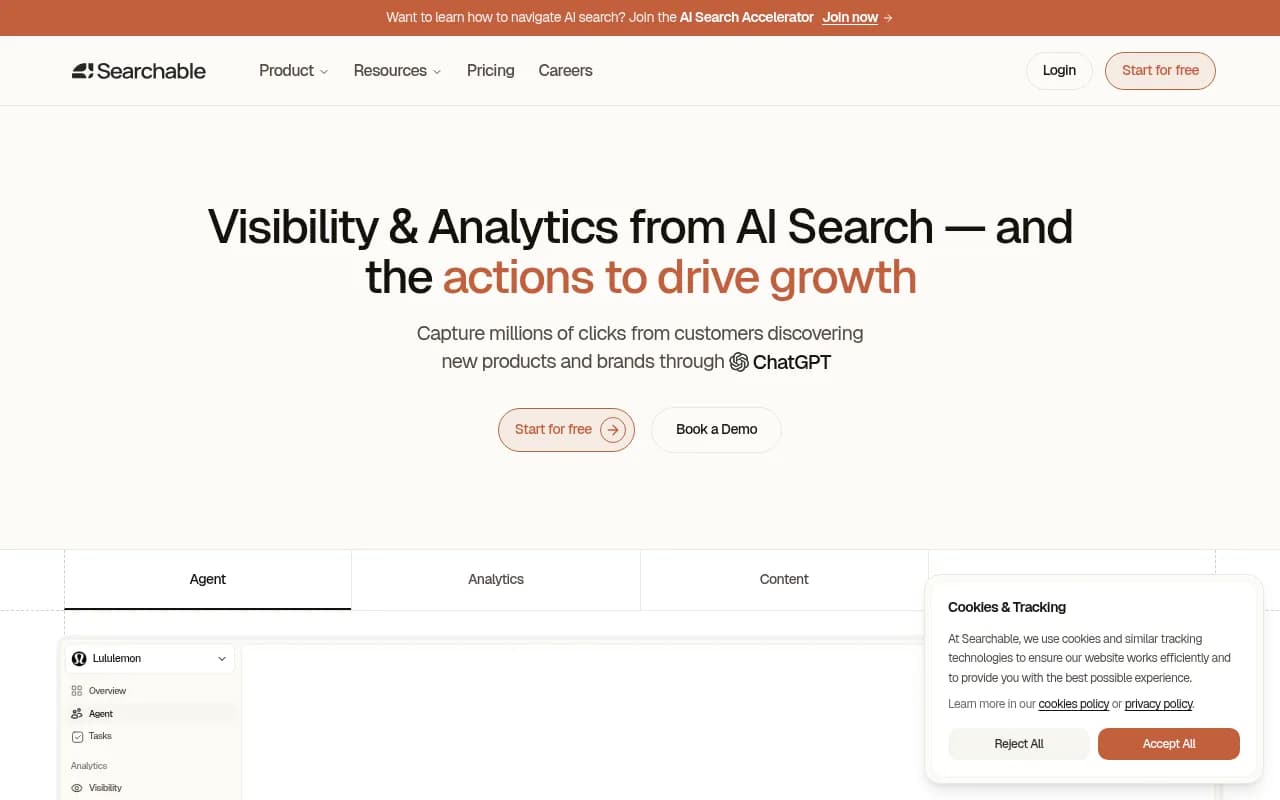
Searchable has a clear pitch: get your brand visible in AI search. The platform covers the basics — brand mention tracking across ChatGPT, Perplexity, and Google AI Overviews, plus some content generation features. For teams just getting started with GEO (Generative Engine Optimization), it's a reasonable entry point.
But teams that have been using it for a few months tend to hit the same wall. The monitoring data tells you that you're invisible for certain prompts. It doesn't tell you why, and it doesn't help you fix it with any real precision. There's no crawler log visibility, no prompt volume data to prioritize your efforts, no Reddit or YouTube citation tracking, and no traffic attribution to connect AI visibility to actual revenue.
If you've outgrown Searchable — or you're evaluating it and want to know what else is out there — this guide covers 10 alternatives worth considering in 2026, with honest notes on what each one does well and where it falls short.
What to look for in a Searchable alternative
Before jumping into the list, it's worth being clear about what separates a useful GEO platform from a monitoring dashboard that just shows you a score.
The platforms that actually move the needle tend to do three things: they identify specific content gaps (not just "you're not ranking"), they help you create content that AI models want to cite, and they show you whether that content is working. Most tools in this space only do the first part.
Other things worth checking:
- How many AI models does it cover? ChatGPT and Perplexity are table stakes. Claude, Gemini, DeepSeek, Grok, Mistral, and Meta AI matter too.
- Does it track prompt volume and difficulty, so you can prioritize?
- Can it show you which specific pages are being cited — not just your domain?
- Does it have crawler logs so you can see how AI bots interact with your site?
- Is there any traffic attribution, or does visibility data sit in a silo?
With that in mind, here are the 10 best Searchable alternatives in 2026.
The 10 best Searchable alternatives
1. Promptwatch
Promptwatch is the most complete GEO platform available right now. Where most competitors (including Searchable) stop at monitoring, Promptwatch is built around a full optimization loop: find gaps, create content, track results.
The Answer Gap Analysis shows you exactly which prompts competitors are visible for that you're not — not as a vague category, but as specific questions with volume estimates and difficulty scores. The built-in AI writing agent then generates articles, listicles, and comparisons grounded in 880M+ citations analyzed. And page-level tracking shows whether that new content is actually getting cited by ChatGPT, Claude, Perplexity, or any of the other 10 models it covers.
What makes it genuinely different from Searchable is the depth underneath the surface. AI Crawler Logs show you which pages ChatGPT and Perplexity are actually reading, how often they return, and what errors they encounter. Reddit and YouTube citation tracking surfaces the discussions that influence AI recommendations — a channel most platforms ignore. ChatGPT Shopping tracking monitors product recommendation appearances. And traffic attribution (via code snippet, GSC integration, or server log analysis) connects visibility to revenue.
Pricing starts at $99/mo for the Essential plan (1 site, 50 prompts, 5 articles), $249/mo for Professional (2 sites, 150 prompts, 15 articles, crawler logs), and $579/mo for Business (5 sites, 350 prompts, 30 articles). A free trial is available.

2. Profound
Profound is the other platform that genuinely competes at the top of this category. It's well-funded, covers 10+ AI models, and has a Conversation Explorer feature that lets you dig into how AI models are actually responding to prompts in your space — not just whether your brand appears.
The main friction point is price. Profound starts at $499/month, which puts it out of reach for most SMBs and smaller agencies. It's built for enterprise brands with dedicated analytics resources, and the feature depth reflects that. If you have the budget and need the most comprehensive monitoring available, Profound is worth a serious look.
It doesn't have Reddit tracking, ChatGPT Shopping monitoring, or built-in content generation, so it's more of a monitoring-and-analysis platform than a full optimization stack.

3. Otterly.AI
Otterly.AI is one of the most popular monitoring-only tools in the GEO space, and it earned Gartner Cool Vendor recognition in 2025 with strong user ratings. It covers ChatGPT, Perplexity, and Google AI Overviews, and its pricing undercuts Searchable significantly.
The limitation is that it's purely a monitoring dashboard. There's no content generation, no crawler logs, no traffic attribution, and no prompt volume data. You'll know where you're invisible; you won't get much help becoming visible. For teams that just need a lightweight tracker and are handling optimization separately, it works well. For teams that want one platform to do both, it falls short.

4. Peec AI
Peec AI takes a different approach to accuracy: it scrapes actual AI search interfaces rather than using API responses, which means you're seeing what real users see rather than synthetic outputs. That's a meaningful distinction for teams where accuracy matters more than speed.
It also has the strongest multilingual coverage in the category — 115+ languages, which makes it the go-to for global brands tracking non-English markets. Funding of $30M+ suggests it's not going anywhere soon.
The downsides: it's monitoring-only, with no content generation or optimization tools, and the pricing (starting around €89/month) is reasonable but adds up quickly as you scale prompts.

5. AthenaHQ
AthenaHQ sits in an interesting middle ground. It has an "Action Center" that provides strategic recommendations based on your visibility data — which is more than most monitoring tools offer — and it has native GA4 and Google Search Console integrations on its self-serve plan, which is genuinely useful for connecting AI visibility to web analytics.
Case studies on the site show 10x citation rate improvements, which is a specific enough claim to take seriously. The platform starts at $295/month and covers ChatGPT, Perplexity, Claude, and Gemini.
The gap versus Promptwatch is content generation. AthenaHQ tells you what to fix but doesn't help you create the content to fix it. For teams with strong in-house writers, that's fine. For teams that want the full loop in one tool, it's a limitation.

6. AirOps
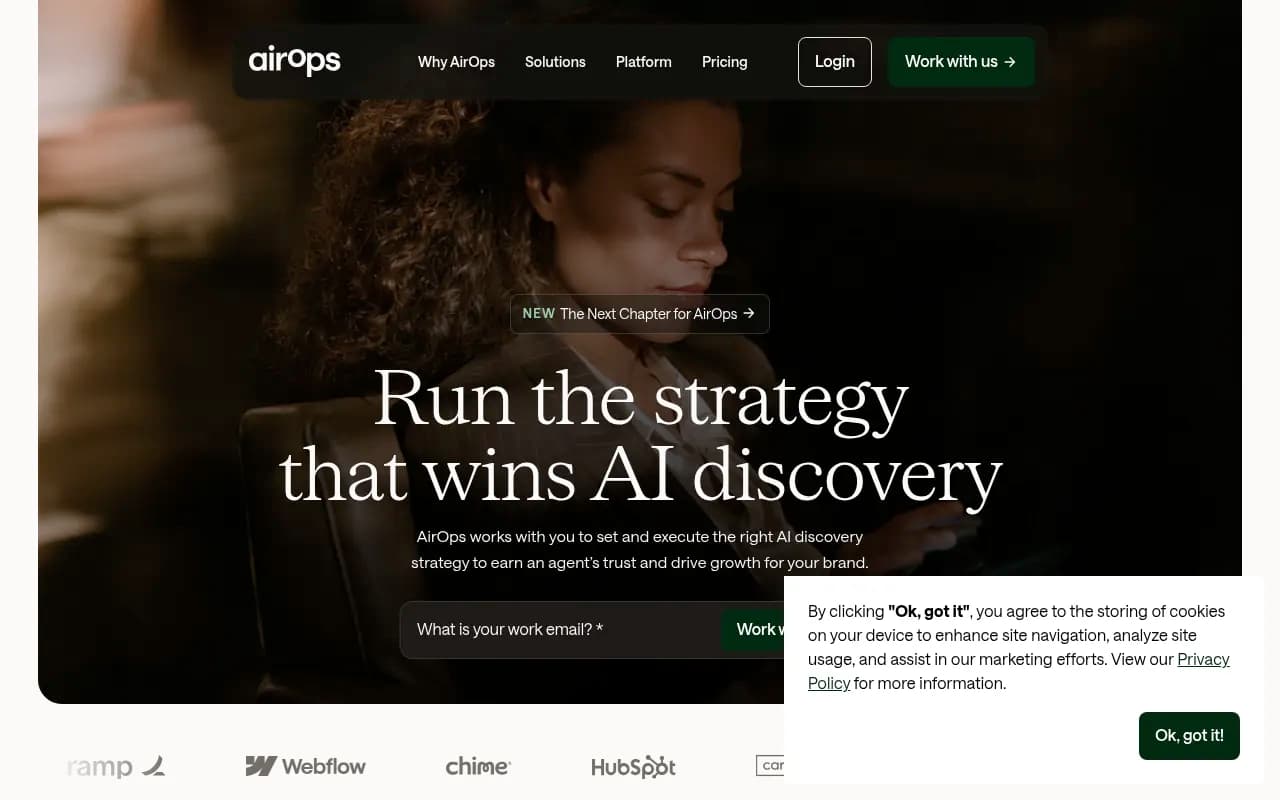
AirOps approaches GEO from the content side rather than the monitoring side. It's an end-to-end content engineering platform that helps teams research, write, and publish content specifically designed to get cited by AI models. The citation data it draws on is substantial, and it integrates with existing content workflows reasonably well.
If your primary problem is "we need to create more AI-optimized content at scale" rather than "we need to understand our current visibility," AirOps is worth evaluating. It's less useful as a monitoring tool and more useful as a production system.
7. Scrunch AI
Scrunch AI is one of the more enterprise-focused options in this list, with SOC 2 compliance that matters for larger organizations with security requirements. It covers 7+ AI platforms and has solid monitoring capabilities.
The starting price of $300/month puts it in a competitive range with AthenaHQ and Profound's lower tiers, but it doesn't offer content generation or crawler logs. For compliance-conscious enterprise teams that need a monitoring solution and handle content optimization elsewhere, it's a reasonable choice.
8. SE Ranking
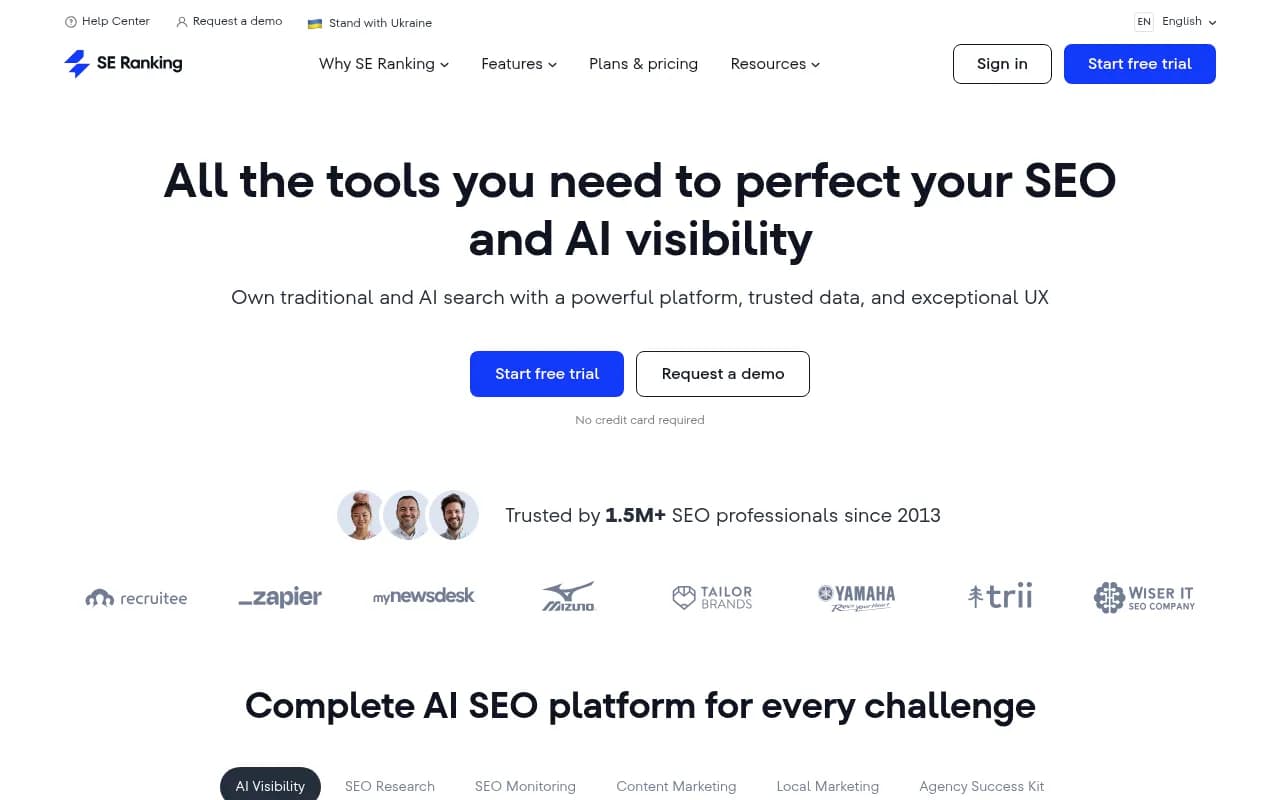
SE Ranking is primarily a traditional SEO platform — rank tracking, site audits, keyword research — but it has added AI visibility features that make it worth mentioning here. If your team is already paying for an SEO platform and wants basic AI search monitoring without adding another tool, SE Ranking covers that ground.
The AI visibility features aren't as deep as dedicated GEO platforms, but the value proposition is clear: one subscription for both traditional SEO and basic AI monitoring. For teams that don't need deep GEO optimization, this consolidation makes sense.
9. Omnia
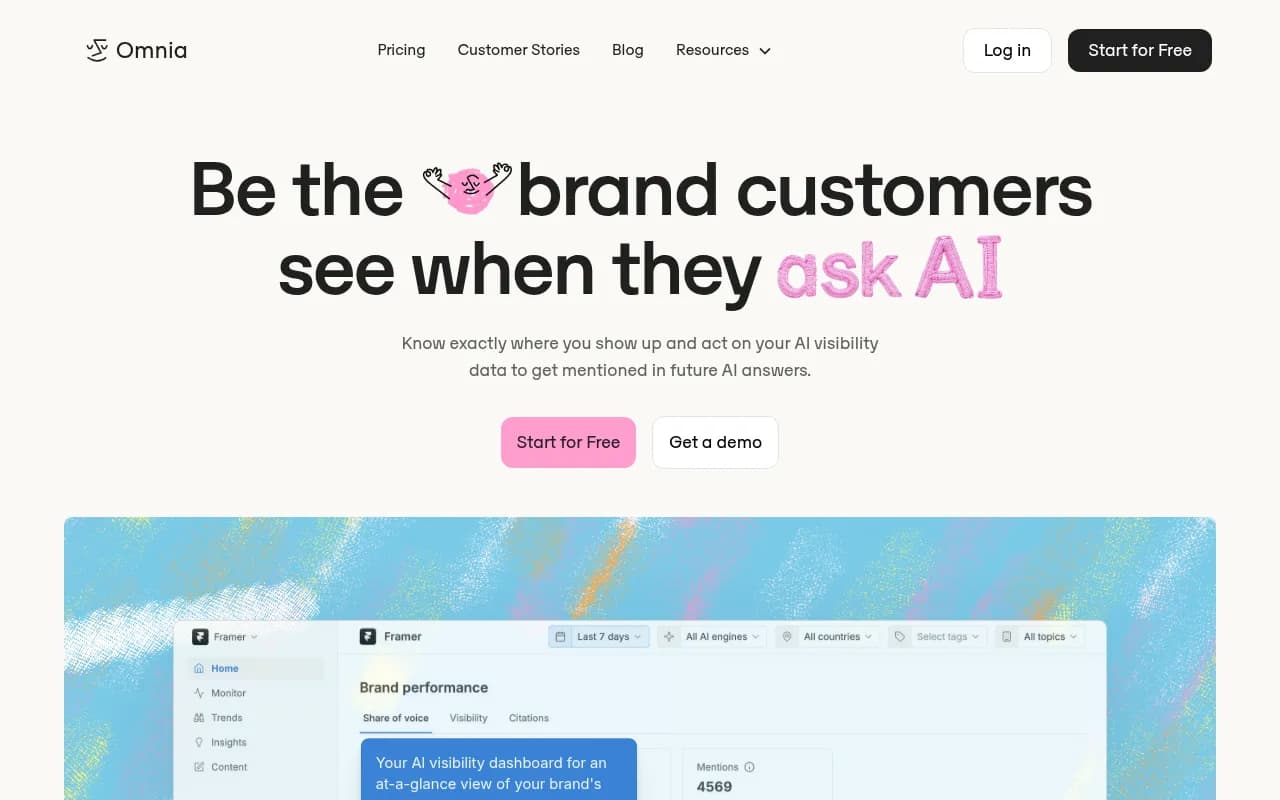
Omnia focuses on URL-level citation intelligence — not just "your domain appears," but "this specific page is being cited in this specific context." For teams that want to understand which content is driving AI visibility at a granular level, that's genuinely useful.
It also has multi-engine monitoring and geo-by-country tracking. The platform is positioned for growth teams that need actionable data quickly, and the free tier makes it easy to test before committing.
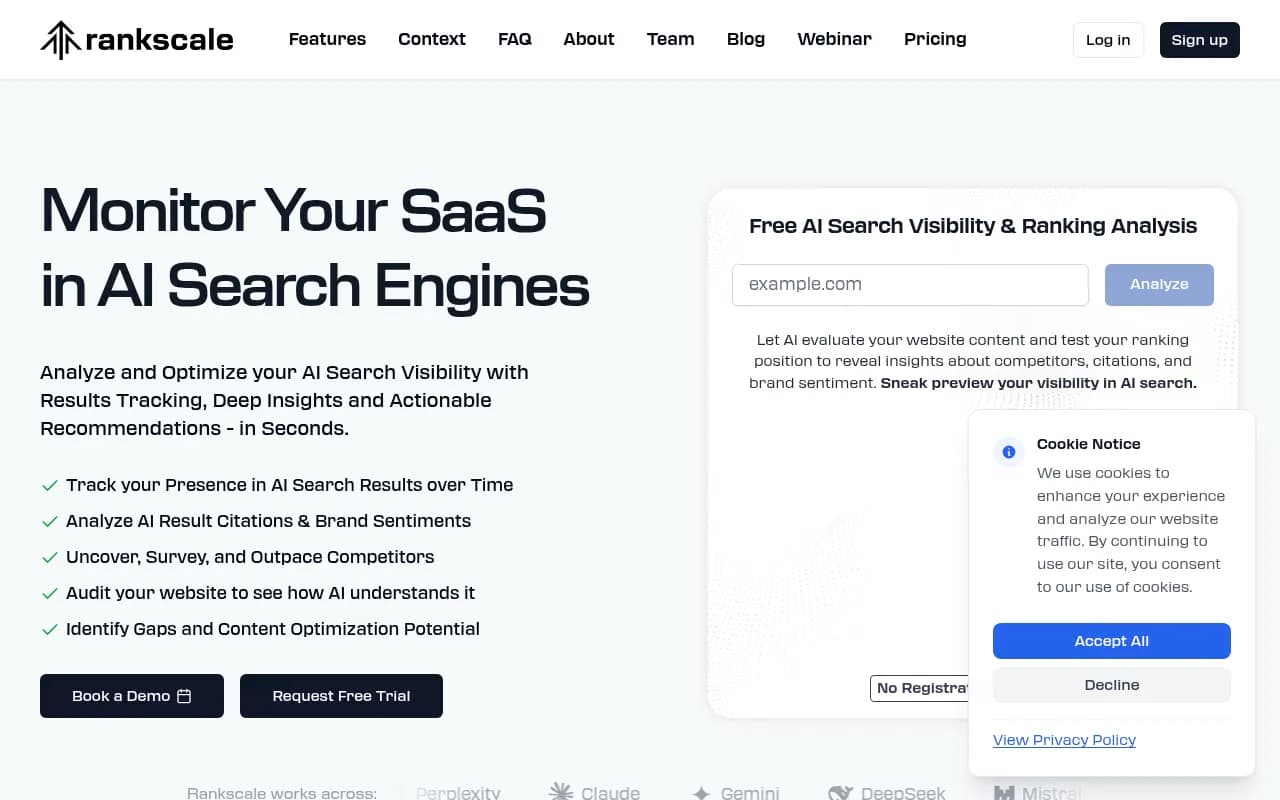
10. Rankscale
Rankscale is the most affordable entry point on this list, starting at $20/month. It covers ChatGPT, Claude, Perplexity, and Google AI Overviews, and has solid core monitoring features for the price.
For startups and small businesses that need basic AI visibility tracking without a significant budget commitment, Rankscale is the obvious starting point. It won't give you content generation, crawler logs, or deep analytics, but it gets the job done for teams in the early stages of GEO.
Side-by-side comparison
| Platform | Starting price | AI models covered | Content generation | Crawler logs | Traffic attribution | Best for |
|---|---|---|---|---|---|---|
| Promptwatch | $99/mo | 10 (incl. Mistral, Meta AI) | Yes (AI writing agent) | Yes | Yes (GSC, snippet, logs) | Full optimization loop |
| Profound | $499/mo | 10+ | No | No | No | Enterprise monitoring |
| Otterly.AI | ~$29/mo | 3 (ChatGPT, Perplexity, AIO) | No | No | No | Budget monitoring |
| Peec AI | €89/mo | 3+ | No | No | No | Multilingual tracking |
| AthenaHQ | $295/mo | 4 | No | No | GA4/GSC integration | Analytics-heavy teams |
| AirOps | Custom | Multiple | Yes | No | No | Content-first teams |
| Scrunch AI | $300/mo | 7+ | No | No | No | Compliance-conscious enterprise |
| SE Ranking | ~$65/mo | Limited | No | No | No | Traditional SEO + basic AI |
| Omnia | Free tier | Multiple | No | No | No | URL-level citation tracking |
| Rankscale | $20/mo | 4 | No | No | No | Startups, tight budgets |
| Searchable | Custom | Multiple | Limited | No | No | Basic AI monitoring |
How to choose
The right tool depends on what problem you're actually trying to solve.
If you're starting from zero and just want to understand where your brand stands across AI search engines, Rankscale or Otterly.AI get you there cheaply. If you need multilingual coverage, Peec AI is the clear choice. If you're an enterprise team with a serious budget and dedicated analysts, Profound gives you the most depth.
But if you want to actually improve your AI visibility — not just measure it — the gap between monitoring tools and optimization platforms is significant. Promptwatch is the only platform in this comparison that covers the full cycle: identifying which prompts you're losing and why, generating content engineered to get cited, and tracking whether that content is working. The crawler logs and traffic attribution features are things you won't find bundled together anywhere else at this price point.
Most teams that outgrow Searchable do so because they realize monitoring data without an action layer is just a more expensive way to feel bad about your AI visibility. The platforms that actually move the needle are the ones that help you do something about what you find.
Final thoughts
Searchable isn't a bad tool — it's a limited one. The monitoring features work, and for teams that are purely in "understand the landscape" mode, it may be enough. But the category has moved fast in 2026, and the gap between monitoring dashboards and optimization platforms has widened considerably.
Before you switch, run a quick audit of what you actually need: How many AI models matter to your audience? Do you need content generation, or do you have that covered? Is traffic attribution important for your reporting? The answers will narrow the list quickly.
For most teams that have hit Searchable's ceiling, Promptwatch is the most direct upgrade — it covers everything Searchable does and adds the optimization layer that makes the data actionable. For teams with enterprise budgets and dedicated analytics resources, Profound is worth the premium. For teams that just need basic monitoring at a lower price, Otterly.AI or Rankscale will do the job.