Key Takeaways
- Whitebox positions itself as an "agentic GEO" platform that generates and ships fixes automatically, while Brandlight focuses on monitoring and insights with a $30M Series A backing
- Pricing: Brandlight starts at $199/mo with public tiers up to $750/mo; Whitebox uses custom enterprise-only pricing with no published rates
- Brandlight has clearer Fortune 500 traction (Mastercard, Estée Lauder, Humana visible on site), Whitebox lists clients like Palo Alto Networks and eToro but less public case detail
- Neither platform offers a free tier or trial -- both are enterprise/mid-market focused
- Whitebox emphasizes automated solution generation; Brandlight emphasizes measurement and optimization but less clarity on execution automation
- For teams that want transparent pricing and a defined entry point, Brandlight is more accessible. For teams that want a white-glove agentic approach and have budget flexibility, Whitebox may fit better.
Overview
Whitebox
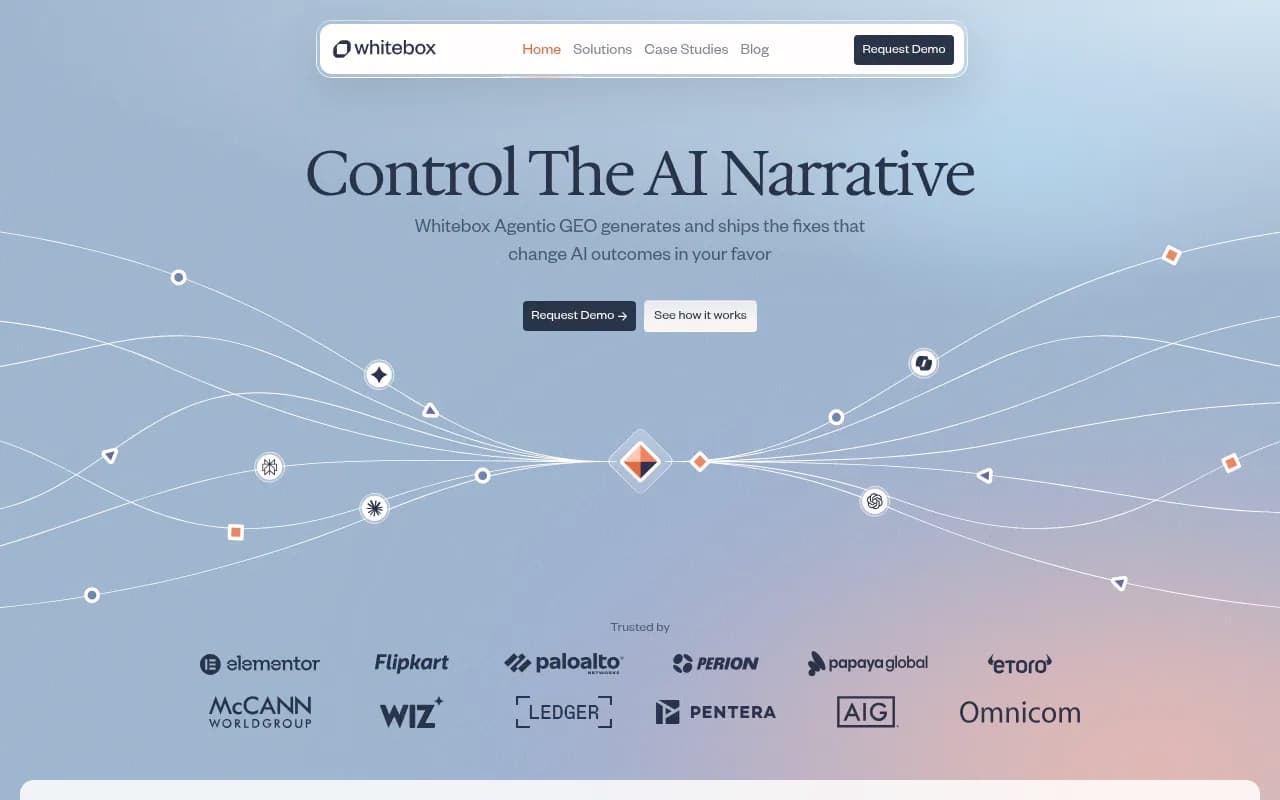
Whitebox calls itself an "agentic GEO" platform -- the pitch is that it doesn't just show you problems, it generates the fixes and ships them. The homepage emphasizes "control the AI narrative" and promises to "generate and ship the fixes that change AI outcomes in your favor." Client logos include Elementor, Flipkart, Palo Alto Networks, Perion, Papaya, eToro, McCann, Wiz, Ledger, Pentera, AIG, and Omnicom. The platform is structured around three pillars: "See the Truth" (understand how AI interprets your brand), "Get the Solutions" (measure real-time shifts), and "Influence Outcomes" (strategic intervention). Pricing is custom/enterprise-only with no public tiers.
Brandlight
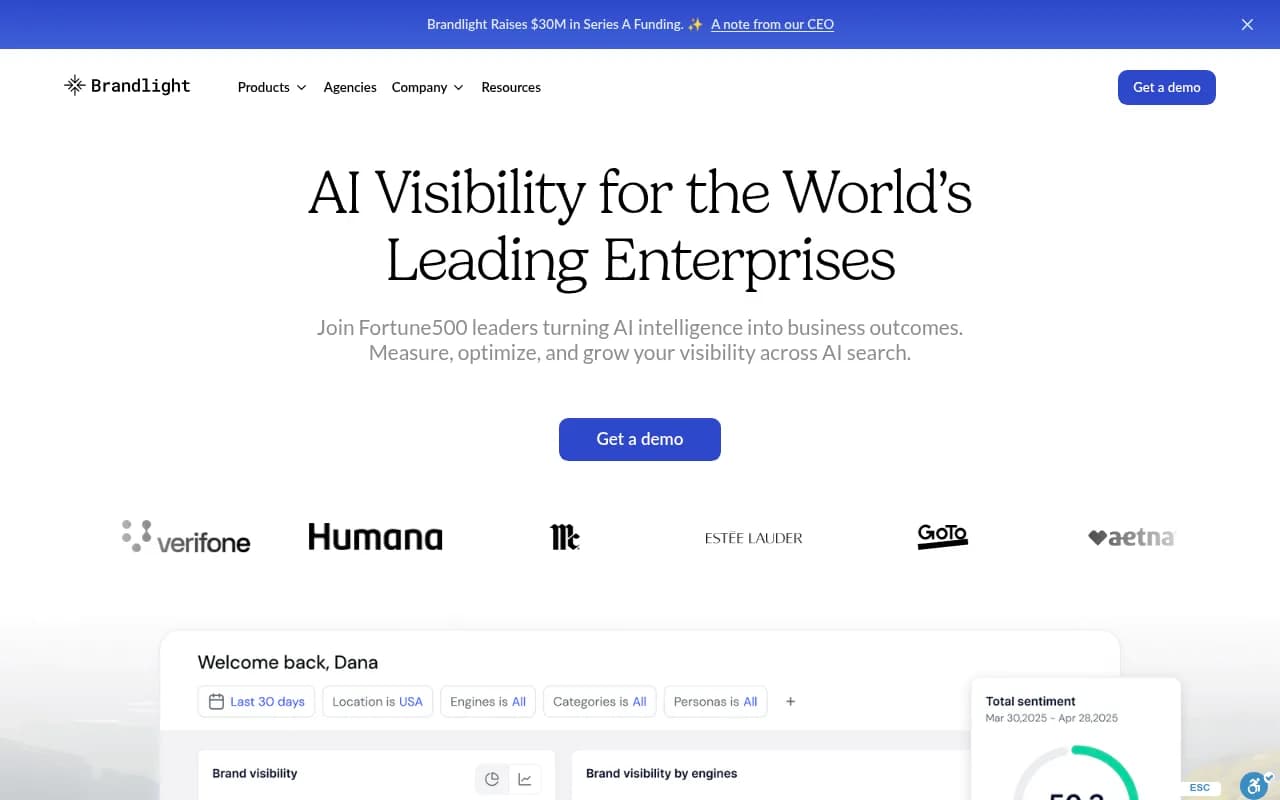
Brandlight is an AI brand visibility platform that recently raised $30M in Series A funding. It monitors and optimizes brand presence across AI search engines, with a focus on Fortune 500 clients -- Mastercard, Estée Lauder, Humana, Verifone, GoTo, Aetna, Charter, Kimberly-Clark, and Microchip are listed on the homepage. The tagline is "AI Visibility for the World's Leading Enterprises" with an emphasis on measuring, optimizing, and growing visibility across AI search. Unlike Whitebox, Brandlight publishes pricing: base tier at $199/mo, activation plan at $750/mo, plus custom enterprise options. The platform positions itself as a single source of truth for AI visibility data.
Side-by-side comparison
| Feature | Whitebox | Brandlight |
|---|---|---|
| Starting price | Custom (no public pricing) | $199/mo |
| Free tier | No | No |
| Pricing transparency | None (enterprise-only) | Public tiers + enterprise |
| Agentic automation | Yes ("generates and ships fixes") | Limited (optimization guidance) |
| Fortune 500 clients | Yes (Palo Alto, AIG, Omnicom) | Yes (Mastercard, Estée Lauder, Humana) |
| Recent funding | Not disclosed | $30M Series A (2025) |
| AI engines monitored | Not specified on site | Not specified on site |
| Content generation | Implied ("generates fixes") | Not mentioned |
| Single source of truth | Not emphasized | Yes (core positioning) |
| Trial availability | No | No |
| Target market | Enterprise | Mid-market to enterprise |
| API access | Not mentioned | Not mentioned |
Pricing breakdown
| Plan | Whitebox | Brandlight |
|---|---|---|
| Entry tier | Custom quote only | $199/mo (base) |
| Mid tier | Custom quote only | $750/mo (activation) |
| Enterprise | Custom quote | Custom quote |
| Free trial | No | No |
| Annual discount | Unknown | Unknown |
Whitebox's lack of public pricing makes it harder to budget or compare directly. If you're a mid-sized company that wants to know costs upfront, Brandlight wins here. If you're an enterprise buyer used to RFP processes and custom deals, the pricing model difference matters less.
Agentic capabilities and automation
Whitebox's core differentiator is the "agentic GEO" claim -- the platform says it generates the fixes and ships them, not just tells you what's wrong. The homepage copy emphasizes "We Generate The Fixes" and talks about influencing outcomes strategically. This suggests some level of automated content generation, optimization recommendations that get implemented, or direct integrations that push changes live. The details are vague, but the positioning is clear: this is meant to be a do-it-for-you platform, not just a dashboard.
Brandlight doesn't make the same agentic claim. The focus is on "measure, optimize, and grow your visibility" -- classic monitor-and-advise language. The $30M raise and Fortune 500 client list suggest the platform is robust, but the messaging doesn't emphasize automation or fix generation. You're getting insights and recommendations, then your team executes.
Verdict: If you want a platform that claims to automate fixes, Whitebox is positioned for that. If you want a measurement platform with strong enterprise credibility, Brandlight fits. The gap is whether you trust Whitebox's agentic claims without seeing the product.
Enterprise credibility and client base
Both platforms list impressive clients. Whitebox shows Palo Alto Networks, AIG, Omnicom, eToro, Wiz, Ledger, and others. Brandlight counters with Mastercard, Estée Lauder, Humana, Verifone, GoTo, Aetna, Charter, Kimberly-Clark. Brandlight's $30M Series A (announced prominently on the homepage) adds a layer of validation -- investors are betting big on this space, and Brandlight is one of the winners.
Whitebox doesn't mention funding or investor backing on the homepage, which could mean they're bootstrapped, privately funded, or just not emphasizing it. The client logos are strong, but there's less public case study or testimonial content visible.
Verdict: Brandlight has more visible enterprise momentum right now, especially with the funding announcement. Whitebox has solid clients but less public proof.
User experience and accessibility
Brandlight's pricing transparency ($199/mo entry point) makes it more accessible to mid-market teams or companies that want to test the waters without a six-month enterprise sales cycle. You can see the cost, evaluate the ROI, and make a decision.
Whitebox's custom-only pricing means you're going through a demo, discovery call, and quote process no matter what. This works fine for enterprises with procurement teams, but it's a barrier for smaller companies or teams that want to move fast.
Neither platform offers a free tier or trial, which is standard for enterprise GEO tools but still a friction point. You're committing budget before you see the product in action.
Verdict: Brandlight is easier to buy if you're not an enterprise. Whitebox requires more upfront sales engagement.
Data depth and monitoring coverage
Neither platform specifies which AI engines they monitor on their public-facing sites. This is a gap -- you'd expect to see "ChatGPT, Perplexity, Claude, Gemini, etc." listed somewhere. Whitebox's homepage talks about "how AI systems interpret your brand" (plural), and Brandlight mentions "AI search" broadly, but no specifics.
Brandlight emphasizes being a "single source of truth" for AI visibility data, which suggests centralized reporting and unified dashboards. Whitebox talks about "scientific clarity" and "real-time shifts in AI perception," which implies granular tracking but doesn't spell out the data model.
Without hands-on access or detailed feature pages, it's hard to compare data depth directly. Both platforms are clearly monitoring multiple AI engines, but the lack of transparency here is frustrating.
Verdict: Tie, but both platforms should publish more specifics about coverage.
Content optimization and execution
Whitebox's "agentic" positioning suggests it helps you create or optimize content to influence AI outcomes. The "Influence Outcomes" pillar and "generates the fixes" language point to some form of content generation or optimization workflow. Whether that's AI-written articles, schema markup suggestions, or something else isn't clear from the homepage.
Brandlight doesn't mention content generation or optimization tools on the public site. The focus is on visibility measurement and tracking. You're getting the data to inform your content strategy, but you're building the content yourself (or with other tools).
This is a meaningful difference. If you want a platform that helps you act on the insights -- not just see them -- Whitebox's positioning is stronger. If you have a content team and just need the visibility data, Brandlight works.
Verdict: Whitebox appears to offer more on the execution side, though specifics are unclear. Brandlight is monitoring-first.
Pros and cons
Whitebox pros
- Agentic positioning (claims to generate and ship fixes, not just report)
- Strong enterprise client logos (Palo Alto, AIG, Omnicom)
- Emphasis on influencing outcomes, not just tracking
- "Scientific clarity" and real-time measurement messaging
Whitebox cons
- No public pricing (enterprise-only, custom quotes)
- Vague on specifics (which AI engines, what "fixes" look like, how automation works)
- No free tier or trial
- Less visible funding or market validation compared to Brandlight
Brandlight pros
- Public pricing starting at $199/mo (more accessible)
- $30M Series A funding (strong market validation)
- Fortune 500 client base with recognizable brands (Mastercard, Estée Lauder, Humana)
- "Single source of truth" positioning for unified reporting
- More transparent entry point for mid-market teams
Brandlight cons
- No mention of content generation or automated optimization
- Monitoring-focused, less emphasis on execution
- No free tier or trial
- Vague on which AI engines are covered
- Higher-tier pricing ($750/mo activation plan) still expensive for smaller teams
Who should pick which tool
Pick Whitebox if:
- You're an enterprise with budget flexibility and want a white-glove, agentic approach
- You want a platform that claims to generate fixes and influence outcomes, not just report data
- You're comfortable with custom pricing and a longer sales cycle
- You value the "do it for you" positioning over transparent pricing
Pick Brandlight if:
- You want transparent pricing and a clear entry point ($199/mo)
- You're a mid-market or enterprise team that needs visibility data but has content/optimization resources in-house
- You value recent funding and visible Fortune 500 traction as a signal of platform stability
- You want a "single source of truth" dashboard for AI visibility without needing automated fix generation
Consider alternatives if:
- You want a platform with a free tier or trial (neither offers this)
- You need detailed public documentation on which AI engines are covered before buying
- You're looking for a tool that combines monitoring with content gap analysis and AI-generated articles -- Promptwatch covers that angle with transparent pricing, crawler logs, and a built-in content generation engine grounded in 880M+ citations analyzed.

Final verdict
Brandlight is the safer pick for most teams in 2026. The $199/mo entry point, $30M funding round, and Fortune 500 client base give you confidence you're buying a real platform with staying power. You're getting visibility measurement and optimization insights, which is what most teams need to start.
Whitebox's agentic positioning is compelling if it delivers -- a platform that generates and ships fixes would be a huge time-saver. But the lack of pricing transparency, vague feature details, and less visible market validation make it a riskier bet. If you're an enterprise buyer who can afford a custom deal and wants a white-glove approach, Whitebox might be worth the discovery call. For everyone else, Brandlight's clearer value prop and accessible pricing make it the better starting point.
The real question is whether either platform gives you the full loop: find gaps, create content, track results. Both are strong on tracking, weaker on content execution. That's where a tool like Promptwatch fits as a complement -- it shows you what's missing, helps you generate the content AI models want to cite, then tracks the visibility lift. Whitebox hints at this with "agentic" language, but the details aren't public. Brandlight is transparent about being a measurement platform. Pick based on whether you need the data or the full workflow.