Key Takeaways
- Bear AI starts at $100/mo and targets growth teams with a focus on traffic generation, while Brandlight starts at $199/mo and positions itself for Fortune 500 enterprises with deeper analytics
- Bear AI's Basic plan only tracks ChatGPT (GPT-5), making it limiting for multi-LLM visibility -- Brandlight covers more AI engines out of the box
- Brandlight just raised $30M Series A and works with Mastercard, Humana, and Estée Lauder -- it's built for enterprise compliance and scale
- Bear AI emphasizes "marketing stack for AI agents" with a product-led growth approach, while Brandlight leans into audits, strategy consulting, and white-glove service
- Neither platform publicly details content generation or optimization tools in the way some competitors do -- both are primarily monitoring and analytics platforms
- If you're a startup or mid-market team looking for affordable multi-LLM tracking, Bear AI's Enterprise tier (custom pricing) is worth exploring. If you're a large enterprise needing vendor credibility and Fortune 500 references, Brandlight is the safer bet.
Overview
Bear AI
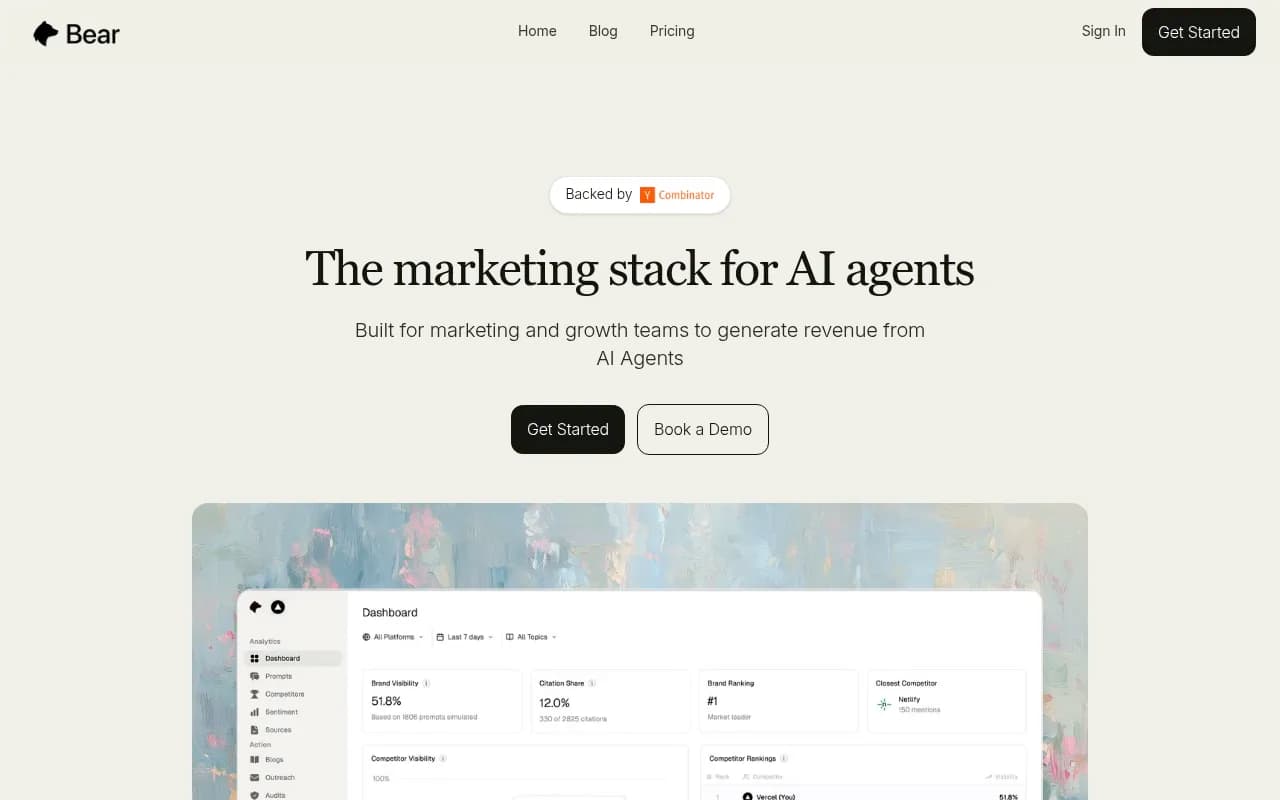
Bear AI calls itself "the marketing stack for AI agents" and targets marketing and growth teams trying to generate revenue from AI search. Backed by Y Combinator, it's used by companies like Peerspace, Medal, and Wispr Flow. The platform tracks how AI agents discover your brand and provides optimization guidance to boost traffic from LLMs.
The pitch is straightforward: see how AI talks about you, find the most-searched prompts, and optimize your visibility. Bear AI monitors ChatGPT, Claude, Google AI Overviews, Perplexity, and other major LLMs. Pricing starts at $100/mo for a Basic plan (GPT-5 only, 30 prompts, 2 blogs/mo), with Enterprise plans offering unlimited tracking across all AI platforms.
Brandlight
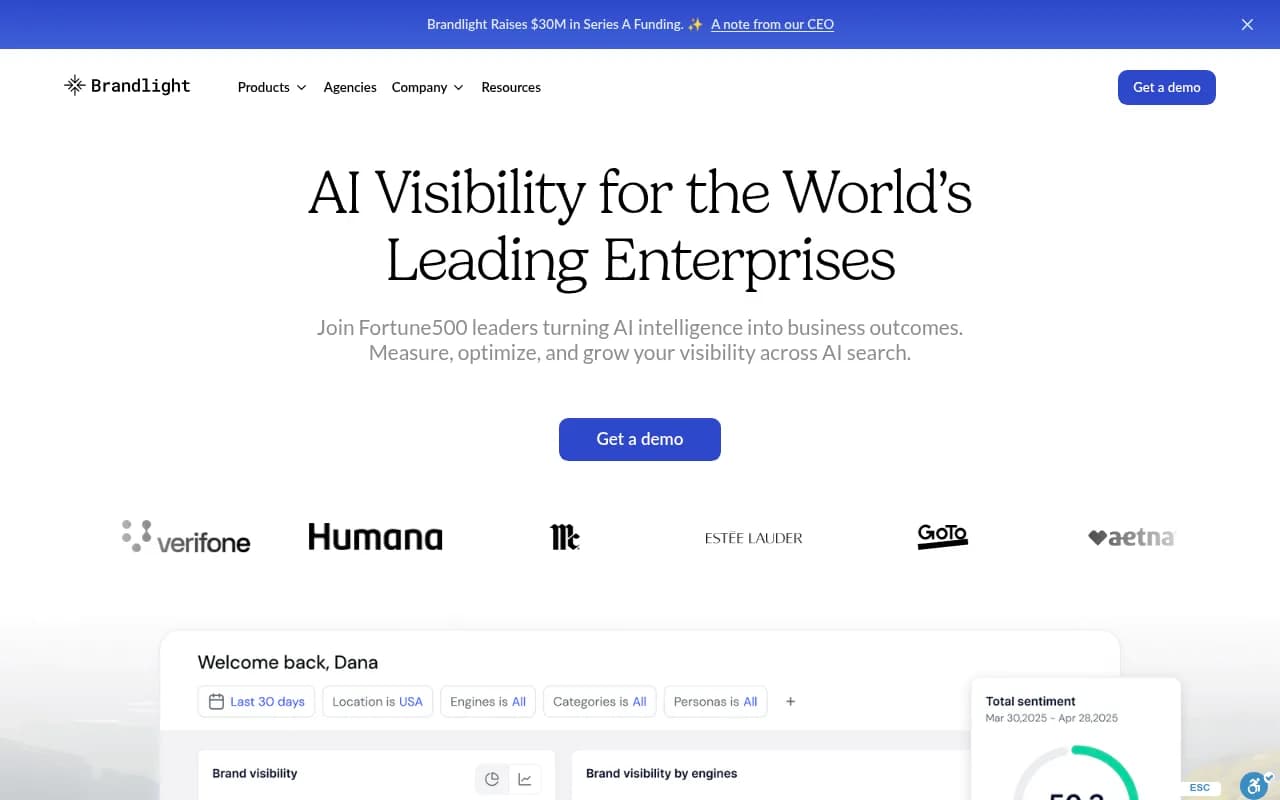
Brandlight positions itself as the AI visibility platform for Fortune 500 enterprises. It just raised $30M in Series A funding and works with Mastercard, Humana, Estée Lauder, Aetna, and other large brands. The platform monitors and analyzes brand presence across AI search engines, helping companies understand their visibility in LLM-generated responses.
Brandlight's messaging emphasizes "AI intelligence into business outcomes" and offers AI Visibility Audits, Generative Content Strategy, and real-time threat intelligence. Pricing starts at $199/mo for the base tier, $750/mo for the activation plan, and custom enterprise pricing for larger deployments. The focus is on measurement, optimization, and growth across AI search.
Side-by-side comparison
| Feature | Bear AI | Brandlight |
|---|---|---|
| Starting price | $100/mo | $199/mo |
| Free tier | No | No |
| LLM coverage (Basic) | ChatGPT only (GPT-5) | Multiple LLMs |
| LLM coverage (Enterprise) | All major LLMs | All major LLMs |
| Prompt tracking (Basic) | 30 prompts | Not disclosed |
| Content generation | 2 blogs/mo (Basic) | Not disclosed |
| Target customer | Startups, growth teams | Fortune 500 enterprises |
| Customer examples | Peerspace, Medal, Wispr Flow | Mastercard, Humana, Estée Lauder |
| Backing | Y Combinator | $30M Series A |
| API access | Not disclosed | Not disclosed |
| White-glove service | Not emphasized | AI Visibility Audits, strategy consulting |
| Traffic analytics | Yes ("analyze traffic from all major LLMs") | Yes ("measure, optimize, and grow visibility") |
Pricing breakdown
Both platforms use tiered pricing, but the structure and value proposition differ significantly.
| Plan | Bear AI | Brandlight |
|---|---|---|
| Entry tier | $100/mo (Basic: GPT-5 only, 30 prompts, 2 blogs/mo) | $199/mo (base tier, details not disclosed) |
| Mid tier | Not disclosed | $750/mo (activation plan, details not disclosed) |
| Enterprise | Custom pricing (all AI platforms, unlimited tracking) | Custom pricing |
Bear AI's Basic plan is cheaper but severely limited -- you only get ChatGPT tracking, which defeats the purpose of multi-LLM visibility. The real value is in the Enterprise tier, but pricing isn't public. Brandlight's $199/mo base tier presumably covers more LLMs from the start, but the feature breakdown isn't clear on the website. The $750/mo "activation plan" suggests a heavier focus on strategy and consulting, not just software access.
Neither platform offers a free tier or trial, which is a barrier compared to some competitors in this space.
LLM coverage and tracking depth
Bear AI explicitly lists ChatGPT, Claude, Google AI Overviews, Google AI Search, and Perplexity in its marketing. The Basic plan only covers "GPT-5" (presumably ChatGPT), which is a major limitation. The Enterprise plan unlocks "all AI platforms," but there's no public list of exactly which models that includes.
Brandlight's website doesn't list specific LLMs by name, which is frustrating. The messaging is all about "AI search engines" and "LLM-generated responses," but no breakdown of whether that means ChatGPT, Claude, Gemini, DeepSeek, Grok, etc. For an enterprise platform charging $199-$750/mo, this lack of transparency is a red flag.
Both platforms claim to track "trending prompts" and "most-searched prompts," but neither explains how they estimate prompt volume or difficulty. This is a key differentiator in the GEO space -- some platforms (like Promptwatch) provide prompt intelligence with volume estimates and difficulty scores, helping you prioritize high-value queries instead of guessing.

Content optimization and generation
Bear AI includes "2 blogs/mo" in the Basic plan, suggesting some level of AI content generation. The website mentions "optimize visibility to boost traffic," but there's no detail on whether this is automated content creation, manual guidance, or something in between. The Enterprise plan presumably offers more content generation capacity, but again, no public details.
Brandlight talks about "Generative Content Strategy" and "real-time threat intelligence," which sounds like consulting and strategy work rather than automated content tools. The $750/mo activation plan likely includes hands-on help from Brandlight's team to create content that ranks in AI search, but this isn't a self-service product feature.
Neither platform appears to offer the kind of action-oriented content gap analysis and AI writing agent that some competitors provide. If you want to see exactly which prompts competitors rank for but you don't, then generate articles grounded in citation data to close those gaps, you'll need to look elsewhere or supplement with another tool.
User interface and ease of use
Bear AI's website shows a clean dashboard with trending prompts, LLM logos, and traffic analytics. The design is modern and product-led, suggesting a self-service onboarding experience. The Y Combinator backing and startup customer base (Peerspace, Medal) imply a tool built for teams that want to move fast without heavy implementation.
Brandlight's website is more corporate and sales-led. The emphasis on Fortune 500 logos, "AI Visibility Audits," and "Get a demo" CTAs suggests a longer sales cycle and more hand-holding. This isn't necessarily bad -- enterprise buyers often prefer white-glove onboarding and dedicated account management. But if you're a small team that wants to sign up and start tracking today, Brandlight's approach may feel slow.
Customer profiles and use cases
Bear AI is for:
- Startups and mid-market companies (Peerspace, Medal, Wispr Flow)
- Marketing and growth teams focused on traffic generation
- Teams comfortable with self-service tools and product-led onboarding
- Companies that want to track AI search visibility without a six-figure budget
Brandlight is for:
- Fortune 500 enterprises (Mastercard, Humana, Estée Lauder, Aetna)
- Brands that need vendor credibility, compliance, and references
- Teams that value strategy consulting and white-glove service over self-service software
- Companies willing to pay premium pricing for enterprise support and custom implementations
Integration and API access
Neither platform publicly documents API access, webhooks, or integrations with other tools. This is a gap. If you want to export AI visibility data to Looker Studio, connect it to your CRM, or build custom workflows, you'll need to ask during the sales process.
Some competitors in this space offer APIs and integrations out of the box, which is a significant advantage for teams that want to build AI visibility tracking into their existing marketing stack.
Competitive intelligence and benchmarking
Both platforms claim to show how AI agents recommend your brand, but neither website details competitor benchmarking features. Can you see how your visibility compares to competitors across specific prompts? Can you track competitor mentions over time? These are critical questions for any GEO platform, and the lack of public information is frustrating.
Bear AI's website mentions "see what users ask AI agents about your brand," which implies some level of prompt discovery. Brandlight talks about "real-time threat intelligence," which could mean competitor tracking or could mean something else entirely. Without demos or detailed documentation, it's hard to judge.
Pros and cons
Bear AI pros:
- Lower entry price ($100/mo vs $199/mo)
- Y Combinator backing and startup credibility
- Clean, modern UI and product-led approach
- Explicit LLM coverage listed (ChatGPT, Claude, Perplexity, Google AI)
- Includes content generation (2 blogs/mo on Basic plan)
Bear AI cons:
- Basic plan only tracks ChatGPT, making it nearly useless for real multi-LLM visibility
- Limited public information on Enterprise plan features and pricing
- No free tier or trial
- Unclear how prompt volume and difficulty are calculated
- No API or integration details
Brandlight pros:
- Strong enterprise credibility (Mastercard, Humana, Estée Lauder)
- $30M Series A funding signals long-term viability
- White-glove service and AI Visibility Audits for teams that need hands-on help
- Likely better compliance and security for Fortune 500 buyers
Brandlight cons:
- Higher starting price ($199/mo vs $100/mo)
- Extremely limited public information on features, LLM coverage, and pricing tiers
- Sales-led approach may feel slow for small teams
- No transparency on content generation or optimization tools
- No free tier or trial
- Unclear what you actually get at each pricing tier
Who should pick which tool
Pick Bear AI if:
- You're a startup or mid-market company with a limited budget
- You want a self-service platform you can start using quickly
- You're comfortable with a product-led tool and don't need heavy consulting
- You're willing to pay for the Enterprise tier to unlock full LLM coverage (don't bother with the Basic plan)
Pick Brandlight if:
- You're a Fortune 500 enterprise that needs vendor credibility and references
- You value white-glove service, audits, and strategy consulting over self-service software
- You have budget for premium pricing and custom implementations
- You need compliance, security, and account management that comes with enterprise software
Pick neither if:
- You want transparent pricing and feature details before talking to sales
- You need deep content optimization tools like gap analysis and AI writing agents
- You want API access and integrations with your existing marketing stack
- You're looking for a platform that goes beyond monitoring to actually help you create content that ranks in AI search
Final verdict
Bear AI and Brandlight are both monitoring-focused platforms, but they target completely different buyers. Bear AI is cheaper, more transparent, and built for startups that want to move fast. Brandlight is more expensive, less transparent, and built for enterprises that want credibility and hand-holding.
The problem with both platforms is the lack of public information. Bear AI's Basic plan is a trap -- $100/mo for ChatGPT-only tracking is a waste of money. Brandlight's website tells you almost nothing about what you get at each tier. If you're evaluating GEO platforms in 2026, you should demand detailed feature breakdowns, LLM coverage lists, and API documentation before signing a contract.
For most teams, the real question isn't "Bear AI or Brandlight?" -- it's "Do I need a monitoring-only platform, or do I need a platform that helps me take action?" If you just want dashboards and reports, either tool can work depending on your budget and company size. If you want to close content gaps, generate AI-optimized articles, and track the results, you'll need to look at platforms that go beyond monitoring.