Key takeaways
- A Google rank tracker records a numeric position for a keyword. A ChatGPT tracker records how often your brand is mentioned or cited across repeated runs of the same prompt. Those are different measurements, not two versions of one.
- ChatGPT has no results page, so "rank" is the wrong word. The stable metric is mention rate over many runs, plus citations, position inside the answer, sentiment and competitor share of voice.
- Almost half of ChatGPT responses cite 10 or more unique domains, so most answers are shared with many other sources. One citation is not a win. Context and description matter.
- ChatGPT behaviour can change overnight. On August 8, 2026 it started using the site: operator at scale, which makes continuous monitoring more useful than one-off audits.
- Keep your Google tracker. Add a ChatGPT tracker next to it. Do not expect one to predict the other.
The short version of the difference
A Google rank tracker asks: for this keyword, in this location and on this device, which position does my URL hold? The answer is a number between 1 and 100, and it is fairly stable from one day to the next.
A ChatGPT tracker asks something softer: when people ask this question, does ChatGPT name my brand, link to my site, and say something good about me? The answer is a rate, not a position. Ask the same prompt thirty times and you may get your brand in twelve of them.
That gap is the whole article. Everything else is detail about why the gap exists and what to do about it.
How a Google rank tracker works
Google rank tracking is old, boring and reliable, and that is a compliment. A tracker takes a keyword list, queries Google from a chosen country, city and device, and records where each domain appears in the organic results. Most also log SERP features such as featured snippets, local packs and, increasingly, whether an AI Overview appears.
What you get:
- A numeric position per keyword, per URL
- Trends over days and weeks
- Visibility indexes weighted by search volume
- Competitor position comparisons on the same keyword list
The unit of measurement is a URL in an ordered list. Position 3 beats position 4. That ordering is what makes the metric comparable over time.
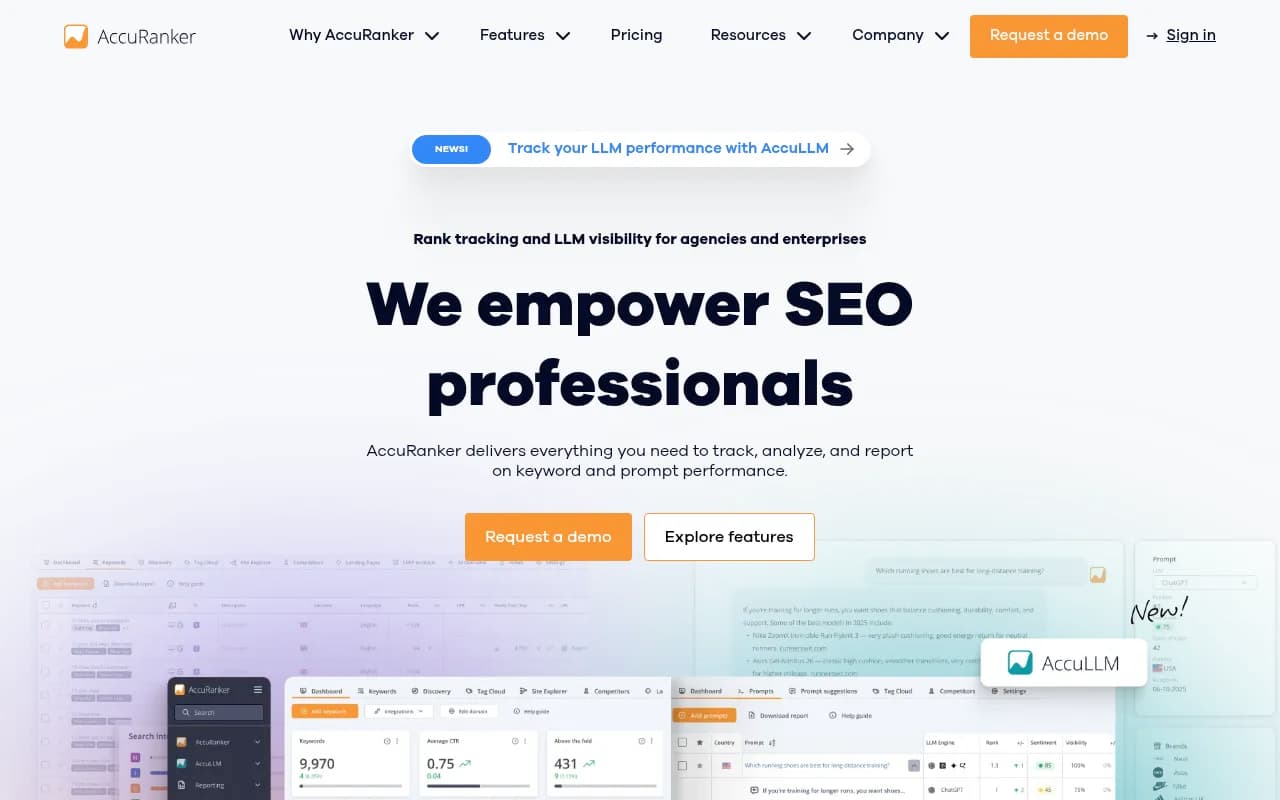
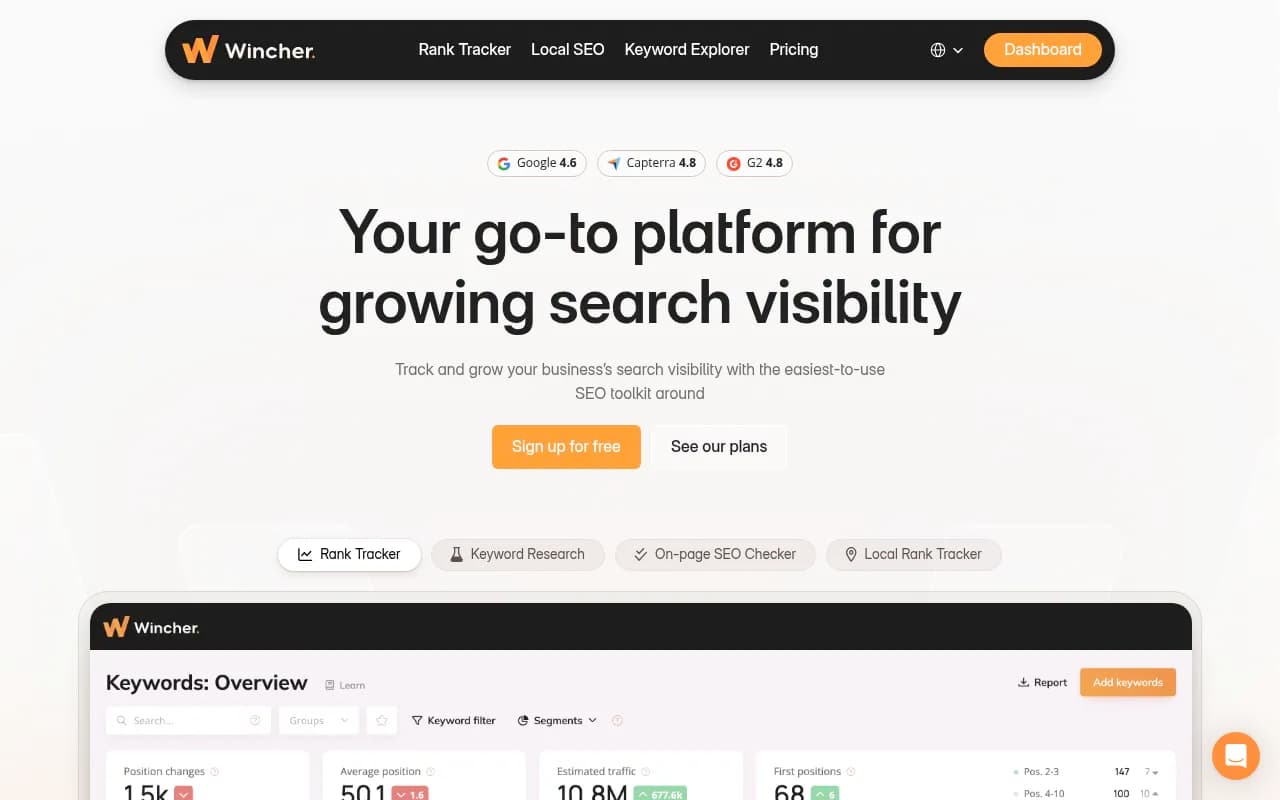
Tools in this category include Ranktracker, AccuRanker, Wincher and Advanced Web Ranking, plus the rank modules inside SE Ranking and Semrush.

How a ChatGPT tracker works
ChatGPT does not return ten blue links. It generates one answer, and that answer can name your brand, a competitor, or nobody. Ask again and it may change, even though the question did not.
So a ChatGPT tracker does something different. It runs a fixed set of prompts through ChatGPT on a schedule, daily or weekly depending on the plan, and logs what came back. Over time you get sampled data, not a ranking.
The Rework guide to ChatGPT rank tracking tools puts it bluntly: this is sampling a moving target, and the honest tools say so. I agree with that framing. A tool that shows you "position 2 in ChatGPT" from a single run is selling you a screenshot.
Retrieval and fan-outs
When ChatGPT searches the web, it does not just run your prompt as a query. It fans out into several smaller searches, and your content only has to match one of them. According to Promptwatch's ChatGPT query fanout data, average fan-outs per response fell from 2.15 in early December to about 1.84 by early March, and the queries got shorter, closer to keyword-style searches of roughly six to eight words by April.
That is one reason keyword rank and prompt visibility drift apart. The query that retrieves you may not resemble the prompt the user typed.
Modes matter
ChatGPT can answer from training data alone or invoke web search. In the first mode it cannot cite anything, because nothing was retrieved. A good tracker tells you which mode it tested. Many do not, and the numbers are hard to interpret when they stay silent about it.
What each tracker actually measures
| Dimension | Google rank tracker | ChatGPT rank tracker |
|---|---|---|
| Core unit | URL position in an ordered list | Brand mention or citation inside generated text |
| Primary metric | Position (1-100) | Mention rate across repeated runs |
| Stability | High, small daily moves | Low, answers vary run to run |
| Sampling | One query, one result page | Many runs per prompt to get a rate |
| Input | Keywords | Natural-language prompts, often long |
| Secondary metrics | SERP features, search volume, CTR estimates | Citations, position in answer, sentiment, share of voice |
| What you can influence | Your own page's ranking signals | Cited sources, brand descriptions, third-party mentions |
| Cadence | Daily | Daily or weekly, depends on prompt count and plan |
The six metrics that survive the move to ChatGPT
The Mencoro comparison lists a set of metrics that hold up statistically even though the answers vary. Here is how I would read them.
- Mention rate. The share of runs where your brand appears at all. This is the closest thing to a ranking, and the only one stable enough to trend.
- Position within the answer. First recommendation or fourth name in a list. Being mentioned last in a paragraph is not the same as leading it.
- Mention type. Recommended, listed among options, or named in passing. A raw count that treats all three alike hides the thing you most want to know.
- Sentiment. Being named as the expensive option is a mention and a problem at the same time.
- Citations. Which URLs the answer leans on. This is the practical part, because cited pages are the ones you can go and influence.
- Competitor share of voice. Your presence against named rivals for the same prompt set. This turns a number into a decision.
Notice what is missing: a single rank number. That is on purpose.
Why your Google rank will not predict your ChatGPT visibility
Some vendor blogs claim that only 12% of URLs cited by ChatGPT overlap with Google's top 10. I could not verify that figure independently, so treat it as a vendor claim. The direction is believable, though, and Promptwatch's own data gives better evidence of why.
Take the number of sources behind an answer. Promptwatch Data on unique domains per ChatGPT response (Sep 28 to Oct 4, 2026) found that 47.6% of responses cite 10 or more domains, and 66.1% cite at least 8. Only 1% cite a single domain. For general questions with no brand named, 52.5% cite 10 or more domains.
So the older "about 10 sources per response" line is a rough average. The real picture is a distribution that depends on prompt type. For brand-specific prompts like "is Asana good for small teams", 5 domains is the most common count, and 40.7% cite 5 or fewer.
What does that mean for tracking? Expect to share every answer. Being cited is the entry ticket, not the win. How ChatGPT describes you, and where you sit among the other sources, is the real signal.
The type of page that gets cited is different too. Promptwatch's content type data shows product pages as the most cited type at 22.4% of ChatGPT citations (Sep 28 to Oct 4, 2026), followed by landing pages and listicles. A blog post that ranks well on Google for an informational keyword may not be the page ChatGPT wants.
Domain authority behaves differently as well. In August 2026, according to Promptwatch's domain rank data, sites with domain rank 46-75 earned almost half of ChatGPT citations, while DR 91-100 fell to about 3%. The giant sites that dominate Google head terms do not automatically dominate ChatGPT.
Volatility is the strongest argument for a separate tracker
Google rankings move when you or your competitors change something, or when a core update lands. ChatGPT can change its retrieval behaviour on its own schedule, and the changes are big.
On August 8, 2026, ChatGPT Search started using the site: operator at scale. Per Promptwatch's site: operator report, site:-scoped fan-out queries jumped from about 0.4% to roughly 17% of all fan-outs in a single day, and average fan-outs per response went from about 1.08 to about 1.83. The site: searches were added on top of generic ones, not in place of them.
The practical read: your own domain became a direct retrieval surface, and only pages that search engines have indexed can surface there. Any keyword-to-query mapping you built before that date is stale.
A second example. Promptwatch's Reddit data shows reddit.com's share of ChatGPT citations falling from about 4% to 0.5% on August 14, 2026. If your ChatGPT strategy leaned on Reddit threads, that changed overnight, and a quarterly audit would have caught it months late.
A Google rank tracker would not have seen either change. That is the strongest reason to treat these as separate instruments.
Where the two overlap
They are not unrelated. ChatGPT Search draws on web results, and one vendor source says it leans on Bing. Strong Google rankings do not automatically translate into Bing coverage, so if you rank on Google but are absent from Bing, ChatGPT may not find you. Checking Bing Webmaster Tools next to Search Console is cheap insurance.
Technical access matters on both sides too. If an AI crawler cannot read your pages, no amount of content work helps. Crawler logs show whether GPTBot, OAI-SearchBot and ChatGPT-User actually reach you, which is something no rank tracker of either type can tell you. Promptwatch's AI crawler traffic report covers weekly verified requests across OpenAI, Anthropic, Google, Perplexity and Mistral if you want a benchmark.
Choosing tools
The market is crowded. The research here covers listicles of 8, 12 and 19 tools, and our catalog has far more. A rough sorting by job:
| Job | Type of tool | Examples |
|---|---|---|
| Classic Google position tracking | Traditional rank tracker | AccuRanker, Wincher, Ranktracker |
| Google rankings plus AI mode in one suite | SEO suites with AI add-ons | SE Ranking, Semrush One, Nightwatch |
| Cheap ChatGPT mention tracking | Lightweight prompt trackers | Otterly.AI, Rankscale, Xofu |
| Enterprise AI narrative monitoring | Enterprise AI visibility | Profound, Scrunch AI, Brandlight |
| Tracking plus fixing what you find | AI visibility and optimization platforms | Promptwatch, Leapd Alex |
Hybrid tools
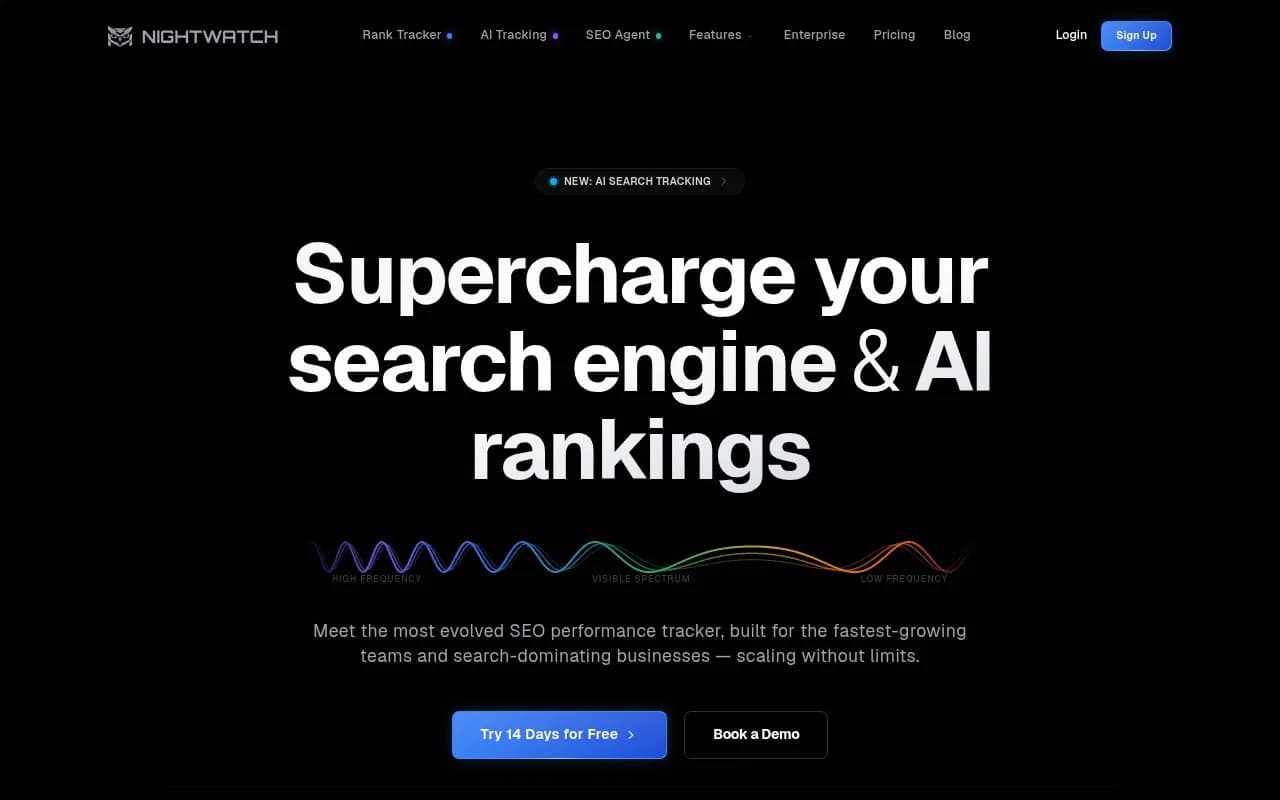
If you want one dashboard for both worlds, a hybrid is the easy path. Nightwatch, for example, pairs classic SERP tracking with an AI add-on, and AccuRanker and Advanced Web Ranking have added AI search monitoring. These are good when AI visibility is a side metric. The trade-off is usually depth: fixed prompt sets and fewer ways to see why you are or are not named.

Dedicated AI visibility platforms
If ChatGPT is a real channel for you, a dedicated platform is worth it. Promptwatch is the one I would put first, because it does not stop at "was my brand mentioned?". It tracks the real ChatGPT interface rather than only API output, logs IP-verified AI crawler visits, ties AI-referred visits to conversions, and has a Content Agent and Action Board that turn gaps into published pages. Then it checks whether those pages got crawled and cited. Most monitoring-only tools leave that loop to you.

Other options worth a look: Profound for enterprise monitoring, and Peec AI for multi-language tracking.


For a wider shortlist, the GEO software directory at bestgeosoftware.com and the AI rank tracking directory at ai-rank-tools.com are both useful starting points.
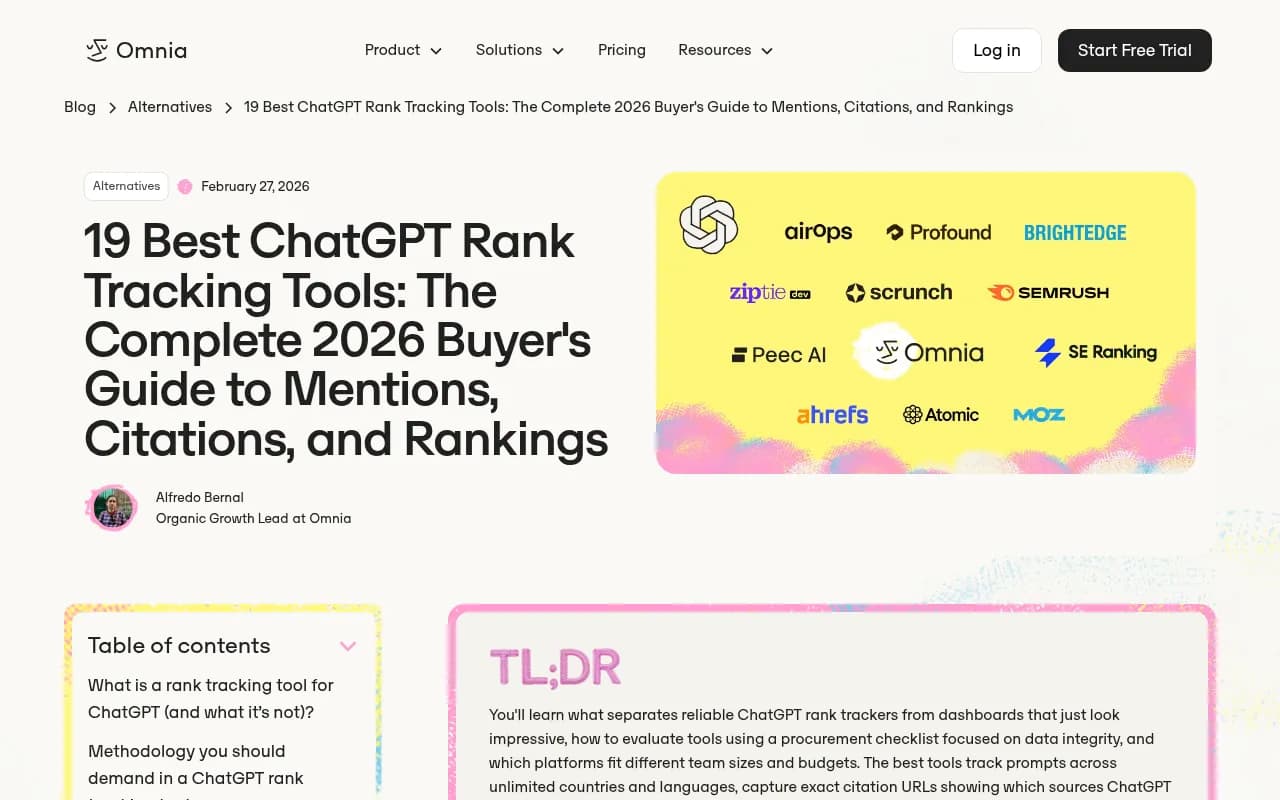
The Omnia guide above is a reasonable procurement reference. Its checklist on data integrity is worth borrowing even if you pick a different vendor.
Questions to ask any ChatGPT tracker vendor
- Does it run the real ChatGPT interface, or only the API? User-facing answers and citations can differ from API output.
- How many runs per prompt? A mention rate from one run is a screenshot, not a measurement.
- Which mode was tested: training-only or web search?
- Does it store the cited URLs, including pages retrieved but not quoted?
- Can it separate mentions from citations?
- Can it track by country and language?
- Does it connect any of this to traffic? Visibility that never turns into visits is hard to defend in a budget meeting.
Price claims also deserve care. The research notes include figures from vendor blogs, such as plans from $29 to $99 a month, dated between April and October 2026. I did not re-verify them. Check each vendor's pricing page before you buy.
A workable setup for most teams
You do not need to abandon anything. A sane stack looks like this:
- Keep your Google rank tracker for keyword positions and SERP features.
- Add a ChatGPT tracker with a prompt list built from real customer questions, not from your keyword list. Include organic, brand-specific and competitor-comparison prompts, since citation behaviour differs between them.
- Report mention rate, sentiment and share of voice monthly, with weekly spot checks for sudden drops.
- Read the citations, not just the counts. The sources ChatGPT trusts for your category are your content and outreach to-do list.
- Check crawler access and Bing indexing before blaming your content.
- Re-audit after known platform changes. After August 8, 2026, that meant rethinking any site-specific content mapping.
Common mistakes
- Treating mention rate like rank. A 40% rate over thirty runs is a measurement. It is not position 4.
- Tracking only brand prompts. You will look great and learn nothing. The money is in the organic and comparison prompts where you are one of ten domains.
- Judging by one screenshot. Answers vary.
- Ignoring sentiment. A mention that calls you the pricey option is not a win.
- Assuming Google strength carries over. It often does not.
Bottom line
A Google rank tracker tells you where a page sits in a list. A ChatGPT tracker tells you how often a generated answer includes you, who else is in it, and what it says. They answer different questions, so you need both if both channels matter to your revenue. Start with a small, honest prompt set, run it often enough to see a rate, and read the citations. The fixes are in there.