Key takeaways
- SERP-overlap clustering (Keyword Insights, KeyClusters, LowFruits, Keyword Cupid, SE Ranking) groups keywords by shared ranking URLs, which usually maps closest to how Google treats a topic.
- If you already pay for Semrush, Ahrefs or SE Ranking, try the grouping built into your plan before buying a dedicated tool.
- Pricing comes in three shapes: subscriptions, pay-as-you-go credits, and bundled suites. Occasional projects are often cheaper on credits.
- Clustering is only step one. You still need to map clusters to pages, check intent, and plan for how AI search splits queries into sub-questions.
- Many prices below come from third-party blogs and conflict with each other. Confirm on vendor pricing pages before you buy.
Why clustering matters when you plan content at scale
A list of 8,000 keywords is not a content plan. It is a spreadsheet problem. Somewhere in there, 40 phrases mean the same thing, and if you write 40 articles you get keyword cannibalization: two or more of your pages fighting for one query, neither ranking well.
Clustering fixes that by sorting keywords into groups that deserve one page each. Done by hand, it takes days and the results are inconsistent between people. Done by a tool, it takes minutes, and you spend your time on the part that needs a human: deciding which clusters are worth writing.
There is a second reason it matters in 2026. AI search engines break a prompt into several smaller searches before answering. Promptwatch's ChatGPT query fanouts data shows how that behavior looks in practice, and I'll come back to it near the end, because it changes how you should size your clusters.
How automated clustering works
There are two main methods, and the difference matters more than most feature lists.
SERP-overlap clustering
The tool pulls the top results for every keyword and groups the ones that share ranking URLs. KeyClusters, for example, uses a fixed threshold of 3 or more shared URLs. If Google ranks the same pages for two phrases, Google evidently considers them one topic, so you should probably cover them on one page.
This is the method most dedicated tools use: Keyword Insights, LowFruits, KeyClusters, Keyword Cupid and SE Ranking. The upside is that it reflects reality instead of guessing. The downside is cost. Every keyword needs a live SERP pull, which is why these tools charge by credit.
NLP or semantic clustering
The alternative groups keywords by meaning and phrasing, using language models. Contadu works this way, and Semrush uses it in part. It is cheaper and faster, and it works for keywords with no meaningful SERP yet. But it can group terms that Google treats very differently, like a "what is" query and a "buy" query that share vocabulary.
My take: for anything you plan to publish, SERP-based clustering is the safer default. Use semantic grouping for early exploration, or as a sanity check.
Quick comparison of the main tools
Prices below are indicative. Several come from competitor roundups and some conflict, so treat them as starting points.
| Tool | Method | Reported entry price | Best for |
|---|---|---|---|
| Keyword Insights | SERP-based | $58/mo (Basic), $99 (Professional), $299 (Premium) | Agencies and large keyword sets |
| KeyClusters | SERP overlap, 3+ shared URLs | $19 for 2,500 keywords, pay-as-you-go | One-off projects |
| Keyword Cupid | SERP intersect plus neural network | From $9.99/mo (500 keywords/mo), reported otherwise by some sources | Visual clustering, small batches |
| LowFruits | SERP overlap | First analysis free, paid plans reportedly from about $19/mo | Solo marketers |
| SE Ranking Keyword Grouper | SERP overlap, adjustable accuracy | From $103.20/mo billed annually | Teams already on SE Ranking |
| Semrush Keyword Strategy Builder | SERP plus NLP | Pro around $139.95/mo | In-house teams on Semrush |
| Ahrefs Keywords Explorer | Parent Topic and shared terms | Lite around $129/mo | Data depth, not dedicated clustering |
| Contadu | NLP plus topical map | From $47/mo | Topical maps |
| Keywords People Use | Clustering | 150 keywords free, paid from $15/mo | Small tests |
The tools, one by one
Keyword Insights
The name that comes up most for agencies and large keyword sets. It clusters by SERP overlap and bundles content briefs. The pricing page lists Basic at $58/mo, Professional at $99/mo and Premium at $299/mo, with clustering of up to 10,000 keywords on the lower tiers and one free re-clustering included. The credit model is simple: one credit clusters one keyword, and a content brief costs 100 credits. Basic includes 10,000 credits.
Watch the credits. Briefs eat them quickly if you generate one per cluster. One more caveat: the most glowing roundup of Keyword Insights I found (a 95/100 score) was written by Keyword Insights itself.
KeyClusters
No subscription, clustering only. Reported prices are $19 for 2,500 keywords, $110 for 20,000, and $350 for 100,000. If you cluster a big list twice a year, this is probably the cheapest honest option. If you cluster monthly, a subscription may win.
Keyword Cupid
Uses SERP intersect plus a neural network, with a 7-day trial and confidence scoring on clusters. Sources disagree on its pricing. One puts it at $9.99/mo for 500 keywords a month, up to $499.99/mo for Enterprise; another describes a one-time credit system from around $27. Check the vendor site.
LowFruits
Built for solo marketers and small budgets. It clusters by SERP overlap and is strong at surfacing low-competition terms. The first analysis is free, which makes it easy to test on your own data.
SE Ranking, Semrush and Ahrefs
These are the suites. If you already have one, start with what is in your plan.
SE Ranking's Keyword Grouper uses SERP overlap with adjustable accuracy and a 14-day trial. Optional search volume checks cost $0.005 per keyword.
Semrush's Keyword Strategy Builder is bundled into paid plans and can't be bought alone. It adds intent labeling, which helps when you decide which cluster becomes a blog post and which becomes a product page.
Ahrefs groups by Parent Topic and shared terms. That is useful, but it is not a dedicated clustering engine, so don't expect Keyword Insights-style output from it.
Contadu, Search Atlas and Topical Map AI
Contadu combines NLP clustering with a topical map. Freelance plans start at $47/mo with 5 content strategies and a 7-day trial. Its Keywords Grouper is free with no login, which is handy for a quick test.
Search Atlas is pitched as the pick for automated content planning and topical maps, at a reported $99/mo. I couldn't verify current pricing, so check before relying on that figure.

If topical maps are the main thing you want, Topical Map AI and NeuralText also show up in the catalog. NeuralText pairs keyword clustering with content briefs.
Answer Socrates
Starts from question-based keywords other tools miss, then clusters them. It has a free plan and reportedly starts at $9/month. Worth a look if your content is built around questions and FAQs.
Content platforms with clustering-adjacent features
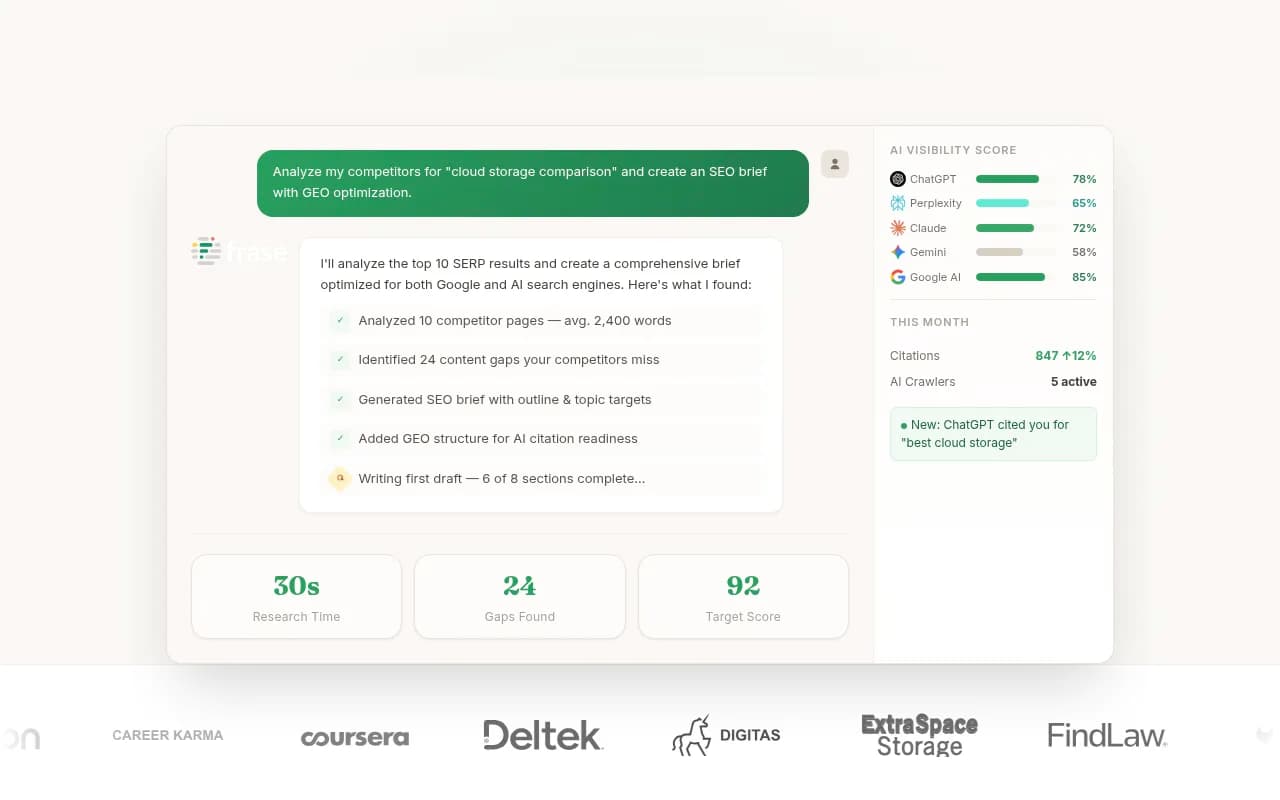
Surfer, MarketMuse, Frase and Clearscope suggest outlines, headings and topic coverage once you know what to write. They are not clustering tools in the strict sense. Think of them as the step after clustering.

Free options
Free tools are fine for small lists and for testing whether clustering helps you at all.
| Tool | Automation | Notes |
|---|---|---|
| Keyword Cupid (trial) | Light | 7-day trial |
| KeywordClustering.net | Light | Quick grouping |
| Pemavor | Moderate | Free tool |
| ChatGPT with manual prompts | Manual | Cheap, but inconsistent at scale |
| Contadu Keywords Grouper | Light | No login |
| Thruuu | Light | Free clustering tool |
A warning on ChatGPT-as-clusterer: it will happily group 300 keywords, but it is guessing from wording, not from what ranks. Fine for brainstorming. Risky for deciding which pages to publish.
How to choose
| Your situation | Start with |
|---|---|
| Agency with many clients and big lists | Keyword Insights |
| One-off site migration or content audit | KeyClusters (pay-as-you-go) |
| Solo marketer or bootstrapped founder | LowFruits or Keywords People Use |
| Already on Semrush | Keyword Strategy Builder first |
| Already on SE Ranking | Keyword Grouper first |
| Want topical maps, not just groups | Contadu or Search Atlas |
Three questions settle most decisions. How often will you cluster? How big are your lists? Do you need briefs, or only groups? Occasional projects are often cheaper on credits than on any subscription. Regular, large-scale work usually favors a subscription, as long as you keep an eye on how fast briefs and volume checks use up credits.
A workflow that works at scale
- Collect keywords from your research tool, Search Console, competitors and question sources.
- Clean the list. Remove branded junk, duplicates and obvious irrelevance before you pay per keyword.
- Cluster with a SERP-based tool. Start at a moderate threshold. Too loose and you cram two intents onto one page; too strict and you create near-duplicate pages.
- Label intent for each cluster: informational, commercial, transactional.
- Pick the primary keyword per cluster, usually the highest volume term that fits the intent.
- Check existing content. Map each cluster to a page you already have before creating a new one. This is where cannibalization gets caught.
- Prioritize by volume, difficulty and business value, then hand the clusters to writers as briefs.
I'd spot-check the output by hand on the first run. No independent accuracy benchmark exists for these tools, so your own review of 20 or 30 clusters tells you more than any vendor claim.
Planning clusters for AI search
Classic clustering answers one question: which keywords belong on one page? AI search adds another: what sub-questions will a model fire off when someone asks about this topic?
Promptwatch tracks this in its ChatGPT query fanouts report. The measured averages moved around: about 2.15 searches per response in early December 2025, about 1.84 by early March 2026, and exactly 1.0 per response when fanouts returned in April. Average fanout query length also shrank, from about 117 characters in December to the high 80s through February and March, and about 53 characters (six to eight words) in April. The page didn't state the model or full date range behind the 1.0 figure, so check the live page before quoting it.

The practical advice from that data fits neatly with clustering:
- Cover the sub-questions: comparisons ("X vs Y"), pricing, alternatives and how-tos.
- Prefer a cluster of focused pages over one mega-page. A page aimed at one intent beats one that half-covers two.
- Write headings that read like search queries, with the entity and category first, for example "Best CRM for small agencies 2026".
- Re-audit your keyword-to-heading mapping after major ChatGPT updates.
In other words, the output of your clustering tool is a starting point. Once a cluster is published, a tool that tracks AI visibility can show whether those pages get cited. For more options there, the GEO software directory at bestgeosoftware.com lists the field.
Pitfalls to avoid
- Trusting a single threshold. Test two settings on the same list and compare.
- Ignoring intent. Two keywords can share SERP URLs and still deserve separate pages if one is clearly commercial.
- Burning credits on briefs you won't use. Generate briefs only for clusters you will actually write.
- Treating clusters as final. SERPs change. Re-cluster when you add a large batch of keywords, or when rankings shift.
- Quoting vendor prices from blog posts. The numbers here come from several sources that disagree with each other.
Bottom line
If you cluster rarely, pay as you go with KeyClusters or try LowFruits's free first analysis. If you cluster constantly and at volume, Keyword Insights is the specialist to test. If you already pay for Semrush or SE Ranking, use their built-in grouping first and only add a dedicated tool when it starts to limit you. For broader software comparisons, see surferstack.com.