NeuralText Review 2026
AI SEO tool focused on keyword clustering, SERP analysis, and content brief generation to help marketers plan and create content that targets the right search intent.
Key takeaways
- NeuralText combines keyword clustering, SERP analysis, content brief generation, and an AI writing assistant in one platform -- a solid all-in-one for traditional SEO content workflows
- Pricing starts at $19/month with a 5-day free trial, making it one of the more affordable options in the SEO content tool space
- Best suited for freelance writers, small marketing teams, and agencies doing volume content production for Google search
- Does not monitor AI search engines (ChatGPT, Perplexity, Claude, etc.) and has no GEO or AEO capabilities -- if AI search visibility matters to you, a dedicated platform like Promptwatch covers that gap entirely
- Google Search Console integration is a genuine differentiator at this price point, but multi-seat support is limited until the Pro tier
NeuralText is an Italian-founded AI content and SEO platform that has been quietly building a loyal user base since its early days as an AI copywriting tool. Over time it shifted focus toward SEO workflows -- keyword research, clustering, SERP analysis, and content briefs -- while keeping an AI writing assistant in the mix. The result is a platform that covers the full content production cycle from keyword discovery to published draft, without requiring a stack of separate tools.
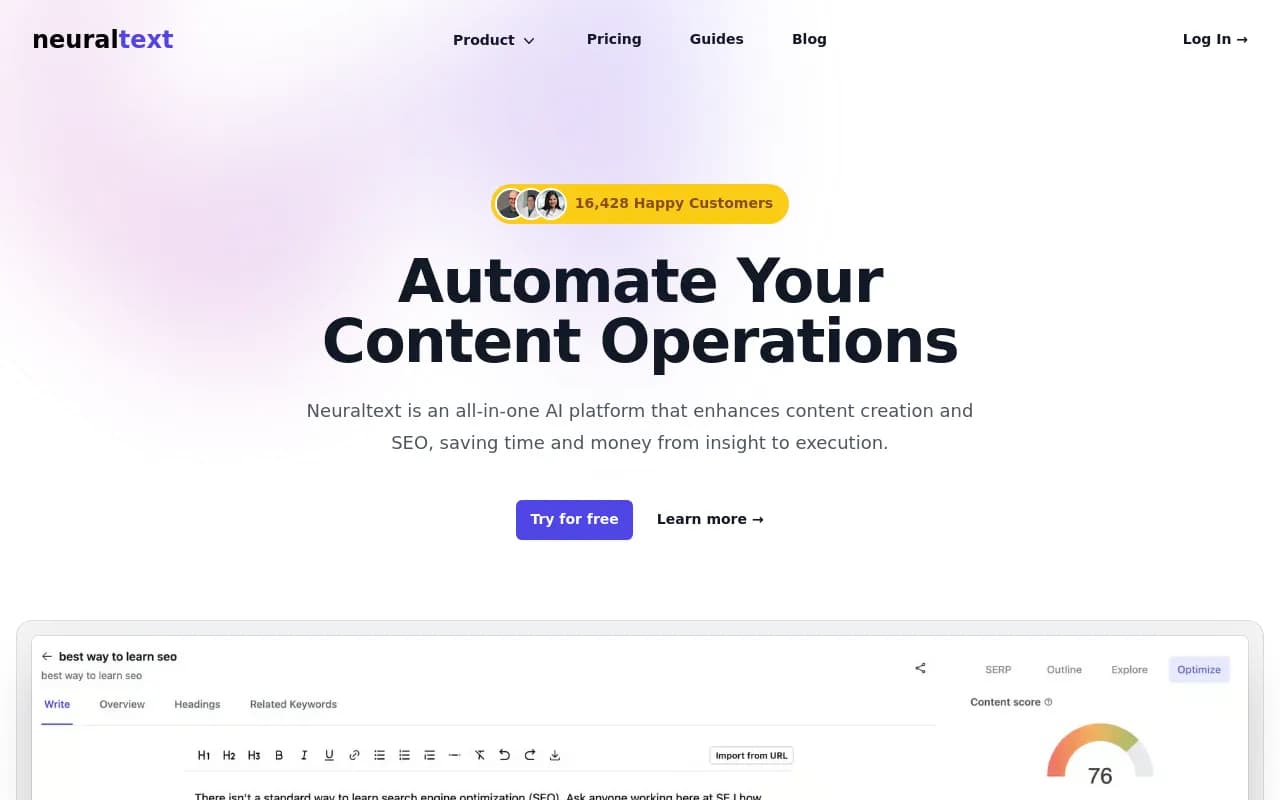
The target audience is pretty clear: content marketers, SEO professionals, and freelance writers who need to produce Google-optimized articles at scale without spending hours on manual competitor research. With 16,000+ customers and logos like eBay, Forbes, Ray-Ban, and Maersk on the homepage, NeuralText has clearly found traction beyond the indie blogger crowd. That said, it's not an enterprise-grade platform -- it's priced and designed for individuals and small-to-mid-sized teams who want practical SEO tooling without the complexity or cost of Semrush or Ahrefs.
The platform has gone through at least one significant redesign (users on review sites reference a "new version"), and the current iteration feels polished. The UI is clean, the workflow is logical, and the Google Docs-style editor makes it approachable for writers who aren't SEO specialists.
Key features
Keyword clustering
This is arguably NeuralText's strongest feature. You feed it a list of keywords and it groups them into topic clusters based on SERP similarity -- meaning keywords that return overlapping search results get grouped together, which is a more reliable clustering method than pure semantic similarity. The practical output is a map of which pages you need to create and which keywords each page should target. At the Pro tier you can cluster up to 30,000 keywords at once, which is enough for serious content audits. The Starter plan caps at 5,000, which is fine for smaller sites or individual campaigns.
- Clusters based on SERP overlap, not just semantic similarity
- Shows which pages to create and how many to cover a topic
- Outputs are actionable: you know exactly what to build
SERP analysis and content briefs
NeuralText pulls live SERP data for your target keyword and analyzes the top-ranking pages to extract topics, questions, headings, and semantic terms your content should cover. The output is a structured content brief that a writer can follow without needing to do their own competitor research. This is the feature that saves the most time in practice -- manual SERP research for a single article can take 30-60 minutes; NeuralText compresses that to a few clicks.
- Real-time SERP data (not cached)
- Extracts questions, topics, and recommended headings from top results
- Brief is exportable and shareable with writers
- Supports 17+ languages for SERP analysis
AI writing assistant
The writing assistant lives inside a Google Docs-style editor and offers inline autocompletion, paraphrasing, summarizing, and expansion. It's not a standalone AI writer in the ChatGPT sense -- it's designed to work alongside your own writing rather than replace it. You get 100,000 AI words/month on Starter and Basic, and 300,000 on Pro. The contextual menu approach (select text, choose an action) is intuitive and keeps the focus on editing rather than prompting.
- Inline autocompletion for drafting
- Selection-based actions: rephrase, summarize, simplify, expand
- Integrated with the content brief so you're writing against your SEO targets in real time
- Helps overcome writer's block without fully automating the writing process
Content optimization scoring
NeuralText scores your content against the top-ranking pages for your target keyword, flagging gaps in topic coverage, readability issues, and length. The scoring system is proprietary but the output is practical: a list of topics and terms you're missing, with suggestions for where to add them. This is similar to what tools like Clearscope or Surfer SEO offer, though NeuralText's implementation is more streamlined and less granular.
- Readability analysis
- Topic coverage scoring against SERP competitors
- Identifies missing semantic terms and questions
- Real-time feedback as you write
Keyword discovery
Beyond clustering existing keyword lists, NeuralText can generate long-tail keyword suggestions from a seed term. The Basic plan gives you 20,000 suggestions per month; Pro gives 50,000. You also get popularity data and trend information. It's not a replacement for a dedicated keyword research tool like Ahrefs or Semrush, but for content teams that don't have those tools, it covers the basics well.
- Long-tail keyword suggestions from seed terms
- Popularity and trend data
- Direct pipeline from discovery to clustering to brief creation
Google Search Console integration
This is a genuinely useful addition. NeuralText connects to your GSC account and surfaces performance data -- traffic, rankings, impressions -- alongside content optimization opportunities. You can identify pages that are ranking on page 2 and push those keywords directly into NeuralText's tools for a quick content refresh. At the Pro tier you can connect 5 GSC properties, which is enough for small agencies managing a handful of client sites.
- Real-time performance metrics from GSC
- Identifies content optimization opportunities from existing rankings
- Sends keywords directly to NeuralText tools for analysis
- 1 property on Starter/Basic, 5 on Pro
Who is it for
NeuralText fits best with freelance writers and content creators who are producing SEO articles regularly and want to cut research time without sacrificing quality. If you're writing 10-20 articles a month and doing all your own SERP research manually, the Basic plan at $49/month pays for itself quickly. The content brief feature alone -- generating structured outlines from live SERP data -- is worth the subscription for anyone doing this work at volume.
Small in-house marketing teams at SaaS companies, e-commerce brands, or media publishers are another strong fit. The GSC integration makes it easy to identify underperforming content and prioritize what to update, which is a common workflow for content teams managing large site archives. The Pro plan's 3 seats and 5 GSC properties are enough for a small team without needing to negotiate enterprise pricing.
Digital marketing agencies doing content production for multiple clients can use NeuralText to standardize their brief creation process. The ability to generate a content brief in minutes rather than hours is a real operational win when you're managing 10+ clients. That said, agencies with larger teams will hit the seat limits quickly -- the Pro plan only includes 3 seats, and there's no visible enterprise or agency tier on the current pricing page.
Who should probably look elsewhere: anyone whose primary concern is AI search visibility. NeuralText is built entirely around traditional Google search optimization. It doesn't track how your brand appears in ChatGPT, Perplexity, or Claude responses, doesn't analyze AI citations, and has no GEO or AEO capabilities. If your audience is increasingly finding you through AI search engines, NeuralText won't help you understand or improve that visibility.
Integrations and ecosystem
NeuralText's integration story is intentionally minimal. The main external connection is Google Search Console, which is well-implemented and genuinely useful. Beyond that, the platform is largely self-contained.
- Google Search Console: Full integration for performance data, ranking tracking, and keyword discovery from existing content
- Google Docs-style editor: The writing environment is familiar to anyone who uses Google Docs, lowering the learning curve for writers
- Export: Content briefs can be shared with writers; the platform supports exporting content for use in other tools
- Languages: SERP analysis supports English, Spanish, German, French, Danish, Dutch, Italian, Finnish, Norwegian, Czech, Polish, Portuguese, Swedish, Turkish, Romanian, Hindi, and Slovak
There's no public API documented on the main site, no Zapier integration listed, no Slack notifications, and no CMS integrations (WordPress, Webflow, etc.). For a tool at this price point that's not unusual, but it does mean NeuralText sits somewhat outside your broader marketing stack rather than inside it.
Pricing and value
NeuralText offers three paid tiers plus a 5-day free trial (no credit card required based on Capterra data):
- Starter: $19/month -- 100,000 AI words, 5 content briefs, 2,000 keyword suggestions, 5,000 keywords to cluster, 1 GSC property, 1 seat
- Basic: $49/month -- 100,000 AI words, 40 content briefs, 20,000 keyword suggestions, 10,000 keywords to cluster, 1 GSC property, 1 seat
- Pro: $119/month -- 300,000 AI words, 100 content briefs, 50,000 keyword suggestions, 30,000 keywords to cluster, 5 GSC properties, 3 seats
The Starter plan is genuinely cheap for what it offers, though 5 content briefs per month is limiting for anyone doing serious content production. The jump from Starter to Basic is mostly about content brief volume -- if you need more than 5 briefs a month, Basic is the practical entry point.
Compared to alternatives: Surfer SEO starts at $89/month for similar content optimization features. Clearscope starts at $170/month. Frase starts at $45/month. NeuralText is competitive on price, particularly at the Basic tier. The main trade-off is that tools like Surfer and Clearscope have more refined content scoring and deeper integrations, but they cost significantly more.
The 5-day trial is short -- most users will need more time to properly evaluate the keyword clustering and SERP analysis features across a real project. That said, no credit card requirement lowers the friction to try it.
Strengths and limitations
What NeuralText does well:
- Keyword clustering quality: The SERP-overlap clustering method produces more actionable groupings than purely semantic approaches. For content strategy planning, this is the feature that delivers the most value.
- Price-to-feature ratio: At $49/month for 40 content briefs and 20,000 keyword suggestions, it's hard to find a comparable tool at this price. Competitors with similar feature sets charge 2-3x more.
- Workflow integration: The pipeline from keyword discovery to clustering to brief to writing all happens in one place, which reduces context-switching and keeps the workflow tight.
- GSC integration at low price points: Most tools reserve GSC integration for higher tiers. NeuralText includes it from the Starter plan.
- Multi-language SERP support: 17+ languages is solid for a tool at this price, making it viable for non-English content teams.
Honest limitations:
- No AI search visibility: NeuralText has zero coverage of AI search engines. It doesn't track brand mentions in ChatGPT, Perplexity, Claude, or any other LLM. For teams that care about GEO or AEO, this is a complete blind spot. Tools like Promptwatch are built specifically for this use case.
- Seat limits are restrictive: Only 1 seat on Starter and Basic, and 3 on Pro. Teams larger than 3 people have no clear upgrade path without custom pricing.
- No CMS or workflow integrations: No WordPress plugin, no Webflow integration, no Zapier. The platform is an island, which means manual copy-paste to get content into your actual publishing workflow.
- Content scoring is less granular than competitors: Surfer SEO and Clearscope offer more detailed NLP-based scoring. NeuralText's optimization feedback is useful but less precise.
Bottom line
NeuralText is a well-priced, practical tool for content teams doing traditional SEO content production. The keyword clustering and SERP-based content briefs are genuinely good, and the all-in-one workflow from research to writing saves real time. For freelancers, small agencies, and in-house teams producing Google-optimized content at volume, it's one of the better value options available in 2026.
If your content strategy needs to account for AI search visibility -- how your brand appears in ChatGPT, Perplexity, or Google AI Overviews -- NeuralText won't help you there. That's a separate problem requiring a dedicated platform like Promptwatch, which tracks AI citations, identifies content gaps for AI search, and helps you create content engineered to get cited by LLMs.
Best for: Freelancers and small content teams who need fast, affordable SERP-based content briefs and keyword clustering for traditional Google SEO.
Tags:
Frequently asked questions
What is NeuralText?
How much does NeuralText cost?
Is there a free trial for NeuralText?
What languages does NeuralText support?
How does NeuralText's keyword clustering work?
Does NeuralText track AI search visibility (ChatGPT, Perplexity, etc.)?
Similar and alternative tools to NeuralText