Key takeaways
- Promptwatch and NeuralText solve fundamentally different problems. Promptwatch tracks and optimizes your brand's presence in AI search engines (ChatGPT, Claude, Perplexity, Gemini). NeuralText helps you plan and write content for traditional Google search.
- NeuralText is much cheaper -- plans start at $19/mo vs Promptwatch's $99/mo -- but the price difference reflects a completely different scope and use case.
- If you're asking "why isn't my brand showing up in ChatGPT responses?", Promptwatch answers that. If you're asking "what keywords should I cluster for my next blog post?", NeuralText answers that.
- Promptwatch includes content generation, but it's engineered for AI citation -- not traditional SERP ranking. NeuralText's content tools are built around Google's ranking signals.
- These tools can complement each other. They barely overlap. Picking one over the other is usually the wrong framing -- you'd use them for different jobs.
- For teams that only have budget for one: the choice depends entirely on which search channel matters more to your business right now.
Overview
Promptwatch

Promptwatch is an AI Search Visibility platform used by 8,000+ brands including Booking.com, Typeform, and Yelp. The core idea is straightforward: as more people search via ChatGPT, Perplexity, and Gemini instead of Google, brands need to know whether they're being cited in those responses -- and if not, why not. Promptwatch monitors 10+ AI models in real time, shows you exactly which prompts your competitors appear for that you don't, and includes a content generation agent that creates articles and comparisons grounded in actual citation data. It also logs AI crawler activity on your site, so you can see when GPTBot or ClaudeBot visits your pages and what they read.
The platform sits at the intersection of monitoring and action. Most AI visibility tools stop at showing you a dashboard. Promptwatch tries to close the loop: find the gap, generate the content, track the improvement.
NeuralText
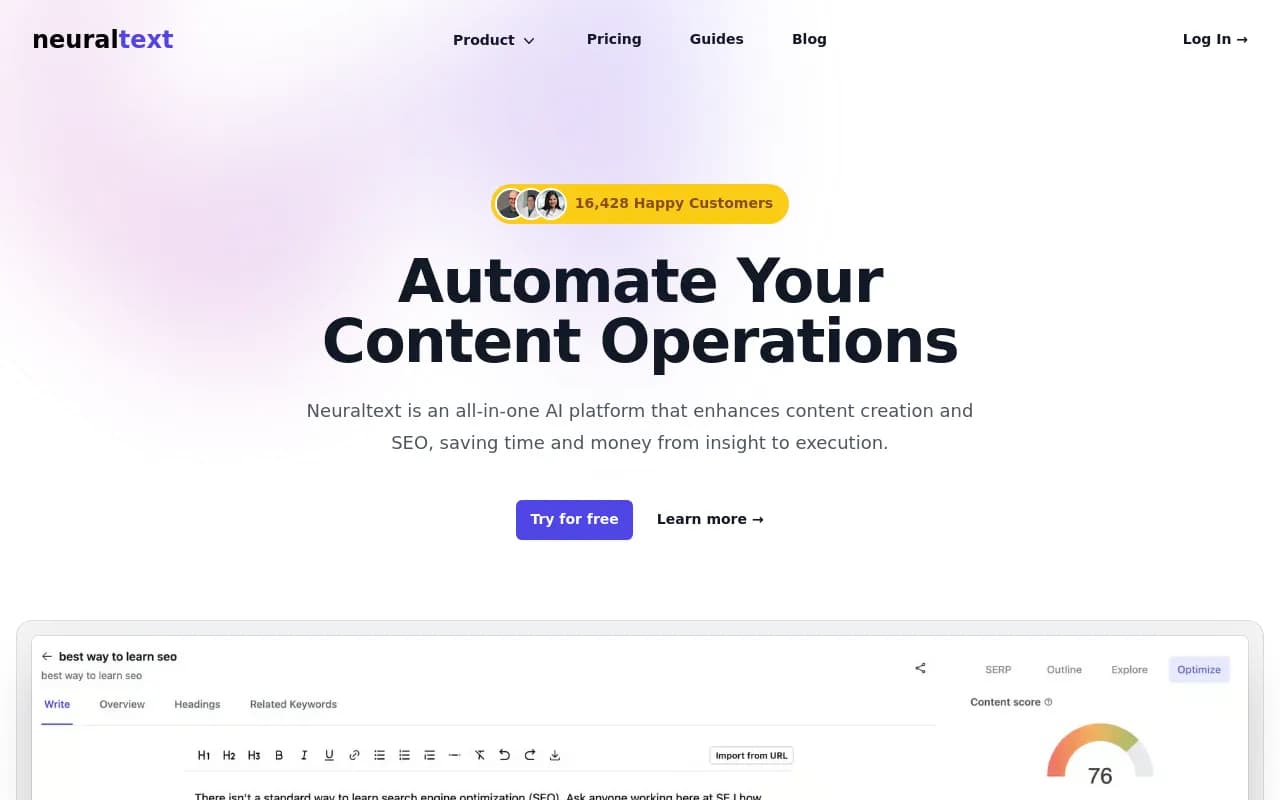
NeuralText is an AI-assisted SEO content platform with a focus on keyword clustering, SERP analysis, and content brief generation. It's been around since the early wave of AI writing tools and has built a solid reputation among content teams at companies like Forbes Advisor, eBay, and Maersk. The workflow is: discover keywords, cluster them by intent, pull live SERP data, generate a content brief, then write or assist with the actual article using the AI writing assistant.
NeuralText integrates with Google Search Console, which lets you surface underperforming content and find quick-win optimization opportunities. It's a practical, affordable tool for content teams that live and breathe traditional SEO.
Side-by-side comparison
| Feature | Promptwatch | NeuralText |
|---|---|---|
| Primary use case | AI search visibility & GEO | Traditional SEO content planning |
| AI model monitoring | 10+ (ChatGPT, Claude, Gemini, Perplexity, Grok, DeepSeek, Copilot, Mistral, Meta AI, Google AI Overviews) | None |
| Keyword clustering | No | Yes (core feature) |
| SERP analysis | No | Yes (live SERP data) |
| Content brief generation | No (AI content generation instead) | Yes |
| AI content generation | Yes (citation-grounded, LLM-optimized) | Yes (Google SEO-focused) |
| Google Search Console integration | No | Yes |
| AI crawler logs | Yes (real-time) | No |
| Citation & source analysis | Yes (880M+ citations analyzed) | No |
| Competitor AI visibility tracking | Yes | No |
| Traffic attribution | Yes (GSC, code snippet, server logs) | Partial (via GSC integration) |
| Reddit & YouTube tracking | Yes | No |
| ChatGPT Shopping tracking | Yes | No |
| Free tier | No (7-day free trial) | Yes (5-day trial + freemium) |
| Starting price | $99/mo | $19/mo |
| G2 rating | 4.7/5 | Not prominently listed |
| Target audience | Marketing/SEO teams, agencies, brands in AI search | Content teams, SEO writers, solo marketers |
Head-to-head feature deep-dive
Core purpose and philosophy
This is where the comparison gets a bit awkward to make, because these tools genuinely aren't competing for the same job.
Promptwatch is built on the premise that AI search engines (ChatGPT, Perplexity, Claude, etc.) are becoming a meaningful traffic and revenue channel -- and that brands need to actively manage their visibility there, just like they manage Google rankings. The platform tracks whether AI models mention your brand when users ask relevant questions, shows you the gaps, and helps you create content that gets cited.
NeuralText is built on the premise that Google search is still the primary content channel, and that content teams need better tooling to plan, brief, and write articles that rank. It's a workflow tool for the traditional content production pipeline.
Neither premise is wrong. They're just different bets on where your attention should go.
Verdict: Choose based on your primary search channel. If AI search visibility is a priority, Promptwatch. If Google SEO content production is the bottleneck, NeuralText.
AI search monitoring
Promptwatch monitors your brand across 10 AI models: OpenAI/ChatGPT, Perplexity, Google AI Overviews, Google AI Mode, Claude, Gemini, Meta/Llama, DeepSeek, Grok, Mistral, and Copilot. You set up prompts relevant to your industry, and the platform runs them regularly to track whether your brand appears, how often, and with what sentiment. You also get competitor heatmaps showing who's winning for each prompt and why.
NeuralText has no AI search monitoring at all. It doesn't track LLM citations, doesn't monitor ChatGPT responses, and doesn't have any concept of AI search visibility. This isn't a criticism -- it's just outside the product's scope.
Verdict: Promptwatch wins by default. NeuralText doesn't play in this space.
Keyword research and SERP analysis
NeuralText's keyword clustering is genuinely good. You feed it a seed keyword or a list, and it groups them by search intent using semantic clustering. This saves real time when planning content -- instead of manually sorting through hundreds of keywords, you get logical clusters you can target with individual pages or articles. The live SERP analysis pulls real-time data on what's ranking, what topics the top results cover, and what your content needs to compete.
Promptwatch doesn't do traditional keyword research. It has "Prompt Intelligence" -- volume estimates and difficulty scores for AI search prompts, plus query fan-outs that show how one prompt branches into sub-queries. That's useful for AI search strategy, but it's not a substitute for keyword clustering if you're planning a Google SEO content calendar.
Verdict: NeuralText wins for traditional keyword research and SERP analysis. Promptwatch's prompt intelligence serves a different purpose.
Content generation
Both tools generate content, but with very different goals.
NeuralText's AI writing assistant helps you write articles based on SERP data and content briefs. It handles autocompletion, paraphrasing, summarizing, and expansion. The output is designed to rank in Google -- it's informed by what's currently ranking and what topics the top results cover.
Promptwatch's content agent generates articles, listicles, and comparison pages grounded in citation data from 880M+ analyzed citations. The goal isn't to rank in Google's blue links -- it's to get cited by ChatGPT, Claude, and Perplexity when users ask relevant questions. The agent factors in prompt volumes, competitor analysis, and persona targeting to produce content that AI models are more likely to reference.
| Dimension | Promptwatch content agent | NeuralText AI writer |
|---|---|---|
| Optimized for | AI search citation | Google SERP ranking |
| Data source | 880M+ LLM citations | Live SERP data |
| Output types | Articles, listicles, comparisons | Articles, blog posts, copy |
| Brief generation | No | Yes |
| Persona targeting | Yes | No |
| Competitor analysis integration | Yes | Partial (SERP-based) |
Verdict: Different tools for different goals. NeuralText for Google SEO content, Promptwatch for AI-cited content.
Technical and integration features
Promptwatch has some features that NeuralText simply doesn't attempt. The AI Crawler Logs show you in real time when GPTBot, ClaudeBot, PerplexityBot, and others crawl your pages -- which URLs they hit, how often, and any errors they encounter. This is genuinely useful for diagnosing why certain pages aren't getting cited. The traffic attribution layer (Google Search Console integration, code snippet, or server log analysis) connects AI visibility to actual website traffic and conversions.
NeuralText's standout integration is Google Search Console, which surfaces underperforming content and cannibalization issues. It's a practical, well-executed integration for traditional SEO workflows.
Verdict: Promptwatch has a deeper technical feature set for AI search. NeuralText's GSC integration is more useful for traditional SEO teams.
Ease of use and learning curve
NeuralText is straightforward. The workflow is linear -- cluster keywords, build a brief, write content -- and the UI reflects that. Most users can get productive within an hour.
Promptwatch has more moving parts. Setting up prompt tracking, configuring competitors, understanding citation analysis, and interpreting crawler logs takes more time. That said, reviews consistently describe it as easier to use than its complexity might suggest. The 7-day free trial gives you enough time to get a feel for the core workflow.
Verdict: NeuralText is easier to pick up. Promptwatch has a steeper learning curve but covers more ground.
Pricing comparison
| Plan | Promptwatch | NeuralText |
|---|---|---|
| Free tier | No (7-day free trial) | Yes (freemium + 5-day trial) |
| Entry plan | $99/mo (Essential: 1 site, 50 prompts, 5 articles) | $19/mo (Starter) |
| Mid plan | $249/mo (Professional: 2 sites, 150 prompts, 15 articles, crawler logs) | $49/mo (Basic) |
| Top plan | $579/mo (Business: 5 sites, 350 prompts, 30 articles) | $119/mo (Pro) |
| Agency/Enterprise | Custom pricing | Not prominently listed |
| Annual discount | Yes | Not confirmed |
The price gap is significant. NeuralText is accessible to solo marketers and small teams. Promptwatch is priced for marketing teams and agencies that are actively investing in AI search as a channel.
It's worth noting that these aren't really competing for the same budget line. A team might spend $49/mo on NeuralText for their Google SEO content workflow and $249/mo on Promptwatch for AI search visibility -- and that's a reasonable allocation if both channels matter.
Pros and cons
Promptwatch
Pros:
- Monitors 10+ AI models in a single platform
- Real-time AI crawler logs -- a feature most competitors lack entirely
- Content generation grounded in actual citation data, not generic SEO signals
- Answer Gap Analysis shows exactly which prompts competitors win that you don't
- Traffic attribution connects AI visibility to real revenue
- Reddit and YouTube tracking surfaces content that influences AI recommendations
- ChatGPT Shopping monitoring for e-commerce brands
- 4.7/5 on G2 with strong reviews from enterprise users
Cons:
- Expensive for small teams -- $99/mo minimum with no permanent free tier
- No traditional keyword research or SERP analysis
- No Google Search Console integration for traditional SEO
- Steeper learning curve than simpler monitoring tools
- Overkill if AI search isn't yet a meaningful channel for your business
NeuralText
Pros:
- Very affordable -- starts at $19/mo with a freemium option
- Excellent keyword clustering that saves real time in content planning
- Live SERP analysis pulls real-time competitor data
- Google Search Console integration for content performance tracking
- Clean, linear workflow that's easy to learn
- Trusted by content teams at Forbes, eBay, and Maersk
- Good for solo marketers and small content teams
Cons:
- No AI search monitoring whatsoever -- zero coverage of ChatGPT, Claude, Perplexity, etc.
- Content generation is Google-focused, not optimized for LLM citation
- No crawler logs, no citation analysis, no AI traffic attribution
- Limited scalability for agencies managing multiple clients
- Doesn't address the growing shift toward AI-driven search behavior
Who should pick which tool
Pick Promptwatch if:
- You want to know whether ChatGPT, Perplexity, or Claude mentions your brand when users ask relevant questions
- You're running a GEO (Generative Engine Optimization) strategy and need data to back it up
- You manage multiple brands or clients and need AI visibility reporting
- You want to create content specifically engineered to get cited by AI models
- You need to diagnose why AI crawlers aren't indexing certain pages on your site
- You're in a competitive industry where AI search share of voice matters
Pick NeuralText if:
- Your primary search channel is Google and you need a better content planning workflow
- You're a solo marketer or small team with a tight budget
- You spend a lot of time manually clustering keywords and building content briefs
- You want to integrate with Google Search Console to find quick-win content opportunities
- AI search isn't yet a significant traffic source for your business
- You need an affordable AI writing assistant for day-to-day content production
Final verdict
Promptwatch and NeuralText aren't really competing -- they're solving different problems in different eras of search. NeuralText is a solid, affordable tool for teams that live in the Google SEO world and need better keyword clustering and content brief workflows. It does that job well at a price that makes sense for small teams.
Promptwatch is for teams that are taking AI search seriously as a channel. If you're not tracking whether ChatGPT mentions your brand, you're flying blind in a search environment that's changing fast. Promptwatch is the more complete platform for that job -- monitoring, content generation, crawler logs, traffic attribution -- and the price reflects that scope.
If you can only pick one: ask yourself where your next 1,000 website visitors are more likely to come from -- a Google search or an AI search engine. That answer tells you which tool to prioritize.