Kabini AI Review 2026
Monitors brand and product mentions across AI search engines and chatbots. Helps marketing teams identify which prompts surface their brand and where competitors have the edge.
Key takeaways
- Kabini AI is a niche GEO/AI visibility platform built specifically for Shopify stores -- a focused angle that most competitors don't take
- Lacks core optimization capabilities that Promptwatch offers: no AI content generation, no crawler logs, no AI traffic attribution, no Reddit/YouTube tracking, no prompt volume or difficulty scoring, and no query fan-outs
- Monitors only 4 AI models (ChatGPT, Gemini, Perplexity, Claude) vs. Promptwatch's 10+ models
- Pricing starts at $99/month for very limited coverage (1 site, 5 products, 2 AI engines) -- expensive for what you get at the lower tiers
- Best suited for small-to-mid Shopify merchants who want a simple, ecommerce-focused dashboard without needing deep optimization workflows
Kabini AI is an AI visibility monitoring platform with a specific focus: Shopify stores. While most GEO tools are built for general websites or marketing teams, Kabini has carved out a narrower lane -- helping ecommerce brands understand how their products appear in AI-powered shopping recommendations across ChatGPT, Gemini, Perplexity, and Claude. The pitch is straightforward: if shoppers are increasingly asking AI assistants "what's the best running shoe under $100?" or "recommend a skincare routine for dry skin," Kabini wants to tell you whether your products show up in those answers.
The platform is aimed squarely at Shopify merchants, from solo sellers to enterprise DTC brands. It's not trying to be a full-stack SEO suite or a general-purpose brand monitoring tool. That focus is both its main selling point and its biggest constraint. If you run a Shopify store and want a simple way to see how your products rank in AI responses, Kabini offers a reasonably clean starting point. If you need to actually do something about those rankings -- generate content, fix crawl issues, attribute AI traffic to revenue -- you'll quickly hit the ceiling.
The company appears to be an early-stage product. There's no public information about funding, founding team, or notable customer logos beyond anonymized testimonials on the homepage. The testimonials themselves (400% lift in AI mentions in 30 days, 300% more AI citations) are the kind of numbers that are hard to verify without more context, so take them with appropriate skepticism.
Key features
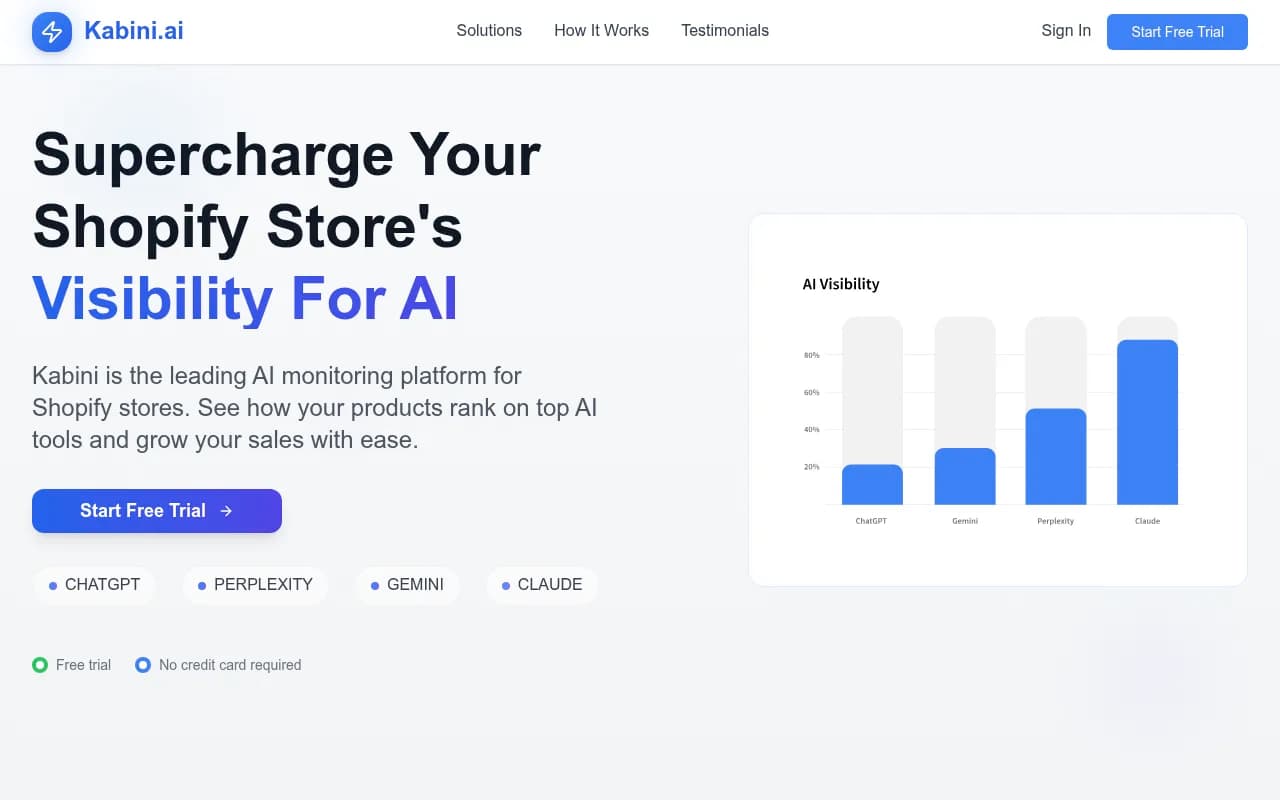
AI Visibility Score Kabini's core dashboard shows an aggregate visibility score for your Shopify store across the AI models it monitors. You can see how your products perform on each platform individually -- ChatGPT, Gemini, Perplexity, Claude -- and track changes over time. The score is presented as a percentage (e.g., 85/100), which gives a quick read on overall presence but doesn't tell you much about why you're scoring where you are without digging into the underlying data.
Multi-engine monitoring The platform tracks visibility across four AI models: ChatGPT, Gemini, Perplexity, and Claude. Coverage depends on your plan -- the free tier only covers ChatGPT, the Starter plan adds Gemini, Growth adds Perplexity, and Claude is reserved for Enterprise. This tiered model for AI engine access is a notable limitation. Paying $99/month and only getting two AI engines covered feels restrictive, especially when competitors like Promptwatch monitor 10+ models across all plans.
Competitor intelligence Kabini lets you track competitor products alongside your own and compare "Share of AI Voice" -- essentially how often your brand vs. competitors gets cited in AI responses. You can see citation frequency, tone, and placement comparisons. The Growth plan allows up to 10 competitors; Starter limits you to 3. This is a useful feature for DTC brands trying to understand the competitive landscape in AI shopping recommendations.
GEO Optimization Suite This is where Kabini tries to go beyond pure monitoring. The optimization suite checks schema coverage, content freshness, and internal linking on your product pages, then gives recommendations for making your content more AI-readable. It's a useful starting point, but the recommendations appear to be fairly surface-level -- schema audits and content freshness checks are table stakes for any SEO tool. There's no AI content generation capability, so you get the diagnosis but have to do the treatment yourself.
Question Generator One of the more interesting features: Kabini generates FAQ and Q&A blocks for your Shopify product pages, designed to help AI models better understand your products. The idea is that structured Q&A content is more likely to be cited in AI responses to shopper queries. This is a practical, ecommerce-specific application of GEO principles. It's not a full AI writing agent, but it's a targeted tool for a real problem.
Shopper Intent Insights Kabini maps query intent across informational, comparative, and transactional categories, showing you what real shoppers are asking AI assistants in your product category. It also includes sentiment analysis of how your brand is framed in AI responses. This is genuinely useful for understanding the language shoppers use when asking about products like yours -- and for identifying gaps where competitors are getting cited and you're not.
Regional and language monitoring The platform supports monitoring across different regions and languages, which matters for Shopify stores selling internationally. This is a solid inclusion, though the depth of regional coverage isn't detailed publicly.
Alerts Kabini sends alerts when your product drops in AI answers. This is a basic but necessary feature for any monitoring tool -- you want to know when something changes, not just see a static snapshot.
Who is it for
Kabini's clearest use case is the small-to-mid Shopify merchant who is starting to think about AI search visibility but doesn't have a dedicated SEO team or the budget for enterprise GEO tools. A DTC skincare brand with 20-50 SKUs, a Shopify store doing $1-5M in annual revenue, or a solo founder who's noticed that ChatGPT recommendations are driving traffic -- these are the people Kabini is built for. The Shopify-specific framing (product pages, SKU tracking, shopping intent) makes it more immediately relevant to ecommerce operators than a general-purpose GEO tool.
Marketing and SEO teams at mid-size Shopify brands (think: a team of 3-5 people managing a brand doing $5-20M in revenue) could also find value here, particularly in the competitor intelligence and shopper intent features. If you're trying to understand why a competitor's products keep showing up in ChatGPT recommendations for your category, Kabini gives you a structured way to investigate that.
Enterprise Shopify stores are technically supported via the custom Enterprise plan, but at that scale, the limitations of Kabini's feature set (no crawler logs, no traffic attribution, no content generation) become more apparent. A large brand with a real GEO strategy would likely outgrow Kabini quickly.
Who shouldn't use this: anyone running a non-Shopify website, B2B companies, SaaS brands, or publishers. Kabini is built around product pages and shopping intent -- it's not designed for service businesses, content sites, or lead-generation use cases. Also, teams that need to actually generate and publish AI-optimized content will find Kabini's optimization suite too thin.
Integrations and ecosystem
Kabini's primary integration is with Shopify, which is the foundation of the whole product. The Shopify integration is available on Growth and Enterprise plans, which is a bit odd -- you'd expect Shopify connectivity to be a baseline feature for a tool marketed entirely at Shopify stores.
Beyond Shopify, there's no public information about integrations with Google Search Console, Slack, Zapier, or other common marketing stack tools. There's no mention of an API, browser extension, or mobile app. The platform appears to be a standalone web dashboard at app.kabini.ai.
This is a meaningful gap. Most marketing teams work across multiple tools, and the lack of integrations means Kabini data stays siloed. You can't pipe visibility data into a Slack channel, connect it to your analytics stack, or automate reporting to clients.
Pricing and value
Kabini's pricing structure:
- Free: $0, 7-day trial, ChatGPT only, 1 website, 1 competitor, up to 2 products
- Starter: $99/month, ChatGPT + Gemini, 1 website, 3 competitors, up to 5 products, email support
- Growth: $299/month, ChatGPT + Gemini + Perplexity, up to 3 websites, 10 competitors, up to 100 products, Shopify integration, priority email
- Enterprise: Custom pricing, all 4 AI engines (adds Claude), custom catalog, dedicated manager
The value proposition gets shaky at the Starter tier. $99/month for 2 AI engines, 5 products, and 1 website is expensive relative to what you're getting. The Growth plan at $299/month is more reasonable if you're tracking 100 products across 3 sites, but you're still limited to 3 AI engines and there's no Claude coverage.
For comparison, Promptwatch's Essential plan at $99/month covers 10+ AI models, 50 prompts, and includes content generation capabilities -- a significantly broader feature set at the same price point. Kabini's Shopify-specific focus is a differentiator, but it doesn't fully justify the pricing gap at the lower tiers.
The 14-day free trial on paid plans (and a 7-day free tier) is a reasonable way to test the product before committing.
Strengths and limitations
What Kabini does well:
- The Shopify-specific focus is genuinely useful. Product-level tracking, shopping intent analysis, and the FAQ/Q&A generator are all tailored to ecommerce in a way that general GEO tools aren't.
- The competitor intelligence feature -- comparing Share of AI Voice, citation frequency, and tone -- gives ecommerce teams a concrete way to benchmark against rivals in AI shopping results.
- Setup is reportedly fast (the homepage claims 2 minutes), which matters for small merchants who don't have time for complex onboarding.
- The shopper intent mapping (informational vs. comparative vs. transactional queries) is a practical framework for understanding where your products fit in the AI shopping funnel.
Where it falls short:
- No AI content generation. The GEO Optimization Suite tells you what's wrong but doesn't help you fix it. You get schema warnings and content freshness flags, but no tool to actually write or improve your product content for AI visibility. This is a significant gap compared to platforms like Promptwatch, which includes a built-in AI writing agent.
- No AI crawler logs. There's no way to see which AI crawlers are visiting your site, which pages they're reading, or what errors they're encountering. This makes it hard to diagnose why certain products aren't getting cited.
- No traffic attribution. Kabini can tell you that your product appears in AI responses, but it can't connect that visibility to actual website traffic or revenue. There's no code snippet, GSC integration, or server log analysis to close the loop between AI mentions and sales.
- Limited AI model coverage. Four models (and Claude only on Enterprise) is a narrow window. Promptwatch monitors 10+ models including Grok, DeepSeek, Meta AI, Mistral, Copilot, and Google AI Overviews -- all of which are increasingly relevant to how shoppers discover products.
- No Reddit or YouTube tracking. AI models frequently cite Reddit threads and YouTube videos in their responses. Kabini doesn't surface this data, so you're missing a key channel for understanding why competitors get cited.
- No prompt volume or difficulty scoring. You can't prioritize which queries to target based on how often shoppers actually ask them or how competitive those queries are.
Bottom line
Kabini AI is a focused, ecommerce-specific tool that does one thing reasonably well: showing Shopify merchants how their products appear in AI shopping recommendations. For a small DTC brand just getting started with GEO, it's an accessible entry point with a clean interface and Shopify-native framing.
The problem is that monitoring is only half the job. Knowing your product ranks 65% on Gemini doesn't tell you how to get to 85%. Kabini's optimization suite is thin, there's no content generation, no crawler diagnostics, and no way to connect AI visibility to actual revenue. Teams that need to move from "we see the problem" to "we fixed it" will need a more complete platform. Promptwatch covers 10+ AI models, includes an AI writing agent for content gap analysis, tracks AI crawler activity, and attributes AI traffic to revenue -- making it the stronger choice for teams that want to actually optimize, not just monitor.
Best for: Shopify store owners who want a simple, product-focused dashboard to track AI shopping visibility and benchmark against competitors, without needing deep optimization workflows.
Frequently asked questions
What is Kabini AI?
How much does Kabini AI cost?
Is there a free trial for Kabini AI?
Which AI models does Kabini monitor?
Does Kabini AI work with non-Shopify websites?
How does Kabini compare to other GEO tools like Promptwatch?
Similar and alternative tools to Kabini AI