Topical Map AI Review 2026
AI tool that generates topical maps and content plans to help websites build authority around specific niches. Streamlines content strategy and internal linking structure.
Key takeaways
- Generates 800-1,200 clustered keywords per topical map in roughly 60 seconds, with real search volume and difficulty data pulled via DataForSEO
- Content briefs are included on every map -- no need for a separate tool like Surfer or MarketMuse for the brief-generation step
- White-label PDF export is available from the Pro plan upward, making it practical for freelancers and small agencies delivering client work
- Pricing starts at $56/mo (Starter, annual billing), significantly cheaper than Ahrefs ($129/mo) or Semrush ($139/mo) for this specific use case
- Does one thing well -- topical mapping -- and is not a replacement for a full SEO suite; no backlink analysis, rank tracking, or site audit capabilities
- Bootstrapped, solo-founder product with active weekly updates and a 30-day refund policy
Topical Map AI is a focused content strategy tool built by Megan Ragab, a former agency strategist who got tired of spending hours manually clustering keywords for clients. The premise is simple: you enter a niche, and within about 60 seconds the platform returns a complete topical authority map with 800-1,200 keywords organized into semantic clusters, each with search volume, difficulty scores, and content brief generation built in. It launched as an internal workflow tool and has grown to over 2,500 SEO professionals as of early 2026.
The target audience is clearly defined: solo SEOs, freelance content strategists, bloggers building niche sites, and small agencies that need to deliver topical audits to clients without the overhead of a full enterprise SEO suite. It's not trying to compete with Ahrefs or Semrush on breadth -- it's competing on speed and focus for one specific workflow.
The bootstrapped, no-VC-funding angle is worth noting. Megan still reads every support message personally and ships updates weekly. That kind of founder-led product development tends to produce tools that actually solve the problem they claim to solve, and the user testimonials (including from Julian Goldie, a well-known SEO agency owner) suggest the core workflow genuinely delivers.
Key features
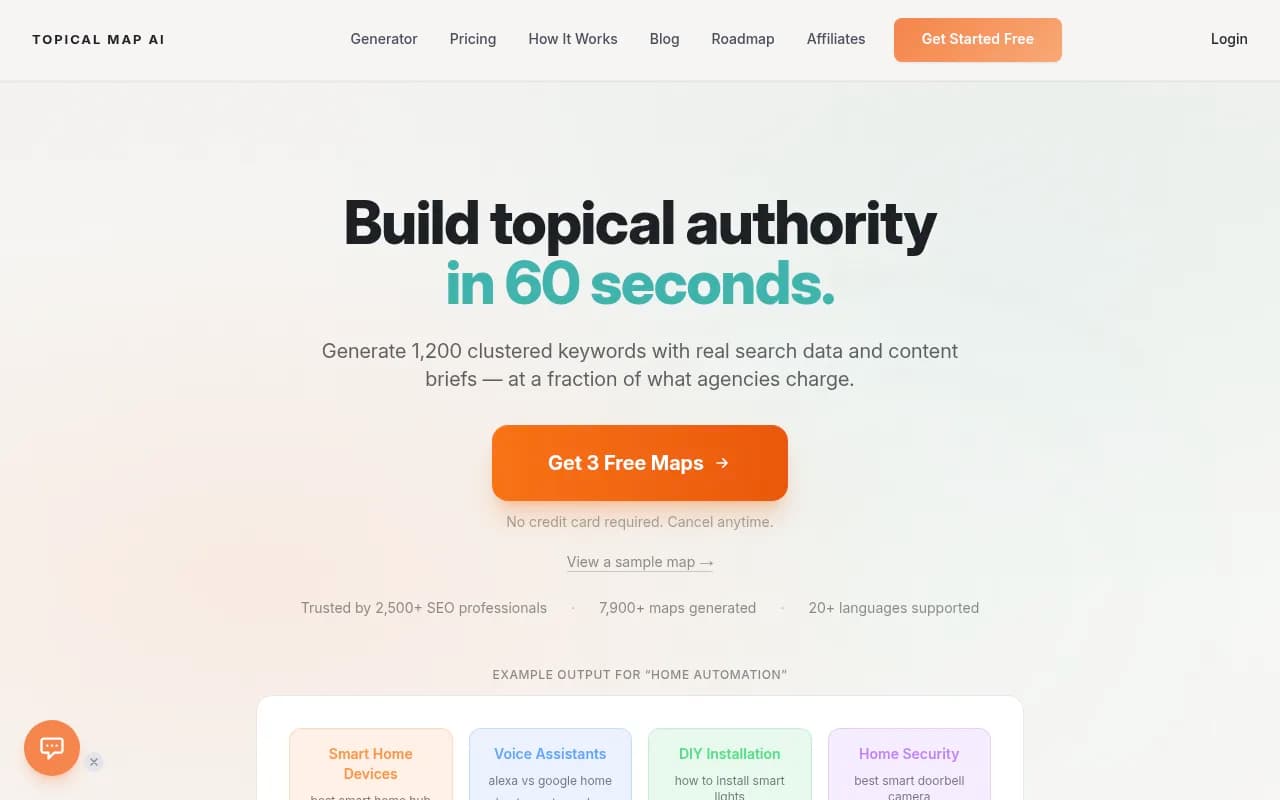
Topical map generation in 60 seconds The headline feature. You enter a niche or topic, and the AI generates a full topical authority map with 800-1,200 keywords automatically clustered by subtopic. The example on the homepage for "Home Automation" shows 1,247 keywords across 16 clusters generated in 52 seconds. In practice, the Pro plan processes maps in 2-3 minutes (the "fast processing" tier), while the Starter plan presumably takes longer. The clustering is semantic -- keywords are grouped by intent and topic relationship, not just surface-level string matching.
Five map types The platform supports five distinct map formats:
- SEO maps (standard topical authority structure)
- Social maps (viral content planning for social channels)
- Product maps (buyer journey and product launch content)
- News maps (industry tracking and trending topics)
- A fifth type implied by the "All 5 map types" plan language
This is more flexible than most competitors, which typically only generate SEO-focused keyword clusters. The social and product map types make it useful for content marketers who aren't purely focused on organic search.
Real search volume data via DataForSEO Keywords come with live search volume, difficulty scores, and competition data. The site explicitly states it uses DataForSEO metrics rather than estimates, which is a meaningful distinction -- many cheaper tools generate plausible-sounding keywords with fabricated or stale volume data. DataForSEO is a legitimate data provider used by several professional SEO tools.
Content briefs built in Every map includes the ability to generate full content briefs per cluster directly inside the platform. This removes the need to export to a separate tool like Surfer SEO or MarketMuse just to get a brief. For freelancers billing clients for topical audits, this is a real time-saver -- you can hand off a complete brief to a writer or AI writing tool without an extra step.
White-label PDF export From the Pro plan upward, you can export branded PDF reports with your own logo and branding. This is specifically designed for agency and freelance use cases where you're delivering client-facing documents. CSV and Excel exports are available on all paid plans. The white-label feature is notably absent from Ahrefs and Semrush, which the comparison table on the site correctly points out.
Bring your own API key Users can connect their own OpenAI API key to reduce costs and maintain control over usage. This is a practical feature for power users who are generating large volumes of maps and want to avoid paying a markup on AI inference costs.
20+ languages and 25+ countries International SEO support is built in -- you can generate maps in Arabic, Chinese, Portuguese, Spanish, French, German, Italian, Dutch, Russian, Japanese, Korean, and more. Language is selected during map creation. This makes it viable for agencies running multilingual campaigns or SEO professionals working in non-English markets.
Batch generation The Pro plan and above include batch generation of up to 5 maps simultaneously. For agencies building out topical maps for multiple clients or multiple site sections at once, this is a meaningful workflow improvement over generating maps one at a time.
GEO/AI search optimization The comparison table claims "AI Search / GEO Optimized" as a built-in feature, which Ahrefs lacks and Semrush only partially supports. The specifics of what this means in practice aren't fully detailed on the site, but it suggests the content briefs and keyword clustering take AI search intent into account alongside traditional Google search signals.
Who is it for
The clearest use case is the solo SEO or freelance content strategist who needs to deliver topical authority maps to clients quickly. If you're charging $1,500-2,500 for a topical audit and currently spending 6-10 hours on keyword research and clustering, Topical Map AI compresses that to under an hour including brief generation. At $104/mo on the Pro plan, the math works out favorably after a single client engagement.
Niche site builders and bloggers are a strong secondary audience. The tool is explicitly designed to require no prior SEO experience, and the workflow (enter niche, get map, export, start writing) is accessible to someone who doesn't know what a keyword cluster is. Sadie Smiley's testimonial as a "professional blogger" reflects this -- the tool handles the structural thinking so you can focus on writing.
Small agencies (2-10 person teams) running content-heavy campaigns for clients in specific verticals will find the batch generation and white-label export genuinely useful. The Business and Agency plans (pricing not fully detailed on the public page beyond the Pro tier at $104/mo) presumably accommodate higher map volumes.
Who should not use this tool: anyone who needs a full SEO suite. Topical Map AI has no backlink analysis, no rank tracking, no technical site audit, no competitor backlink gap analysis. If you're an in-house SEO at a mid-size company who needs all of those capabilities, you're still going to need Ahrefs or Semrush. The tool itself acknowledges this -- "Most agencies use TMAI alongside their existing tools, not instead of them." That's honest positioning.
Enterprise SEO teams with complex content governance requirements will also find it limited -- there's no team collaboration, no approval workflows, and no CMS integration.
Integrations and ecosystem
The integration story is fairly minimal at this stage, which is typical for a bootstrapped early-stage product.
Export formats: CSV, Excel, and PDF are supported on paid plans. Google Docs export is mentioned in the "How It Works" section, suggesting some level of Google Workspace integration, though the details aren't fully specified.
OpenAI API: Bring-your-own-key support for OpenAI is the main API integration. This lets users plug in their own GPT-4 or GPT-4o access rather than relying on the platform's shared inference.
DataForSEO: Used as the underlying keyword data provider. Not a user-facing integration, but worth knowing for anyone evaluating data quality.
No native CMS integrations: There's no direct connection to WordPress, Webflow, Contentful, or similar platforms. You export and then manually implement.
No Zapier or Make integration: Automation workflows aren't currently supported, which limits how well it fits into larger content production pipelines.
The lack of integrations is the most obvious gap for teams trying to build automated content workflows. Keyword import is listed as "coming soon," which suggests the roadmap is actively expanding.
Pricing and value
Topical Map AI uses a tiered subscription model with monthly and annual billing options. Annual billing saves 17%.
- Starter: $56/mo (annual) -- entry-level, limited maps per month, basic features
- Pro: $104/mo (monthly) -- 100 maps/month, all 5 map types, white-label PDF, batch generation (5 at once), fast processing (2-3 min), priority support, 20+ languages and 25+ countries
- Business and Agency: Pricing not fully detailed on the public page, but referenced in the FAQ and comparison pages as going up to $374-399/mo range based on the comparison pages with Search Atlas and MarketMuse
Free tier: 3 free maps with no credit card required. This is a genuinely useful free tier -- 3 maps is enough to evaluate whether the output quality works for your niche before committing.
30-day refund policy: Full refund if you've used fewer than 10 credits within 30 days. Reasonable for a subscription tool.
Compared to the alternatives it positions against:
- Ahrefs starts at $129/mo and topical mapping is not a core feature
- Semrush starts at $139/mo with partial content brief support
- Surfer SEO starts at $89/mo but focuses on content optimization rather than topical mapping
- MarketMuse starts at $99/mo with a narrower feature set for this specific workflow
For the specific job of generating topical authority maps with content briefs, $56-104/mo is competitive pricing. The value proposition is strongest for freelancers and small agencies where the time savings directly translate to billable hours recovered.
Strengths and limitations
What it does well
The speed is real. Generating 1,200 clustered keywords in under 2 minutes is genuinely faster than any manual workflow, and faster than running the equivalent process in Ahrefs or Semrush where topical clustering is an add-on rather than the core experience.
The content brief integration is a meaningful workflow improvement. Having briefs generated inside the same tool where you built the map removes a context-switching step that adds up over many client projects.
White-label PDF export at the Pro tier is well-suited to the freelance and small agency use case. Most tools at this price point don't include client-ready branded exports.
The free tier with 3 maps and no credit card requirement is a low-friction way to evaluate the tool. You can test it on your actual niche before spending anything.
The founder-led development model means the product is actively improving. Weekly updates and personal support responses are unusual for a SaaS product and suggest genuine responsiveness to user feedback.
Limitations and honest gaps
No rank tracking or backlink analysis. This is by design, but it means you need a separate tool to measure whether your topical authority work is actually moving rankings. You're flying somewhat blind on results unless you pair it with Google Search Console or another rank tracker.
Keyword import isn't available yet. If you have existing keyword research you want to incorporate, you can only use it as context for the topic you enter -- you can't upload a list and have the tool cluster it. This is a real limitation for SEOs who already have keyword data and want to build a map around it.
The "GEO/AI search optimized" claim in the comparison table isn't well-documented. It's unclear exactly what this means in practice -- whether content briefs include specific guidance for AI search optimization or whether it's more of a marketing claim. For teams specifically trying to optimize for AI search visibility and citation tracking in tools like ChatGPT or Perplexity, a dedicated platform like Promptwatch would be more appropriate -- it handles AI crawler monitoring, citation tracking, answer gap analysis, and content generation specifically engineered for AI search, which goes well beyond what a topical mapping tool addresses.
No team collaboration features. There's no way to share maps within a team, assign briefs, or manage approval workflows. For agencies with multiple team members, this creates friction.
Bottom line
Topical Map AI does one thing well: it takes the most time-consuming part of content strategy planning -- keyword research and topical clustering -- and compresses it from hours to minutes. For freelance SEOs, niche site builders, and small agencies that regularly need to produce topical authority maps, the time savings at $56-104/mo are hard to argue with.
Best use case in one sentence: a freelance SEO or small agency that needs to deliver client-ready topical authority maps with content briefs quickly, without paying for a full enterprise SEO suite they'll only use 20% of.
Tags:
Frequently asked questions
What is Topical Map AI?
How much does Topical Map AI cost?
Is there a free plan?
How is Topical Map AI different from Ahrefs or Semrush?
Can I use Topical Map AI for client work?
What languages does Topical Map AI support?
Similar and alternative tools to Topical Map AI