Key takeaways
- "AI search tools" covers three separate jobs for marketers: using AI to research, using AI to write and optimize content, and tracking whether AI engines mention your brand. Most buying mistakes come from mixing them up.
- Research is best handled by general assistants like Perplexity, ChatGPT, Gemini, and Claude, plus your own customer call transcripts.
- For content, pair a drafting tool with an optimization tool such as Surfer SEO, Clearscope, or Frase, and ground it in what AI engines actually cite.
- For visibility, trackers that only report a score are the weakest option. Favor tools that show why you are missing and help you fix it.
- Promptwatch data from Sep 28 to Oct 4, 2026 shows product and landing pages make up about 39% of ChatGPT citations, so your commercial pages matter more than most blog posts.
The three jobs people lump together
Search "AI search tools" and you get a mess. Some results are chatbots you use to research. Some are writing assistants. Others are dashboards that tell you whether ChatGPT recommends your brand. They solve different problems, and a marketing team usually needs one of each.
Tim Soulo of Ahrefs makes a similar split in his 2026 roundup: tools that use AI to speed up traditional SEO work, and a newer category that tracks AI visibility. I'd add a third bucket, plain research assistants, because that is where most teams actually start.
Here is the rough map.
| Job | What you need | Example tools |
|---|---|---|
| Research | Fast, cited answers; synthesis of calls and documents | Perplexity, ChatGPT, Gemini, Claude, NotebookLM |
| Content | Drafting plus optimization against search and AI signals | Claude, Surfer SEO, Clearscope, Frase, Writesonic |
| Visibility | Tracking mentions and citations in AI answers, then fixing gaps | Promptwatch, Profound, Ahrefs Brand Radar, Peec AI, Otterly.AI |
Pricing for most of these changes often, so check each vendor's pricing page before you commit. I have not verified current prices for the tools below.
Research: where AI search actually helps
For day-to-day research, the general assistants are good enough that paying for a dedicated product rarely makes sense. A Segmetrics roundup lists Perplexity as its pick for market research because it returns fast answers with cited sources. That matches my experience. You can check the sources in two clicks, which matters when someone pastes a statistic into a deck.
A few practical notes:
- Perplexity is the quickest route to a sourced answer. Treat the citations as leads, not proof.
- ChatGPT is the generalist. It handles research, brainstorming, and image work in one place.
- Claude is strong for long documents and synthesis. Feed it a competitor's whole docs site or a batch of reports.
- NotebookLM is underrated for grounded research. Upload your own sources and it answers only from those.
The research source most teams skip
The same Segmetrics guide points out something I agree with: the best research tool is your own customer calls. Drop transcripts into Claude or ChatGPT and ask for objections, the exact phrases buyers use, and feature requests across hundreds of conversations. That gives you messaging and content topics no keyword tool will surface.
Keyword and topic research
Classic SEO suites still do the heavy lifting here. Ahrefs, Semrush, and SE Ranking have added AI keyword features, and cheaper options like Ubersuggest and Mangools cover the basics.
The newer wrinkle is prompt research. Keywords tell you what people type into Google. Prompts tell you what they ask an AI, and those are longer and more conversational. Tools that show prompt volumes and the web searches an AI runs behind each answer (query fan-outs) give you a better content brief than a keyword list alone. Promptwatch's data on ChatGPT query fanouts shows how many searches ChatGPT fires per response, and it is more than most people assume.
Content: drafting and optimizing
Drafting and optimizing are different jobs, and the best setups use two tools.
For drafting, Claude and ChatGPT are the default. For optimization, you want something that scores a draft against what already ranks and, increasingly, what AI engines cite.
A few honest observations:
- Surfer SEO and Clearscope are the established optimization picks. Both have added AI search features, but their core strength is still on-page scoring.
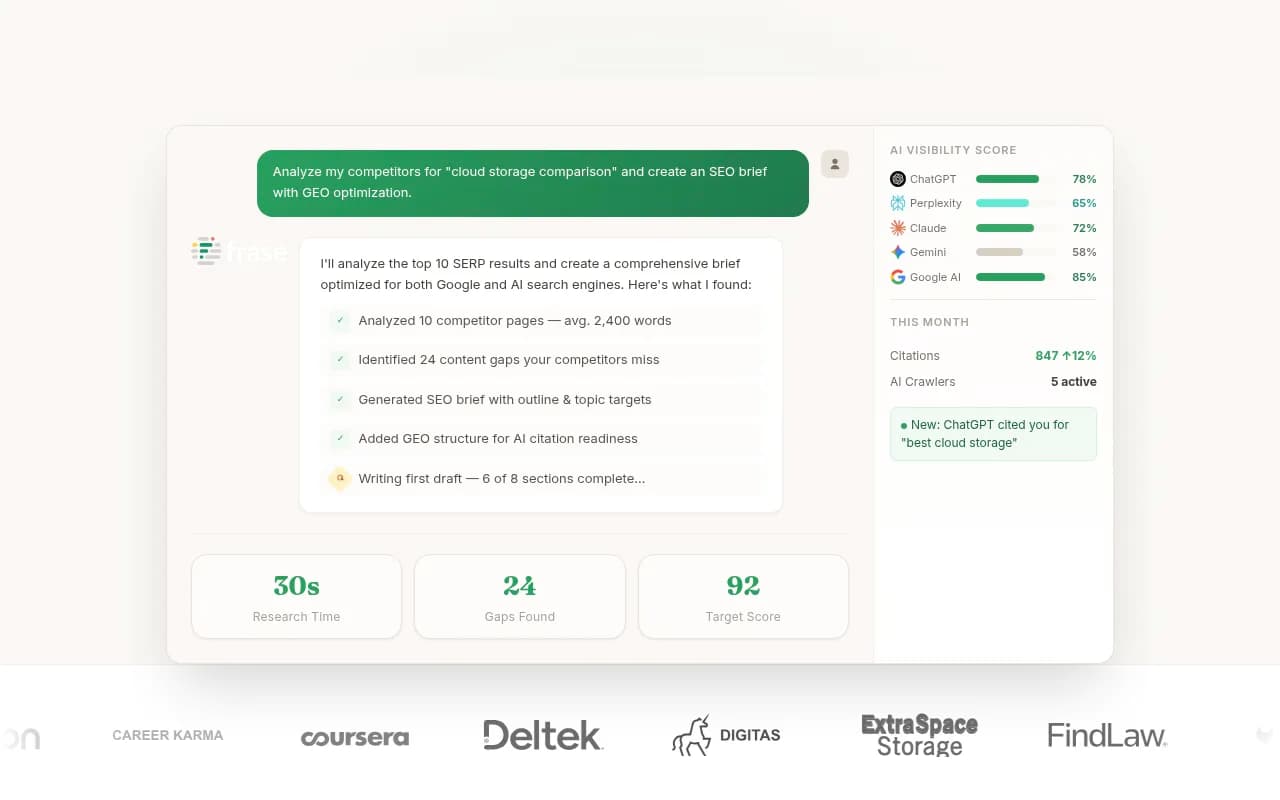
- Frase pitches a research-to-publish workflow with tracking built in. Note that its "10 best AI visibility tools" article ranks Frase first, so treat that ranking as self-assessment.
- Writesonic bundles writing, site audits, and AI visibility tracking in one login. That is attractive if you want to consolidate, though bundles are rarely the best at every piece.
- Jasper and Copy.ai are workflow-oriented content tools. They generate well, but they have no view of what AI engines are citing, so you are writing blind.
What the citation data says about what to write
Before you scale any content program, look at what AI actually cites. Promptwatch Data's content type report for Sep 28 to Oct 4, 2026 found:
| Content type | Share of ChatGPT citations |
|---|---|
| Product pages | 22.4% |
| Landing pages | 16.8% |
| Listicles | 13.6% |
| How-tos | 8.7% |
| Documentation | 7.5% |
| General articles | 6.1% |
| Comparisons | 5.9% |
| News | 5.7% |
For commercial prompts like "best CRM for small businesses", product pages, landing pages, listicles and comparisons make up almost 70% of citations. That should change your plan. Another blog post about industry trends is probably the weakest way to earn an AI citation. A sharper product page, a comparison page, and a presence in third-party "best of" roundups are better bets.
Shelf life matters too. In Promptwatch's content half-life analysis, news pages lost half their citations within about five weeks, while landing pages and docs held on for months. If you are building evergreen assets, favor the types that last.
Social content is a platform-by-platform call
Promptwatch's social media citations report (Sep 28 to Oct 4, 2026) found that social platforms were only 0.46% of ChatGPT citations, but 12.2% of Google AI Overviews citations. YouTube was 4.28% of AI Overviews citations. So a Reddit-heavy strategy that worked in 2025 is a poor fit for ChatGPT now. The Reddit decline report shows reddit.com's share of ChatGPT citations dropping from about 4% to 0.5% on August 14, 2026. If you want AI Overviews visibility, YouTube and Facebook look like better investments.
Visibility: tracking and fixing how AI talks about you
This is the newest category and the most crowded. The catalog of tools is long, and they differ in one important way: whether they stop at the dashboard or help you act.
Two things to keep in mind when reading vendor comparisons. First, nearly every one of them ranks its own product first. The Frase article, the Profound agency roundup, and Ahrefs' CMO's Medium post all do some version of this. Second, big claims like "243M+ prompts" or "no other tool matches" come from the vendor itself. They may be true, but they are unverified.
What to look for
The IndustryLens comparison put it well: choose the tool that helps explain a missing mention over the one that gives you another score to report. In practice that means checking for:
- Real interface data rather than only API calls, since user-facing answers can differ from API outputs.
- Source pages behind each answer, so you can see who is being cited instead of you.
- Crawler logs, to confirm AI bots can actually read your site.
- Traffic attribution, so you can tie citations to visits and conversions.
- A path from gap to published content.
The tools worth a look
Promptwatch is the one I'd start with for teams that want more than a score. It tracks ChatGPT, Google AI Overviews, Google AI Mode, Gemini, Perplexity, Copilot, Claude, and others through their real interfaces. It adds IP-verified AI crawler logs, visitor analytics for AI-referred traffic, content gap analysis, and a Content Agent that plans, writes, and publishes to WordPress, Webflow, or Framer. Where most trackers answer "was I mentioned?", it also tries to answer what to do about it. 1001 SEO Media uses it for its own AI visibility work.

The main alternatives:



- Profound is strong on monitoring depth and enterprise features, and prices accordingly. It is a better fit for large brands and agencies than for a three-person team.
- Ahrefs Brand Radar suits teams already living in Ahrefs. It folds AI mentions, citations, and share of voice into a tool you may already pay for, and its Custom Prompts let you track your own questions.
- Peec AI and Otterly.AI are lighter trackers. They are fine for getting started and watching trends, but neither includes crawler logs or content generation. Otterly's entry plan is claimed at around $29 per month, which I could not verify.
- Semrush's AI toolkit is the natural pick if Semrush is already your suite.
- AthenaHQ and Scrunch sit in the monitoring-plus-recommendations middle ground.
If you want to browse the wider field, the GEO software directory at bestgeosoftware.com lists far more options than any single article can cover.
Comparison at a glance
| Tool | Best for | Strength | Watch out for |
|---|---|---|---|
| Promptwatch | Teams that want to track and fix | Crawler logs, traffic attribution, content agent, real-UI data | More capability than a casual user needs |
| Profound | Enterprise and large agencies | Deep monitoring, agency workflows | Higher price, overkill for small teams |
| Ahrefs Brand Radar | Existing Ahrefs users | Search demand tied to AI mentions | Fixed index vs custom prompts to check |
| Peec AI | Prompt-set tracking | Multi-language, clear limits | Model add-ons can raise cost |
| Otterly.AI | Solo marketers, small agencies | Cheap, quick setup | No prompt volume data or content generation |
| Semrush One | Semrush shops | One suite for SEO and AI | Fixed prompt sets, shallower AI data |
| Writesonic | Consolidation seekers | Writing plus tracking in one login | Jack of all trades |
Matching tools to team size
Teams differ more than tool lists admit. Here is how I'd approach it.
Solo marketer or tiny team
Start free. Run a no-login AI visibility check, use Perplexity and ChatGPT for research, and draft in Claude. Add one low-cost tracker like Otterly.AI or Peec AI once you know which prompts matter. Do not buy a content platform until you have a clear gap to fill.
In-house team of 3 to 10
This is where an end-to-end platform pays off. Pair a general assistant for research, an optimizer like Surfer SEO or Clearscope if you publish a lot, and one visibility platform that connects citations to traffic and content actions. Promptwatch fits here, as does Ahrefs Brand Radar if Ahrefs is already your base.
Agency
You need multi-client workspaces, pitch environments, and white-label reporting. Profound's agency roundup lists 18 options, and Promptwatch's agency plans cover unlimited projects. Rankability and Cairrot are also built around agency use. If you would rather hand this off entirely, 1001 SEO Media runs AI search and GEO programs as a service.
Enterprise
Security reviews and procurement matter. Look for ISO 27001, SSO, audit logs, and dedicated support. Promptwatch, Profound, BrightEdge, Botify, and Conductor are the names that show up at this level.
A workable stack
Here is a stack I'd actually recommend to a mid-size marketing team:
- Research: Perplexity or ChatGPT for quick answers, Claude for synthesis, your own call transcripts for messaging.
- Keywords and prompts: your existing SEO suite plus prompt volume and fan-out data from your visibility platform.
- Content: Claude for drafts, Surfer SEO or Clearscope for scoring, then a human edit. Always.
- Visibility: one platform that tracks real AI interfaces, logs crawler visits, and attributes traffic.
- Measurement: tie everything back to leads and revenue, not mentions.
That last point deserves emphasis. A mention count is a vanity metric until it connects to visits and conversions. Look for tools that join citations, crawl activity, and analytics so you can see which pages AI reads, cites, and sends people to.
Common mistakes
- Buying a tracker and doing nothing with the data. A dashboard without an action list is a monthly report no one reads.
- Chasing every engine equally. Promptwatch's average sources per response page shows ChatGPT cites about 5 sources per web-search answer while AI Overviews and Perplexity cite about 10. Your odds and tactics differ by engine.
- Ignoring technical access. If AI crawlers hit errors on your site, no amount of content fixes that. Check robots.txt, rendering, and crawl logs first.
- Trusting vendor rankings. Read comparisons for the criteria, not the ordering.
- Over-automating content. Fast publishing is great until it fills your site with thin pages. Keep a review step.
FAQ
Do I need a separate AI visibility tool if I already use Semrush or Ahrefs?
Maybe not at first. Both have added AI tracking and it is a sensible starting point. The gaps are usually crawler logs, AI traffic attribution, and flexible custom prompt sets. If those matter, a dedicated platform is worth testing.
Which AI engines should I track?
Start with ChatGPT, Google AI Overviews, and Perplexity. Add Gemini, Copilot, and Claude as your audience warrants. Track in the countries and languages you sell in.
How often should I check visibility?
Daily collection with weekly review works well. AI answers move around, so single snapshots mislead.
Is AI-generated content safe to publish?
It can work if it is accurate, edited, and grounded in real data about your brand. Unreviewed bulk output is where teams get into trouble.
Where to go next
Pick the job you are failing at today. If you cannot answer research questions quickly, start with an assistant. If your content is not getting cited, look at your page types and technical access. If you do not know whether AI mentions you at all, run a free visibility check, then choose a tracker. For wider tool comparisons beyond AI search, the SurferStack directory is a good place to keep browsing, and Promptwatch's data hub is worth bookmarking because the numbers shift month to month.