Ubersuggest Review 2026
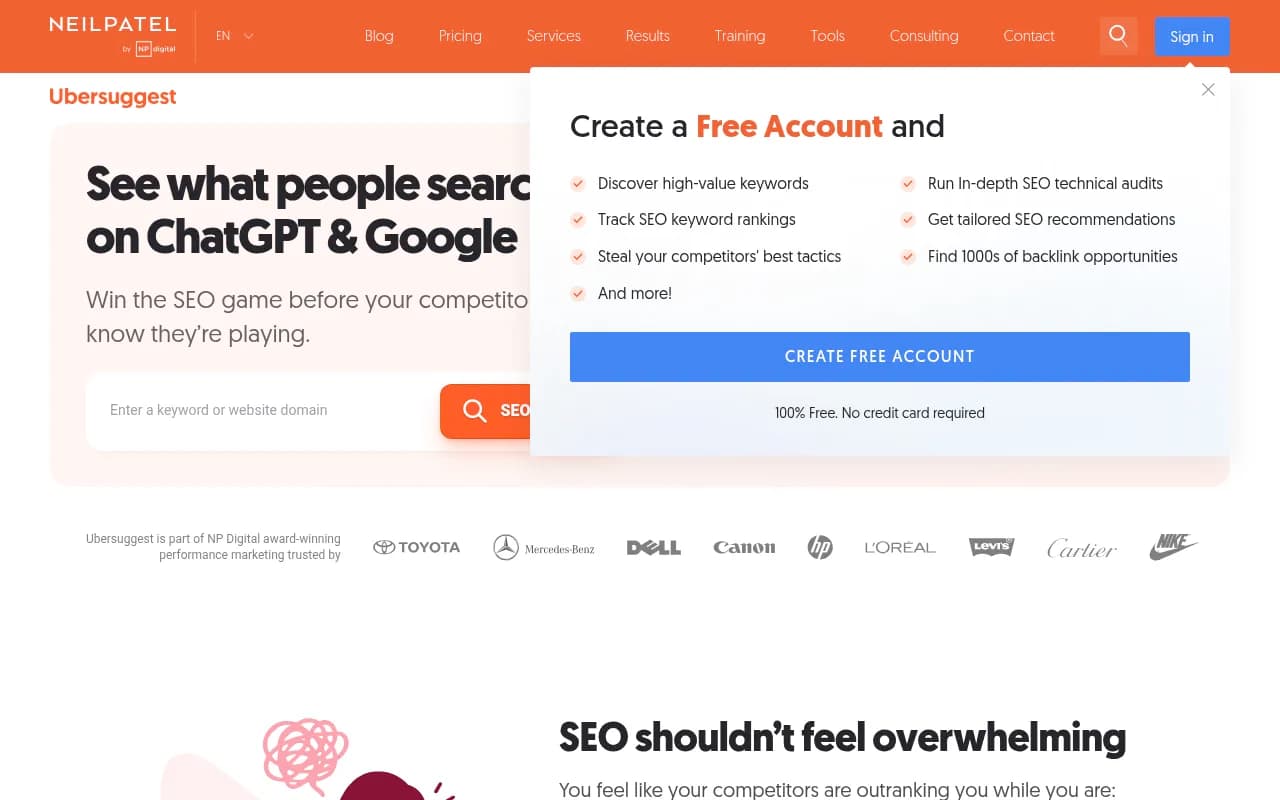
Ubersuggest is Neil Patel's all-in-one SEO platform combining keyword research, competitor analysis, site audits, and rank tracking with AI-powered insights. Built for marketers, agencies, and businesses who want enterprise-level SEO capabilities without enterprise pricing -- starting at a one-time
Summary: Key Takeaways
- Best for budget-conscious SEO practitioners: Ubersuggest offers lifetime access for a one-time payment, making it 90% cheaper than Ahrefs, SEMrush, or Moz -- ideal for solopreneurs, small agencies, and businesses managing 1-5 sites
- AI keyword research meets traditional SEO: Combines a 100M+ keyword database with AI-generated suggestions and brand mention tracking across AI models like ChatGPT
- Monitoring-only for AI visibility: Shows which brands AI models mention but lacks content generation, AI crawler logs, and traffic attribution that Promptwatch offers for actually optimizing AI search presence
- Solid core SEO toolkit: Backlink analysis, site audits, rank tracking, and competitor intelligence cover the fundamentals well
- Limited depth vs premium tools: Smaller keyword database and less granular data than Ahrefs or SEMrush, but sufficient for most small-to-midsize operations

Ubersuggest started as a free keyword suggestion tool in 2017 when marketing guru Neil Patel acquired it and rebuilt it into a full SEO platform. The pitch is simple: give you 80% of what the expensive tools offer at 10% of the price. For a lot of people -- freelancers billing $2k/month, agencies with 10-20 clients, SaaS founders doing their own SEO -- that trade-off makes sense. You're not getting Ahrefs' 24 trillion link index, but you're also not paying $99-$999/month forever.
The 2025-2026 version added AI features that feel half-visionary, half-catching-up. You can now see which brands ChatGPT and other AI models mention when answering queries, get AI-generated keyword ideas, and analyze search intent with machine learning. It's a start, but it's monitoring without optimization -- you see the data, then you're on your own to act on it.
Keyword Research (the core feature)
Type a seed keyword and Ubersuggest returns search volume, SEO difficulty (0-100 scale), paid difficulty, and cost-per-click data. The keyword suggestions come in several flavors: related keywords, questions people ask, prepositions ("for", "with", "near"), and comparisons ("vs", "or", "like"). The AI layer adds contextual suggestions based on semantic relationships, not just string matching.
The database covers 100 million keywords across multiple countries and languages. That's respectable but smaller than Ahrefs (10 billion+) or SEMrush (20 billion+). For most niches it's enough. For hyper-competitive spaces or obscure long-tail queries, you'll hit gaps. The search volume numbers come from Clickstream data providers (same sources competitors use), so accuracy is comparable -- meaning they're directional estimates, not gospel.
Keyword difficulty scoring uses a 0-100 scale that factors in domain authority of ranking pages, backlink profiles, and on-page optimization. A score under 30 is considered easy, 30-50 medium, 50-70 hard, 70+ very hard. In practice, the scores skew slightly optimistic compared to Ahrefs' Keyword Difficulty -- a 35 in Ubersuggest might feel like a 45 in Ahrefs. Adjust your expectations accordingly.
The "Content Ideas" tab shows top-performing articles for your keyword, sorted by social shares and backlinks. You see the headline, domain, estimated visits, shares, and linking domains. It's a quick way to reverse-engineer what's working, though the social share data feels dated (Facebook and Pinterest shares from 2018-2020 dominate).
AI Keyword Features (new in 2025)
Ubersuggest now tracks which brands AI models like ChatGPT, Perplexity, and Claude mention in their answers. You search a keyword, and it shows you a list of brands that appear in AI-generated responses, along with mention frequency. This is useful for brand monitoring -- seeing if your competitors are getting cited more than you.
But here's what's missing: Ubersuggest doesn't tell you why those brands are being mentioned, which specific prompts trigger the mentions, or how to optimize your content to get cited. You see the scoreboard but not the playbook. Tools like Promptwatch go further by showing content gaps (the topics and angles your site is missing that AI models want), tracking AI crawler logs (which pages AI bots are reading on your site), and providing AI-generated content designed to rank in AI search results. Ubersuggest gives you awareness; Promptwatch gives you action.
The AI keyword suggestions use GPT-based models to generate semantically related terms and questions. It's faster than manually brainstorming, but the output is generic -- you'll still need to filter and validate. The search intent classification (informational, navigational, commercial, transactional) is automated but often wrong for ambiguous queries.
Competitor Analysis
Enter a competitor's domain and Ubersuggest estimates their monthly organic traffic, top-ranking keywords, and traffic value (what they'd pay in Google Ads for that traffic). You see their top pages by traffic, their backlink profile (total backlinks, referring domains, domain score), and a list of keywords they rank for that you don't.
The traffic estimates are modeled, not measured, so treat them as rough proxies. A site showing 50k monthly visits might actually get 30k or 80k -- the model assumes average click-through rates and doesn't account for brand searches or featured snippets. The keyword overlap tool ("Keywords Gap") shows terms your competitors rank for that you don't, which is genuinely useful for content planning.
Backlink data comes from Ubersuggest's own crawler, which is smaller than Ahrefs' or Majestic's. You'll find the major backlinks but miss some of the long-tail, low-authority links. For link prospecting, you can filter by domain score, page score, and link type (dofollow/nofollow). The "Link Opportunities" feature suggests sites that link to competitors but not to you -- a decent starting point for outreach.
SERP analysis shows the top 100 results for any keyword, with domain score, page score, backlinks, social shares, and estimated visits for each result. You can export the list and use it to identify link targets or content gaps. The data is a few weeks old (not real-time), which is fine for strategic planning but not for tracking daily SERP volatility.
Site Audit (technical SEO)
The site audit crawler checks your site for 50+ SEO and technical issues: broken links, missing meta tags, duplicate content, slow page speed, mobile usability problems, HTTPS errors, and more. You get an overall "SEO Score" (0-100) and a prioritized list of issues to fix, categorized as critical, warnings, or recommendations.
The crawler is decent but not exhaustive. It catches the obvious stuff (404s, missing alt tags, thin content) but misses some of the nuanced issues that Screaming Frog or Sitebulb would flag (JavaScript rendering problems, canonicalization loops, complex redirect chains). For a $120 lifetime tool, it's more than adequate. For a Fortune 500 site with 100k pages, you'll want something heavier.
Page speed analysis integrates Google's Core Web Vitals (LCP, FID, CLS) and provides specific recommendations (compress images, minify CSS, enable browser caching). The recommendations are generic -- they don't tell you which images to compress or which scripts to defer -- but they point you in the right direction.
The audit runs weekly (on paid plans) and tracks changes over time. You can see if your SEO score is improving or declining, and which issues were fixed or newly introduced. The historical data only goes back a few months, so don't expect long-term trend analysis.
Rank Tracking
Add keywords and Ubersuggest tracks your rankings daily across desktop and mobile, with location targeting down to the city level. You see your current rank, rank change, search volume, and estimated traffic for each keyword. The tracker supports 150+ countries and multiple languages.
The interface is clean but basic. You can group keywords by tags, filter by rank range or traffic potential, and export to CSV. There's no rank distribution chart (showing how many keywords rank in positions 1-3, 4-10, 11-20, etc.), no SERP feature tracking (featured snippets, People Also Ask, local packs), and no competitor rank comparison within the tracker itself. For those features, you'd need SEMrush or Ahrefs.
Daily rank checks are standard on all paid plans. The data updates every 24 hours, which is fine for monitoring trends but not for reacting to algorithm updates in real time. If you need hourly or on-demand rank checks, look elsewhere.
Content Gap Analysis
This feature compares your site to up to three competitors and shows keywords they rank for that you don't. You can filter by search volume, difficulty, and keyword type (questions, prepositions, comparisons). It's a straightforward way to find content opportunities -- topics your competitors are covering that you're not.
The output is a list of keywords with volume, difficulty, and the competitors ranking for each. You can export the list and prioritize based on your content strategy. The tool doesn't suggest how to cover those topics (article format, word count, angle) -- it just identifies the gaps. You're responsible for the content planning.
For AI search visibility, this is where Ubersuggest falls short. It shows traditional SEO gaps but not AI content gaps -- the specific questions, comparisons, and use cases that AI models want answers to but can't find on your site. Promptwatch's Answer Gap Analysis goes deeper by analyzing 880M+ citations to show exactly what content you need to create to get cited by ChatGPT, Claude, Perplexity, and other AI models. Ubersuggest gives you the SEO homework; Promptwatch gives you the AI search homework.
Who Is Ubersuggest For
Ubersuggest is built for budget-conscious SEO practitioners who need solid fundamentals without the enterprise price tag. Specifically:
- Freelance SEO consultants and content marketers managing 1-5 client sites who can't justify $99-$399/month for Ahrefs or SEMrush. The lifetime plan ($120-$290 depending on tier) pays for itself in 2-3 months.
- Small agencies (2-10 people) handling local SEO, content marketing, or niche site building. You get enough data to impress clients without bleeding cash on tools.
- SaaS founders and solopreneurs doing their own SEO. You're not an SEO expert, so you need something that doesn't require a PhD to operate. Ubersuggest's interface is simpler than the competition.
- Bloggers and affiliate marketers building niche sites. Keyword research, rank tracking, and backlink analysis cover 90% of what you need. The content ideas feature helps you find angles that are already working.
Who should NOT use Ubersuggest:
- Enterprise SEO teams managing 50+ sites or sites with 100k+ pages. The data depth, crawler capacity, and API access aren't there. You need Ahrefs, SEMrush, or BrightEdge.
- Link building agencies that live and die by backlink data. Ubersuggest's link index is too small. You'll miss opportunities that Ahrefs or Majestic would surface.
- Brands focused on AI search visibility. If your goal is to rank in ChatGPT, Perplexity, Claude, and Google AI Overviews, Ubersuggest's AI features are too shallow. You see brand mentions but can't optimize for them. Promptwatch is purpose-built for AI search optimization with crawler logs, content generation, and traffic attribution.
- Technical SEO specialists who need deep crawl diagnostics, log file analysis, or JavaScript rendering insights. Ubersuggest's site audit is surface-level.
Integrations & Ecosystem
Ubersuggest integrates with Google Search Console to import your site's actual ranking data and compare it to Ubersuggest's estimates. This is useful for validating the tool's accuracy and finding discrepancies. The integration is read-only -- you can't push data back to GSC.
There's a Chrome extension that shows keyword data (volume, CPC, competition) directly in Google search results. It's handy for quick research without opening the full app. The extension also displays SEO metrics (domain score, backlinks, traffic estimate) when you visit any website.
No Zapier integration, no API (except for enterprise clients), no Slack notifications, no webhooks. The tool is self-contained. You export data to CSV or PDF and work with it elsewhere. For agencies building custom dashboards or automating reporting, this is limiting.
Mobile app available for iOS and Android. It's a stripped-down version of the web app -- keyword research, rank tracking, and site audit only. The interface is clunky on mobile. You'll do 95% of your work on desktop.
Pricing & Value
Ubersuggest's pricing is its biggest differentiator. Three tiers, all available as lifetime purchases:
- Individual: $120 lifetime (or $12/month). 1 website, 150 searches/day, 125 tracked keywords, 1,000 backlinks/month, 5 competitors tracked, 1 user.
- Business: $200 lifetime (or $20/month). 7 websites, 300 searches/day, 500 tracked keywords, 5,000 backlinks/month, 10 competitors, 2 users.
- Enterprise: $290 lifetime (or $40/month). Unlimited websites, 900 searches/day, 900 tracked keywords, 15,000 backlinks/month, 25 competitors, 5 users.
The lifetime pricing is aggressive. Ahrefs starts at $99/month ($1,188/year). SEMrush starts at $139.95/month ($1,679/year). Moz starts at $99/month. Over two years, Ubersuggest's Enterprise plan ($290 one-time) saves you $3,000+ compared to Ahrefs Lite.
The catch: you get what you pay for. Ubersuggest's data is shallower, the features are less sophisticated, and the support is slower. For many users, that trade-off is worth it. For others, the limitations become frustrating after six months.
There's a free tier with 3 searches/day and limited data. It's enough to test the tool but not enough to do real work. The free tier is a lead magnet -- you'll hit the limit in 10 minutes and upgrade.
No free trial on paid plans. You buy lifetime access upfront. There's a 30-day money-back guarantee, so you can test it risk-free. Refunds are processed within 5-7 business days.
Strengths & Limitations
What Ubersuggest does well:
- Unbeatable pricing: Lifetime access for $120-$290 is 90% cheaper than competitors. For budget-conscious users, this is the deciding factor.
- Beginner-friendly interface: Cleaner and simpler than Ahrefs or SEMrush. You can onboard a junior marketer in 30 minutes.
- Solid keyword research: 100M+ keywords, AI suggestions, search volume, difficulty, and content ideas cover the basics well.
- Decent competitor analysis: Traffic estimates, top pages, keyword gaps, and backlink profiles give you a starting point for competitive research.
- Site audit covers the essentials: Catches the most common SEO issues (broken links, missing tags, slow pages) without overwhelming you.
Where Ubersuggest falls short:
- Smaller data sets: Keyword database, backlink index, and SERP data are less comprehensive than Ahrefs, SEMrush, or Moz. You'll miss long-tail keywords and obscure backlinks.
- AI visibility monitoring only: Shows which brands AI models mention but doesn't help you optimize for AI search. Missing content gap analysis for AI, AI crawler logs, AI traffic attribution, Reddit/YouTube tracking, and content generation that Promptwatch provides. If your goal is to rank in ChatGPT or Perplexity, Ubersuggest gives you awareness but not action.
- Limited rank tracking features: No SERP feature tracking, no rank distribution charts, no competitor rank comparison within the tracker. Basic daily rank checks only.
- Shallow site audit: Misses nuanced technical issues that Screaming Frog or Sitebulb would catch. Fine for small sites, insufficient for complex enterprise sites.
- No API or advanced integrations: Can't build custom dashboards, automate reporting, or integrate with other tools beyond GSC. Agencies building white-label solutions will struggle.
- Slower support: Email-only support with 24-48 hour response times. No live chat, no phone support. For a lifetime purchase, you're not getting premium support.
Bottom Line
Ubersuggest is the budget champion of SEO tools -- you get 70-80% of what Ahrefs or SEMrush offer at 10% of the cost. For freelancers, small agencies, and solopreneurs managing a handful of sites, the lifetime pricing is hard to beat. The keyword research, competitor analysis, and site audit features cover the fundamentals well enough to drive results.
But the data depth and feature sophistication aren't there for enterprise teams, link building specialists, or anyone who needs cutting-edge capabilities. And if your focus is AI search visibility -- ranking in ChatGPT, Perplexity, Claude, or Google AI Overviews -- Ubersuggest's AI features are too shallow. You see brand mentions but can't optimize for them. For AI search optimization, Promptwatch is the stronger choice with content gap analysis, AI crawler logs, traffic attribution, and AI content generation.
Best use case in one sentence: Small-to-midsize SEO practitioners who need solid keyword research, rank tracking, and competitor analysis without the recurring cost of premium tools.
Tags:
Frequently asked questions
What is Ubersuggest and what does it do?
How much does Ubersuggest cost?
Is Ubersuggest free to use?
Who is Ubersuggest best for?
How does Ubersuggest compare to Ahrefs and SEMrush?
What AI features does Ubersuggest offer?
What SEO tools are included in Ubersuggest?
Similar and alternative tools to Ubersuggest