Key takeaways
- AI search traffic grew 527% year-over-year, and fewer than 10% of sources cited by ChatGPT actually rank in Google's top 10 -- so traditional SEO success doesn't automatically carry over
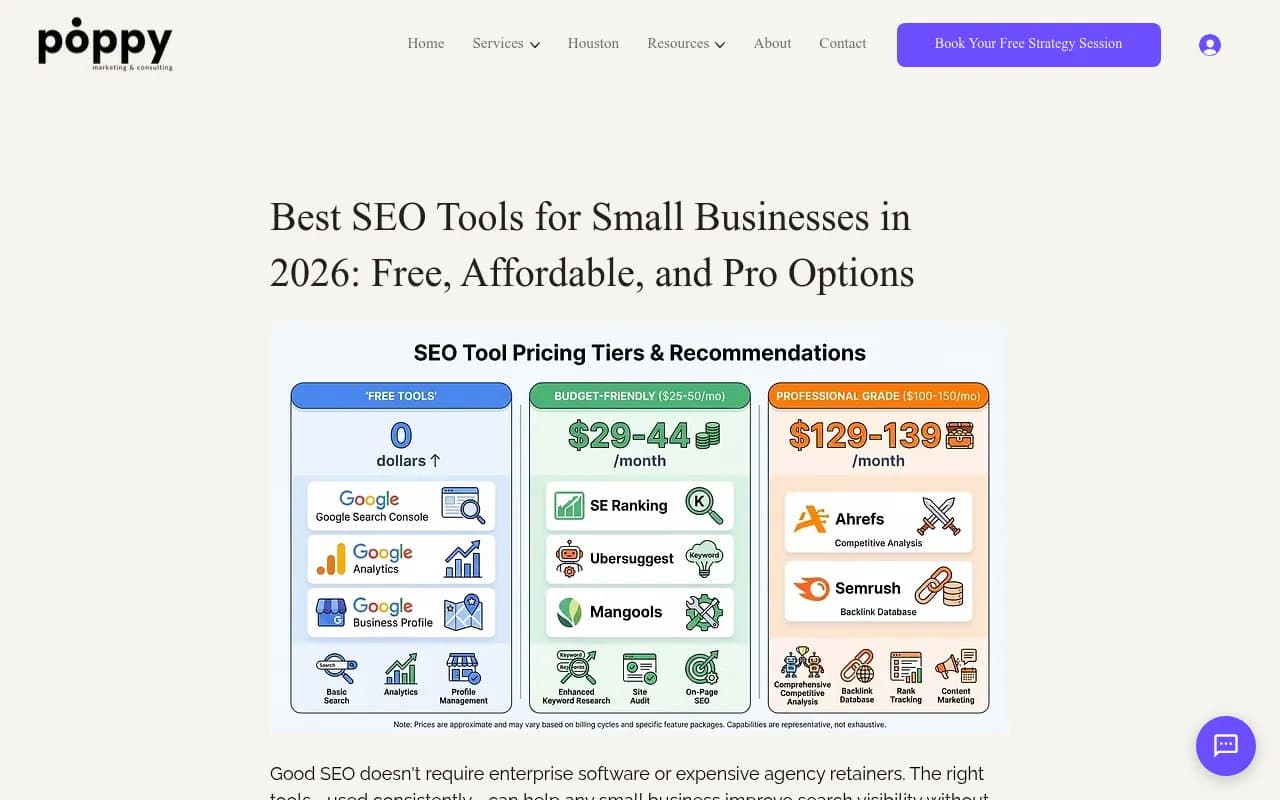
- Small businesses don't need enterprise tools to compete; free Google tools plus one paid platform in the $30-100/month range covers most needs
- The biggest gap in 2026 isn't traditional rankings -- it's AI visibility: whether ChatGPT, Perplexity, and Gemini recommend your business when customers ask
- Most affordable AI visibility tools are monitoring-only; the ones that help you act on the data (content gap analysis, AI-optimized content generation) are worth paying more for
- Start with Google Search Console and one keyword/content tool, then layer in AI visibility tracking once your site has solid fundamentals
Why small businesses can't ignore AI search in 2026
Here's a number worth sitting with: 92% of brands are currently invisible to ChatGPT. That's not a niche concern for tech companies -- it applies to the local accountant, the e-commerce store selling handmade goods, the B2B software startup. When someone asks an AI assistant "what's the best [your category] near me" or "which [your product type] should I buy," most businesses simply don't exist in that answer.
AI search traffic increased 527% year-over-year according to Semrush's 2026 data. Some websites now report over 1% of total sessions coming from platforms like ChatGPT alone -- and that number is growing fast. Half of prospective customers use AI tools during their research process before making a purchase decision.
The uncomfortable reality is that your Google rankings don't automatically translate to AI citations. The algorithms are different. The content signals are different. And the tools you need to track and improve your AI visibility are different from the keyword rank trackers you've been using for the last decade.
The good news: you don't need a $5,000/month enterprise contract to compete. There are solid options at every price point, from free to around $100/month, that give small businesses a real shot at showing up in AI-generated answers.
The two types of SEO you need to cover in 2026
Before picking tools, it helps to be clear about what you're actually trying to do. In 2026, "SEO" means two distinct things:
Traditional search optimization -- ranking in Google's blue links, appearing in local packs, building backlinks, fixing technical issues. This still matters. Google still drives the majority of search traffic for most businesses.
AI search optimization (GEO) -- getting cited and recommended by ChatGPT, Perplexity, Google AI Overviews, Claude, Gemini, and other AI engines. This is newer, growing fast, and most small businesses haven't started yet.
The tools that handle these two jobs overlap in some places and diverge in others. A good small business stack covers both without doubling your software spend.
Free tools that should be in every small business stack
You can do a lot with free tools. Seriously. Before spending a dollar, make sure you're using these:
Google Search Console is the most important free SEO tool that exists. It shows exactly which queries bring people to your site, which pages rank, and any technical issues Google has flagged. The data comes directly from Google -- no third-party approximation. Check the Performance report weekly and focus on queries where you rank positions 8-20. Those are your fastest wins.
Google Analytics 4 connects your search performance to actual business outcomes. Rankings are vanity; conversions are sanity. Set up conversion events for form submissions, phone calls, and purchases, then check whether your organic traffic is actually doing anything useful.
Google Business Profile is non-negotiable for any business with a local component. For service-area businesses, it often drives more leads than the website itself. It's the first thing potential customers see, and it's free.
These three tools together give you a solid foundation. The question is what to add on top.
Affordable paid tools for traditional SEO (under $50/month)
Once you've maxed out the free tools, a paid platform fills the gaps: competitor analysis, keyword research beyond what GSC shows, backlink data, and site audits.
The sweet spot for small businesses is $29-50/month. Here's what's worth considering:
SE Ranking sits around $44/month for the essential plan and has become one of the better all-in-one options for small teams. It covers keyword research, rank tracking, site audits, backlink analysis, and -- importantly for 2026 -- it has AI visibility tracking built in. That's rare at this price point.
Mangools at $29/month is genuinely beginner-friendly. The keyword research tool (KWFinder) is excellent, the rank tracker is clean, and the learning curve is low. It doesn't have AI visibility features, but for pure traditional SEO it punches above its price.
Ubersuggest at $29/month is Neil Patel's tool and covers the basics. It's fine for keyword research and basic site audits. Not the deepest data, but accessible for someone just getting started.
For most small businesses, SE Ranking is the best value in this tier because it bridges traditional SEO and AI visibility in one subscription. You're not paying for two separate tools.
Mid-range options ($50-150/month) for growing businesses
If your business is generating meaningful revenue from search and you need more depth, the $50-150/month range opens up significantly better tooling.
Semrush at $139/month is the most comprehensive traditional SEO platform available. Keyword database, backlink analysis, competitor research, content tools, site audits -- it does everything. The AI visibility features (AI Overviews tracking, etc.) are present but use fixed prompts, which limits how useful they are for tracking your specific brand queries.
Ahrefs at $129/month has the best backlink database in the industry and excellent keyword research. Its Brand Radar feature tracks AI mentions, but like Semrush, it uses fixed prompts and lacks AI traffic attribution. Still, if backlinks and content gap analysis are your priority, Ahrefs is hard to beat.
Surfer SEO at around $89/month focuses specifically on content optimization. It analyzes top-ranking pages and tells you exactly how to structure and write content to rank. If content is your main SEO lever, Surfer is worth it.
AI visibility tools: the category most small businesses are missing
This is where things get interesting -- and where most small businesses have a real opportunity to get ahead of competitors who haven't noticed the shift yet.
AI visibility tools track whether and how your brand appears in responses from ChatGPT, Perplexity, Gemini, Claude, and other AI engines. They answer questions like: When someone asks "what's the best [your category]?", does your brand get mentioned? Which competitors are getting cited instead of you? What content would make AI models more likely to recommend you?
The challenge is that most tools in this space are monitoring-only. They show you the data and leave you to figure out what to do with it. That's useful, but it's not the whole job.
Budget AI visibility tracking (under $50/month)
Otterly.AI at $29/month is the entry point for AI visibility tracking. It monitors your brand mentions across major AI platforms and gives you basic visibility data. For a small business just starting to understand its AI presence, it's a reasonable starting point.
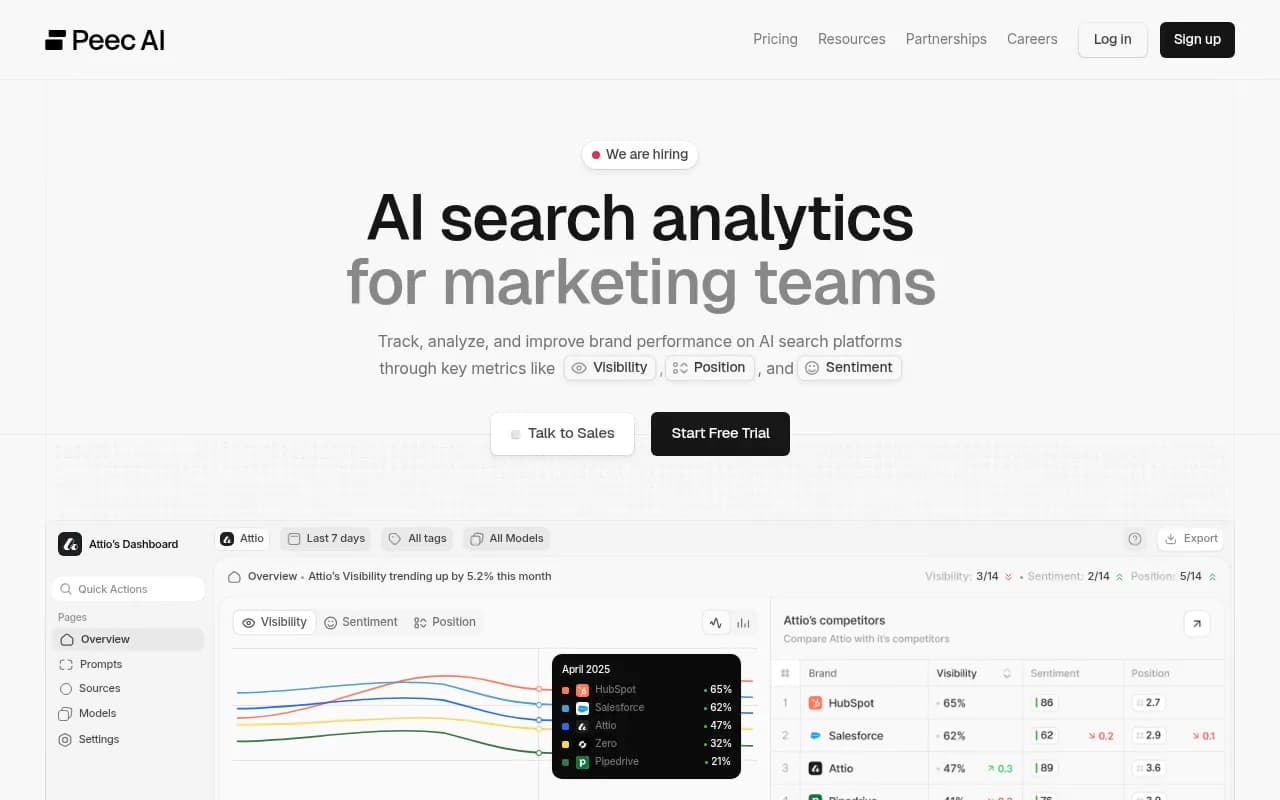
Peec AI covers multi-language AI visibility tracking, which matters if you serve international markets. It's in a similar price range to Otterly and focuses on monitoring.
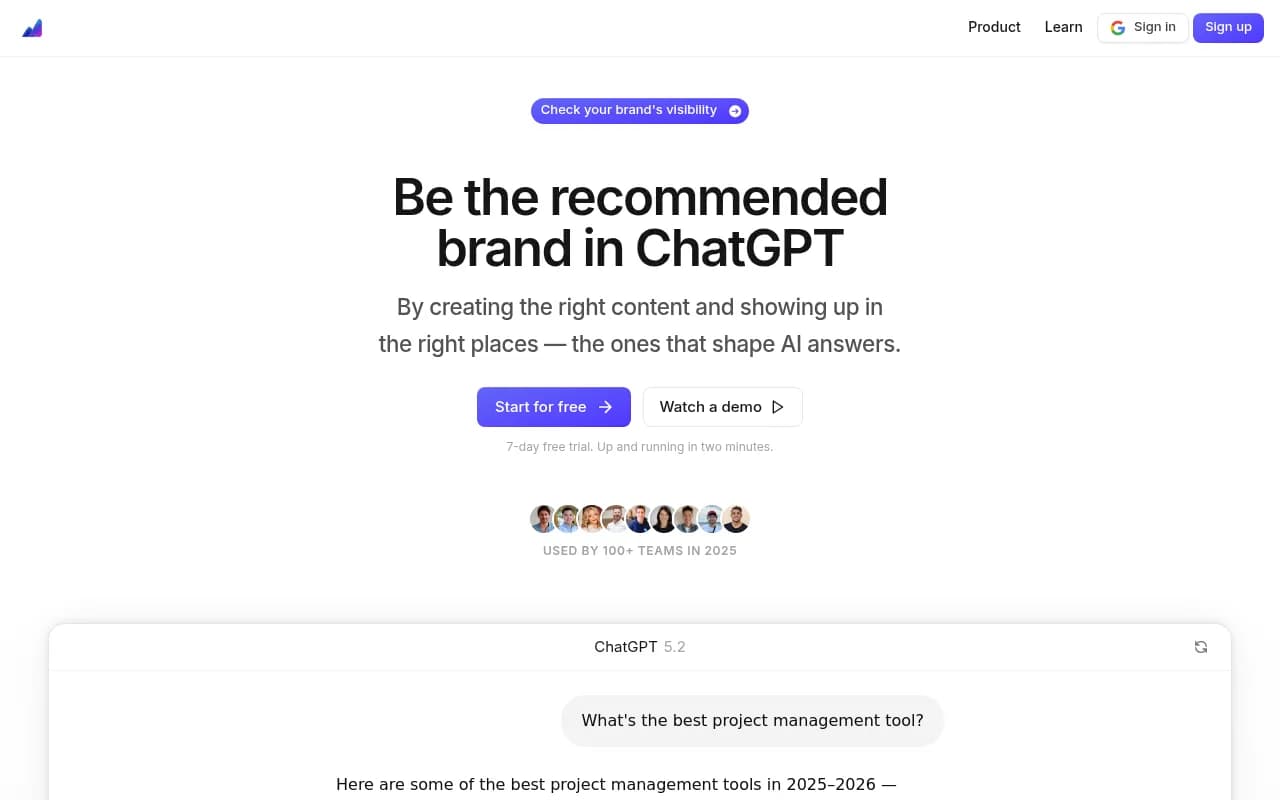
Airefs is worth a look for budget-conscious teams that want affordable AI search visibility data without committing to a larger platform.
Mid-range AI visibility tools ($50-200/month)
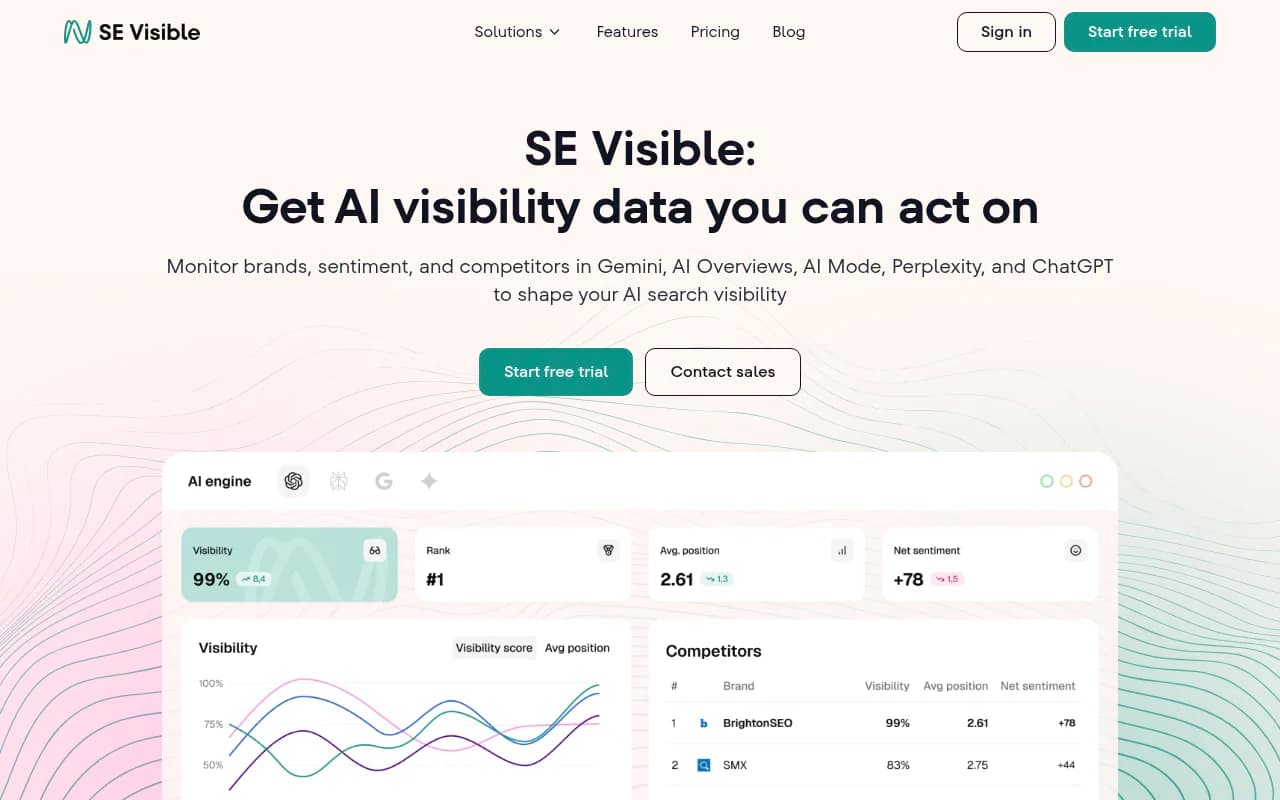
SE Visible from the SE Ranking team is specifically built for AI visibility tracking. It's user-friendly and integrates well with SE Ranking's broader platform if you're already using that.
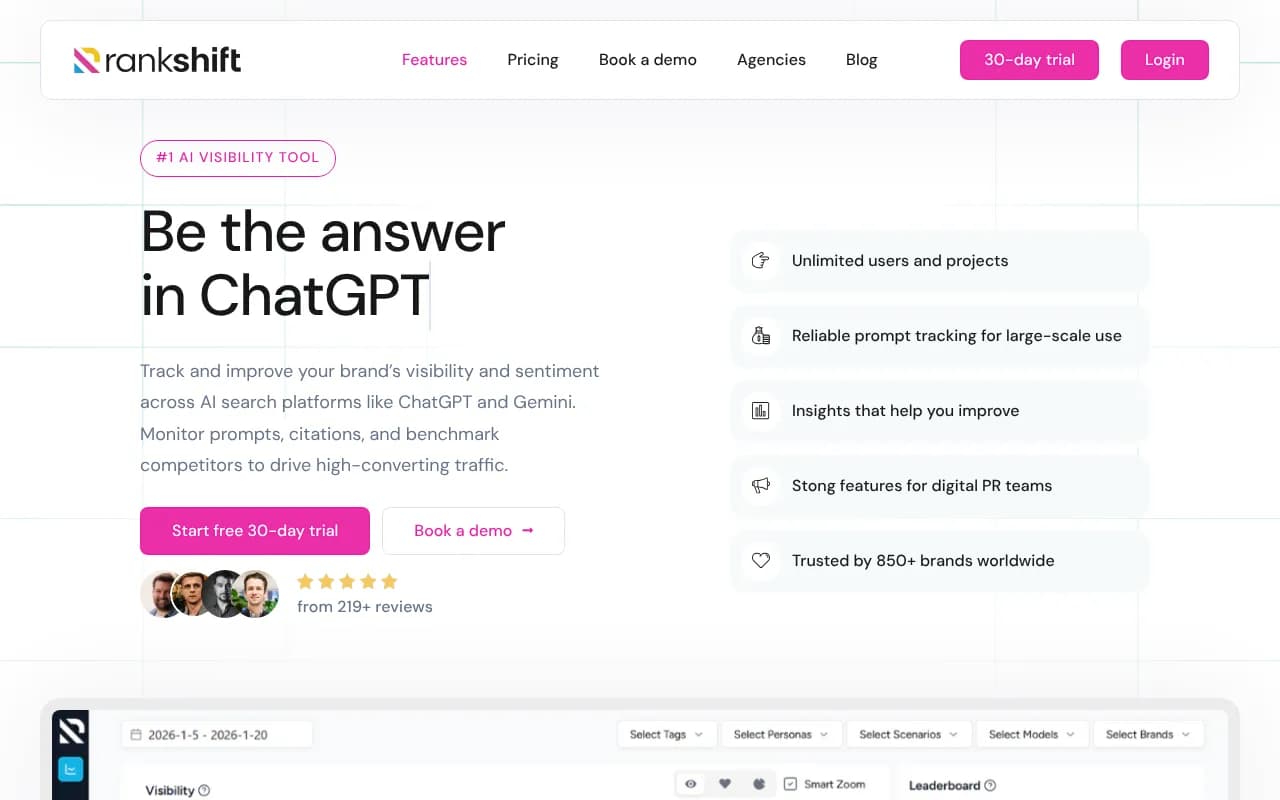
Rankshift tracks LLM visibility with a GEO focus and gives you data on how your brand appears across different AI models.
Profound tracks and helps optimize brand visibility across AI search engines. It has a stronger feature set than basic monitoring tools but sits at a higher price point.

The full-stack option: when you want to act, not just watch
Here's the honest problem with most AI visibility tools: they tell you where you're invisible but don't help you fix it. You get a dashboard showing that ChatGPT mentions your competitor 40 times and you zero times, and then... you're on your own.
Promptwatch is built differently. It runs the full loop: find the content gaps where competitors are visible and you're not, generate content engineered to get cited by AI models (using data from 880M+ citations analyzed), and then track whether your new content actually improves your visibility scores. For small businesses that want results rather than just data, that closed loop matters.

It also has features most small business tools lack entirely -- AI crawler logs that show which pages ChatGPT and Perplexity are actually reading on your site, prompt volume and difficulty scores so you can prioritize winnable queries, and Reddit/YouTube tracking to surface discussions that influence AI recommendations. The Essential plan starts at $99/month, which is reasonable given it replaces what would otherwise be multiple separate tools.
Comparison: which tool for which situation
| Situation | Recommended tool | Monthly cost |
|---|---|---|
| Just starting out, zero budget | Google Search Console + GA4 | Free |
| Traditional SEO, small budget | Mangools or SE Ranking | $29-44 |
| Traditional SEO + AI visibility in one tool | SE Ranking | $44 |
| Best backlink data, content gaps | Ahrefs | $129 |
| Content optimization for rankings | Surfer SEO | $89 |
| Basic AI visibility monitoring | Otterly.AI | $29 |
| AI visibility + content generation + gap analysis | Promptwatch | $99 |
| Enterprise SEO with AI features | Semrush | $139+ |
Content tools: because AI visibility is ultimately a content problem
Whether you're optimizing for Google or for ChatGPT, the underlying lever is the same: content. AI models cite sources that answer questions clearly, authoritatively, and specifically. If your website doesn't have content that addresses the questions your customers are asking AI assistants, you won't get cited.
A few tools worth knowing:
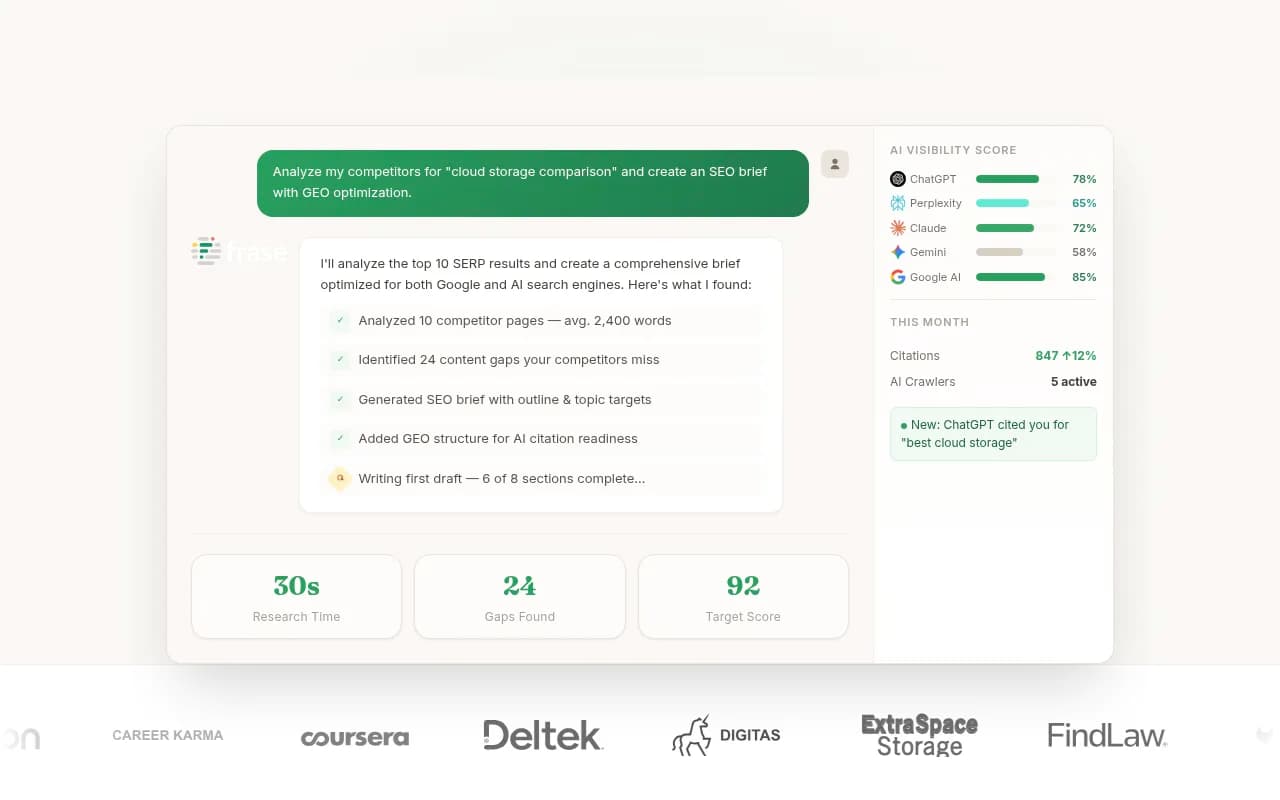
Frase researches, writes, and optimizes content with both traditional SEO and GEO in mind. It's particularly good at content briefs and answering the specific questions that show up in AI responses.
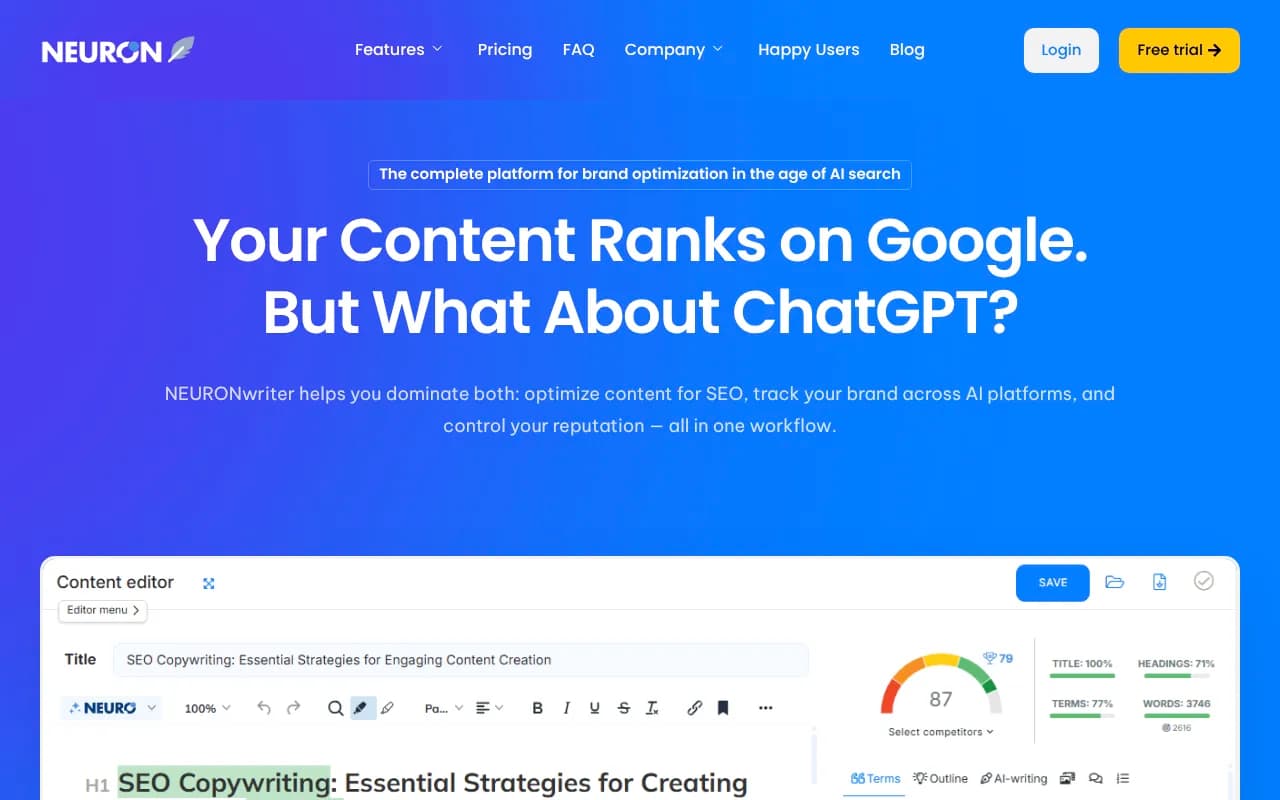
NeuronWriter uses semantic analysis to optimize content, which aligns well with how AI models evaluate topical authority.
Clearscope is excellent for content optimization -- it analyzes what top-ranking pages cover and helps you match that depth. Pricier than the others but well-regarded.
GrowthBar is specifically built for small businesses and agencies that need to produce SEO content quickly. It writes and optimizes blog posts with keyword data baked in.
Technical SEO: don't skip the basics
AI models can only cite your content if they can read it. Technical SEO -- making sure your site is crawlable, fast, and properly structured -- matters just as much for AI visibility as it does for Google.
Screaming Frog is the standard tool for technical SEO audits. The free version handles up to 500 URLs, which covers most small business websites. It finds broken links, redirect chains, missing meta tags, and crawl errors.
Sitebulb is a friendlier alternative to Screaming Frog with better visualization of crawl data. Good for teams that find Screaming Frog's interface overwhelming.
One thing most small businesses overlook: AI crawlers (the bots that ChatGPT and Perplexity use to read your site) have their own crawl behaviors and can hit errors that don't show up in Google Search Console. Tools like Promptwatch's AI Crawler Logs track this specifically -- which pages AI bots are reading, which ones they're skipping, and what errors they're encountering. It's a blind spot worth addressing.
Building a practical small business stack
Rather than buying every tool mentioned here, here's how to think about building a stack that grows with your needs:
Stage 1: Foundation (free) Google Search Console, Google Analytics 4, Google Business Profile (if local). This covers your basics and costs nothing.
Stage 2: Traditional SEO ($30-50/month) Add SE Ranking or Mangools for keyword research, rank tracking, and site audits. SE Ranking is the better pick if you want AI visibility features included.
Stage 3: AI visibility ($99/month) Once your site has solid traditional SEO fundamentals, add AI visibility tracking and optimization. Promptwatch makes sense here because it goes beyond monitoring to actually help you create content that gets cited -- the gap analysis and content generation tools mean you're not just watching your visibility score, you're improving it.
Stage 4: Content depth (optional, $50-90/month) If content production is a bottleneck, add Surfer SEO or Frase to speed up research and optimization.
Total for a full stack at Stage 3: roughly $150-200/month. That's real capability -- traditional SEO plus AI visibility plus content optimization -- for less than what most agencies charge for a single blog post.
The honest bottom line
The businesses that will win in AI search over the next two years are the ones that start now, while most competitors are still ignoring it. The tools exist at every price point. The data is clear that AI search is growing fast. And the content gap between "brands that AI models cite" and "brands that AI models ignore" is still early enough to close with consistent effort.
Start with the free tools. Add one paid platform. Track your AI visibility. Create content that answers the specific questions your customers are asking AI assistants. That's the whole playbook -- and you don't need an enterprise budget to execute it.