Qwairy Review 2026
Comprehensive generative engine optimization platform helping brands improve visibility across AI search with strategic content recommendations.
Key Takeaways:
- Qwairy monitors 10 AI models (ChatGPT, Claude, Perplexity, Gemini, Copilot, Grok, Google AI Overview/Mode, Mistral, DeepSeek) but lacks the content generation engine that Promptwatch offers -- you get visibility data but must create optimized content elsewhere
- Five-module workflow (Visibility, Insights, Strategy, Technical, Analytics) covers monitoring to optimization, though the Strategy module focuses on briefs and backlink sourcing rather than AI-native content creation
- Strong social intelligence features pull from Reddit, YouTube, Hacker News, and 10+ platforms to surface emerging topics and real user questions
- Pricing starts at €49/mo (Starter) with 100 free credits to test -- competitive entry point for freelancers and small businesses
- Missing AI crawler logs and detailed traffic attribution that Promptwatch provides for connecting visibility to actual revenue

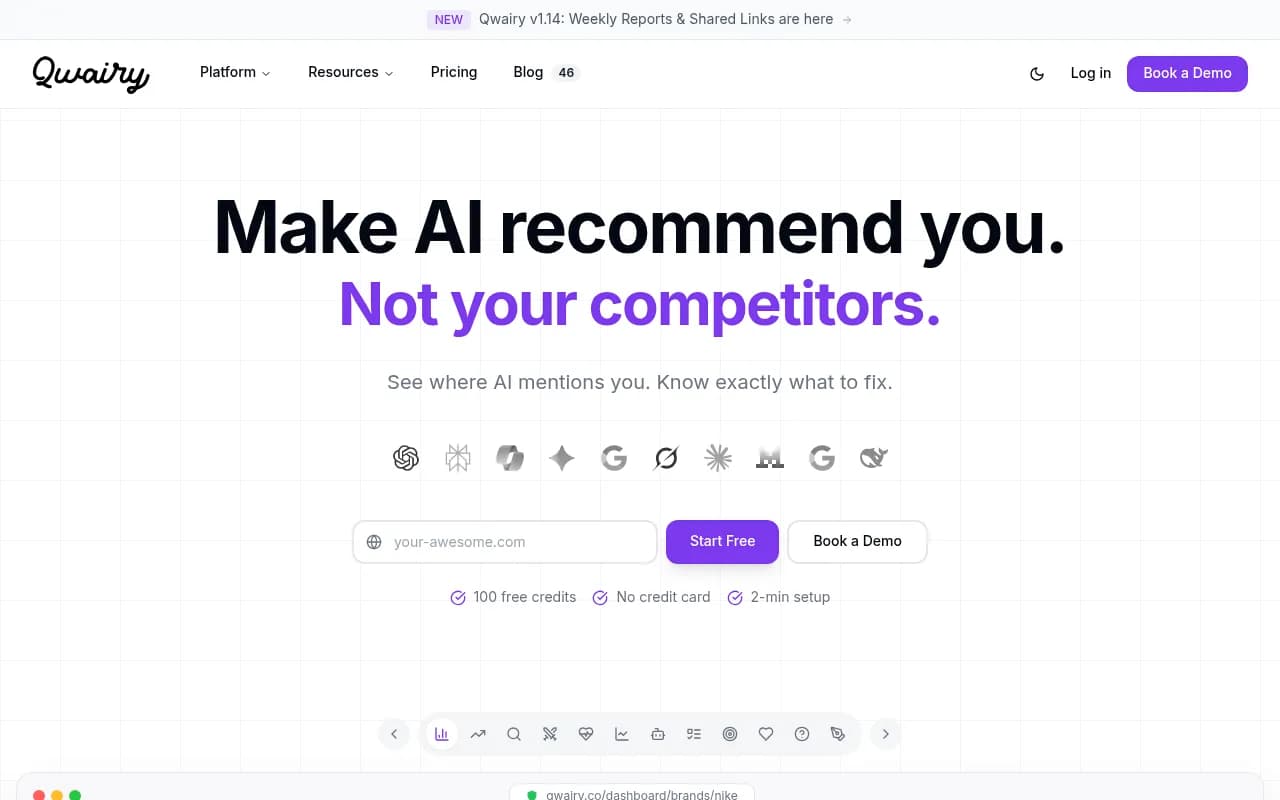
Qwairy positions itself as a complete generative engine optimization platform for brands that want to be recommended by AI instead of their competitors. Founded by a team that's been researching GEO since the early days of ChatGPT's rise, the platform has grown to 2,000+ users including enterprise brands like TotalEnergies, Match Group, and Air Transat. The pitch is straightforward: see where AI mentions you, know exactly what to fix, and measure the results.
The target audience spans three main groups. SEO and growth marketers looking to extend traditional search expertise into AI engines. B2B SaaS and e-commerce companies that want to appear when customers ask ChatGPT or Perplexity for product recommendations. Marketing agencies managing multiple client portfolios who need consolidated dashboards and white-label reporting. Qwairy launched in 2024 and has been iterating rapidly -- the v1.14 update in early 2026 added weekly reports and shared links for easier client communication.
Visibility Module -- Brand Monitoring Across 10 AI Models
The core of Qwairy is tracking where your brand appears in AI responses. You monitor ChatGPT (both API and UI), Perplexity (API + UI), Claude (API), Gemini (API + UI), Copilot (UI), Grok (API + UI), Google AI Overview (API), Google AI Mode (UI), Mistral (API), and DeepSeek (API). That's 10 models with a mix of API-based automated tracking and UI-based manual checks.
For each tracked prompt, Qwairy calculates four key metrics. Brand-mention visibility shows the percentage of responses where your brand is mentioned at all, plus your average position when mentioned. Source-citation visibility tracks how often your actual website content gets cited as a source, with average citation position. Share of Voice compares your mention volume against competitors -- if you appear 149 times and competitors combine for 841 total mentions, your share is 17.7%. Average Sentiment scores how positively or negatively AI models describe your brand, with a relevance score showing how on-topic the mentions are.
The Prompt Tracking feature lets you add custom prompts that matter to your business -- product comparison queries, buying guide questions, troubleshooting searches. Qwairy runs these prompts across all monitored models and shows you which ones mention your brand, which cite your content, and where competitors outrank you. You can filter by model, date range, sentiment, and relevance.
Response Analysis breaks down individual AI responses. You see the full text of what ChatGPT or Claude said, which competitors were mentioned alongside you, which sources were cited, and the sentiment/relevance scores. This granular view helps you understand not just whether you were mentioned, but in what context and with what framing.
Citation Sources surfaces every domain that AI models cite when discussing your category. Reddit threads, YouTube videos, review sites, news articles, competitor blogs. You see citation frequency, average position, and which models prefer which sources. This tells you where to publish guest content, which platforms to engage on, and which third-party sites influence AI recommendations most.
Competitor Mentions tracks up to 10 competitors per brand. You see their mention frequency, average position, share of voice, and sentiment scores. The competitive heatmap shows who's winning for each prompt and which models favor which brands. Useful for benchmarking and identifying gaps where competitors dominate.
Insights Module -- Social Intelligence and Search Data
Qwairy pulls conversation data from Reddit, YouTube, Hacker News, Quora, and 10+ other platforms to surface what people are actually asking about your category. The Social Intelligence feature aggregates threads, comments, and videos where your brand or competitors are discussed. You can filter by platform, date, engagement level, and sentiment. This helps you find emerging topics before they hit mainstream search volume.
Search Intelligence connects to Google Search Console to import your existing keyword data. Qwairy cross-references this with AI visibility -- showing which keywords you rank for in Google but are invisible for in ChatGPT, and vice versa. The goal is to identify SEO keywords that could translate to AI visibility with content adjustments.
Shopping Intelligence monitors when your brand appears in AI shopping recommendations and product carousels. Currently focused on ChatGPT's shopping features, with plans to expand to other models as they roll out commerce capabilities. You see which products get recommended, in what contexts, and how often.
Local Intelligence tracks location-based mentions -- useful for multi-location businesses or regional brands. You can monitor AI responses by city, state, or country to see where your brand is visible geographically.
Sentiment Analysis aggregates all brand mentions and scores them on a -100 to +100 scale. You see overall sentiment trends over time, which prompts generate positive vs negative mentions, and which competitors have better or worse sentiment. The relevance score filters out off-topic mentions that skew sentiment data.
Strategy Module -- Content Briefs and Backlink Sourcing
The Strategy module is where Qwairy moves from monitoring to recommendations. Content Opportunities uses a dual gap scoring system. The first gap score shows prompts where you're completely absent -- AI models never mention you. The second score shows prompts where competitors are mentioned but you're not. High-gap prompts get prioritized as content opportunities.
For each opportunity, Qwairy generates a Content Studio brief. This includes the target prompt, current top-cited sources, competitor mentions, sentiment analysis, and a suggested content structure. The brief tells you what to write about, which angles to cover, and which sources to reference. However, Qwairy does not generate the actual article content -- you write it yourself or use a separate AI writing tool. This is a key difference from Promptwatch, which has a built-in AI writing agent that creates citation-ready articles grounded in 880M+ citations analyzed.
Backlink Opportunities compares 32+ backlink marketplaces (Fiverr, Upwork, specialized link vendors) to help you find the best price for acquiring links from high-authority domains. The idea is that AI models cite authoritative sources, so building backlinks to those sources (or getting your content on them) improves citation chances. Qwairy shows domain authority, price ranges, and vendor ratings.
Google Search Console integration imports your GSC data directly into Qwairy. You can see which pages drive traditional search traffic vs which pages get cited by AI models. The overlap analysis shows content that performs well in both channels vs content that only works for one.
Brand Perception aggregates sentiment data across all prompts and models to give you a holistic view of how AI engines describe your brand. You see common themes, frequently mentioned attributes (positive and negative), and how perception shifts over time.
Technical Module -- AI Crawler Access and Site Health
The Technical module checks whether AI crawlers can actually access your content. Technical Analysis scans your robots.txt, meta tags, and server responses to verify that GPTBot, ClaudeBot, PerplexityBot, and other AI crawlers aren't blocked. If you're accidentally blocking these bots, AI models can't index your content and will never cite you.
Site Diagnostics runs basic health checks -- broken links, slow page loads, missing meta descriptions, crawl errors. This overlaps with traditional SEO tools but focuses on issues that specifically impact AI discoverability. For example, pages with no structured data or thin content are less likely to be cited by AI models.
What's missing here compared to Promptwatch: Qwairy does not provide real-time AI crawler logs showing exactly which pages GPTBot or ClaudeBot visited, when they visited, how often they return, or what errors they encountered. Promptwatch's crawler logs give you a live feed of AI bot activity on your site, which is critical for debugging indexing issues and understanding how AI models discover your content.
Analytics Module -- Traffic Attribution and Page Performance
The Analytics module attempts to connect visibility to actual traffic. Referrer Analytics tracks visitors coming from chatgpt.com and perplexity.ai referrers. You see which pages they land on, how long they stay, and whether they convert. This requires adding a Qwairy tracking snippet to your site or integrating with Google Analytics.
Crawler Analytics monitors AI bot activity in your server logs. You connect Qwairy to your hosting provider (Vercel, Cloudflare, Netlify, Fastly, Akamai, WordPress, Shopify) and it parses logs to show GPTBot, ClaudeBot, PerplexityBot, and 15+ other AI crawler visits. You see total requests, pages crawled, and crawl frequency over time.
However, this is not as detailed as Promptwatch's crawler logs. Qwairy shows aggregate stats -- total visits, top pages crawled. Promptwatch shows individual requests with timestamps, response codes, user agents, and error details. The difference matters when debugging why a specific page isn't getting cited.
Page Performance ranks your pages by AI visibility. You see which pages get cited most often, which prompts they appear in, and which models cite them. This helps you double down on high-performing content and identify underperforming pages that need optimization.
Content Optimization (beta) suggests changes to existing pages to improve citation chances. Qwairy analyzes top-cited competitor pages and recommends structural changes, keyword additions, or content expansions. This is still in beta and less developed than the Content Studio brief generation.
Who Is Qwairy For?
Qwairy works best for three groups. First, SEO teams and growth marketers at mid-sized companies (50-500 employees) who already have content production workflows and want to extend their SEO expertise into AI search. You're comfortable writing or commissioning content based on briefs, and you need data to guide what to create. Qwairy gives you that data -- gap analysis, competitor benchmarks, citation sources -- but doesn't write the content for you.
Second, B2B SaaS and e-commerce brands that want to appear in AI product recommendations. If you sell project management software, CRM tools, or consumer products, you care about being mentioned when someone asks ChatGPT "What's the best X for Y?" Qwairy tracks those mentions, shows you where competitors win, and helps you identify content gaps. The Shopping Intelligence feature is particularly useful for e-commerce brands monitoring product recommendation visibility.
Third, marketing agencies managing 5-20 client brands. Qwairy's multi-client dashboards let you monitor all brands in one platform. You can generate white-label reports for clients showing AI visibility improvements over time. The Starter plan supports one brand, but Growth and higher tiers support multiple brands with consolidated billing.
Who should NOT use Qwairy: Solo freelancers or very small businesses (under 10 employees) with limited content budgets. The platform gives you a lot of data and recommendations, but you still need resources to act on them. If you can't produce 2-4 high-quality articles per month, the visibility data won't translate to results. Also, if you want an all-in-one platform that generates optimized content for you, Promptwatch is a better fit -- its AI writing agent creates citation-ready articles based on the same gap analysis, so you don't need a separate content team.
Integrations and Ecosystem
Qwairy integrates with Google Search Console (import keyword data), Google Analytics (track AI traffic), Looker Studio (build custom reports), and Slack (get alerts for new mentions or visibility changes). The API and MCP (Model Context Protocol) support let developers pull Qwairy data into custom dashboards or automation workflows.
For hosting and log analysis, Qwairy connects to Vercel, Cloudflare, Netlify, Fastly, Akamai, WordPress, and Shopify. HubSpot and Power BI integrations are in beta. You can export data as CSV or JSON for offline analysis.
No browser extension or mobile app. Everything runs in the web dashboard.
Pricing and Value
Qwairy offers three main tiers. Starter at €49/mo (billed €590 annually, so about €49/mo with annual discount) covers one brand, basic visibility tracking, and access to the Insights and Strategy modules. You get 100 free credits to test the platform before subscribing. Growth tier pricing isn't listed on the site but is described as "advanced" with multi-brand support and deeper analytics. Enterprise is custom pricing for agencies and large brands needing white-label reports, dedicated support, and higher usage limits.
The credit system works like this: each prompt you track costs credits. Monitoring a prompt across all 10 AI models costs more credits than monitoring just ChatGPT. Social intelligence queries, content briefs, and backlink comparisons also consume credits. The Starter plan includes a set number of credits per month; if you run out, you either upgrade or wait for the next billing cycle.
Compared to competitors: Qwairy's €49/mo entry point is cheaper than Promptwatch Essential ($99/mo) but also offers less -- no AI content generation, no detailed crawler logs, no traffic attribution beyond basic referrer tracking. Otterly.AI and Peec.ai are monitoring-only tools in a similar price range but lack Qwairy's social intelligence and backlink sourcing features. Profound and Scrunch are higher-priced ($200-500/mo) with more enterprise features but still don't offer content generation.
Value assessment: If you have an existing content team and just need visibility data to guide them, Qwairy is solid value at €49/mo. You get comprehensive monitoring, actionable gap analysis, and social intelligence that most competitors lack. However, if you're a lean team that needs the platform to help create content (not just recommend topics), you'll hit a wall -- Qwairy gives you the brief but not the article. Promptwatch closes that loop with its AI writing agent, making it a better fit for teams that want optimization, not just monitoring.
Strengths and Limitations
Qwairy does several things exceptionally well. The social intelligence feature is more comprehensive than most competitors -- pulling from 10+ platforms including Reddit, YouTube, Hacker News, and Quora. This surfaces real user questions and emerging topics that haven't hit mainstream search volume yet. The dual gap scoring system (absent vs competitor-dominated prompts) is a smart prioritization framework that helps you focus on winnable opportunities. The backlink marketplace comparison is unique -- no other GEO platform helps you source links at the best price. And the multi-model coverage (10 AI engines) is on par with Promptwatch and ahead of most competitors.
Limitations: Qwairy lacks AI content generation. You get detailed briefs but must write the articles yourself or use a separate tool. Promptwatch has a built-in AI writing agent that generates citation-ready content grounded in 880M+ citations analyzed, so you can go from gap analysis to published article in one platform. Qwairy also lacks detailed AI crawler logs -- you see aggregate crawler stats but not individual requests with timestamps and error codes. Promptwatch provides real-time logs showing exactly which pages GPTBot or ClaudeBot visited, when, and what errors they encountered. Finally, traffic attribution is basic -- Qwairy tracks referrers from chatgpt.com and perplexity.ai but doesn't offer the deep visitor analytics or server log analysis that Promptwatch provides for connecting visibility to revenue.
Other missing features: No prompt volume estimates or difficulty scoring to help you prioritize high-value prompts. No query fan-outs showing how one prompt branches into sub-queries. No ChatGPT Shopping tracking beyond basic product mention monitoring. These are all capabilities Promptwatch offers.
Bottom Line
Qwairy is a solid monitoring and insights platform for brands that already have content production workflows and want data to guide them. The social intelligence, dual gap scoring, and backlink sourcing features are genuinely useful and differentiate it from basic monitoring tools like Otterly.AI or Peec.ai. If you're an SEO team at a mid-sized company with 2-4 content writers, Qwairy gives you the visibility data and content briefs to keep them busy.
However, if you're a lean team (1-3 people) that needs the platform to help create content, not just recommend topics, Promptwatch is the stronger choice. Its AI writing agent generates optimized articles based on the same gap analysis, so you don't need a separate content team. Promptwatch also provides detailed crawler logs and traffic attribution that Qwairy lacks, making it easier to connect visibility improvements to actual revenue.
Best use case in one sentence: Qwairy is ideal for SEO teams with existing content resources who want comprehensive AI visibility data and social intelligence to guide their content strategy, but need to pair it with a separate writing solution.
Tags:
Frequently asked questions
What is Qwairy and what does it do?
How much does Qwairy cost?
Who should use Qwairy?
Does Qwairy offer a free plan?
What AI models does Qwairy monitor?
What features does Qwairy include?
How is Qwairy different from Promptwatch?
Similar and alternative tools to Qwairy