Key Takeaways
- Pricing: Otterly.AI starts at $29/mo (15 prompts) vs Qwairy at €49/mo (~$53, 100 credits) -- Otterly is cheaper at entry level but Qwairy includes more monitoring capacity
- AI engine coverage: Qwairy monitors 10 AI engines (ChatGPT, Claude, Perplexity, Gemini, Copilot, Grok, Mistral, AI Overviews, AI Mode, DeepSeek) vs Otterly's 6 (ChatGPT, Perplexity, AI Overviews, AI Mode, Gemini, Copilot)
- Core difference: Otterly.AI is a monitoring-focused dashboard with GEO audit features. Qwairy positions itself as a comprehensive strategy platform with content studio, backlink opportunities, and action-oriented workflows
- Best for beginners: Otterly.AI's simpler interface and lower entry price make it easier to start tracking AI visibility without overwhelming features
- Best for optimization: Qwairy's Content Studio, Content Opportunities module, and Action Center give you tools to actually improve visibility -- not just watch it
- Data depth: Qwairy offers more granular analytics (crawler logs, referrer tracking, page performance, query fan-outs) while Otterly focuses on brand mentions and citation tracking
Overview
Otterly.AI

Otterly.AI launched as an affordable entry point into AI search monitoring. The platform tracks brand mentions and website citations across six major AI engines. Its core pitch: see where you show up, what's being said, and which content gets cited. The GEO Audit tool analyzes 25+ on-page factors to identify what's holding your site back from earning citations. Pricing starts at $29/mo for 15 prompts, making it one of the cheapest ways to start monitoring AI visibility.
The interface emphasizes simplicity. You set up prompts, Otterly runs them across AI engines, and you get a dashboard showing mention rates, citation counts, and share of voice. The 14-day free trial lets you test before committing.
Qwairy
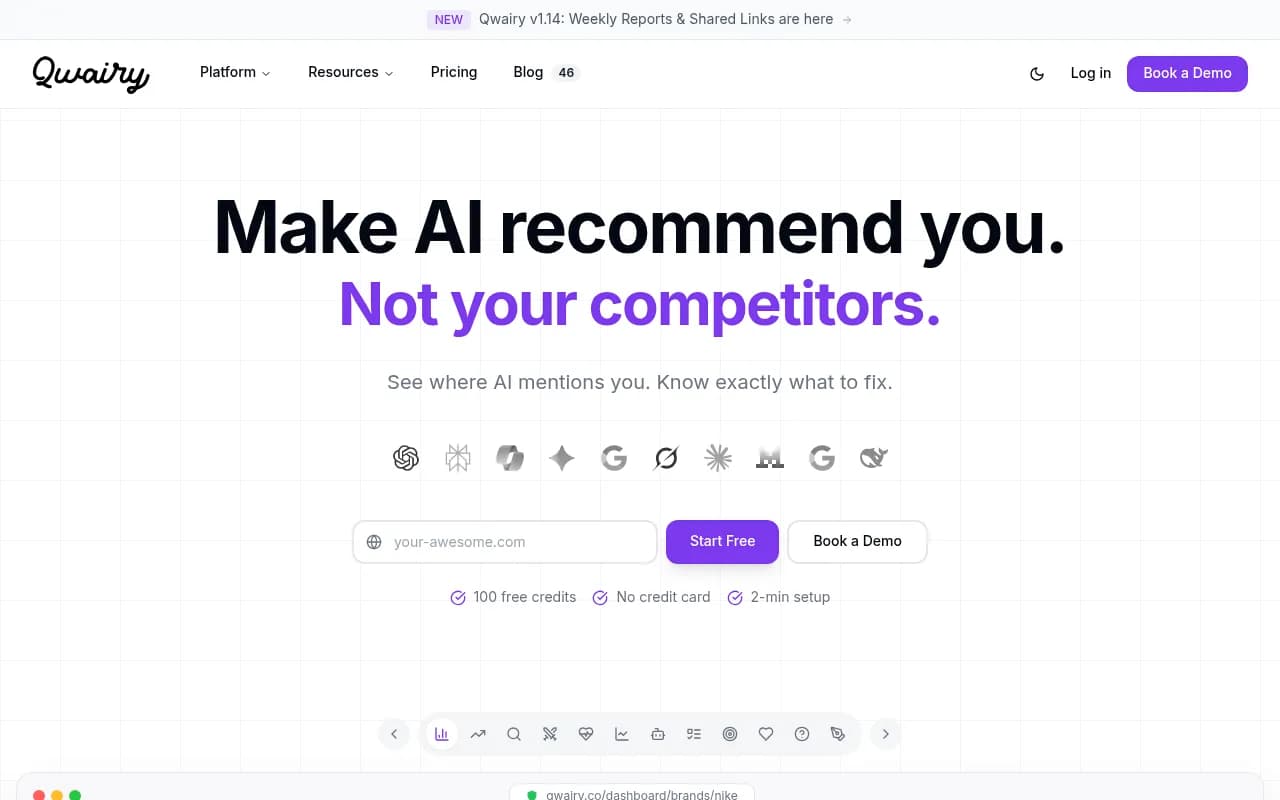
Qwairy positions itself as "the most advanced and actionable GEO platform." It monitors 10 AI engines -- more than Otterly -- and adds strategic layers on top of monitoring. The Content Studio helps you create optimized content. Content Opportunities surfaces gaps where competitors rank but you don't. The Action Center consolidates recommendations across technical, content, and outreach dimensions.
Qwairy's dashboard is denser. You get visibility scores, GEO Matrix comparisons, sentiment analysis, query fan-outs, social signals, shopping results tracking, and local business monitoring. The platform integrates Google Search Console and Bing Webmaster Tools to connect AI visibility with traditional search performance. Pricing starts at €49/mo with 100 credits included.
Side-by-Side Comparison
| Feature | Otterly.AI | Qwairy |
|---|---|---|
| Starting price | $29/mo (15 prompts) | €49/mo (~$53, 100 credits) |
| Free trial | 14 days | 100 free credits, no card required |
| AI engines monitored | 6 (ChatGPT, Perplexity, AI Overviews, AI Mode, Gemini, Copilot) | 10 (adds Claude, Grok, Mistral, DeepSeek) |
| Brand mention tracking | ✓ | ✓ |
| Citation tracking | ✓ | ✓ |
| Share of voice | ✓ | ✓ |
| GEO audit | ✓ (25+ factors) | ✓ (Technical Analysis module) |
| Content creation tools | ✗ | ✓ (Content Studio) |
| Content gap analysis | ✗ | ✓ (Content Opportunities) |
| Crawler analytics | ✗ | ✓ |
| Query fan-outs | ✗ | ✓ |
| Sentiment analysis | Basic | Advanced |
| GSC/Bing integration | ✗ | ✓ |
| Backlink opportunities | ✗ | ✓ |
| Action center | ✗ | ✓ |
| API access | Not mentioned | Monitors via API + UI |
| Team management | Not specified | ✓ |
AI engine coverage
Otterly.AI covers six AI engines: ChatGPT, Perplexity, Google AI Overviews, Google AI Mode, Gemini, and Microsoft Copilot. That hits the major platforms most brands care about. The monitoring runs automatically once you set up prompts.
Qwairy adds four more: Claude (Anthropic), Grok (X/Twitter), Mistral, and DeepSeek. The platform also specifies whether it monitors via API, UI, or both -- ChatGPT gets tracked through both API and UI, for example. This matters because API responses can differ from what users see in the interface.
For most brands, Otterly's six engines cover the essentials. If you need Claude visibility (increasingly important as enterprises adopt it) or want to track Grok for X/Twitter audience insights, Qwairy's broader coverage wins.
Monitoring and tracking capabilities
Both platforms track the fundamentals: brand mentions, citation rates, average position, and share of voice. You set up prompts that represent how your audience searches, and the tools run them periodically to see where you appear.
Otterly.AI keeps it straightforward. You get mention rate (how often your brand appears), citation rate (how often your content gets sourced), and share of voice (your mentions vs competitors). The dashboard shows which prompts trigger mentions and which don't. The GEO Audit scans your pages for 25+ factors that influence AI citations -- things like content structure, entity mentions, and topical authority signals.
Qwairy adds layers. Query fan-outs show how one prompt branches into related queries, helping you understand the full search landscape around a topic. Sentiment analysis breaks down whether mentions are positive, neutral, or negative. Social signals surface Reddit threads and YouTube videos that influence AI recommendations. Shopping results tracking shows when your products appear in AI shopping carousels. Local business monitoring catches when AI engines recommend your physical locations.
The Competitor Compare feature (added in v1.15) lets you benchmark your visibility against specific competitors across all tracked prompts. Otterly shows competitor mentions in aggregate, but Qwairy's side-by-side comparison makes it easier to spot exactly where competitors outrank you.
Content optimization and strategy
This is where the platforms diverge sharply.
Otterly.AI gives you the GEO Audit -- a diagnostic tool that analyzes your pages and flags issues. You see what's wrong, but you're on your own to fix it. The platform doesn't generate content, suggest specific improvements, or guide you through optimization steps. It's a monitoring tool with audit capabilities, not an optimization platform.
Qwairy built its strategy layer around taking action. The Content Studio helps you create articles, listicles, and comparisons optimized for AI citations. Content Opportunities identifies gaps where competitors rank but you don't, then shows you what content to create to fill those gaps. The Action Center consolidates recommendations across technical fixes, content creation, and outreach opportunities. Backlink Opportunities surfaces sites you should target for links to boost authority.
The Technical Analysis module goes deeper than Otterly's audit -- it checks crawler accessibility, indexing issues, and site diagnostics that affect how AI engines read your content. The integration with Google Search Console and Bing Webmaster Tools connects AI visibility with traditional search performance, giving you a unified view of organic presence.
If you just want to know where you stand, Otterly works. If you want help improving your position, Qwairy's optimization tools matter. Worth noting that tools like Promptwatch take this even further -- they show you content gaps, generate optimized articles, and track results in a closed loop. But between Otterly and Qwairy, Qwairy is the one that helps you act on the data.

Analytics and reporting
Otterly.AI's analytics focus on visibility metrics. You see mention trends over time, citation counts, and share of voice changes. The interface is clean and easy to scan. For reporting to stakeholders who want a quick read on AI visibility, it works well.
Qwairy's analytics go deeper. Crawler Analytics shows which AI crawlers hit your site, how often, and which pages they access. Referrer Analytics tracks traffic coming from AI engines (if you've set up tracking). Page Performance breaks down which specific URLs get cited most often and by which engines. The GEO Matrix gives you a single score that combines mention rate, citation rate, share of voice, and sentiment -- useful for tracking overall progress.
The Workspace Settings and Team Management features in Qwairy suggest it's built for agencies or in-house teams managing multiple brands. Otterly doesn't specify team collaboration features on its site, though the Premium plan mentions unlimited prompts which implies larger-scale use.
Pricing comparison
| Plan | Otterly.AI | Qwairy |
|---|---|---|
| Entry tier | $29/mo (Lite: 15 prompts) | €49/mo (~$53, Starter: 100 credits) |
| Mid tier | $189/mo (Standard: 100 prompts) | Not specified |
| Top tier | Custom (Premium: unlimited prompts) | Not specified |
| Free trial | 14 days | 100 free credits |
| Annual billing | Not mentioned | Available (discount not specified) |
Otterly's pricing is transparent and starts cheaper. $29/mo for 15 prompts is accessible for solo marketers or small businesses testing AI visibility. The jump to $189/mo for 100 prompts is steep -- that's a 6.5x price increase for 6.7x more prompts. The Premium plan with unlimited prompts requires custom pricing, which usually means enterprise-level costs.
Qwairy's €49/mo entry point (~$53 USD) includes 100 credits. The site doesn't break down what a "credit" covers -- whether it's one prompt run, one engine check, or something else. The lack of visible mid-tier and top-tier pricing makes it harder to budget for scaling. The 100 free credits with no card required is a lower-friction trial than Otterly's 14-day limit.
For pure cost efficiency at the entry level, Otterly wins if you only need to track 15-20 prompts. If you need broader monitoring from the start, Qwairy's 100 credits at €49 likely covers more ground than Otterly's 15 prompts at $29.
Pros and cons
Otterly.AI pros
- Lowest entry price in the GEO space ($29/mo)
- Simple, focused interface -- easy to understand at a glance
- 14-day free trial lets you test before paying
- GEO Audit identifies on-page issues affecting citations
- Covers the six most important AI engines for most brands
Otterly.AI cons
- No content creation or optimization tools -- you're on your own after the audit
- Missing Claude, Grok, Mistral, DeepSeek coverage
- No crawler analytics or referrer tracking
- No content gap analysis to show where competitors outrank you
- Steep price jump from Lite to Standard ($29 to $189)
- Monitoring-only approach leaves you stuck after identifying problems
Qwairy pros
- Monitors 10 AI engines including Claude, Grok, Mistral, DeepSeek
- Content Studio and Content Opportunities help you create optimized content
- Action Center consolidates recommendations across technical, content, and outreach
- Crawler analytics show exactly how AI engines interact with your site
- Query fan-outs reveal related searches you should target
- GSC and Bing integration connects AI visibility with traditional search
- Backlink opportunities guide outreach strategy
- 100 free credits with no card required
Qwairy cons
- Higher entry price (€49 vs $29)
- Credit-based pricing is less transparent than prompt-based
- Denser interface with more features -- steeper learning curve
- No visible mid-tier or enterprise pricing on the site
- More complex than needed if you just want basic monitoring
Who should pick which tool
Pick Otterly.AI if:
- You're just starting with AI visibility tracking and want the cheapest entry point
- You need a simple dashboard to show stakeholders where your brand appears in AI search
- You're comfortable handling optimization yourself after seeing the audit results
- You only care about the six major AI engines (ChatGPT, Perplexity, AI Overviews, AI Mode, Gemini, Copilot)
- You're a solo marketer or small team without dedicated resources for content creation
- You want a 14-day trial to test the waters before committing
Pick Qwairy if:
- You need broader AI engine coverage including Claude, Grok, Mistral, and DeepSeek
- You want tools that help you improve visibility, not just monitor it
- Content gap analysis and optimization recommendations matter to your workflow
- You need crawler analytics to understand how AI engines interact with your site
- You're managing multiple brands or running an agency with team collaboration needs
- You want to connect AI visibility with traditional search performance (GSC/Bing integration)
- You're willing to pay more upfront for a comprehensive platform that guides strategy
Consider alternatives if:
- You need end-to-end optimization with content generation, gap analysis, and closed-loop tracking -- platforms like Promptwatch combine monitoring, content creation, and traffic attribution in one workflow
- You're an enterprise needing custom AI models, white-label reporting, or API access for building internal tools
- You want Reddit and YouTube tracking as core features, not add-ons
Final verdict
Otterly.AI is the budget-friendly starting point for AI visibility monitoring. It does one thing well: shows you where your brand appears across six AI engines. The $29/mo entry price and simple interface make it easy to justify and easy to use. But it stops at monitoring. Once you see the problems, you're on your own to fix them.
Qwairy is the optimization platform. It monitors more engines, gives you deeper analytics, and -- critically -- helps you improve your visibility with content tools, gap analysis, and strategic recommendations. The higher entry price (€49 vs $29) buys you a platform that guides action, not just observation.
If you're testing whether AI visibility matters for your brand, start with Otterly. If you're committed to improving your position in AI search and need tools that help you do it, Qwairy's comprehensive approach justifies the extra cost. The real question is whether you want a dashboard or a strategy platform.