Nudge Review 2026
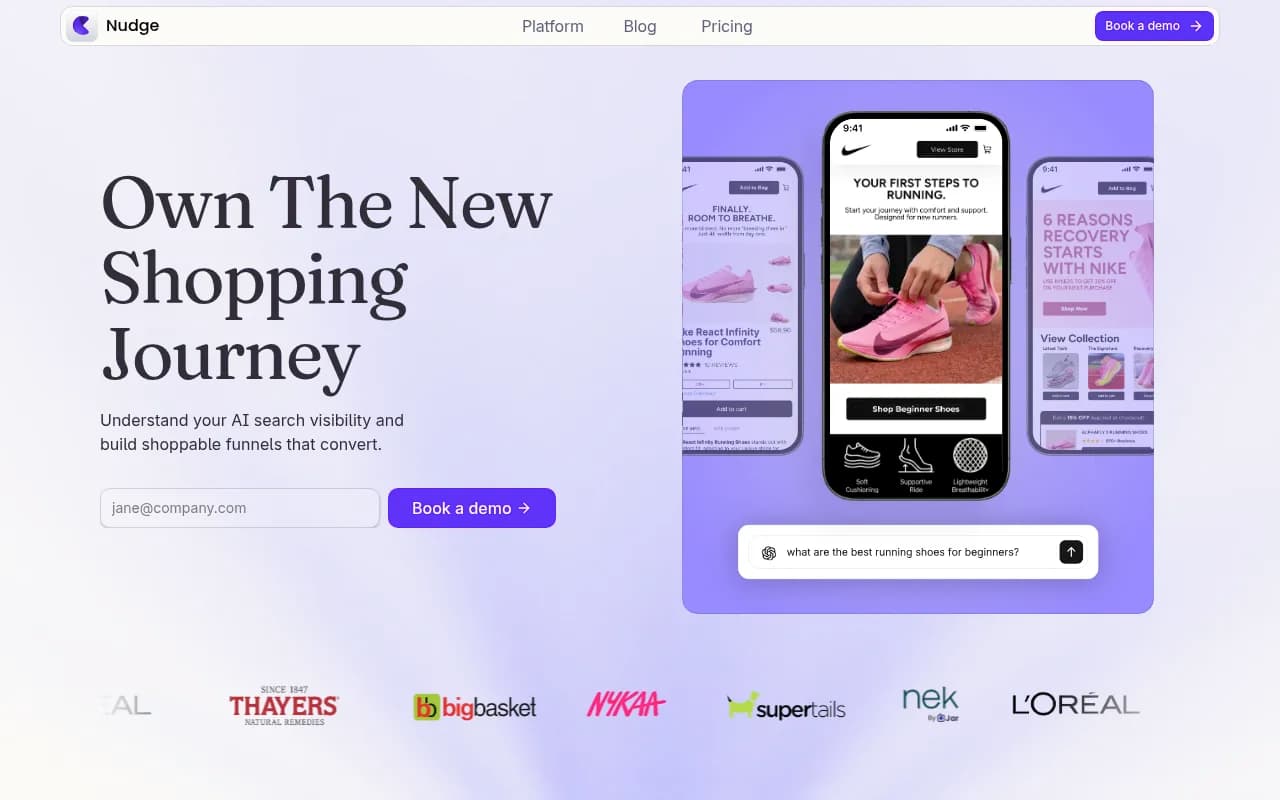
Nudge is an AI discovery and conversion platform built for commerce brands. It tracks how your products appear in AI shopping assistants like ChatGPT, Perplexity, and Gemini, then helps you optimize product pages and build shoppable funnels that convert AI-driven shoppers. Designed for DTC brands and retailers navigating the shift from search to AI-powered product discovery.
Key takeaways
- Monitoring-only approach: Nudge tracks AI visibility and generates shoppable funnels, but lacks content gap analysis, AI crawler logs, and traffic attribution that Promptwatch offers
- Commerce-specific focus: Built exclusively for ecommerce brands with Shopify integration, product catalog optimization, and SKU-level tracking
- Shoppable funnel builder: Automatically generates prompt-specific landing pages designed to convert shoppers coming from AI assistants
- Limited AI model coverage: Monitors ChatGPT, Perplexity, and Google AI -- fewer models than platforms like Promptwatch (10+ models)
- Enterprise positioning: SOC 2 Type II certified with SSO support, targeting mid-market and enterprise commerce teams

Nudge launched in 2024 as a specialized platform for commerce brands trying to figure out how to show up in AI shopping assistants. The premise is straightforward: millions of shoppers now ask ChatGPT or Perplexity what to buy instead of Googling product reviews. If your brand doesn't appear in those AI answers, you lose consideration before the shopper even clicks through to your site.
The platform targets DTC brands, retailers, and commerce teams who've noticed traffic patterns shifting but don't have a way to measure or influence how AI models recommend their products. Nudge positions itself as the bridge between AI discovery and actual conversion -- not just showing you where you're invisible, but helping you build experiences that convert AI-driven traffic.
What sets Nudge apart from general AI visibility platforms is its commerce-specific feature set. Everything is built around product catalogs, SKUs, and shopping intent. You're not just tracking brand mentions -- you're seeing which specific products AI assistants recommend, how they describe your catalog, and where competitors get cited instead of you.
Key features
AI search visibility tracking: Nudge monitors how ChatGPT, Perplexity, and Google AI mention your brand and products across shopping-related prompts. You define the queries that matter to your business ("best running shoes for flat feet", "affordable skincare for sensitive skin", etc.) and Nudge shows you whether your products appear in the answers, how they're positioned, and what language AI models use to describe them. The dashboard breaks down visibility by prompt, product, and AI engine. You can see which SKUs get recommended frequently vs. which ones never show up.
Prompt intelligence: The platform surfaces the exact prompts and buying-intent questions where your brand appears or disappears. This isn't just keyword tracking -- it's understanding the full shopping query landscape. Nudge shows you which questions shoppers are asking AI assistants, which competitors appear in those answers, and where gaps exist in your coverage. The prompt library helps you prioritize which queries to optimize for based on relevance to your catalog.
Competitive benchmarking: See which competitor brands AI recommends over yours and why. Nudge compares your visibility against competitors across key shopping queries, showing you where you're winning and where you're losing ground. The competitive analysis breaks down positioning, product signals, and citation frequency. You can track multiple competitors simultaneously and see how their visibility changes over time.
Shoppable funnel builder: This is where Nudge moves beyond monitoring. The platform automatically generates prompt-specific landing pages and buying guides designed to convert shoppers coming from AI assistants. These aren't generic product pages -- they're built around the specific question the shopper asked, the decision criteria they care about (use case, budget, features), and the products in your catalog that match. The funnels are designed to be cited by AI models and to convert once the shopper clicks through. You can customize layouts, add comparison tables, and A/B test different approaches.
Catalog optimizer: Nudge analyzes your product pages at scale to identify data gaps and optimization opportunities. The tool scores each SKU based on how well AI shopping agents can understand and recommend it. It flags missing attributes, weak descriptions, and structural issues that prevent AI models from citing your products. You get specific recommendations for each product page -- add this attribute, clarify that use case, include these comparison points. The optimizer integrates with Shopify to pull product data and push updates.
Brand and product visibility dashboard: The main dashboard shows how often your brand and specific SKUs get mentioned across AI platforms. You can filter by product category, price range, or specific prompts. The interface highlights trends over time -- are mentions increasing or decreasing? Which products are gaining traction? The dashboard also surfaces narrative analysis, showing you the language and positioning AI models use when they do recommend your products.
Integration ecosystem: Nudge connects to Shopify for product catalog sync, Google Ads and Meta for performance data, and Klaviyo for customer insights. The integrations enrich AI visibility data with actual sales and traffic signals, helping you understand which AI mentions correlate with revenue. The platform is designed to fit into existing commerce stacks without requiring major workflow changes.
Who is it for
Nudge is built for commerce teams at DTC brands and retailers who are seeing traffic patterns shift toward AI-driven discovery. The ideal user is a marketing director or ecommerce manager at a brand doing $5M-$100M in annual revenue, managing 50-500 SKUs, and noticing that traditional SEO and paid acquisition channels are getting more expensive while AI assistants are eating into search volume.
The platform works best for brands selling products with clear use cases and decision criteria -- think outdoor gear, beauty products, home goods, electronics. Categories where shoppers ask questions like "best X for Y" or "what should I buy if I need Z". If your products require education or comparison shopping, Nudge's funnel builder becomes particularly valuable.
Smaller brands (under $1M revenue) might find the pricing steep and the feature set more than they need. Nudge is positioned as an enterprise tool with SOC 2 certification and SSO support, which signals a focus on mid-market and larger teams. Solo founders or small teams might get more value from a simpler AI monitoring tool.
Brands selling commoditized products or competing purely on price will struggle to extract value. Nudge's strength is helping you articulate differentiation and match products to specific shopper needs. If your entire pitch is "cheapest option", the platform's funnel builder and catalog optimizer won't have much to work with.
Agencies managing multiple commerce clients could use Nudge, but the platform isn't explicitly designed for multi-client workflows. There's no white-label option or agency-specific pricing tier mentioned. Each brand would need its own workspace.
Integrations and ecosystem
Nudge integrates with Shopify for product catalog sync, pulling in SKU data, descriptions, images, and attributes. This is the core integration -- without it, the catalog optimizer and funnel builder don't function. The Shopify connection is bidirectional, meaning you can push optimizations back to product pages from within Nudge.
Google Ads and Meta integrations pull performance data to enrich AI visibility insights. You can see which products getting AI recommendations also drive paid traffic, and which ones are invisible across both channels. This helps prioritize optimization efforts.
Klaviyo integration brings in customer data and email performance metrics. The idea is to connect AI visibility with actual customer behavior -- are the products AI recommends also the ones your existing customers love?
The platform mentions being "platform agnostic" in its enterprise features, which suggests API access or custom integrations for larger clients. No public API documentation is visible, so this likely requires an enterprise plan and direct support.
No mention of integrations with other AI visibility platforms, SEO tools, or analytics platforms beyond the commerce stack. Nudge operates as a standalone system.
Pricing and value
Nudge uses custom pricing based on the number of prompts tracked, products monitored, tracking frequency, and AI engines covered. There's no public pricing page with specific numbers. The site mentions "transparent pricing" but directs you to book a demo for a quote.
From the FAQ, pricing factors include:
- Number of prompts you want to track
- Number of products in your catalog
- How frequently you want monitoring to run
- Which AI engines you want covered
- Usage of the funnel builder and catalog optimizer
Enterprise plans are available for larger brands, with features like SOC 2 Type II compliance, SSO, and premium support. This suggests a tiered structure where smaller brands pay less but get fewer features or lower limits.
The lack of transparent pricing is a red flag for smaller brands. If you have to book a demo to learn the cost, you're probably looking at $500+/month minimum, possibly $1,000-$3,000/month for mid-market brands. Enterprise pricing could easily hit $5,000+/month.
Compared to general AI visibility platforms like Promptwatch ($99-$579/mo with transparent pricing), Nudge is positioning itself as a premium, commerce-specific solution. You're paying for the Shopify integration, funnel builder, and catalog optimizer -- features that generic platforms don't offer. Whether that's worth 3-5x the cost depends on how much revenue you're driving from AI-influenced shoppers.
No free trial is mentioned. The onboarding process involves booking a demo, which suggests a sales-led motion rather than self-serve signup.
Strengths and limitations
Nudge's biggest strength is its commerce-specific feature set. The Shopify integration, SKU-level tracking, and shoppable funnel builder are purpose-built for ecommerce teams. If you're a DTC brand trying to figure out AI visibility, Nudge speaks your language and solves your specific problems. The catalog optimizer is particularly useful -- most AI visibility platforms tell you what's wrong but don't help you fix it at scale.
The shoppable funnel builder is genuinely differentiated. Most platforms stop at monitoring. Nudge goes further by helping you create conversion-optimized landing pages that match the shopper's original AI query. This closes the loop from discovery to purchase in a way that pure monitoring tools can't.
SOC 2 Type II certification and SSO support signal that Nudge is serious about enterprise readiness. If you're a larger brand with security and compliance requirements, this matters.
The limitations are significant. Nudge only monitors three AI platforms (ChatGPT, Perplexity, Google AI) compared to platforms like Promptwatch that cover 10+ models including Claude, Gemini, DeepSeek, Grok, and others. As AI shopping expands to more assistants, this gap will hurt.
Nudge is monitoring-only when it comes to understanding why you're invisible. It shows you where you don't appear and helps you optimize product pages, but it lacks the content gap analysis and AI crawler logs that platforms like Promptwatch provide. You don't see which prompts competitors are visible for that you're missing, and you don't get insights into how AI crawlers are actually accessing your site. This makes optimization more guesswork than data-driven.
No AI traffic attribution or visitor analytics. Nudge doesn't help you measure how many shoppers are actually coming from AI assistants or which AI-influenced visitors convert. You're optimizing for visibility without being able to prove ROI. Promptwatch offers traffic attribution via code snippet, GSC integration, or server log analysis -- Nudge doesn't.
The lack of transparent pricing is frustrating. If you're a smaller brand trying to evaluate whether this is worth the investment, you have to sit through a sales demo just to learn the cost. This sales-led approach works for enterprise but alienates mid-market teams.
No mention of Reddit or YouTube tracking, which are increasingly important sources that influence AI recommendations. Nudge focuses on direct AI assistant monitoring but misses the broader ecosystem.
Bottom line
Nudge is a solid choice for mid-market and enterprise commerce brands ($5M+ revenue) that want a commerce-specific AI visibility platform with built-in conversion tools. If you're on Shopify, managing a catalog of 50-500 SKUs, and willing to pay premium pricing for features like the funnel builder and catalog optimizer, Nudge delivers value.
For brands that want deeper optimization capabilities, broader AI model coverage, and transparent pricing, Promptwatch is the stronger alternative. It covers 10+ AI models, includes content gap analysis and AI crawler logs, offers traffic attribution to measure ROI, and provides clear pricing starting at $99/mo.
Best use case for Nudge: A $20M DTC skincare brand on Shopify that's seeing search traffic decline and wants to build shoppable buying guides that convert AI-driven shoppers.
Frequently asked questions
What is Nudge and who is it for?
How much does Nudge cost?
What AI platforms does Nudge monitor?
Does Nudge integrate with Shopify?
How is Nudge different from other AI visibility platforms?
Is there a free trial for Nudge?
Similar and alternative tools to Nudge