Key Takeaways
- Whitebox positions itself as an "agentic GEO" platform that generates and ships fixes to change AI outcomes, while Nudge focuses specifically on commerce brands with AI discovery tracking plus shoppable funnel generation
- Both require custom pricing quotes (no public tiers), making them enterprise-oriented -- expect higher price points than platforms with transparent pricing like Promptwatch
- Whitebox serves a broader enterprise audience (Palo Alto Networks, Wiz, eToro, AIG) across industries, while Nudge is laser-focused on e-commerce and DTC brands
- Nudge's unique angle is connecting AI visibility directly to conversion with prompt-specific shoppable funnels -- something Whitebox doesn't offer
- Neither platform publicly shares which AI models they track, how many prompts you can monitor, or specific feature limits -- you'll need a demo to get details
- If you need transparent pricing and want to start tracking AI visibility today, tools like Promptwatch offer clear plans starting at $99/mo with immediate access
Overview
Whitebox: Agentic GEO for enterprise brand control
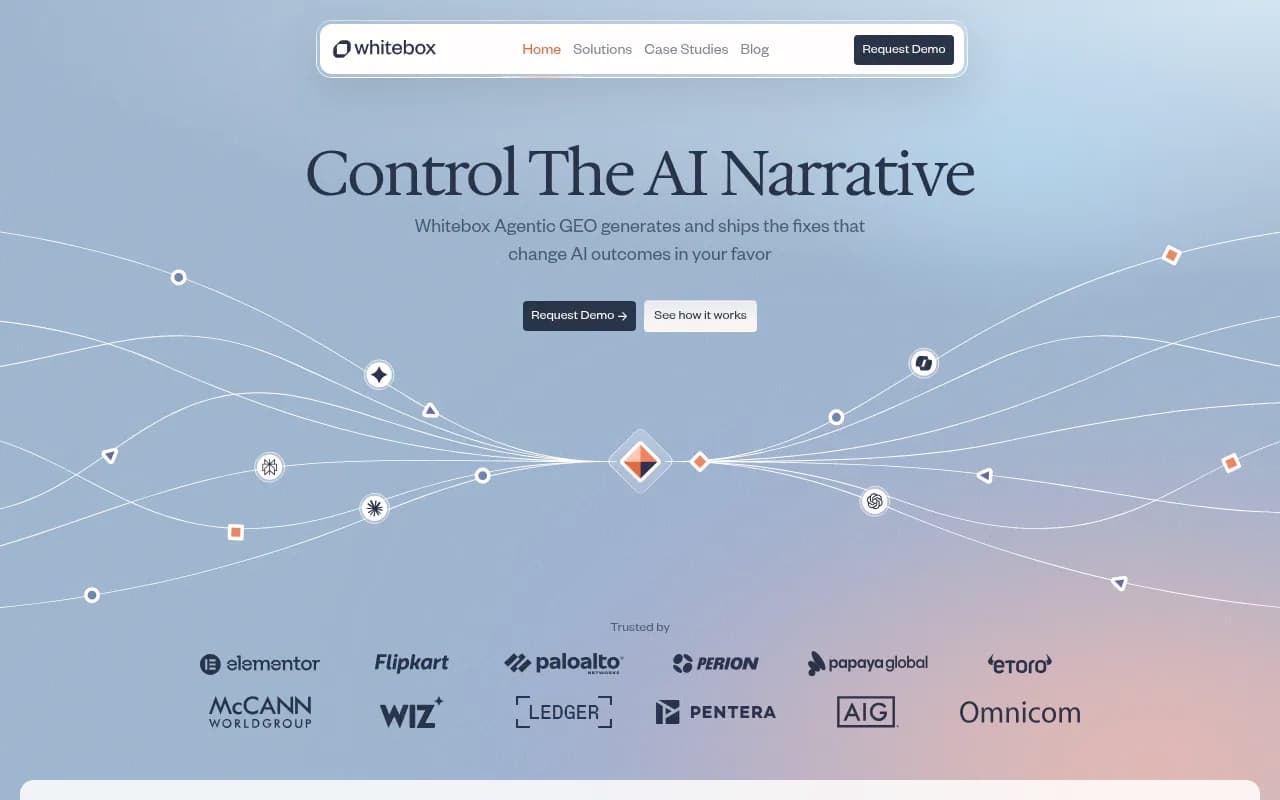
Whitebox markets itself as an "agentic GEO" platform -- meaning it doesn't just show you how AI engines perceive your brand, it generates the fixes and "ships" them to change outcomes. The homepage emphasizes "Control The AI Narrative" and promises to "generate and ship the fixes that change AI outcomes in your favor."
Their client roster includes heavy hitters: Palo Alto Networks, Wiz, eToro, Flipkart, AIG, Ledger, McCann, Omnicom. This signals an enterprise focus with likely high price points and white-glove service. The platform breaks down into three core promises: "See the Truth" (understand how AI interprets your brand), "Get the Solutions" (measure real-time shifts), and "Influence Outcomes" (strategically change AI perception).
What's missing from their website: specific AI models tracked, feature breakdowns, pricing tiers, or even a clear product tour. You have to book a demo to learn anything concrete.
Nudge: AI discovery meets commerce conversion
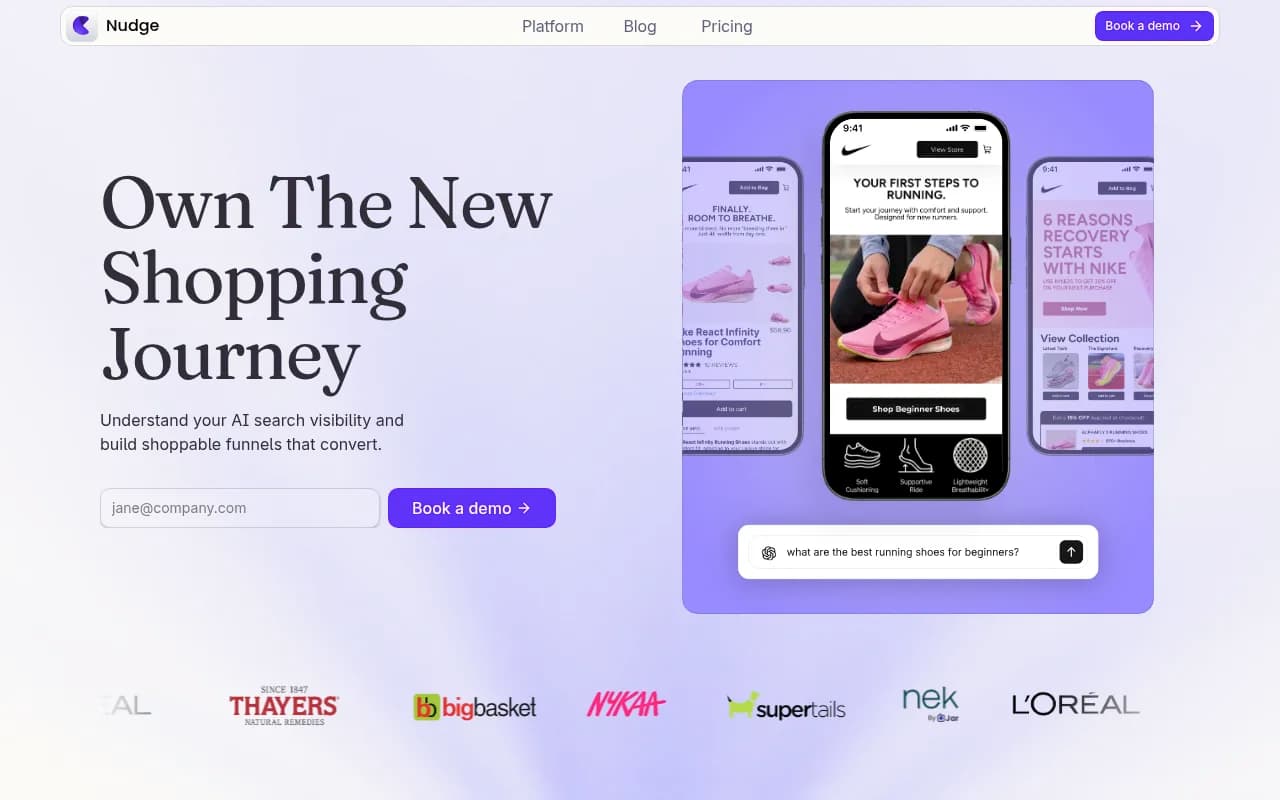
Nudge takes a different angle. It's explicitly built for commerce brands and splits its value proposition into two parts: AI Search Visibility (tracking where and how AI mentions your products) and Shoppable Funnels (generating prompt-specific landing pages optimized for conversion).
The pitch is that 100M+ consumers now use AI to decide what to buy, skipping traditional search, social, and ads. If your products don't show up in AI answers, you lose visibility and revenue. Nudge wants to own both the discovery moment (when someone asks ChatGPT or Perplexity "what's the best X?") and the conversion experience (the funnel they land on after clicking).
Client logos include recognizable e-commerce and DTC brands, though the site doesn't name them as prominently as Whitebox does. Like Whitebox, pricing is custom and requires a demo.
Side-by-side comparison
| Feature | Whitebox | Nudge |
|---|---|---|
| Target audience | Enterprise brands across industries | Commerce/DTC brands |
| Core focus | Brand narrative control in AI | Product discovery + conversion |
| AI models tracked | Not disclosed | Not disclosed |
| Pricing transparency | None (custom only) | None (custom only) |
| Free trial | Not mentioned | Not mentioned |
| Shoppable funnels | No | Yes (unique feature) |
| Content generation | Implied ("generates fixes") | Yes (prompt-specific funnels) |
| Competitive benchmarking | Not explicitly mentioned | Yes |
| Citation analysis | Implied | Yes |
| Prompt tracking | Unknown limits | Unknown limits |
| API access | Unknown | Unknown |
| Self-service onboarding | No (demo required) | No (demo required) |
Target audience and positioning
Whitebox and Nudge serve fundamentally different buyers, even though both operate in the GEO space.
Whitebox is going after enterprise marketing teams, brand managers, and PR departments at large companies. The client list -- cybersecurity firms, fintech platforms, global agencies -- tells you this is a tool for protecting and shaping brand perception at scale. If you're worried about how ChatGPT describes your company when someone asks "what are the top cybersecurity vendors?" or "is [YourBrand] trustworthy?", Whitebox wants to be your answer.
The "agentic" framing suggests they're doing more than monitoring -- they're actively intervening, possibly through content creation, citation building, or other optimization tactics. But without a public feature list, it's hard to know what "ships the fixes" actually means in practice.
Nudge, on the other hand, is laser-focused on commerce. If you're not selling products, Nudge probably isn't for you. Their pitch assumes you care about product recommendations in AI answers and want to convert that traffic into sales. The shoppable funnel feature is the differentiator here -- it's not enough to get mentioned in a ChatGPT response, you need a landing page optimized for the specific prompt that brought the user to you.
This makes Nudge a better fit for DTC brands, e-commerce managers, and growth teams at consumer product companies. Whitebox is for brand stewards; Nudge is for revenue drivers.
Feature breakdown
AI visibility tracking
Both platforms track how AI engines mention your brand or products, but the details are murky.
Whitebox promises "scientific clarity on how AI systems interpret your brand and why" and "real-time shifts in AI perception and ranking with precision." That sounds like they're monitoring multiple AI models and tracking changes over time. But which models? How many prompts? What's the refresh rate? The website doesn't say.
Nudge explicitly mentions tracking across ChatGPT, Perplexity, and Gemini. They surface "citation gaps" (places where competitors are cited but you're not) and "optimization signals" (what you need to fix to get mentioned). This is more concrete than Whitebox's messaging, though still light on specifics.
Neither platform comes close to the transparency you get with something like Promptwatch, which lists exactly which 10 AI models it tracks, how many prompts each plan includes, and what the refresh intervals are.

Content and optimization
Whitebox's "agentic GEO" claim suggests they generate content or optimization recommendations. The homepage says they "generate the fixes" and "ship" them, but it's unclear if this means:
- They write content for you
- They tell you what to write
- They publish content on your behalf
- They do something else entirely
You'd need a demo to find out.
Nudge is clearer here. They "automatically generate shoppable funnels optimized for real user prompts." This means if someone asks ChatGPT "best running shoes for flat feet," and your product gets mentioned, Nudge creates a landing page tailored to that specific query. The funnel includes product info, social proof, and conversion elements designed to close the sale.
This is a real differentiator. Most GEO platforms (including Whitebox, as far as we can tell) stop at visibility tracking. Nudge connects visibility to revenue by building the post-click experience.
Competitive intelligence
Nudge explicitly mentions competitive benchmarking -- you can see how competitors are performing in AI search and what prompts they're winning. This is table stakes for any serious GEO tool.
Whitebox doesn't mention competitive analysis on their homepage, though it's hard to imagine an enterprise platform not offering this. Again, you'd need a demo to confirm.
Ease of use and onboarding
Both platforms require a demo to get started. There's no self-service signup, no free trial, no way to poke around the interface before committing to a sales conversation.
This is fine for enterprise buyers who expect white-glove onboarding, but it's a barrier if you're a smaller brand or want to test the platform before committing budget. It also signals that both tools are likely expensive -- if pricing were accessible, they'd advertise it.
Pricing comparison
Neither Whitebox nor Nudge publishes pricing, so we can't do a direct comparison. Both require a demo and custom quote.
Based on their enterprise positioning and client rosters, expect both to be in the thousands per month range, possibly with annual contracts and setup fees.
For context, here's how they compare to platforms with public pricing:
| Platform | Starting price | What you get |
|---|---|---|
| Whitebox | Custom (likely $2,000+/mo) | Unknown features, enterprise support |
| Nudge | Custom (likely $1,500+/mo) | AI tracking + shoppable funnels |
| Promptwatch | $99/mo | 1 site, 50 prompts, 5 AI-generated articles, 10 AI models |
| Otterly.AI | $49/mo | Basic monitoring, limited prompts |
| Peec.ai | $99/mo | Monitoring only, no content tools |
If you need to start tracking AI visibility today without a sales cycle, Promptwatch or one of the lower-priced monitoring tools makes more sense. If you're an enterprise with budget and need a managed solution, Whitebox or Nudge could be worth the investment -- but you'll need to sit through demos to find out what you're actually paying for.
Pros and cons
Whitebox pros
- Enterprise-grade platform with impressive client roster
- "Agentic" approach suggests active optimization, not just monitoring
- Likely includes white-glove support and strategic guidance
- Broad industry applicability (not limited to commerce)
Whitebox cons
- Zero pricing transparency -- you can't budget without a demo
- Vague feature descriptions make it hard to evaluate fit
- No self-service option for smaller brands
- Unclear which AI models are tracked or how many prompts you can monitor
- Likely expensive with annual contracts
Nudge pros
- Unique shoppable funnel feature connects visibility to conversion
- Clear focus on commerce makes it a natural fit for DTC brands
- Explicitly mentions ChatGPT, Perplexity, Gemini tracking
- Competitive benchmarking and citation gap analysis included
Nudge cons
- Only relevant if you're selling products -- not for B2B SaaS, services, or pure brand management
- No pricing transparency (custom quotes only)
- No free trial or self-service signup
- Feature details are thin -- you need a demo to understand capabilities
- Unclear how many prompts you can track or what the limits are
Who should pick which tool
Choose Whitebox if:
- You're an enterprise brand (B2B SaaS, fintech, cybersecurity, etc.) worried about how AI describes your company
- You need to manage brand narrative and reputation across AI engines
- You have budget for a premium, white-glove solution
- You're willing to go through a sales process to access the platform
- You want a partner who will actively help you optimize, not just show you data
Choose Nudge if:
- You're a commerce brand (DTC, e-commerce, consumer products) focused on product discovery
- You want to connect AI visibility directly to sales with optimized landing pages
- You care about conversion rate optimization, not just brand mentions
- You have budget for an enterprise tool but want something commerce-specific
- You're willing to invest in a custom solution with a sales cycle
Choose something else if:
- You need transparent pricing and want to start today -- look at Promptwatch ($99/mo), Otterly.AI ($49/mo), or Peec.ai ($99/mo)
- You're a small business or solo operator without enterprise budget -- most GEO platforms with public pricing are more accessible
- You want to test before committing -- platforms with free trials let you evaluate fit without a sales conversation
- You need specific feature details before deciding -- demo-only platforms make it hard to compare objectively
Final verdict
Whitebox and Nudge are both enterprise-grade GEO platforms with opaque pricing and demo-required onboarding. The choice between them comes down to what you're selling and what you're optimizing for.
If you're managing brand perception for a large company and need to control how AI describes you, Whitebox is the play. Their "agentic" positioning and enterprise client roster suggest they're built for this exact use case.
If you're a commerce brand trying to get products recommended in AI search and convert that traffic into sales, Nudge's shoppable funnel feature is a real differentiator. They're the only platform we've seen that explicitly connects AI visibility to post-click conversion.
But here's the thing: both platforms make you jump through hoops just to understand what you're buying. No pricing, no feature lists, no free trials. If you're early in your GEO journey or don't have enterprise budget, you'll get more value from a transparent platform where you can see exactly what you're paying for and start optimizing today.