Key takeaways
- SOCi's 2026 Local Visibility Index (350,000+ locations) found ChatGPT recommends only 1.2% of franchise locations for "near me" queries, versus 35.9% appearing in Google's local 3-pack, 11.0% in Gemini, and 7.4% in Perplexity.
- AI models score each location independently on data accuracy, review sentiment, and content freshness. A strong national brand does not carry a weak or inconsistent local listing.
- Location-level pricing tools (GrowthPro AI, Grid My Business) are built for the 50-500+ location range; agency-style retainers (Cintra, Uberall's GEO Studio) tend to cap out around 10 locations per tier before requiring a custom quote.
- ChatGPT cites roughly 5 sources per answer on average, Google AI Overviews cites closer to 10. That means ChatGPT's local slots are scarcer and more competitive than Google's for the same "best plumber near me" query.
- Franchises that avoid "waterfall posting" (copying corporate content verbatim to every location page) outperform the 23.3% of brands that don't, according to SOCi's dataset.
Why 50+ locations breaks every local SEO playbook you already know
Here's the uncomfortable number to sit with: ChatGPT recommends roughly 1 in 83 franchise locations when someone asks it for the best plumber, dentist, or gym "near me." That's from SOCi's 2026 Local Visibility Index, which pulled data across 2,751 multi-location brands and 350,000 individual locations. Compare that to the 35.9% of those same locations that still show up in Google's old-school local 3-pack, and you start to see the gap. Gemini does better at 11.0%, Perplexity sits at 7.4%. ChatGPT is just stingy.
I don't think this is a coincidence or a bug. ChatGPT cites around 5 sources per web-search response on average, per Promptwatch's data on average sources per response. Google AI Overviews cites close to 10. When an AI model only has 5 citation slots to hand out for "best HVAC repair in Dayton, Ohio," it's going to be brutally selective, and a chain with weak, inconsistent location pages is going to lose that fight to the single independent shop that nailed its one listing.

That's the core problem this guide is about: how do you track, and then fix, AI visibility across 50, 100, or 500 locations when each one is effectively its own small business in the eyes of ChatGPT and AI Overviews?
AI models grade every location on its own merits, not the brand's
Uberall's research team tells a story that sums this up well. A restaurant chain came to them with two locations in the same town, one permanently closed, one open and thriving. AI models still recommended the closed location because its listing data was stale but technically still indexed, while the open one had drifted out of sync on hours and photos. The brand name meant nothing. The AI judged each address on the evidence in front of it.
That's the mental model franchise marketers need to adopt. Five signals seem to matter most, based on the combined research here: data accuracy (is the address, phone, and hours correct everywhere), recent activity (posts, updated photos, fresh content on the location page), directory presence (is it listed consistently across the web), locally-specific content (not a copy-pasted corporate template), and review sentiment plus response rate.
SOCi's data backs up the review piece specifically: ChatGPT-recommended locations average 4.3 stars, and businesses that respond to reviews are 72% more likely to be chosen by consumers who read reviews first (which is 99% of them). Yet the average multi-location brand only responds to 46.9% of Google reviews and a dismal 3.1% of Yelp reviews. If you're running 50+ locations and your review response rate looks anything like that average, you're leaving a known lever on the table.

The waterfall posting trap
One specific franchise mistake worth calling out: SOCi found that 26.8% of locations in its dataset use "waterfall posting," meaning corporate writes one social or GBP post and it gets copied verbatim to every location's profile. That accounts for 23.3% of all posts in the dataset. The problem isn't laziness, it's that AI models (and honestly, customers) can tell a templated post from a localized one, and engagement on waterfall posts gets diluted across near-identical copies instead of building distinct signal for each location. Culver's, cited by name in the SOCi report, gets recommended by ChatGPT at 30% of its locations, six times the restaurant category average of 5.3%. That gap didn't happen by copying one post to 900 locations.
What a franchise-scale AI visibility program actually needs to cover
Before picking software, it helps to separate what corporate can centralize from what depends on each franchisee. Centralizable: consistent schema markup, a content template system that still allows local variation, review response SLAs, and aggregate monitoring. Franchisee-dependent: actually responding to reviews in a timely, human way, keeping photos current, and local community engagement. Tools help with the first bucket. They can only nudge the second.
With that split in mind, here's what a 50+ location AI visibility stack needs to actually do:
- Scan multiple AI engines (ChatGPT, Gemini, Google AI Mode, AI Overviews, ideally Perplexity too) per location or per market, not just once for the brand overall
- Generate and track location-specific schema and entity data so each address has its own machine-readable footprint
- Flag which locations get cited or recommended and which get skipped, with competitor names attached
- Automate the daily grind of GBP posts, review responses, and content refreshes at scale, because no team can do this manually for 50+ addresses
- Roll results up into brand-level reporting corporate actually looks at
Comparing the local GEO platforms built for multi-location scale
A few platforms stand out for this specific use case, though they take noticeably different approaches to pricing and depth.
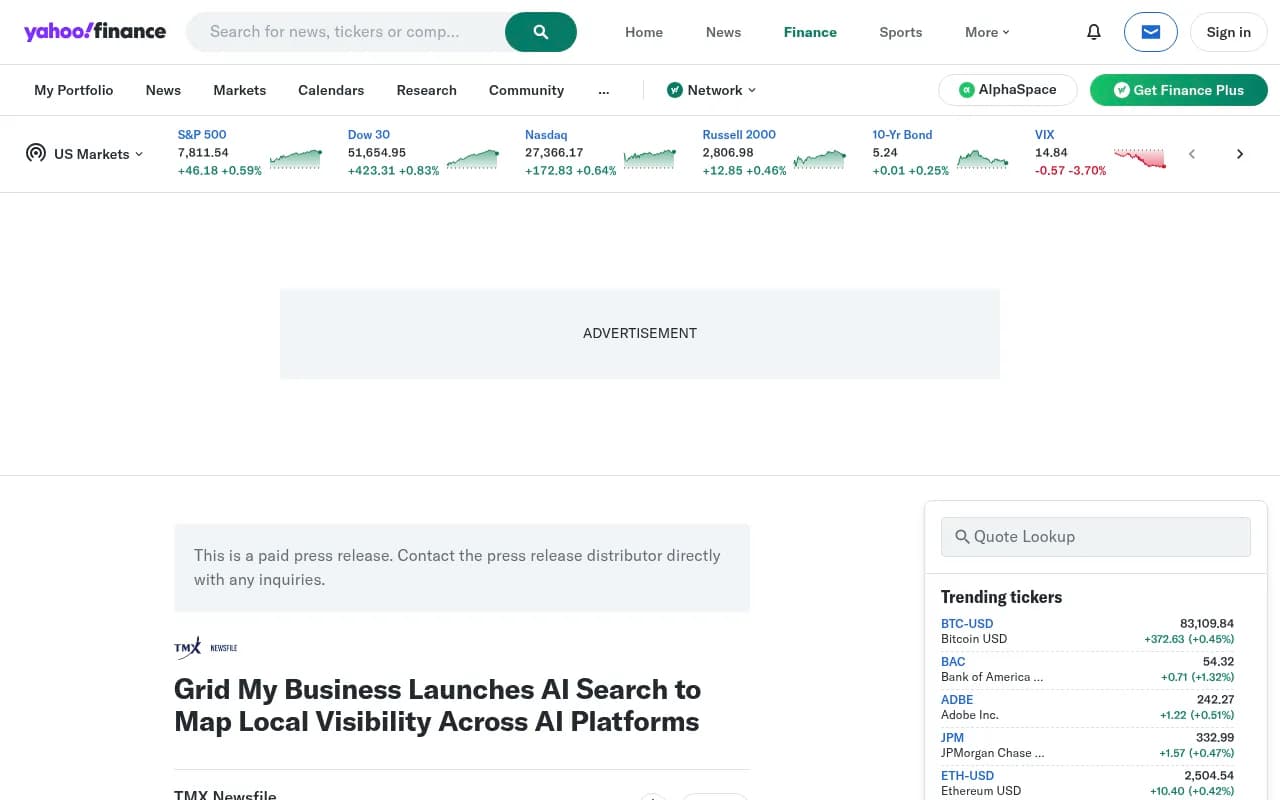
Grid My Business launched an AI Search feature in September 2026 that's purpose-built for this problem. It scans ChatGPT, Gemini, Google AI Mode, and Google AI Overviews using geo-grid scanning, up to 24 custom pins per scan, with nearby pins grouped by locality so franchises aren't billed for redundant overlapping pins. It produces an AI Visibility Score (0-100), AI Share of Voice by engine, and an AI Competitor Tracking feed showing which businesses AI recommends instead of you. Pricing runs in three paid tiers ($29, $69, $89/mo, cheaper billed annually), with scan credits scaling from 7,500 to 30,000 per month and citation checks from 500 to 2,500. It claims coverage across 195 countries and works for service-area businesses, not just storefronts.
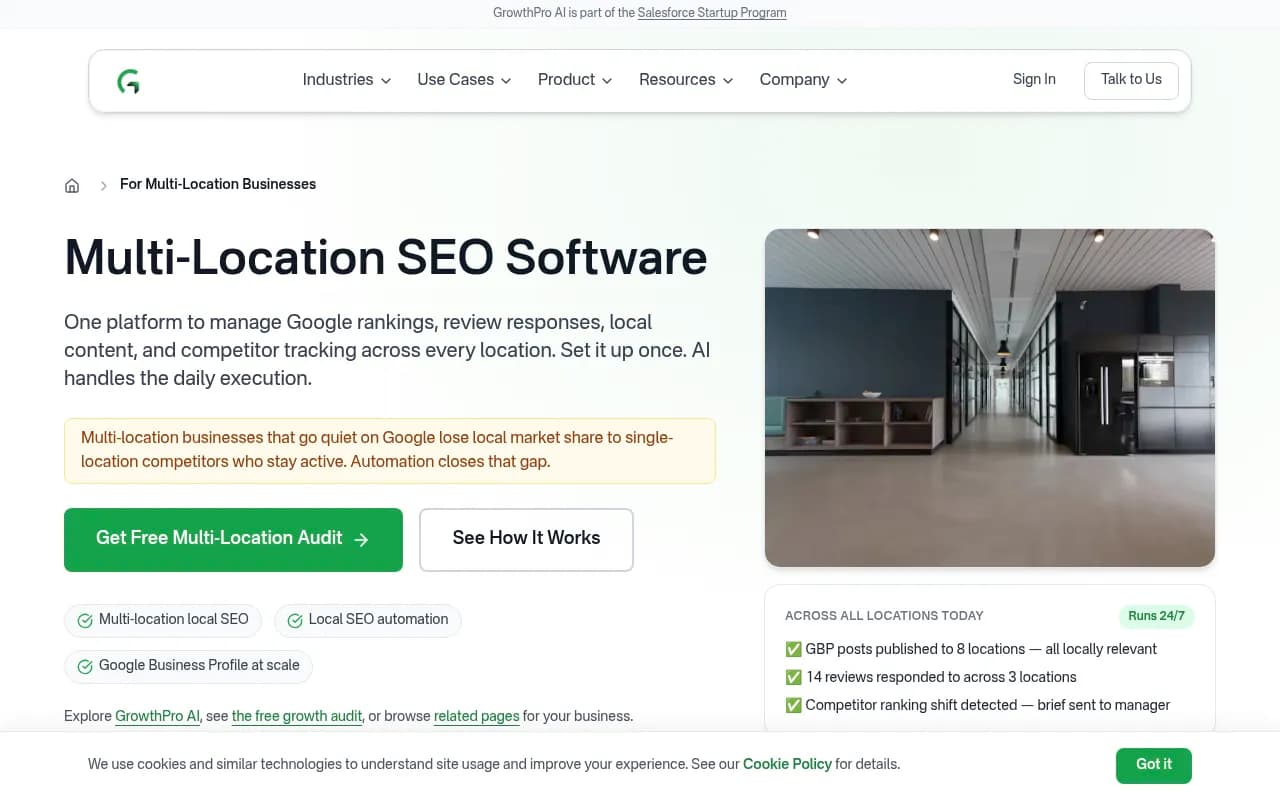
GrowthPro AI takes the "set it up once, AI handles the daily execution" angle, which matters a lot once you're past 50 locations and the manual workload becomes genuinely impossible. It bundles GBP posting, review responses, and AI search visibility monitoring (ChatGPT and Gemini are included by default, Perplexity and Claude are add-ons on some pricing pages) into named automated agents. Its own marketing calls out two by name: Forge, which publishes locally relevant posts per location, and Vega, which audits entity schema and fixes missing AI citation data automatically. Pricing is tiered per location and gets cheaper at volume: roughly $60/location/month for 2-100 locations, dropping to $40/location for 101-300, and $20/location for 301+, plus a flat $75/month WhatsApp automation add-on.
Uberall sells local presence management in packaged tiers (Show Up, Stand Out, Connect) and treats AI visibility as a separate paid add-on called GEO Studio, which tracks AI share of voice and competitive benchmarking on top of the core listings product. It's SOC 2 Type II certified and leans on an "always included" AI assistant as a differentiator against SOCi's module-based pricing, but you're effectively buying two products stacked together rather than one unified AI visibility layer.
Cintra runs on retainer pricing rather than flat SaaS seats, with minimum terms of 3 to 6 months. Its top tier, Authority, is aimed at multi-location and multi-country brands and includes 100-200 optimized pages per month plus citation-gap analysis, but notably its local listings management only covers "up to 10 locations" before you need a custom enterprise quote. If you're running 50+ locations, read that fine print carefully before assuming the advertised tier covers your whole footprint.
| Platform | AI engines tracked | Pricing model | Best fit for 50+ locations |
|---|---|---|---|
| Grid My Business | ChatGPT, Gemini, Google AI Mode, AI Overviews | $29-$89/mo tiers, scan credits | Agencies and brands wanting geo-grid scanning across many addresses cheaply |
| GrowthPro AI | ChatGPT, Gemini, AI Overviews (Claude/Perplexity add-on) | Per-location, $20-$60/location/mo, cheaper at volume | Franchises needing automated posting and review response at true scale |
| Uberall | AI visibility via GEO Studio add-on | Packaged tiers + separate AI add-on | Brands already on Uberall for core listings wanting to bolt on AI tracking |
| Cintra | ChatGPT, AI Overviews, others via retainer | Retainer, 3-6 month minimum | Brands under 10 locations or wanting a managed content/link program |
For general-purpose AI visibility tracking that isn't location-grid specific but covers brand-wide monitoring across ChatGPT, Gemini, Perplexity, and Claude with crawler-log depth and content generation, Promptwatch is worth a look too, though it's built more for a single brand's overall AI search presence than per-address geo-grid scanning. If your franchise's biggest gap is understanding why your corporate domain and content strategy aren't getting cited at all (separate from the hyper-local "near me" problem), that's where it fits.
A practical rollout process for tracking and fixing 50+ locations
SOCi's research team recommends a process that's genuinely usable regardless of which tool you pick, so I'll lay it out here:
- Pull your category's AI visibility benchmark (restaurants average 5.3% ChatGPT recommendation rate, retail 10.2%, financial services 3.1%, per the 2026 Index)
- Pull the same metrics for every one of your locations
- Flag the biggest channel gap per location, whether it's ChatGPT, Gemini, or the local 3-pack
- Tier your locations: top 25%, middle 50%, bottom 25% by visibility score
- Set tier-specific targets rather than one blanket goal for all 50+ addresses
- Separate what corporate can fix centrally (schema, review-response SLAs, templated-but-localized content) from what depends on individual franchisees (actual review responses, photo freshness)
- Report quarterly, not annually, because AI citation share moves fast
One caveat worth flagging: SOCi's methodology asks each AI platform to recommend 10 businesses for an industry and market, then counts a location as "likely recommended" if it appears in the first 5 results. That's a reasonable proxy, but it also means cross-engine visibility doesn't correlate neatly with traditional rankings. Across the industries SOCi studied, fewer than half of the brands leading in conventional local search also showed up among the top AI recommendations. Don't assume your Google Maps dominance translates to ChatGPT visibility. It often doesn't.
Making individual location pages verifiably local for AI
A few concrete fixes matter more than people expect:
- Local Business schema on every single location page, with correct NAP data that matches your Google Business Profile and directory listings exactly
- Unique, locally-specific content on each page: neighborhood names, local landmarks, staff names, actual service-area details, not a find-and-replace city name dropped into a corporate template
- Fresh photos and GBP posts on a real cadence, since AI models weight recency heavily
- A review response standard that applies across all locations, since 4.3 stars is the average among ChatGPT-recommended businesses and response rate itself is a trust signal
DR doesn't have to be a blocker here either. Promptwatch's citation data shows mid-authority domains (DR 46-75) captured nearly half of all ChatGPT citations in August 2026, while top-tier DR 91-100 sites fell to just 3-4.4% of citations by month's end, according to the ChatGPT citation share by domain rank report. A lower-authority location subdomain or page is not automatically shut out of citations just because the corporate homepage outranks it. That's genuinely good news for franchise location pages, which are almost always lower-DR than the national brand domain.
Where to go from here
If you're managing 50+ locations, start by figuring out whether your biggest gap is monitoring (do you even know which locations are invisible right now) or execution (you know the gaps but have no bandwidth to fix them one by one). Grid My Business and similar tools solve the first problem cheaply. GrowthPro AI's automation agents and SOCi's managed service solve the second. Most franchises eventually need both.
For a wider look at AI rank tracking tools outside the local-specific category, the directory at ai-rank-tools.com is a decent next stop, and the broader GEO software directory at bestgeosoftware.com covers platforms built for brand-wide, not just location-level, AI visibility. If the real bottleneck turns out to be strategy and execution capacity rather than software, an agency partner is sometimes the faster path; 1001 SEO Media runs GEO and AI search visibility programs for exactly this kind of multi-location complexity.