Key takeaways
- bydefault ($99/mo Starter) is the only one of the three that shows you the exact fan-out search queries a model ran before answering, plus it tracks coding-agent surfaces like Cursor and Claude Code that neither competitor touches.
- Peec AI (currently €85/Pro €205/Advanced €425 per month) is the deepest analytics product of the three, with an Ads library and ChatGPT Shopping tracking, but it explicitly refuses to generate content "by design."
- AthenaHQ has the widest model coverage on its paid Starter plan (11 models vs. bydefault's 4 and Peec's 3) and the only genuinely free, non-expiring tier, but its $295/month paid entry point is the steepest of the three and its credit system takes some getting used to.
- None of these three is a full content-production engine. If your real bottleneck is publishing fixes at volume rather than finding gaps, it's worth looking at platforms built around that workflow, something I'll get to at the end.
- Pricing on all three has moved around in 2026 (Peec switched from USD to EUR pricing in August), so treat the numbers here as a snapshot and confirm on the vendor's own page before you buy.
Why this comparison matters right now
There's a reason these three keep getting compared against each other instead of, say, Semrush or Ahrefs. They occupy a specific middle ground: dedicated AI-visibility trackers that have each, in their own way, started bolting on "do something about it" features. That's a different category than a pure monitoring dashboard, and it's a different category than a full content platform. If you're choosing between them, you're really choosing how much of the fixing you want the tool to attempt versus how much you want to keep in-house.
The context worth knowing before you pick any of these: how many citation "slots" are actually up for grabs per engine. Promptwatch's data shows ChatGPT typically cites only around 5 sources per web-search answer, while Google AI Overviews and Perplexity average closer to 10 each, a notably steadier number over time (Promptwatch's average sources per response data). Microsoft Copilot's citation count, by contrast, has swung from under 2 to nearly 17 sources within weeks, which tells you Copilot's retrieval pipeline is still being rebuilt and any Copilot numbers you see in a dashboard should be judged on a monthly trend, not a weekly snapshot. That backdrop matters because it changes what "good" visibility looks like depending on which engines a tool actually tracks.
The three platforms, in one paragraph each
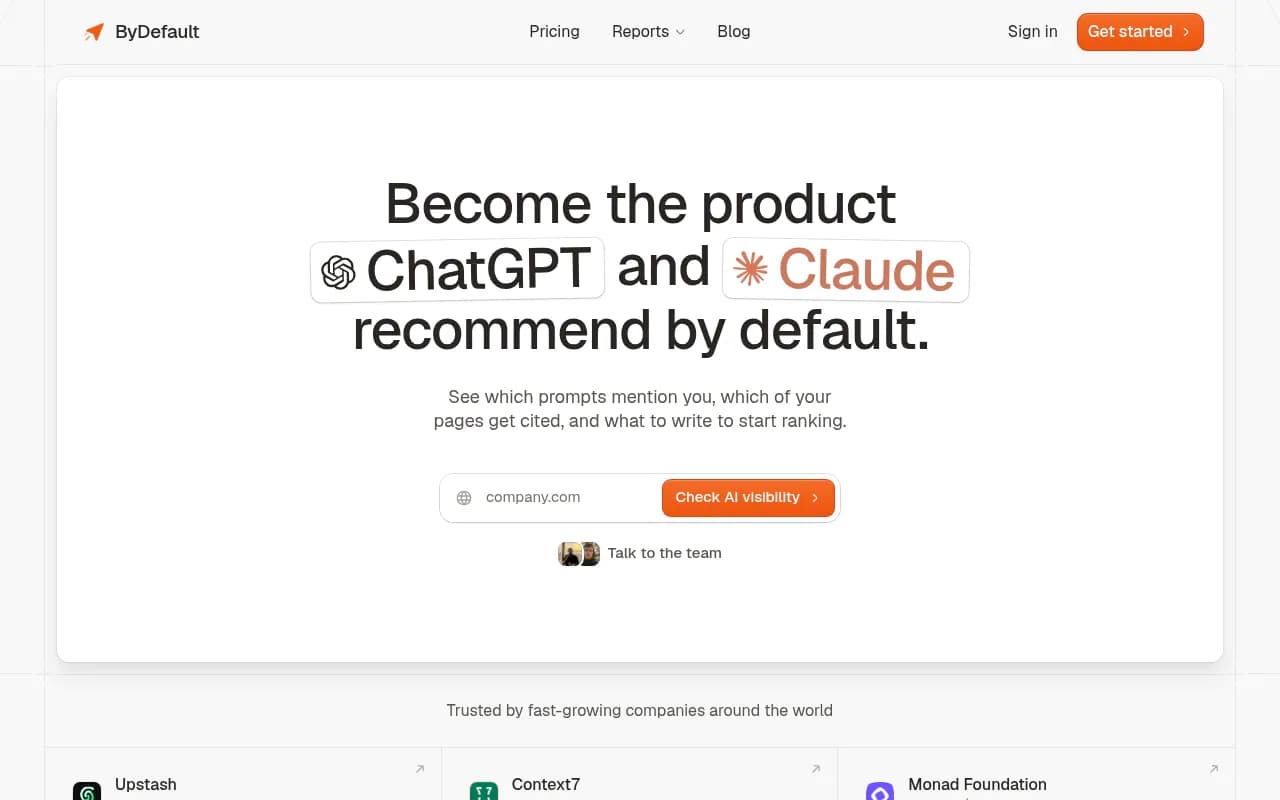
bydefault is the newest and smallest of the three, built by a team that seems genuinely fixated on the mechanics of how AI models search before they answer. Its headline feature is surfacing the actual web-search queries (the "fan-out" queries) that ChatGPT, Claude, Gemini, or AI Overviews ran before generating a tracked response. That's a useful signal for content planning: instead of guessing what to write, you see the literal sub-query the model fired off and didn't find a good answer to.
Peec AI is the Berlin-built analytics specialist. It raised a $21M Series A in November 2025 and reportedly crossed $10M ARR about 16 months after its February 2025 launch, with 2,500+ customers including names like n8n, Attio, ElevenLabs, and Chanel. It is, by its own admission, not a content tool. Its comparison page states plainly that it doesn't offer content generation, by design. What it does instead is go deep: an Ads library for AI search, SKU-level AI Shopping tracking, brand-perception fact-checking, and crawlability audits across 40+ bots.

AthenaHQ sits furthest toward the "action engine" end of the spectrum. Founded in San Francisco by Y Combinator alumni with a team that includes people from Google, DeepMind, OpenAI, and Anthropic, it pairs visibility tracking with a content optimization agent, prioritized on-page and off-page actions, and, at Enterprise, a new Citation Engine feature. It carries a 4.9/5 rating on G2 from customers like SoFi, Wix, and ZoomInfo.

Pricing and plan limits, side by side
Prices move fast in this market, Peec switched its public pricing from USD to EUR in mid-August 2026, so double-check the vendor page before budgeting. Here's where things stood as of this writing:
| Platform | Entry paid plan | What you get | Free tier |
|---|---|---|---|
| bydefault | $99/mo (Starter) | 1 project, 50 prompts, 4 models, 6,000 AI answers/month | None confirmed on pricing page |
| Peec AI | €85/mo (Starter) | 50 prompts, choose 3 models, unlimited users, 1 project | Trial only, terms not published |
| AthenaHQ | $295/mo (Starter); Essential is free | 3,600 credits/month, 11 models, unlimited members | Yes, 300 credits, 5 models, no expiry |
A few things jump out. AthenaHQ's free Essential tier is a real evaluation sandbox, not a 7-day trial, which makes it the easiest of the three to poke at before spending anything. But its paid Starter tier costs three times what bydefault or Peec charge to get started, and that credit system (1 credit equals 1 AI response, so 30 prompts checked daily across 4 models burns through 3,600 credits fast) is something reviewers on G2 flag as hard to forecast if you're not careful about prompt count.
Peec's model math is the trickiest to pin down. Each plan includes only 3 models by default, and extra models cost add-on fees reported in the $30 to $140 per month range depending on tier. If you actually need ChatGPT, Perplexity, Gemini, Claude, AI Overviews, and Copilot, the sticker price you see on the pricing page is not the price you'll end up paying.
bydefault's model selection (4 per plan, drawn from ChatGPT, Claude, Gemini, AI Overviews, plus coding agents like Cursor, Codex, Claude Code, and OpenCode) is the only one of the three that bakes developer-tool surfaces into the core offering, which makes sense given its customer base includes developer-facing products like Upstash and Context7.
Feature comparison: monitoring vs. action
| Capability | bydefault | Peec AI | AthenaHQ |
|---|---|---|---|
| Model coverage (entry plan) | 4, incl. coding agents | 3, EU + 11 at Enterprise | 11 at Starter |
| Fan-out / search-query visibility | Yes, core feature | Not emphasized | Not emphasized |
| AI crawler log analytics | Yes, 1M+ requests/day claimed | Crawlability audit (40+ bots) | Not a standout feature |
| Content generation | Done-for-you articles on Growth/Scale | None, by design | Content optimization agent |
| Shopping / Ads tracking | No | Yes, Ads library + SKU tracking | No |
| Free tier | Unclear, verify directly | No, trial only | Yes, 300 credits, no expiry |
| Agency program | Not highlighted | Yes, tiered agency pricing | Yes, multi-brand workflows |
Where each one actually wins
If you're a developer-tool company whose audience lives partly inside coding assistants, bydefault's tracking of Cursor, Codex, Claude Code, and OpenCode is genuinely distinctive. Neither Peec nor AthenaHQ track those surfaces at all right now, and if your product gets recommended (or ignored) inside an AI coding agent, that's a blind spot worth closing.
If you're running a brand team that wants the deepest possible read on how AI search is actually behaving around you, including whether competitors are buying ads in AI answers or showing up in ChatGPT's shopping carousel, Peec's feature depth is hard to match at its price. Just go in knowing you'll need a separate content or SEO tool to close the loop, because Peec isn't going to write anything for you.
If you want the broadest model coverage without paying extra for it, and you'd rather have a content agent built into the same dashboard that's tracking your visibility, AthenaHQ's Starter plan does more out of the box, for a higher starting price. Case studies the company has published, like Cozy Earth's 3.6x growth in sleepwear mentions and Rootly's roughly 10x citation rate increase, suggest the action layer isn't just a tracking screen with extra buttons.
The honest gap in all three
Here's the thing nobody's pricing page quite says out loud: tracking where you're invisible and actually shipping the fix at the volume AI search demands are two different jobs, and even the "action" features in bydefault and AthenaHQ are closer to assisted drafting than a full publishing pipeline. bydefault's done-for-you articles are capped (5 to 10 per month depending on plan). AthenaHQ's content agent works within a credit budget that's shared with your monitoring usage. Peec doesn't attempt content at all.
This is the gap that platforms built around full-stack AI visibility, from crawler logs through to CMS publishing, are trying to close. Promptwatch takes that approach: it pairs the same kind of prompt tracking, crawler log analytics, and citation data you'd find in these three with Content Agents that plan, write, and publish GEO-optimized pages directly to Webflow, Framer, or WordPress on a schedule, plus a Unified Actions list that turns the data into a prioritized to-do rather than a dashboard you have to interpret yourself. It also tracks Reddit and YouTube citations specifically, two channels none of the three tools above call out as a dedicated report.

That's not a knock on bydefault, Peec, or AthenaHQ specifically, it's a reflection of how young this whole category still is. Most vendors are choosing a lane (deep monitoring, or broad model coverage, or developer-surface tracking) rather than trying to do all of it at once. Promptwatch's own comparison of 21 GEO platforms lays out where each tool's stack actually stops, which is worth reading if you want the fuller picture before committing budget: promptwatch.com/best-geo-and-ai-visibility-platforms-compared-2026.
A quick word on data reliability
One thing worth flagging if you're evaluating any AI visibility tool, not just these three: whether it's scraping the actual user interface of ChatGPT, Perplexity, and AI Overviews, or simulating answers through an API. The two can diverge. API responses don't always match what a real user sees in the product, especially for features like shopping carousels or ads that only render in the consumer UI. Peec AI markets its UI-scraping approach as a differentiator for exactly this reason, and it's a fair question to ask any vendor you're considering.
It's also worth checking how a vendor classifies citations. Promptwatch's research shows that the mix of content types AI engines cite shifts month to month, product pages overtook listicles as the most-cited format in Google AI Overviews in late July 2026, for instance (AI Overviews citation types, July 2026), and ChatGPT's own citation mix shows listicles as its fastest-growing format even while product pages led the month (ChatGPT citation types, July 2026). If a tool's dashboard doesn't break citations down by content type at all, you're missing half the story of why you're (or aren't) showing up.
How to decide
Start by being honest about what you're actually trying to buy. If the goal is understanding AI search mechanics at a granular level, especially for a developer or technical audience, bydefault's fan-out visibility and crawler log depth are worth the $99 a month to test. If you need the deepest analytics on brand perception, ads, and shopping behavior and you already have a content team that can act on what you find, Peec's feature set justifies its price even with the model add-on costs. If you want one dashboard that tracks broadly and nudges content work forward without a separate tool, AthenaHQ's free Essential tier is a low-risk way to see if its action layer fits your workflow before paying $295 a month.
And if what you actually need is the full loop, tracking, crawler diagnostics, and automated publishing that closes the gaps these tools find, that's the problem Promptwatch was built to solve, and it's worth a look alongside whichever of these three you shortlist. For a broader scan of the category beyond just these three names, the GEO software directory at bestgeosoftware.com and the AI visibility rankings at aisearchtoolrank.com are both decent starting points to widen the search.