Key takeaways
- LinkedIn's 2026 "Depth Score" algorithm favors personal profile posts (about 65% of feed allocation) over company pages (roughly 5%), so your scheduling tool needs to support exec and employee posting, not just a brand account.
- Document carousels (PDF uploads, not image galleries) get 2-3x more dwell time and a 6.6% engagement rate, the strongest native format right now. Not every scheduler handles this correctly.
- Tools built on LinkedIn's official Content API (Supergrow, Postbeam, MagicPost) are safer long-term than browser-automation tools, which LinkedIn's User Agreement explicitly prohibits.
- For pure LinkedIn depth, dedicated tools like Taplio, Supergrow, and AuthoredUp beat general schedulers. For B2B teams juggling five+ channels with a content calendar and reporting needs, Hootsuite or Sprout Social still make sense.
- LinkedIn citations barely register in AI chatbot answers (ChatGPT cites LinkedIn in just 0.23% of responses), so treat LinkedIn scheduling as a reach and pipeline play, not a GEO play.
Why LinkedIn-first B2B marketing needs its own tooling logic
Most "best social media scheduler" roundups still treat LinkedIn as the fourth or fifth network on a list led by Instagram or TikTok. That's a mistake if you're doing B2B. Content Marketing Institute's 2025 data, still the benchmark cited going into 2026, found that 97% of B2B marketers use LinkedIn for content distribution, ahead of X at 87% and Facebook at 86%. Digital Applied's 2026 compilation puts LinkedIn usage among B2B marketers at 84% versus 37% for B2C marketers, with an average engagement rate of 3.2%.
So the stakes for getting LinkedIn right are higher than for most other channels on a B2B team's roster. And 2026 made the channel genuinely harder to game. LinkedIn rolled out algorithm changes starting in January built around a "Depth Score" that weighs dwell time, comment depth, saves, and private shares, and it accumulates over 24 to 48 hours after you publish rather than settling in the first hour. That changes how you should even think about scheduling cadence.
Two specifics matter a lot for tool selection:
First, company page reach dropped 60-66% in the new system. Company pages now get roughly 5% of feed distribution while personal profiles get about 65%. If your scheduling tool only supports a brand page and doesn't make it easy for your CEO, sales leaders, or SDRs to post from their own profiles, you're optimizing for the wrong surface.
Second, external links in the post body cut organic reach by roughly 60% because LinkedIn penalizes posts that try to pull people off-platform. Tools that nudge you toward native formats, especially document carousels, which get 2-3x more dwell time and post around a 6.6% engagement rate, are worth more than tools that just auto-post a blog link with a caption.
One more thing worth flagging before the comparisons: LinkedIn visibility and AI chatbot visibility are different goals, and it's easy to conflate them. Promptwatch's data on social citations across AI engines shows LinkedIn accounts for just 0.74% of citations blended across ChatGPT, Perplexity, AI Overviews, and Grok, with Reddit at 3.36% and YouTube at 2.94%. ChatGPT specifically cites LinkedIn in only 0.23% of responses. So scheduling consistently on LinkedIn builds direct audience reach and pipeline, it doesn't meaningfully move the needle on showing up inside AI answers. If AI search visibility is also a goal, that's a separate workstream.

The tools, compared
| Tool | Built for | AI writing | Carousel/document posts | Team collaboration | Starting price |
|---|---|---|---|---|---|
| Hootsuite | Multi-channel B2B teams | Yes | Yes | Yes | $99/user/mo (annual) |
| Sprout Social | Enterprise social + reporting | No native AI copy | Yes | Yes | $199/seat |
| Agorapulse | Mid-market all-in-one | Limited | Yes | Yes | Custom |
| Taplio | LinkedIn-only, creator-led | Yes | Basic image upload only | Yes | $39/mo |
| Supergrow | LinkedIn-only, official API | Yes | Yes (Pro tier) | Yes | $19/mo |
| AuthoredUp | LinkedIn-only, no AI by design | No | No | No | $19.95/mo |
| Oktopost | Enterprise B2B, advocacy + attribution | No | Yes (native, company pages) | Yes | Quote-based ($25k-$80k/yr typical) |
Hootsuite
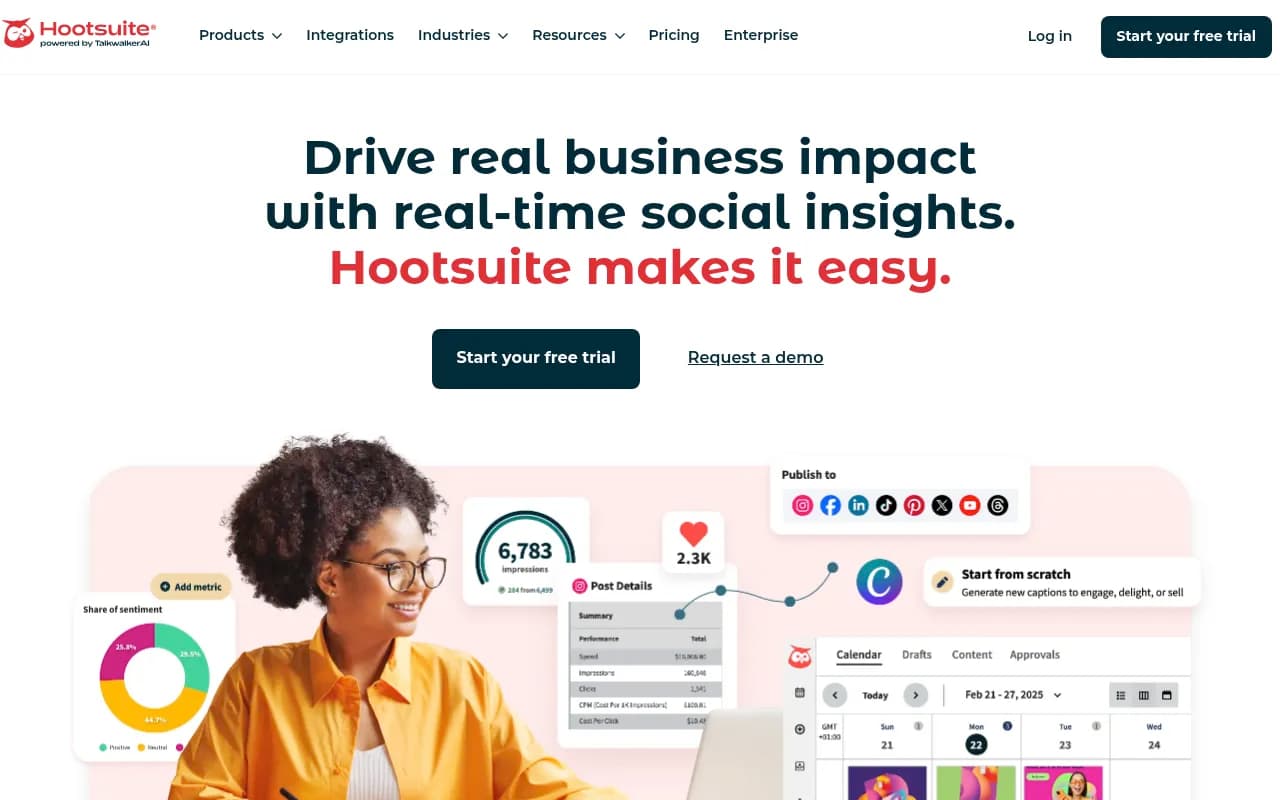
Hootsuite earns its spot on most B2B shortlists because it does the boring stuff well: a visual calendar, bulk scheduling, optimal send-time suggestions, and support for LinkedIn alongside every other channel you're probably also running. It's not LinkedIn-specific, which is both the appeal and the limit. If your B2B marketing is LinkedIn-first but not LinkedIn-only, meaning you've also got a newsletter, X, and maybe YouTube in the mix, Hootsuite's breadth is genuinely useful. Pricing starts at $99/user/month billed annually for up to 10 accounts, with a 30-day free trial.
Sprout Social
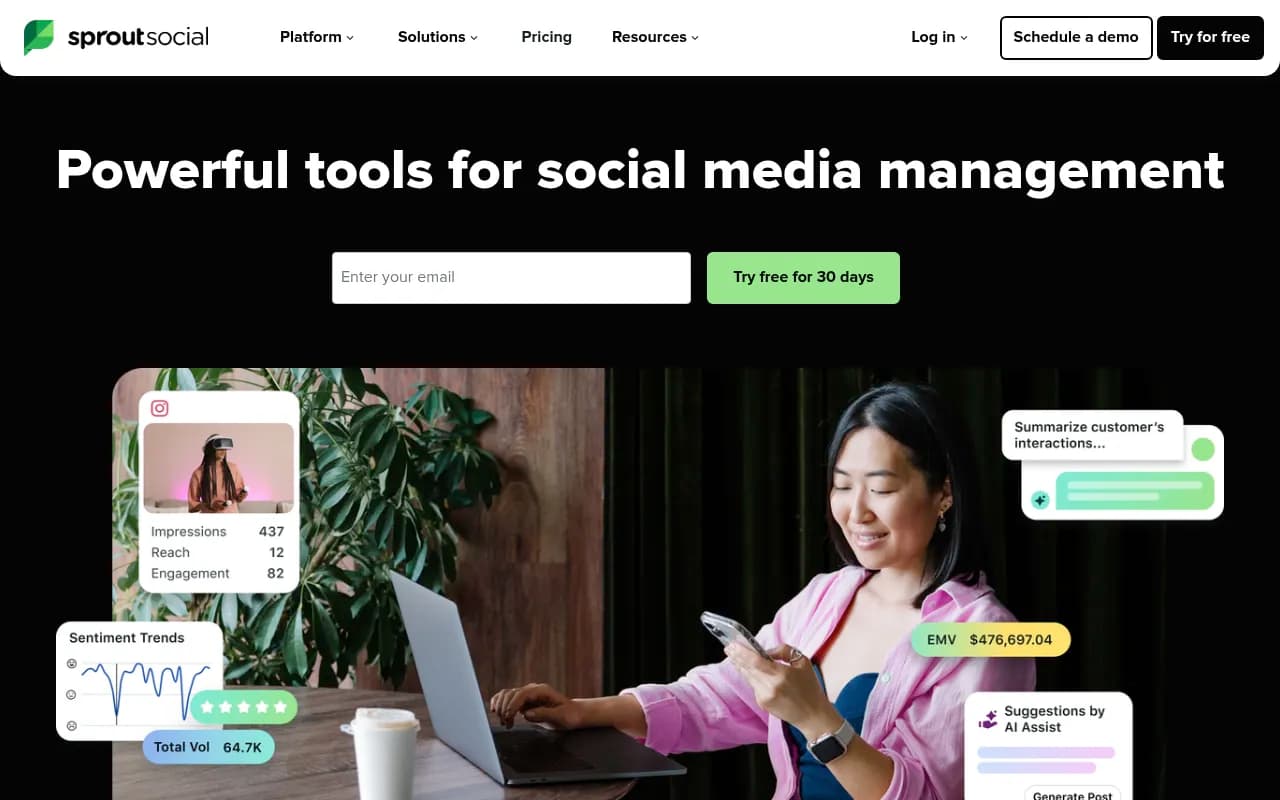
Sprout treats social as a measurable business function rather than a content firehose, which is exactly the framing a B2B marketing team reporting to a CFO wants. Its AI-driven optimal send-time suggestions and business intelligence reporting are strong, and it's one of the few platforms with genuinely enterprise-grade analytics baked in rather than bolted on. The catch is price: $199/seat puts it firmly in the "budget it as a line item, not an impulse buy" category. If your team needs defensible reporting for leadership and LinkedIn is one of several channels you manage, Sprout is worth the cost. If LinkedIn is literally your only channel, you're paying for a lot you won't use.
Agorapulse
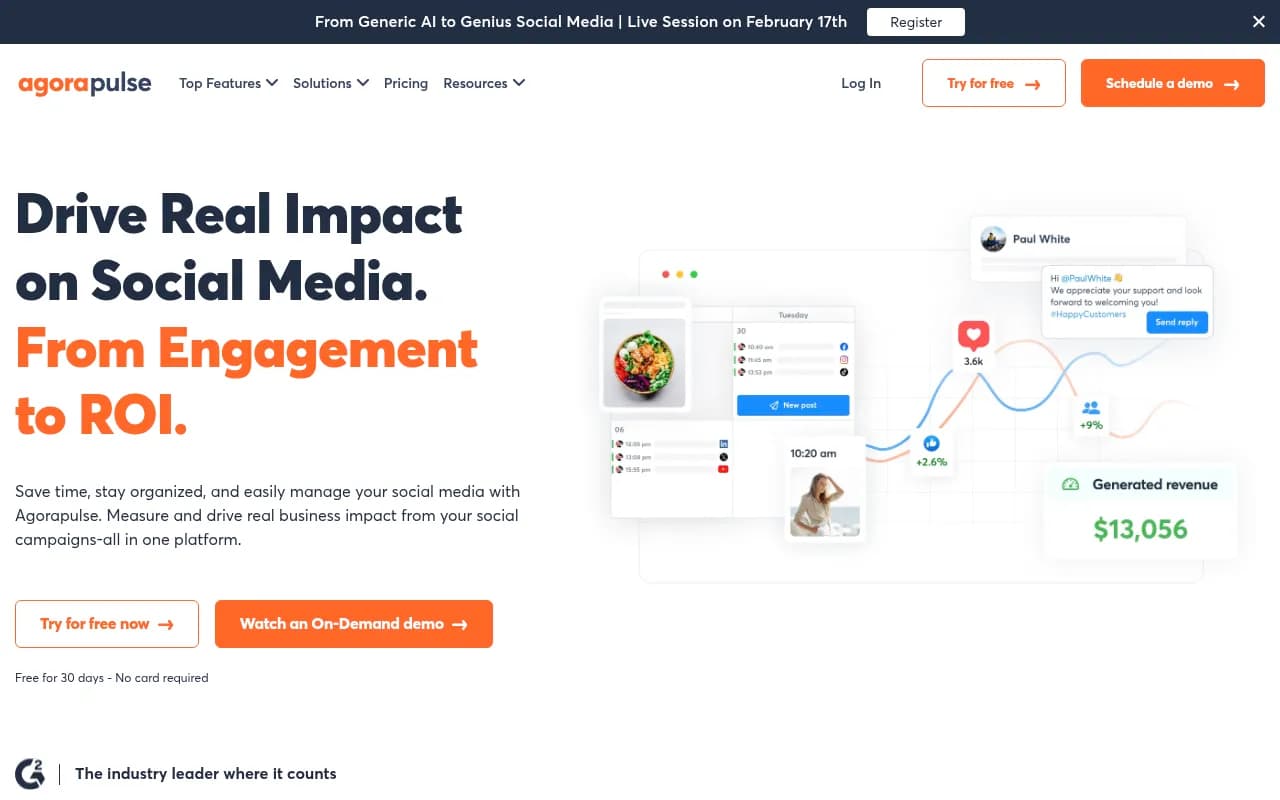
Agorapulse sits in the same all-in-one category as Hootsuite and Sprout but at a friendlier price point for mid-market teams, with ROI tracking built into the publishing workflow rather than treated as a separate add-on. It supports carousel and document-style posting, which matters given how much LinkedIn's algorithm now rewards that format. Worth a look if Hootsuite feels overbuilt for your team size but you still want more than a single-channel scheduler.
Taplio
Taplio, from the lempire team, is a LinkedIn-only tool with a genuinely useful differentiator: a database of 5 million-plus viral posts and a "LinkedIn Benchmark" feature that shows how your content stacks up against similar accounts. The Growth plan at $69/month (or $49 billed annually) adds AI post writing and faster commenting tools, and is the tier most users land on. The gap worth knowing about before you buy: Taplio's carousel support is basic image upload, not true document-post generation, so if carousels are central to your strategy (and the 2026 algorithm data suggests they should be), you'll feel that limitation.
Supergrow
Supergrow is built specifically around LinkedIn's official Content API rather than browser automation, which matters more than it sounds. LinkedIn's User Agreement explicitly prohibits scraping and bot-like automation, and tools that simulate clicks in a browser carry real account risk regardless of where they're hosted. Supergrow and a few competitors like Postbeam market API-based posting as a safety feature, not just a technical detail, and that's a fair selling point given how aggressively LinkedIn's classifiers now detect automation patterns. Pricing starts at $19/month ($16 billed annually), with carousel building gated to the Pro tier at $39/month. It also offers first-comment scheduling, letting you queue a follow-up comment with a hashtag or CTA to drop right after the post goes live, a small but genuinely useful touch for early engagement signals.
AuthoredUp
AuthoredUp takes a deliberate stand against AI-generated copy. No AI writing assistant, full stop. That's a feature for teams whose writers are tired of LinkedIn feeds full of interchangeable AI-flavored posts (and with 95% of B2B marketers now using AI marketing tools per ZoomInfo's compilation, that fatigue is real). What you get instead is deep historical analytics and formatting tools built specifically for how LinkedIn renders text. At $19.95/month per profile, it's priced for individual contributors and execs managing their own presence, not teams, since it has no collaboration or carousel features.
Oktopost
Oktopost is the one enterprise-grade tool on this list actually purpose-built for B2B, with campaign-tagged posts, buyer-journey tracking, and native document-post publishing for company pages that pairs with employee advocacy distribution. It's recognized in the 2026 Gartner Magic Quadrant for social media management. There's no public pricing; negotiated annual contracts run anywhere from roughly $12,000-$15,000 for small deployments up to $50,000-$80,000-plus for larger ones, with separate onboarding fees. This is the right tool if your B2B marketing org needs to tie LinkedIn activity to pipeline attribution and already has budget for an enterprise martech stack. It's overkill for a two-person marketing team.
The employee advocacy question
Given that personal profiles now carry roughly 13x the feed allocation of company pages, B2B teams increasingly need an employee advocacy layer alongside their scheduler, not instead of it. LinkedIn's own data shows employee networks carry about 10x more connections than a company's follower base, and one documented example had a product engineer's post pull 1,405 median impressions versus 659 for the identical story posted from the company page.
Tools like GaggleAMP, Sociabble, and DSMN8 fill this gap, typically priced in the $30-$60 per active user/month range for LinkedIn-native advocacy, with legacy enterprise suites running into five or six figures annually once you add seats, training, and modules. None of these are in most general "scheduler" comparisons because they solve a different problem: getting your whole team posting, not just your brand account. If your LinkedIn strategy depends on executives and SDRs showing up personally, which the 2026 algorithm data suggests it should, budget for this layer separately from your core scheduler.
What to actually do about posting times
The research here is genuinely inconsistent, and it's worth saying so rather than pretending there's a clean answer. Buffer's analysis of 4.8 million LinkedIn posts found a shift toward evenings, with Wednesday at 4pm the single best slot. Sprout Social's 2026 report instead points to late morning through afternoon, Tuesday through Thursday, 11am to 5pm. A synthesis across four studies covering more than 8 million posts lands on Tuesday-Thursday, 10am to noon as the consistent core window, with afternoon and evening slots now outperforming mornings more than they used to.
The honest takeaway: generic benchmarks disagree with each other enough that testing your own audience's response windows will beat following any single study. Most of the tools above, Hootsuite and Sprout Social especially, include optimal-time suggestions based on your own account's historical engagement, which is a better signal than any industry-wide number.
A few pitfalls worth avoiding
Engagement pods are effectively dead. LinkedIn's detection systems now identify reciprocal engagement patterns and can drop an account's reach from thousands to hundreds overnight without warning. If a scheduling tool or community is still pitching "engagement groups" as a growth hack, treat that as a red flag rather than a tactic.
Auto-generated comments are also under active scrutiny. Several scheduling tools bundle auto-commenting as a feature, but LinkedIn's classifiers flag comment timing, language similarity, and reciprocity patterns that look automated. Use first-comment scheduling for your own planned CTA or hashtag, not for auto-replying to other people's posts at scale.
And be skeptical of "engagement bait" formats your tool might make easy to template out, things like "comment YES if you agree" or reaction polling. LinkedIn's 2026 classifier actively suppresses these regardless of your account's prior standing.
Picking the right fit
If you're a solo marketer or small team where LinkedIn is the whole strategy, Supergrow or Taplio will get you further than a generalist tool, and the API-based approach of Supergrow is the safer long-term bet given how LinkedIn's ToS enforcement has sharpened. If you're running LinkedIn alongside four other channels with a reporting requirement attached, Hootsuite or Sprout Social earn their higher price tags. If you're an enterprise B2B org that needs pipeline attribution tied to social activity, Oktopost is built for exactly that, even if the price tag requires a real procurement conversation.
Whichever you pick, build the employee advocacy layer in alongside it. The algorithm data is pretty clear that company-page-only scheduling is a shrinking strategy for 2026, no matter how good the scheduler itself is.
For broader comparisons across the AI visibility and GEO tooling space, which is a related but distinct concern from LinkedIn scheduling, the directory at bestgeosoftware.com is worth a look if your B2B content strategy also needs to show up inside AI chatbot answers.