Key takeaways
- Agency client churn isn't random. Retainer-based agencies average 1.6% monthly churn while project-based shops average 4.2%, and the single biggest 2026-specific driver is clients quietly moving work in-house with AI tools once they stop seeing proof of strategic value.
- AI visibility platforms (the category Searchable.com competes in) have become a retention tool as much as a reporting tool, because they give account managers a weekly, client-facing number that shows up before rankings or revenue do.
- Searchable is a solid, affordably priced option (Pro at $125/month), but agencies managing many client domains often hit its structural limits faster than they expect, and several alternatives offer deeper reporting, agency-specific workflows, or action automation that matters more for renewal conversations.
- The platforms below are ranked not by feature count but by how directly they support the leading indicators that predict churn: response-time to client questions, visible proof of progress, and the ability to catch a stalling account before the renewal call.
- Promptwatch ranks highest on this list because it's the only platform here that goes from "here's your visibility score" to actually drafting and publishing the fix, which shortens the gap between a client's worry and a result you can show them.
Why churn reduction is the right lens for this comparison
Most "Searchable alternatives" roundups compare prompt counts and price per seat. That's useful, but it misses what actually keeps a marketing retainer alive.
According to Focus Digital's 2026 agency churn benchmarks, agencies lose clients at wildly different rates depending on how they're positioned. Full-service agencies churn at around 25% annually, SEO-only shops at 38%, and PPC agencies, the most commoditized service, at a brutal 49%. The common thread across the agencies that churn less: they're seen as strategic partners, not execution vendors. The agencies that churn most are the ones a client can replace with an in-house hire and a few AI tools.
That last point matters more in 2026 than it did two years ago. "AI-driven in-housing" is now a named churn driver in agency research: clients who only see an agency delivering tasks (posting content, running audits, writing briefs) start wondering why they're paying $8,000 a month when ChatGPT and an intern could do the same thing. The agencies that survive this shift are the ones who can point to something the client genuinely can't replicate on their own, like a continuously updated view of how the client's brand shows up across ChatGPT, Perplexity, and Google AI Overviews, tied to a plan for improving it.
That's exactly the category Searchable and its alternatives operate in. Used well, these platforms become the weekly or monthly artifact that justifies the retainer. Used poorly (a static PDF nobody reads), they do nothing for churn at all.
Swydo's client-churn research backs this up with a few numbers worth keeping in your back pocket for renewal conversations: a champion or main point of contact leaving a client company predicts a 51% churn probability within 12 months (65% if that contact was an executive), and email response-time decay of 50%+ shows up 30 to 90 days before a client leaves. If your visibility platform can flag account-level stalling early, it buys your account managers the runway to intervene before the relationship is unsalvageable.
What "churn reduction" actually requires from a tool
Before ranking anything, it's worth being specific about what separates a tool that helps retention from one that's just another dashboard nobody opens:
- Reporting that a non-technical client stakeholder understands in 30 seconds, ideally with your agency's logo on it, not the vendor's
- Enough domains and seats included at a reasonable price tier that you're not rationing which clients get tracked
- A pitch or trial workflow that proves value to prospects before they sign, which shortens sales cycles and reduces the early-tenure churn that hits new accounts hardest
- Some mechanism for turning "you're not visible" into "here's the content that fixes it," because insight alone doesn't move a renewal conversation forward
- Data granular enough to catch an account slipping (falling share of voice, a competitor gaining ground) before the client notices and asks why
The ranked list
1. Promptwatch
Promptwatch is built around the idea that monitoring alone doesn't retain clients, acting on the data does. It's used by 1,840+ brands and agencies and rated 4.7/5 on G2, with customers including Monks (whose clients include Netflix and BMW) using its Answer Gap Report to build content roadmaps for enterprise accounts.

For an agency worried about churn specifically, two features matter more than the rest of the feature list. First, AI crawler logs (Agent Analytics) show exactly when ChatGPTBot, PerplexityBot, and 400+ other crawlers hit a client's site and what they read, which lets you explain why a client's visibility moved, not just that it moved. Clients tolerate bad news a lot better when you can explain the mechanism behind it. Second, Content Agents can plan, write, and publish GEO-optimized content straight to the client's CMS on a schedule, with a review inbox or fully automated. Crisp, one of Promptwatch's customers, scaled to 5-10 published articles per day using this and saw 2x higher conversion rates from AI traffic than from traditional channels, the kind of number that makes a renewal conversation easy.
Pricing runs from Essential at $95/month (1 site) up to Business at $579/month (5 sites, 100M crawler logs), with dedicated agency tiers from $199 to $799/month covering unlimited projects and prompts across 10 seats. Agencies managing a roster of client sites will find the per-client cost comparable to or lower than Searchable once you factor in the white-label reporting and content generation Searchable charges extra for or doesn't offer at all.
2. Searchable
Searchable itself deserves a fair placement, not a dismissal. At $125/month for its Pro tier, it includes unlimited domains, which is genuinely unusual at that price point and useful if you're tracking a long tail of smaller retainer clients. Its "pitch workspace" feature lets agencies run a free AI visibility audit on a prospect before they sign, something Searchable's own agency page frames around a real example: a 12-day pre-signature audit showing an 8.4% visibility lift and 142 brand mentions, then converting straight into a live account at close.
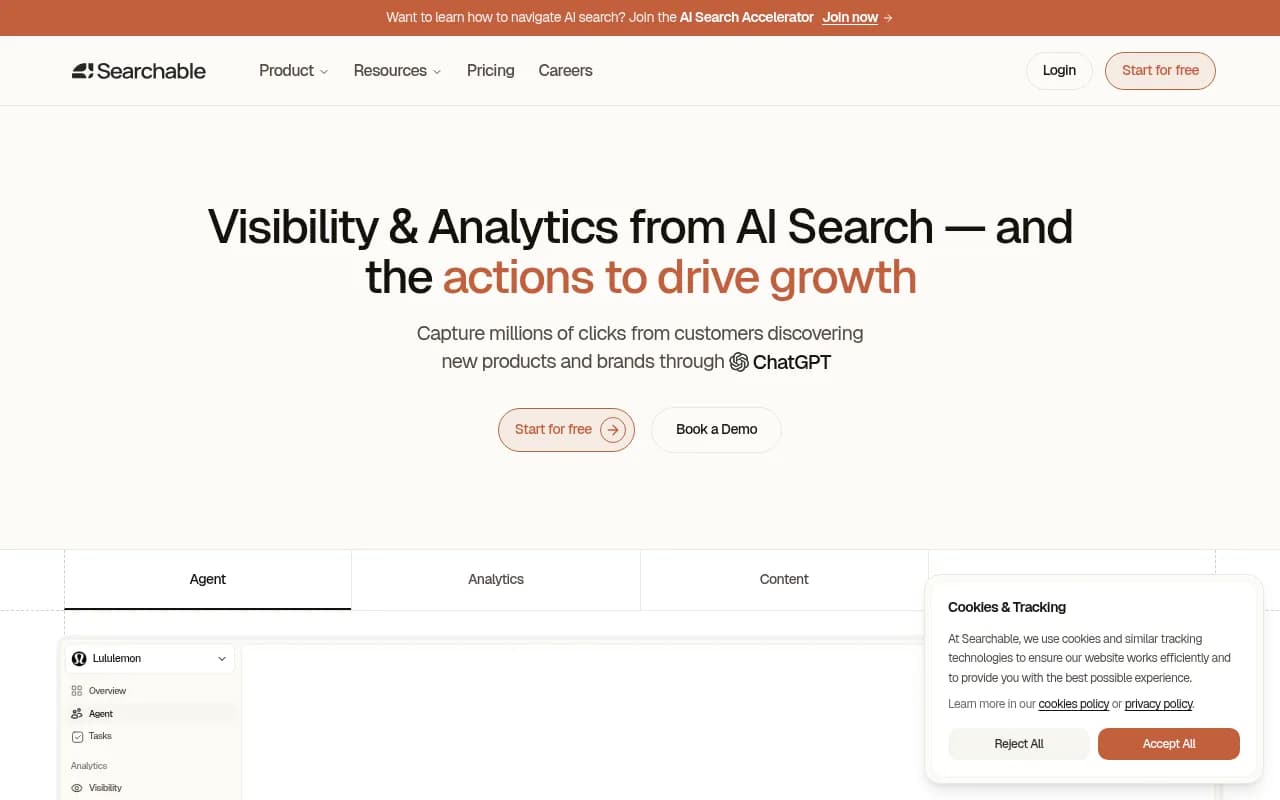
That pitch-to-client workflow genuinely helps new-business churn, which is the leakiest part of most agency pipelines. Where it falls short on the retention side specifically is sentiment analysis (which Searchable's own comparison pages admit it lacks) and any form of automated content remediation. It tells you what's wrong; you still have to staff the fix.
3. Peec AI
Peec AI is the strongest fit for agencies running multi-market or multi-language clients, since it was built with that use case in mind from day one. Agency tiers start at $245/month (Essential, 3 client projects) up to $795/month (Scale, 25 projects), all with unlimited seats, which matters if your account team rotates people across clients.

For churn purposes, the appeal is consistency: clients in regulated or multi-country markets (finance, travel) often churn agencies that can't speak to local nuance, and Peec AI's language coverage addresses that directly. It's thinner on content generation, so pair it with a writing workflow if you want to close the insight-to-action gap.
4. Profound
Profound is positioned for enterprise accounts and it shows in the pricing structure: a 7-day free trial, then straight to custom enterprise quotes with SSO, SAML, and SOC2. There's no public self-serve tier between those two extremes, which rules it out for agencies with a mixed roster of small and large clients.

Where Profound earns a spot on this list is depth: it tracks up to nine answer engines including Exa Search and Google AI Mode, which matters for enterprise clients who ask pointed questions about coverage breadth. If your churn risk concentrates in a handful of large accounts rather than a long tail of small ones, Profound's enterprise focus and credit-based AI agent pricing can be worth the custom-quote conversation.
5. AthenaHQ
AthenaHQ leans analytics-and-observability-first rather than action-first. Its self-serve plan runs $295/month after an initial promo month, and credit-based pricing scales with usage, which can get expensive fast on a large client roster.

It's a reasonable fit for agencies that already have a strong internal content team and just need better dashboards to hand clients, but on its own it does less to move the churn needle than tools with built-in remediation.
6. Otterly.AI
Otterly.AI is the budget option, starting at $29/month for 15 prompts, with a $189/month mid-tier for 100 prompts. It includes sentiment analysis, a gap in Searchable's own feature set, and markets itself around "marketing-friendly, executive-ready" dashboards, which is directly relevant to churn: a dashboard a client's CMO actually understands does more for a renewal than a feature-dense one that gets ignored.

The tradeoff is no content tooling at all, so it works best as the reporting layer in a stack where your agency handles the writing separately.
Comparison table
| Platform | Entry price (agency-relevant tier) | Domains/clients included | Content generation | Standout churn-relevant feature |
|---|---|---|---|---|
| Promptwatch | $199/mo (Agency Kick-off) | Unlimited projects/prompts | Yes, automated CMS publishing | Crawler logs explain why visibility moved |
| Searchable | $125/mo (Pro) | Unlimited domains | Yes, 20 articles/mo at Pro | Free pre-signature pitch workspace |
| Peec AI | $245/mo (Essential, agency) | 3 client projects | Limited | Strong multi-language/market coverage |
| Profound | Custom (Enterprise only) | Unlimited (enterprise) | Credit-based AI agents | 9 answer engines incl. AI Mode, Exa |
| AthenaHQ | $295/mo (Self-Serve) | Credit-based scaling | No | Deep observability dashboards |
| Otterly.AI | $29-$189/mo | 15-100 prompts | None | Built-in sentiment analysis |
How to actually use any of these to reduce churn
Buying the tool is the easy part. The agencies that see churn improve treat the platform as a scheduled ritual, not a one-off audit:
- Set a recurring monthly (or biweekly, for at-risk accounts) check-in where you walk the client through their visibility trend, not just a snapshot. A number going up over three months tells a better story than a single score.
- Tie the report to one concrete action per cycle, a new page published, a FAQ rewritten, a competitor gap closed. Swydo's agency benchmark data suggests retainer clients without mandatory quarterly reviews stay over twice as long as those with frequent reviews, so don't manufacture extra scrutiny you don't need, but do manufacture visible progress.
- Watch for the leading indicators independent of the tool itself: slower email replies from the client's side, a drop in meeting attendance from senior stakeholders, or a champion changing roles. Promptwatch Data's research on ChatGPT citation types over time shows how-to and documentation content nearly doubling in citation share through August 2026, which is a useful talking point if a client's content plan still leans entirely on product pages.
- Use the mid-authority opportunity. Promptwatch's citation share by domain rank data shows domains in the DR 46-75 range capturing close to half of all ChatGPT citations in August 2026, while the very top authority tier (DR 91-100) fell to around 3%. Most client sites sit in that competitive middle, which is good news you can bring to a renewal conversation instead of the usual "we need more domain authority" excuse.
If you're building out this kind of practice more broadly and want to see how other GEO and AI-visibility platforms stack up outside of this specific churn lens, the directory at bestgeosoftware.com is worth a look, and agenticseotools.com covers the newer category of tools that go further into automated execution, the same direction Promptwatch and a handful of competitors are pushing toward.
Bottom line
Searchable is a legitimate, fairly priced tool and its unlimited domains and pitch-workspace feature genuinely help with new-business churn. But for agencies whose biggest risk is an existing retainer client quietly drifting toward in-housing, the deciding factor is usually how fast a platform turns "here's a problem" into "here's what we did about it." That's where Promptwatch's crawler logs and automated content publishing put it ahead on this specific metric, with Peec AI a strong pick for multi-market rosters and Otterly.AI a sensible budget layer if you're handling content generation yourself.
Whichever platform you pick, the tool itself won't save a client relationship. It just gives your account team the early warning and the proof points to have the conversation before the client has already decided to leave.