Key takeaways
- Finseo built a dedicated Query Fan-Out Analysis feature specifically for Google AI Mode, pulling observed sub-queries from grounding metadata rather than guessing at them.
- Promptwatch tracks AI Mode as a distinct surface alongside AI Overviews and seven other models, and backs its GEO advice with first-party citation data, including a report showing google.com itself grabs over 7% of AI Mode citations.
- Finseo's pricing has changed structure three times in 2026 and currently caps you at 3 concurrent models below the Enterprise tier; Promptwatch publishes flat tiers where every model is included at every price point.
- Both tools can publish directly to Webflow, Framer, and WordPress, and Finseo adds native Shopify support, a real edge for ecommerce teams.
- If query fan-out mapping for AI Mode is your single priority, Finseo's tooling is more purpose-built; if you want crawler logs, conversion attribution, and Reddit/YouTube citation data layered on top, Promptwatch's stack goes further.
Why AI Mode changes the comparison
Most GEO tools treat Google AI Mode as a footnote next to ChatGPT. That's a mistake if AI Mode is actually where your buyers are searching. AI Mode doesn't just retrieve and summarize, it decomposes your one question into a handful of synthetic sub-queries, runs each one, and stitches the results into a single answer. If your page doesn't show up for the right sub-query, you're invisible for the whole exchange even if your main topic page is excellent.
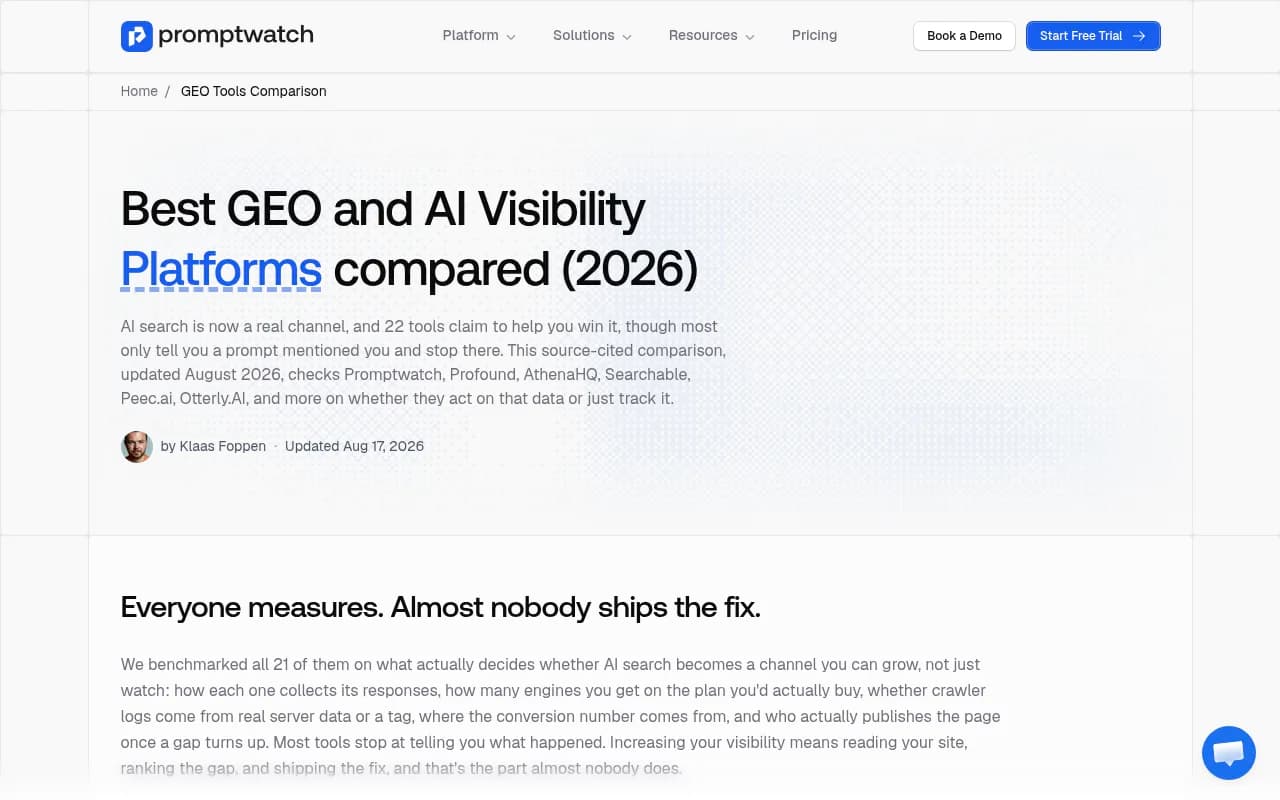
That behavior, query fan-out, is the reason this comparison exists. Finseo markets itself heavily around decoding it. Promptwatch tracks AI Mode too, but leans on a broader data set and an execution layer to close the gaps fan-out analysis uncovers. Picking between them really comes down to whether you want a scalpel or a full toolkit.
One data point worth sitting with before you pick either tool: in Promptwatch's June 2026 AI Mode citation share data, google.com's own properties accounted for 7.31% of AI Mode citations, more than YouTube and Reddit combined, and that share climbed 72% month over month. Below the top three domains, no independent website clears 1% of citation share. In plain terms, AI Mode rewards Google-owned surfaces (Maps, Business Profile, Merchant Center, YouTube) more than it rewards generic websites, and the open-web opportunity lives almost entirely in a long tail of narrow, single-question pages. That context should shape how you read everything below.
Finseo's AI Mode tooling, up close
Finseo's Query Fan-Out Analysis isn't a repackaged keyword tool. The company's own description of the mechanic is accurate: "Google AI Mode rewrites your one question into several synthetic searches, retrieves sources for each, then writes a single reply." Finseo's pitch is that it extracts the observed fan-out queries from grounding metadata rather than generating plausible-sounding guesses, and the company is upfront that the gap between a guess and a real observed sub-query is the whole point of the feature.
On its dedicated AI Mode tracker page, Finseo promises daily brand mention tracking, linked-URL-per-query reporting, share of voice against competitors, sentiment framing, and a feature it calls "query fan-out coverage," which maps which sub-queries surface your brand and which ones leave you out entirely. That's a genuinely useful lens if you're trying to figure out why a topic page ranks for the main query but gets skipped on three of the five sub-queries AI Mode generates around it.
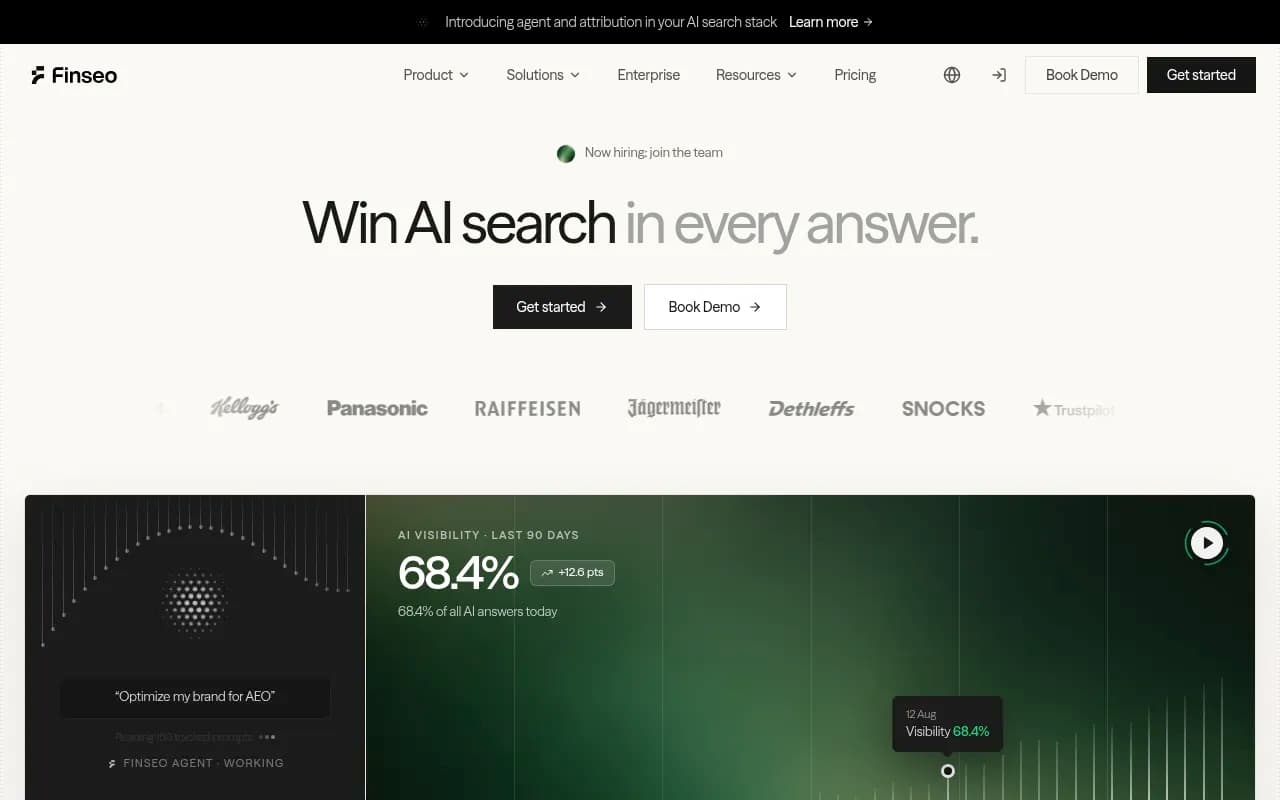
Finseo also ships an AI content agent with native integrations for four CMS platforms: Shopify (around a 60-second OAuth setup), WordPress, Webflow, and Framer. The agent edits product titles, meta descriptions, alt text, schema, and URL handles, but it's explicitly scoped away from themes, app settings, and customer data, and every edit requires inline approval plus an automatic backup. For ecommerce teams specifically, that Shopify connection is a real differentiator, since most GEO tools in this space skip Shopify entirely in favor of Webflow and WordPress.
Where Finseo's pricing gets messy
Here's where things get less tidy. Finseo's published tiers (Starter, Business, Growth, Enterprise) cap you at 3 concurrent AI models even though the platform supports tracking across 10+ engines, including regional ones like Naver, Qwen, Kimi, and Z.ai. You only unlock all of them simultaneously on the custom Enterprise plan. If AI Mode is your priority, you can usually get by on 3 concurrent models (AI Mode, AI Overviews, and ChatGPT), but it's a constraint worth knowing about before you commit.
More importantly, third-party pricing trackers have documented three different pricing structures for Finseo within 2026 alone, moving from an early $19/$49 scheme to a summer naming of Creator/Business/Enterprise, to the current Starter/Business/Growth/Enterprise lineup priced in euros (roughly €84, €210, and €479 per month respectively, per a November 2026 review on ecom-tools.de). That kind of churn makes it hard to budget a year out, and it's one reason Finseo's Enterprise tier is quoted on request rather than published.
Promptwatch's AI Mode tooling, up close
Promptwatch treats Google AI Mode as one of its tracked surfaces alongside AI Overviews, ChatGPT, Perplexity, Claude, Gemini, Meta Llama, DeepSeek, and Grok, scraping the real AI interfaces rather than relying on API simulations that can diverge from what users actually see. That distinction matters for AI Mode specifically, since its UI behavior, including the fan-out and the citation set it surfaces, doesn't always match what you'd get hitting an API directly.

On the fan-out side, Promptwatch's query fan-out data tracks how AI search engines decompose queries over time. One of the more actionable findings: average query length in ChatGPT's fan-out searches dropped from roughly 117 characters in December 2025 to about 53 characters by April 2026, less than half the original length. That's a real behavior shift, AI search is increasingly typing short keyword-style queries rather than full sentences, which means your headings and H2s should read like something a person would type into a search box, six to eight words, entity or category up front. Separately, Promptwatch's report on ChatGPT's use of the site: operator found that operator usage in fan-out queries jumped from roughly 0.4% to nearly 17% of all fanout queries overnight on August 8, 2026, with average queries per response nearly doubling. These aren't Finseo's numbers, they're ChatGPT fan-out specifically, but the underlying lesson, that engines are running more domain-scoped, keyword-style sub-queries than before, applies directly to how you should structure pages for AI Mode too.
Beyond fan-out, Promptwatch's differentiator is the rest of the stack: AI crawler logs (Agent Analytics) that show which pages ChatGPTBot, GoogleOther, PerplexityBot, and 400+ other crawlers actually read and whether they hit errors, native visitor analytics tying AI citations to real site traffic and conversions, and Content Agents that draft and publish fixes straight to Webflow, Framer, or WordPress on a schedule you control. Promptwatch's own 2026 comparison of 21 GEO platforms claims it's the only one of that group scoring full marks on six core capabilities, including real UI-based tracking, crawler logs, conversion attribution, content gap indexing, and automated publishing. Treat that claim as the vendor's own framing, but the underlying feature list (crawler logs plus attribution plus automated CMS publishing in one plan) is genuinely rare among AI visibility tools.
Side-by-side feature comparison
| Feature | Finseo | Promptwatch |
|---|---|---|
| Dedicated AI Mode query fan-out mapping | Yes, core feature with grounding-metadata extraction | Tracked as part of broader fan-out and citation reporting |
| Models tracked concurrently (non-enterprise) | 3 | All tracked models included at every tier |
| Models available total | 10+ including regional engines (Naver, Qwen, Kimi, etc.) | ChatGPT, Gemini, AI Overviews, AI Mode, Perplexity, Claude, Meta Llama, DeepSeek, Grok, Mistral, Copilot |
| AI crawler log analytics | Not part of published feature set | Yes, Agent Analytics tracks 400+ crawlers including page-level citation rate |
| Native CMS publishing | Shopify, WordPress, Webflow, Framer | Webflow, Framer, WordPress |
| Conversion/traffic attribution | Attribution feature on Business tier and above | Native visitor analytics on all paid tiers |
| Reddit and YouTube citation tracking | Not advertised as a distinct feature | Dedicated reports for both channels |
| Pricing transparency | Published but restructured 3 times in 2026 | Stable published tiers since launch |
| Entry price (lowest paid tier) | ~$84-95/mo equivalent (Starter) | $95/mo (Essential) |
| MCP server support | Yes, for Claude, ChatGPT, Cursor | Yes, works with ChatGPT, Claude, Cursor |
| G2 rating | 5.0 stars (3 reviews) | 4.7/5 (17 reviews) |
Which one fits your team
If your team's entire job is making sense of Google AI Mode specifically, nothing else, Finseo's fan-out coverage feature is purpose-built for that question and its Shopify integration is a genuine plus if you run an ecommerce storefront. The tradeoff is a thinner reviewer base, pricing that's moved around enough to make annual budgeting awkward, and a feature set that stops short of crawler-level diagnostics or cross-channel attribution.
If you need AI Mode visibility as one piece of a larger AI search strategy that spans ChatGPT, Perplexity, Claude, and Gemini, and you want to know not just which sub-queries you're missing but why (crawler errors, content gaps, missing schema) and what to do about it, Promptwatch's broader stack does more of the work for you. The Content Agents that publish directly to your CMS and the crawler log data in particular close a loop that fan-out mapping alone doesn't.
For teams still shopping around, it's worth scanning the broader category before locking in. The GEO software directory at bestgeosoftware.com lists dozens of platforms by feature set, and surferstack.com covers the content optimization side if your gap is really about on-page execution rather than tracking.
A quick gut check before you buy either
A few questions worth answering honestly before signing a contract with either vendor:
- Do you actually need 10+ model coverage, or is AI Mode plus two others (say ChatGPT and AI Overviews) enough for the next year?
- Is your team equipped to act on fan-out data manually, or do you need a tool that drafts and ships the fix for you?
- Does your stack run on Shopify? If so, Finseo's native OAuth integration shaves real setup time off the content workflow.
- How much do you care about knowing why a page isn't getting crawled, versus just knowing it isn't cited? Crawler log access is the difference between those two answers.
Neither tool is wrong for AI Mode work specifically. They're just built around different bets: Finseo bets that fan-out mapping is the hard part, Promptwatch bets that mapping is only step one and the execution layer after it is what actually moves visibility.