Finseo Review 2026
Monitors brand mentions, rankings and search integration specifically within Google's AI Mode and AI Overviews.
Key takeaways
- Finseo tracks brand visibility, citations, sentiment and competitor share of voice across nine-plus AI models (ChatGPT, Claude, Gemini, Perplexity, Copilot, Grok, DeepSeek, Mistral, Google AI Mode/Overviews), with regional engines like Qwen, Meta AI and Naver AI Briefing available as add-ons.
- It's largely a monitoring and reporting tool with some content generation bolted on. It lacks the depth of Promptwatch's AI crawler logs, visitor analytics, and automated CMS publishing workflow, so you get the "what" of your AI visibility more than the "why" and the fix.
- Independent reviewers (ecom-tools.de) flag that the most useful parts, tasks, attribution, and crawlability checks, only unlock on the €210/month Business plan, and that automatically generated task suggestions are inconsistent in quality.
- Strong footprint in the German-speaking market with named enterprise customers (Kellogg's, Lidl, Panasonic, Würth, Raiffeisen), EU-hosted data in Frankfurt, and a bootstrapped, profitable company behind it rather than a VC-funded one.
- Best suited for mid-market and enterprise brands, plus agencies, that want a straightforward dashboard for AI visibility reporting without needing the deeper agentic optimization layer.
Finseo is a German-built AI visibility platform from Finseo GmbH, founded in 2025 by David Mühlenweg and Maurice Marinelli, out of Gaildorf, Baden-Württemberg. The pitch is simple: your customers, job applicants, and even journalists are now asking ChatGPT and Gemini questions about your brand before they ever touch Google, and Finseo wants to tell you what those AI systems are saying, who's winning the mentions, and where the citations come from.
The company is bootstrapped and profitable, according to its own site, which is a genuinely unusual claim in a category otherwise stuffed with venture-backed GEO startups. It had a rocky start, originally launching under a different brand name via an AppSumo lifetime deal in mid-2025 before rebranding to Finseo shortly after, a move that drew a pointed complaint from at least one early AppSumo reviewer who felt abandoned mid-deal. Since then the product has matured. The company now counts Kellogg's, Lidl, Panasonic, Würth and Raiffeisen among its logo wall, and its changelog shows active, fairly technical development through 2026, including a September 2026 overhaul of its core visibility metric to count both named mentions and citations rather than text mentions alone.
The target audience leans toward brand marketing teams, in-house SEO teams, and digital agencies managing client reporting, with a visible tilt toward the DACH region. The interface, notably, is English-only despite the European customer base, which is an odd gap for a tool so clearly rooted in the German market.
Key features
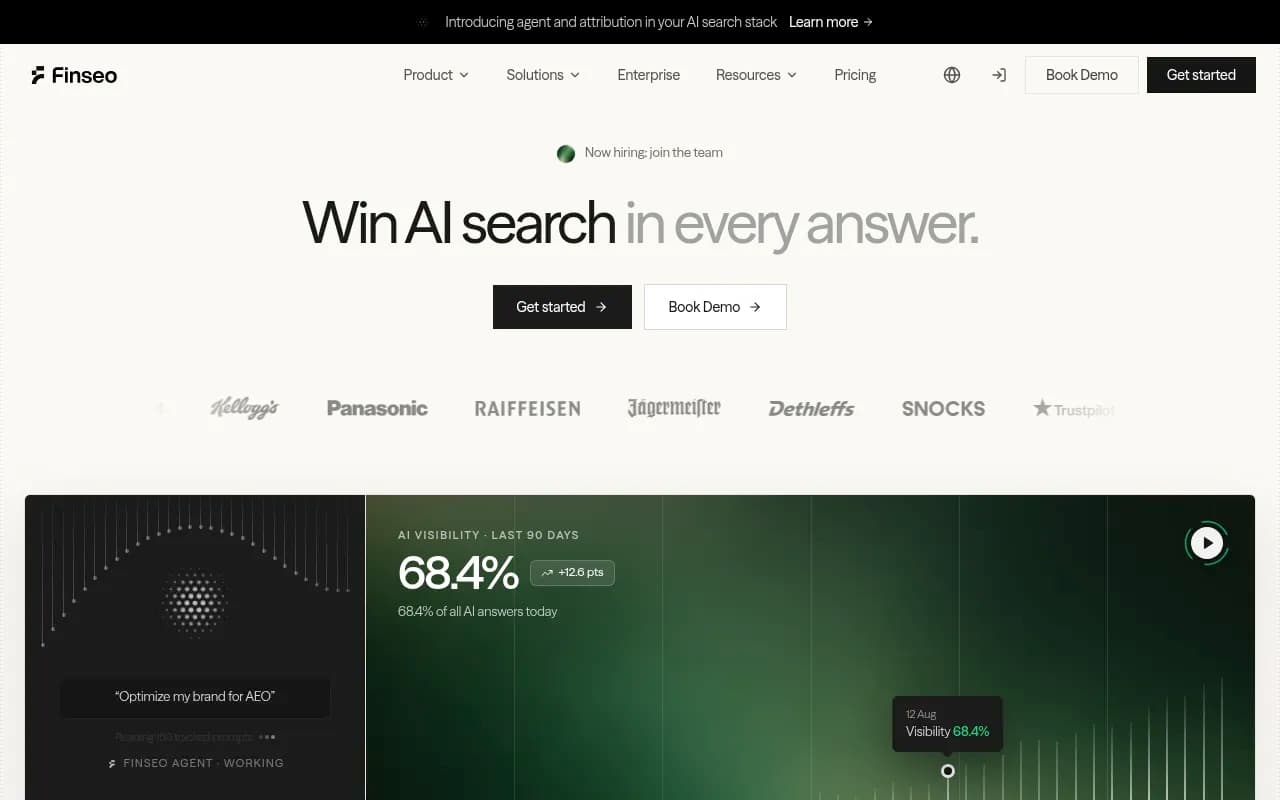
- AI visibility tracking: Finseo sends daily prompts to the AI models you've selected (three concurrently on Starter and Business, up to eleven on Enterprise) and extracts whether your brand is named, cited, or recommended, along with sentiment. It reports this as a single visibility percentage with trend lines over 90 days, plus country-level breakdowns, since the same prompt can return a different answer in Germany versus the US.
- Competitor rankings and source analysis: A competitor table shows each rival's top citation source (Reddit, G2, Wikipedia, Trustpilot, etc.), total citation count, and share of voice. This is useful for spotting that, say, your category is dominated by review sites rather than your own product pages, something you can't see from generic rank tracking.
- Product and pricing extraction: For e-commerce and retail brands, Finseo pulls out which specific products AI models recommend, at what price point, and from which retailer. This is a genuinely distinctive feature versus most GEO monitoring tools, which tend to stop at domain-level citations.
- Finseo Agent: An in-app AI agent (credit-metered, starting at 300 trial credits on Starter) that you can prompt to "optimize my brand for AEO" and it works through tracked prompts, connected integrations like Google Search Console and Google Analytics, and surfaces recommendations. It's closer to a chat assistant layered over your data than a fully autonomous content pipeline.
- AEO content generation: Finseo can generate articles informed by "expert" source data (500 credits per article), with a kanban-style pipeline showing drafts, generating, in review, and published states. It integrates with Notion, Google Drive, Slack, Gmail and similar workspace tools for collaboration, though it stops short of direct CMS publishing seen in more automated competitors.
- Crawlability and bot traffic analysis: Site crawls flag technical issues specific to AI crawlers, and bot traffic analytics (fed by Cloudflare, Fastly, Akamai, Vercel, AWS CloudFront, Raidboxes) show how often AI bots actually visit your pages. This is gated to Business plan and above.
- Report Builder: One-click, white-label PDF/dashboard reports built around AI visibility, competitors, sources and action items, aimed squarely at agencies that need to hand clients something polished every month.
- Query fan-out analysis: Shows how a single prompt decomposes into the sub-queries an AI model actually runs, which is a feature increasingly table stakes in this category but still genuinely helpful for understanding why you're missing from an answer.
- API and MCP server: A REST API and MCP server expose fan-out queries and top cited sources programmatically, which is a nice touch for teams wanting to pipe Finseo data into their own BI stack rather than live inside the dashboard.
Who is it for
Finseo makes the most sense for mid-market and enterprise brand marketing teams, 5 to 50 person in-house teams at companies like the ones in its case studies (HolzLand, Laserhub, Plantura), who want a dashboard that tells leadership "here's our AI visibility this quarter" without needing a data scientist to build it. It also fits digital agencies running GEO reporting for several clients, since the Report Builder and multi-project support on Growth and Enterprise plans are clearly built with that workflow in mind.
The product has a particular pull for companies operating in German-speaking markets. One independent reviewer called it "the most thorough measuring tool for AI answers in the German-speaking market," and the country-level tracking, EU data residency in Frankfurt, and GDPR-native positioning back that up. If your buyers are mostly in DACH and you need to show a works council or EU-based legal team that your vendor keeps data in-region, that matters more than it sounds.
Who should skip it: teams that want a tool to actually do the optimization work, not just report on it, will find Finseo's agent and content tools comparatively thin. Teams on a tight budget should also know that the most actionable modules (tasks, attribution, crawlability) don't appear until the €210/month Business tier, so the entry-level Starter plan is really just a visibility dashboard.
Integrations and ecosystem
Finseo lists over 200 integrations spanning analytics (Google Analytics, Google Search Console, Bing Webmaster, Looker Studio), CMS and e-commerce (Shopify, WordPress, Webflow, Framer, Shopware, WooCommerce), bot traffic sources (Cloudflare, Fastly, Akamai, Vercel, AWS CloudFront, Raidboxes), project management (ClickUp, Asana, Linear, Jira, Monday.com, Trello, Notion) and CRM/attribution tools (HubSpot, Salesforce, Pipedrive, Attio, Stripe, Zapier, Make, n8n, Intercom, Calendly). In practice, G2's small review pool only mentions Google Analytics directly, suggesting real-world adoption of the long tail of integrations is still thin.
There's a public REST API and an MCP server for programmatic access, both gated by plan tier, plus invoice billing, purchase-order workflows and a German AVV (data processing agreement) available across all plans, a detail that matters to EU enterprise procurement teams more than most GEO buyers realize.
Pricing and value
Finseo runs two separate pricing tracks. For brands: Starter at €84/month (€70 billed yearly) with 50 tracked prompts, about 4,500 AI answers per month, one project, and a 7-day free trial; Business at €210/month (€175 yearly) with 150 prompts and roughly 13,500 answers, adding tasks, attribution, bot analytics and crawlability checks; Growth at €479/month (€399 yearly) with 350 prompts, about 31,500 answers, and five projects; and Enterprise/Managed Service, quoted individually, which can include Finseo's own team running prompt strategy and content production for you.
For agencies: Solo at €349/month covers five client projects (about 220 prompts) and 20,000 AI answers; Studio at €599/month covers ten projects and 40,000 answers; Custom scales further with volume discounts on additional projects. Every plan includes unlimited team seats and daily tracking updates, which is a genuinely generous baseline compared to competitors that meter seats.
There's no permanent free plan, just the 7-day Starter trial, so this isn't a tool you can run indefinitely at zero cost the way Promptwatch's Explore tier allows. One independent review scored value for money at 3.5 out of 5, specifically because the modules that make the tool actionable sit behind the Business tier rather than Starter. At €84 a month, Starter is really a "see your score" product; you need to spend at least €210 a month before Finseo starts telling you what to do about it.
Strengths and limitations
Finseo does several things well. Its product and pricing extraction for e-commerce brands is a genuinely distinctive capability most monitoring tools don't bother with. Country-level tracking and EU data residency give it real credibility with European enterprise buyers. The Report Builder is clearly built by people who've had to produce client reports under deadline, and unlimited seats on every plan is a fair deal compared to per-seat competitors.
But measured against a full GEO optimization platform like Promptwatch, the gaps are real. Finseo has no equivalent to Promptwatch's AI crawler logs showing exactly when ChatGPTBot, ClaudeBot or PerplexityBot hit specific pages and what errors they encountered, there's no visitor analytics tying AI referral traffic to actual conversions, and there's no dedicated Reddit or YouTube citation reporting. Its content generation tool produces drafts for review rather than publishing directly to a CMS on a schedule, and there's no Agent Chat equivalent for conversational analysis across prompts, citations and competitors in one interface. ChatGPT Shopping and Ads Radar style tracking, Promptwatch's view into sponsored placements inside AI answers, also doesn't appear in Finseo's feature set.
Independent reviews back up some of the softer complaints too: inconsistent quality in auto-generated task suggestions, an English-only interface despite a German customer base, and a small, not-fully-independently-verified review base (3 reviews on G2, 15 on OMR) relative to how long the company has been operating. An early AppSumo reviewer also reported real product bugs around the SEO audit crawling the wrong pages and a broken article-writer flow, though that predates the 2025 rebrand and the product has visibly matured since.
Bottom line
Finseo is a solid, EU-hosted AI visibility dashboard for brands and agencies that mainly want to measure and report on how they show up across ChatGPT, Gemini, Perplexity and friends, especially if you're operating in German-speaking markets and need GDPR-grade data residency. For teams that want the measurement to turn into actual optimization, automated content publishing, crawler-level diagnostics, and traffic attribution, Promptwatch covers that ground more completely and is worth evaluating alongside it.
Frequently asked questions
What is Finseo used for?
How much does Finseo cost?
Does Finseo have a free plan?
Is Finseo only for German-speaking markets?
How does Finseo compare to Promptwatch?
Which AI models does Finseo track?
Similar and alternative tools to Finseo