Citate.ai Review 2026
Tracks how often and where AI engines cite a brand, positioned as a lightweight GEO monitoring tool.
Key takeaways
- Citate.ai leans hard on scientific credibility: a patented "Iterative Representative Sampling" method that collects up to 100x more AI answers per prompt than typical trackers, built with Harvard and Stanford AI faculty on the team.
- It lacks the crawler logs, traffic attribution, Reddit/YouTube tracking, and ChatGPT Shopping monitoring that Promptwatch offers, and it has no self-serve pricing page, no G2 reviews, and an onboarding process gated behind manual approval.
- The tool is genuinely strong on the analysis side: sentiment, bias detection across dozens of categories, and a custom trusted/distrusted source database for fact-checking AI answers against your own criteria.
- Pricing is entirely sales-led with no public numbers, and the free trial requires handing over your own ChatGPT API key, an unusual ask most competitors don't make.
- Best suited for enterprises, PR/reputation teams, and legal or political clients who need defensible, statistically rigorous AI-citation data rather than a quick dashboard.
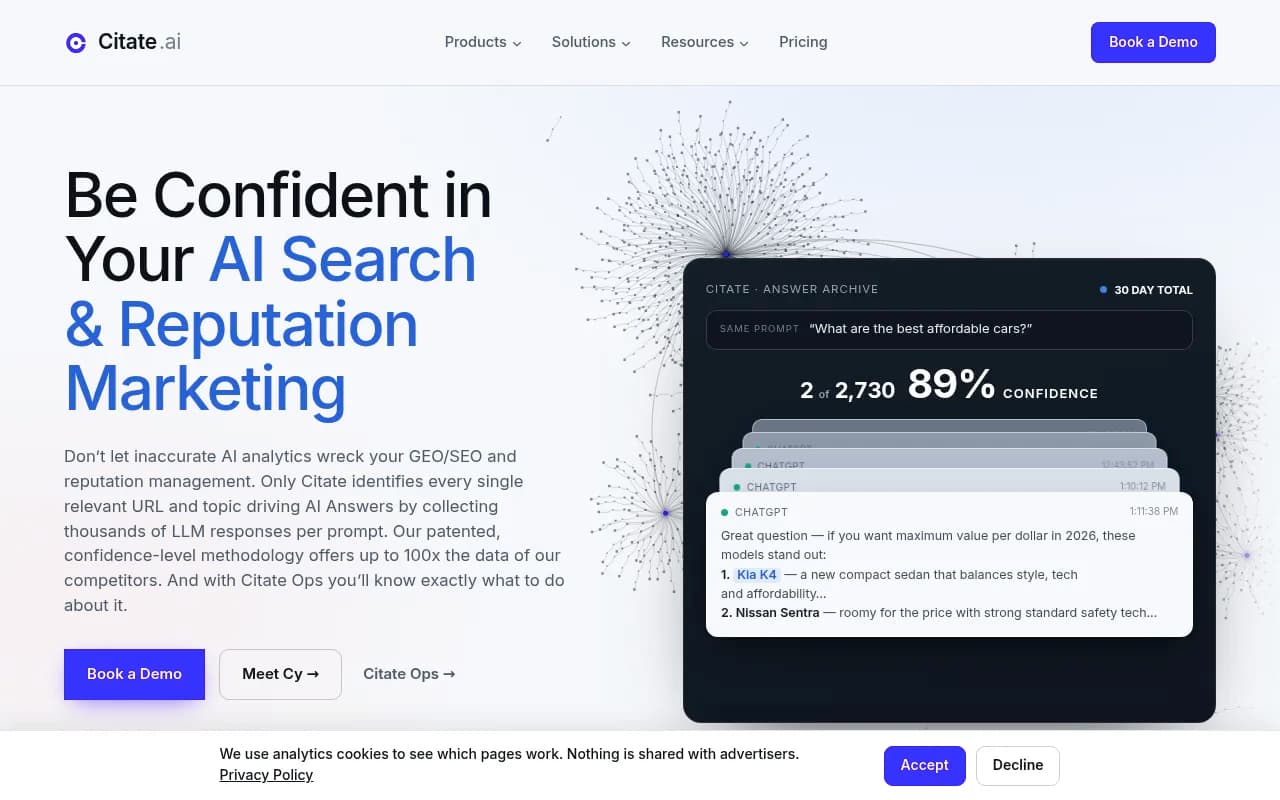
Citate.ai is a GEO measurement platform built by a small team with an odd but interesting pedigree: a former FastCompany.com president, a Harvard Medical School AI professor, a Stanford AI scientist, and an ex-Allen Institute engineer. The pitch is that most AI-visibility tools under-sample. Because large language models are probabilistic rather than deterministic, two identical prompts can return meaningfully different answers, and a tool that checks a prompt once a day is capturing noise, not signal. Citate's answer is to collect thousands of responses per prompt per month and display a confidence score for every result, a methodology it has patented under the name "Iterative Representative Sampling."
The company, legally CBI.ai doing business as Citate.ai, says it has been doing GEO work since 2023 and productized its internal tooling into a client-facing platform more recently. It sits in an unusual spot in the market: heavier on reputation management, bias detection, and factual-accuracy checking than on the keyword-style visibility tracking most competitors ship first. That makes it feel less like a marketing dashboard and more like a research instrument that happens to output marketing insights.
Who actually buys this? Based on the professional-services page, clients include public and private companies, VCs, law firms, and high-profile individuals, people who care as much about what AI says about them as how often it cites them. It is not positioned, at least publicly, as a tool an in-house SEO manager signs up for on a Tuesday afternoon.
Key features
- Iterative Representative Sampling. The core differentiator. Citate collects a very large number of answers per prompt (the site claims up to 100x more than typical competitors) and reports a statistical confidence level alongside every metric. This matters because most citation trackers sample a handful of responses per day and treat the result as ground truth, when LLM output actually varies response to response.
- Cy, the GEO agent. A conversational agent that goes beyond raw stats to produce narrative reports with charts, aimed explicitly at CMOs who want context rather than a number. Two named sub-capabilities live under Cy: Crisis Radar, which continuously watches major LLMs for reputational dips or spikes, and Trend Hunter, which looks for patterns across tens of thousands of collected answers, like a sudden shift in which product feature dominates responses.
- Competitive benchmarking. Tracks brand versus competitor visibility across Google AI Overviews, ChatGPT, Gemini, Meta AI and others, with both daily breakdowns and longer-term trend views.
- Sentiment analysis. Runs at two levels: aggregate sentiment across thousands of responses for a topic, and line-by-line sentiment scoring for individual answers, useful if you need to show a client exactly which sentence tanked the score.
- Bias detection. Surfaces political, confirmation, and stereotyping bias (among other categories) across collected answers, with both aggregate trend tracking and per-answer AI analysis. This is a feature I haven't seen packaged this explicitly anywhere else in the GEO space.
- Inaccuracy detection. You build a custom database of sources you trust or distrust, and Citate continuously checks factual claims in AI answers against that list, flagging conflicts and confirmations over time. It's a clever way to operationalize "is the AI lying about us" instead of just eyeballing transcripts.
- Ranked Topics and Ranked Links. Semantically ranks the topics an LLM cares about most for a given prompt set, which feeds content-brief generation and surfaces content gaps. Ranked Links does the same for source domains and social threads actually being cited, so you can see which competitor URLs or Reddit threads the model leans on.
- Citate Ops. A newer addition (launched around September 2026) that moves from measurement into action: it finds content gaps and generates or refreshes AI-optimized pages, with messaging around avoiding Google's scaled-content penalties through "surgical" patch-only rewrites and paced publishing rather than mass content dumps.
- Complete Answer Archive. Every collected answer, in full text, searchable and annotated with in-answer tools, which is genuinely useful when you need to show a stakeholder the actual sentence an AI model wrote rather than a summarized metric.
Who is it for
Citate.ai is built for enterprise brand and communications teams, CMOs at mid-to-large companies, and firms that live and die by reputation: law firms, VCs, and high-profile individuals who need to know exactly what ChatGPT or Google AI Overviews is saying about them and why. The professional-services arm explicitly serves this crowd, and the product's bias-detection and inaccuracy-detection tools make more sense for a reputation-management use case than for a typical SaaS marketer tracking keyword rankings.
A PR agency managing crisis communications for a public company, or a law firm worried about defamatory AI-generated summaries, is a much better fit here than a five-person startup trying to get more organic traffic from AI search. The sales-gated pricing, manual onboarding approval, and consulting-heavy positioning all point toward six-figure enterprise engagements rather than self-serve subscriptions.
Who should skip it: solo marketers, small agencies, and anyone who wants transparent, instant, self-serve pricing. If you just need to know whether ChatGPT mentions your product and want to sign up with a credit card in five minutes, Citate's approval-gated login and "contact us" pricing will be a frustrating detour.
Integrations and ecosystem
Citate doesn't publish a long integrations list. The platform runs through its own web app (hosted separately from the marketing site), and campaigns, prompt sets tied to a brand or topic, are built manually or through an AI "Campaign Wizard," then grouped into folders for aggregate reporting. There's no public API documentation, no listed Slack, Zapier, or CMS integrations, and no browser extension or mobile app mentioned anywhere in the available material. The company does cross-sell WhiteHatWiki.com, a sister company for Wikipedia-specific citation and authority building, since Wikipedia shows up repeatedly as one of the sources LLMs trust most.
Pricing and value
There is no public pricing page; https://citate.ai/pricing/ returns a 404. Every plan is sold through a contact form, and the Terms of Service state plainly that Citate "reserves the right to amend and change any subscription plan and/or adjust the pricing... in any manner," which is about as vague as pricing language gets. Both monthly and annual billing exist per the terms.
A free trial is available, but it comes with an unusual condition: you have to supply your own ChatGPT API key, and the trial can be cancelled with seven days' notice. That's meaningfully different from how most GEO competitors run trials, and it adds setup friction and potential API cost exposure before you've even seen whether the platform is worth paying for.
For context, self-serve GEO tools in this space start around $29 to $95 a month, while enterprise-only players like Profound and Brandlight run sales-gated pricing up into five figures monthly. Citate sits firmly in that upper, opaque tier. Whether it's good value is impossible to say without a quote, but the lack of any published number, combined with almost no independent review coverage on G2 or Capterra, makes it hard to benchmark against competitors before a sales call.
Strengths and limitations
What Citate does well: the sampling methodology is a legitimate differentiator if you care about statistical rigor over quick dashboards, and the bias-detection and inaccuracy-detection tools are more thorough than anything comparable I've seen from other GEO vendors. The Complete Answer Archive and Ranked Links features give genuinely granular visibility into why a model cites what it cites.
Where it falls short compared to Promptwatch: Citate has no AI crawler logs, so there's no way to see when ChatGPTBot or PerplexityBot actually visits your pages or hits errors, a capability Promptwatch built around its Agent Analytics feature. It also has no visitor analytics or AI-traffic attribution, meaning you can't tie citations to actual site traffic or conversions. There's no dedicated Reddit or YouTube citation reporting, no ChatGPT Shopping or Ads Radar tracking, and no prompt-level volume or difficulty scoring or query fan-out analysis. Citate Ops is a step toward automated content generation, but it lacks the CMS publishing (Webflow, Framer, WordPress), Agent Chat, and Unified Actions workflow that turn Promptwatch's insights into scheduled, prioritized work automatically.

Other honest gaps: no transparent pricing, no self-serve signup, no public API, and a data-use clause in the Terms of Service that grants Citate a broad, perpetual license to use client input and output for training its models, worth flagging to any legal or enterprise buyer before signing.
Bottom line
Citate.ai is a credible, methodology-heavy tool for enterprises and reputation-sensitive clients who want rigorous, statistically defensible AI-citation data and don't mind a sales-led buying process. If your priority is turning visibility data into actual optimization work, automated content publishing, crawler-level diagnostics, and traffic attribution, Promptwatch covers that ground and Citate currently doesn't.
Tags:
Frequently asked questions
What is Citate.ai?
How much does Citate.ai cost?
Who is Citate.ai best for?
Does Citate.ai generate content, or just track citations?
How does Citate.ai compare to Promptwatch?
Is there a free trial for Citate.ai?
Similar and alternative tools to Citate.ai