Key takeaways
- Finseo is a capable tracker but caps entry plans at 100 prompts on one tracked website and leans on demo-gated pricing for its higher tiers, which slows down agencies trying to scope multiple client accounts quickly
- Google AI Overviews and Google AI Mode behave like separate surfaces with different citation volumes, so agencies need tools that track them independently rather than blending them into one score
- White-label depth varies a lot between tools. Some give you a branded PDF, others give you a fully custom-domain dashboard your clients log into directly
- Rank Prompt, Ayzeo, LLM Pulse and Peec AI all have agency-specific tiers worth comparing against Finseo on price-per-prompt and white-label depth
- Promptwatch adds a layer most trackers skip: it doesn't just show where a client's brand is invisible, its Content Agents and Unified Actions help you fix it, which matters when you're selling GEO retainers and need to show action, not just a dashboard
Why agencies are shopping around for Finseo alternatives
If you run an agency with a dozen or more clients on AI visibility retainers, you've probably hit the same three walls with Finseo. The pricing above the Starter tier is demo-gated, meaning you can't quickly model your margin before a sales call. The entry plan tracks 50 prompts on one project, which gets tight fast once you have three or four client accounts that each need their own prompt set. And the AI surface coverage, while broad on paper, concentrates a lot of its differentiated features (Attribution, Tasks, Agent) in the Business tier and above.
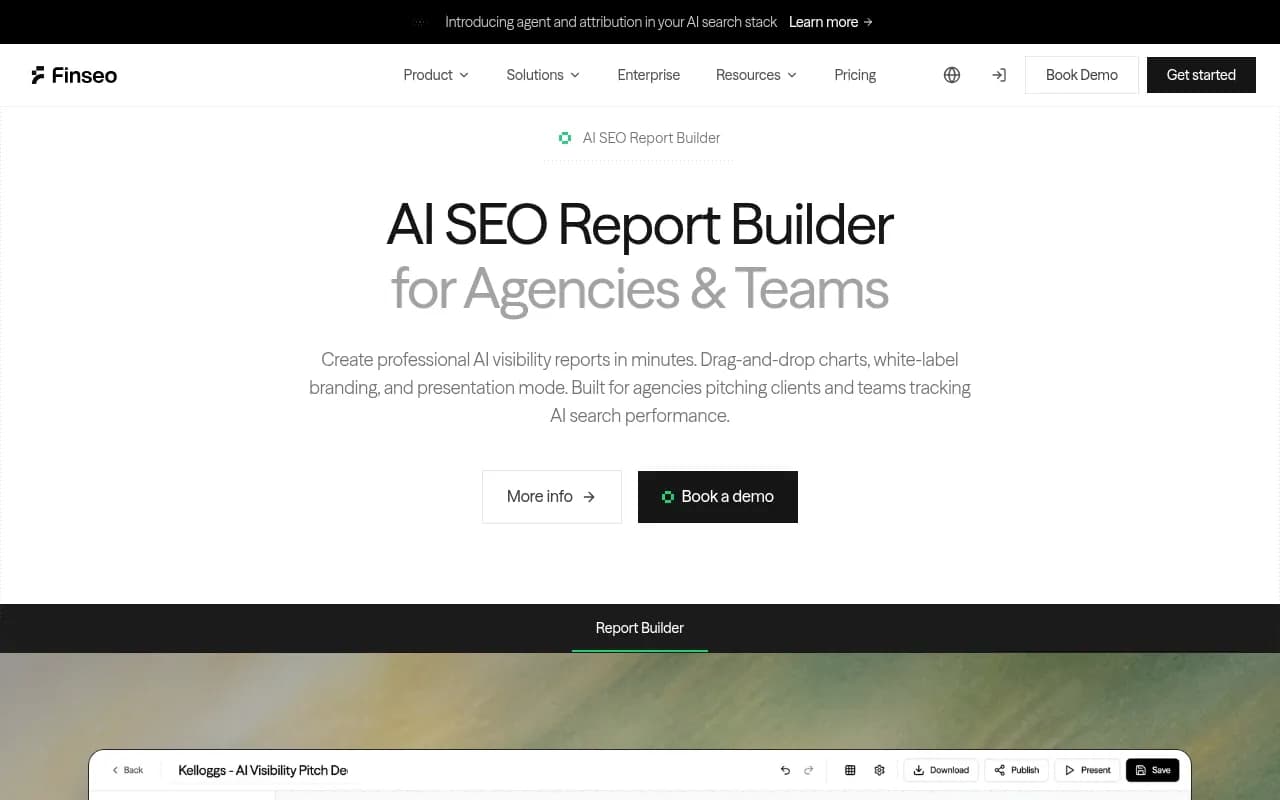
None of this makes Finseo a bad product. It has real customers (Kellogg's, Raiffeisen, Dethleffs are on its logo wall) and a report builder that looks genuinely useful for client pitch decks, with drag-and-drop charts and presentation mode built specifically for agencies closing new business. But "good for pitching" and "good for running fifteen client accounts profitably" are two different jobs, and a lot of agencies end up needing a second tool, or a full switch, to make the math work.
Why AI Mode and AI Overviews need separate tracking, not one blended score
This is the part a lot of buyers miss when shopping for an agency tool: Google AI Mode and Google AI Overviews are not the same surface, and they don't behave the same way. Promptwatch's data on sources per response shows AI Overviews typically cites around 10 sources per answer and has stayed fairly steady over time, while ChatGPT cites roughly 5, making ChatGPT's citation slots far more contested (https://promptwatch.com/data/average-sources-per-response). That gap alone means a client who's invisible in ChatGPT might already be winning in AI Overviews, and a tool that averages the two into a single "visibility score" will hide that from you.
It gets messier. After the GPT-5.3 rollout on March 4, 2026, average citations per ChatGPT response dropped by roughly 27%, from about 6.4 sources per response down to 4.7-4.9, and it never recovered a month later (https://promptwatch.com/data/chatgpt-citation-drop). That drop hit every model variant simultaneously, which is the tell that it was a platform change, not a content problem on any one client's site. If you're running client reports off weekly or monthly snapshots instead of continuous daily tracking, you will misattribute that kind of platform-wide shift to a client's content team, and that's an uncomfortable call to make.
There's also good news buried in this data for agency pitches. In August 2026, mid-authority domains (DR 46-75) earned almost half of all ChatGPT Search citations, while the very top tier (DR 91-100) actually shrank from about 7% to 3% over the course of the month (https://promptwatch.com/data/chatgpt-citation-share-by-domain-rank-august-2026). That's a genuinely useful line in a pitch deck: you don't need a DR 90 site to win AI citations, a focused DR 50 site with the right content can compete. Mid-market clients love hearing that.
What to actually look for in an agency-grade tool
Before comparing specific platforms, it helps to nail down what "agency-ready" means beyond just a logo swap:
- White-label depth: is it a branded PDF export, a branded Looker Studio dashboard, or a fully custom-domain live dashboard your clients log into
- Per-client project limits and whether adding a client means buying a new tier or just a cheap add-on
- Model/surface coverage split by engine, not blended, so you can show a client exactly where AI Mode differs from AI Overviews or ChatGPT
- Seat limits, since agencies often need account managers, strategists, and the client themselves all in the same workspace
- A path from "here's your visibility gap" to actual content work, whether that's a brief, a draft, or a published page
Finseo vs the best 2026 alternatives for agencies
| Tool | Entry price (agency-relevant tier) | White-label depth | Surface coverage | Agency-specific features |
|---|---|---|---|---|
| Finseo | Starter 84/mo; Business 210/mo | Report builder with branding, demo-gated higher tiers | ChatGPT, Gemini, AI Overviews, AI Mode, Claude, Perplexity, Copilot, Grok, DeepSeek, Mistral | Multi-client workspaces, Attribution, Tasks, Bot analytics |
| Rank Prompt | Agency 149/mo, Agency Plus 299/mo | Branded reports, client portal on Plus | ChatGPT, Gemini, Perplexity, Grok, Claude, AI Overviews | Prospecting tool to audit prospects pre-pitch, up to 1,000 brands |
| Ayzeo | Pro 149/mo + add-ons | Branded PDFs standard, full dashboard white-label at 299/mo | ChatGPT + AI Overviews included, Claude/Perplexity/Gemini/Grok as paid add-ons | Unlimited seats on every paid plan, published margin math for agencies |
| Peec AI | Agency Essential 245/mo up to Scale 795/mo | Branded Looker dashboards on agency plans | 6 selectable models per plan | Pitch workspaces, up to 25 projects on top tier |
| LLM Pulse | Roughly 50-60/mo entry | Full: custom domain, complete brand removal | ChatGPT, Perplexity, Gemini, AI Mode, AI Overviews base; others as add-ons | Looker Studio template, MCP, REST API, unlimited seats |
| Promptwatch | Professional 245/mo (2 sites) | Custom reports, white-label dashboard and client portal | ChatGPT, Gemini, Claude, Perplexity, Grok, DeepSeek, Mistral, Copilot, AI Overviews, AI Mode | Crawler logs, Content Agents with CMS publishing, Agent Chat, Unified Actions |
Pricing figures for Peec AI and LLM Pulse vary noticeably between secondary sources (euros vs dollars, different entry tiers quoted), so verify the current number on the vendor's pricing page before you build a client proposal around it.
Finseo
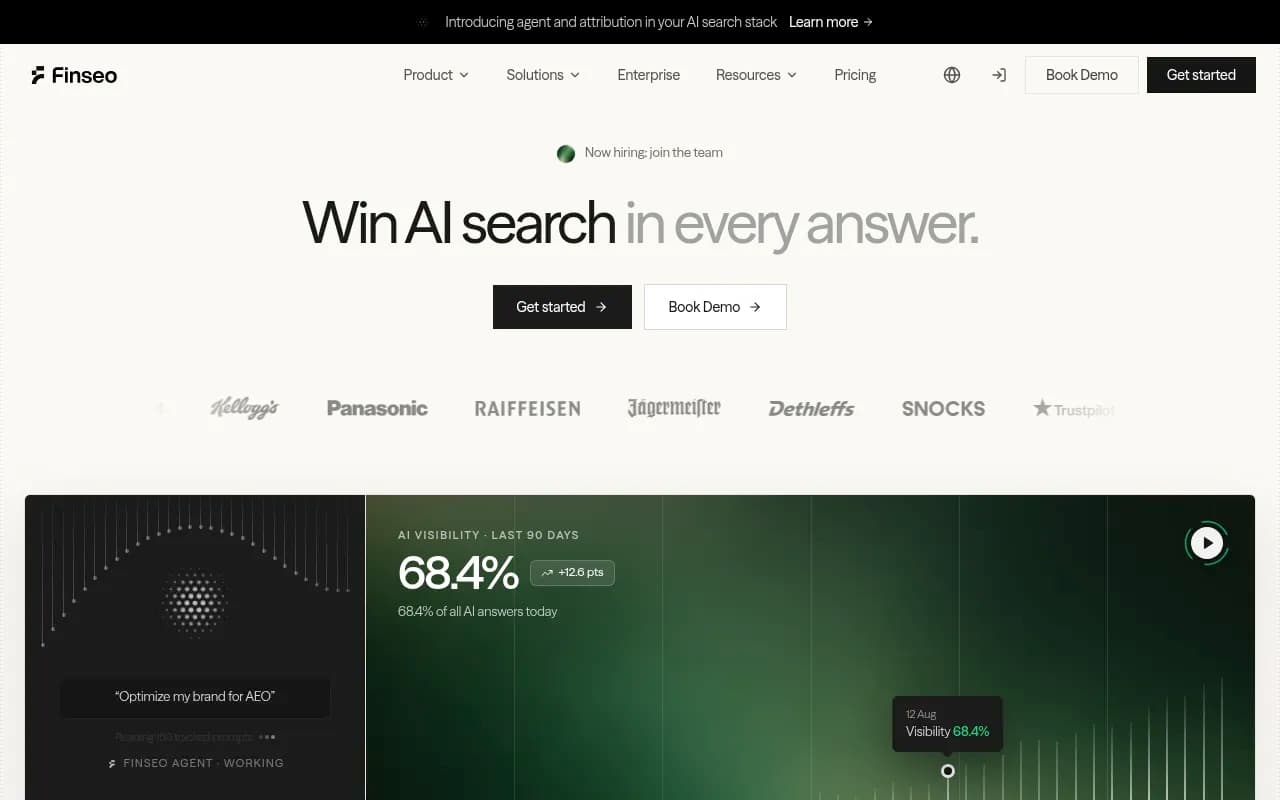
Finseo's strongest agency asset is the report builder: drag-and-drop charts, logo and color branding, and a presentation mode built for pitch decks. If your agency's main bottleneck is closing new business rather than running dozens of accounts, that's a real advantage. The catch is cost predictability. Every plan above Starter sits behind a demo, and the entry tier's 50-prompt, one-project ceiling means most agencies outgrow it within a quarter or two.
Rank Prompt
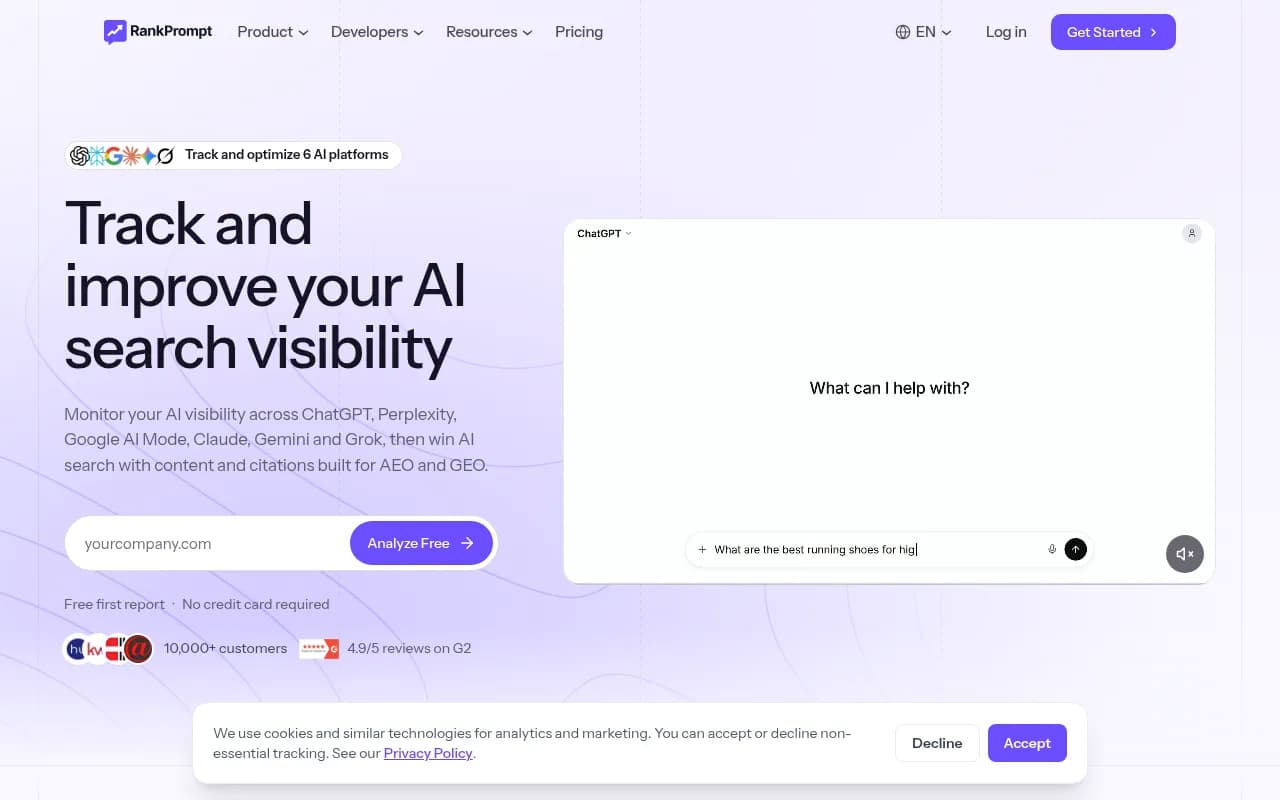
Rank Prompt leans hard into the sales side of agency life. Its prospecting feature lets you run a visibility audit on a prospect before you've signed them, showing which prompts name their competitors but not them, which is a genuinely sharp way to open a pitch. At 149/mo for 500 brands it's priced for volume, and the client portal on Agency Plus closes the loop for retainer reporting.
Ayzeo
Ayzeo publishes its own agency margin math, which is unusual and worth reading if you're trying to justify the tool cost to a partner. At 10 clients, their published numbers put platform cost around 492-791/mo against typical GEO retainers of 500-1,500 per client per month, which pencils out to a healthy margin. The tradeoff is that Claude, Perplexity, Gemini and Grok are paid add-ons at roughly 29/mo per model per project, so a client that needs full multi-model coverage gets expensive fast.
Peec AI

Peec's agency tiers scale from 245/mo up to 795/mo for 65,000 monthly credits, which is a lot of tracked-prompt volume for a large client book. One reviewer note worth flagging: Peec's agency tooling emphasizes pitch workspaces and unlimited seats over formal white-label reporting or a partner program, which some agencies list as a gap compared to Ayzeo or Rank Prompt.
LLM Pulse
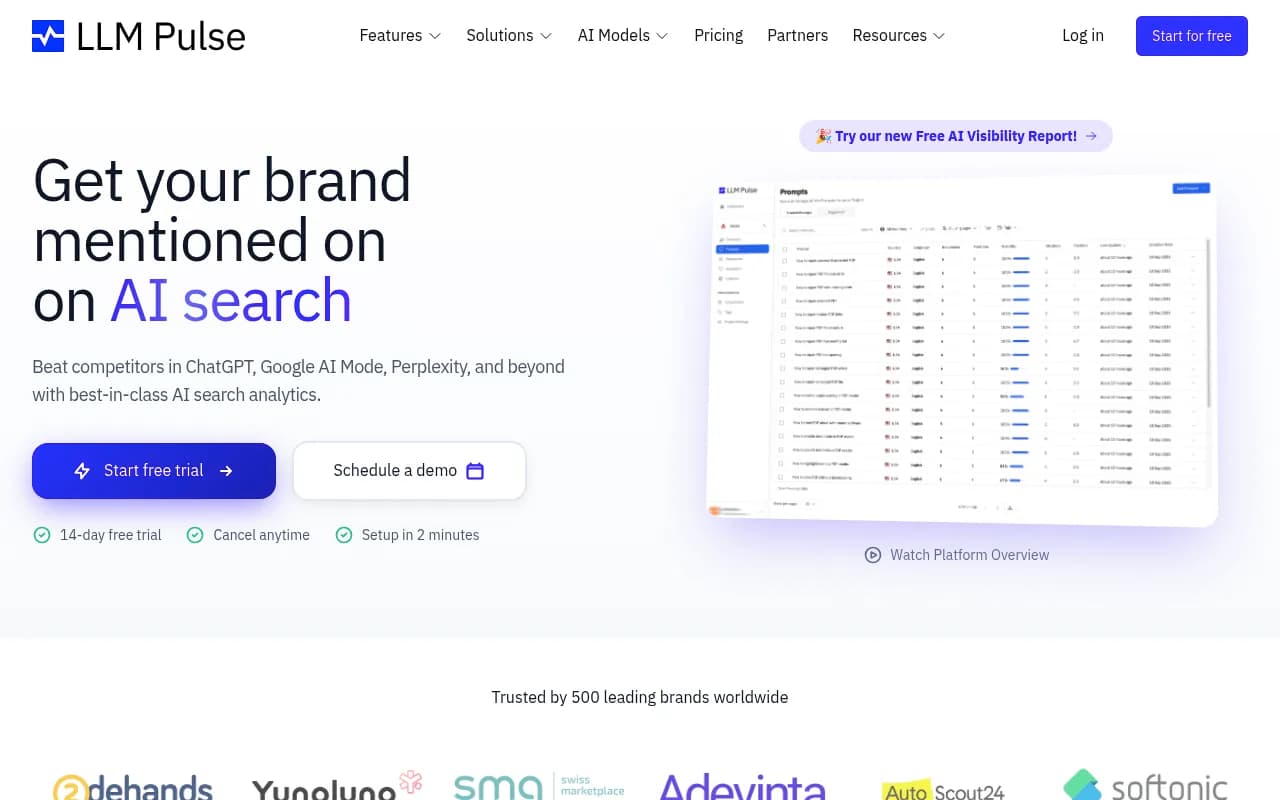
LLM Pulse has the deepest white-label story on this list: custom domain, full brand removal, even an embed option. It's also the cheapest entry point by a wide margin. Base coverage hits the five surfaces that matter most (ChatGPT, Perplexity, Gemini, AI Mode, AI Overviews), with the rest as self-serve paid add-ons. If your clients are mostly mid-market and don't need Claude or Grok tracking, this is hard to beat on price.
Promptwatch
Most of the tools above answer one question well: was the client's brand mentioned. Promptwatch answers a different question, which is why isn't the client visible and what do we do about it. Its crawler logs show exactly when ChatGPTBot, ClaudeBot, PerplexityBot and 400+ other crawlers hit a client's pages and whether they hit errors, which explains the "why" behind a visibility score in a way prompt trackers simply don't capture. When a client's visibility drops, you can check the crawl data before telling them it's their content's fault.

For agencies specifically, the Professional plan at 245/mo covers 2 sites, 150 prompts, and 18,000 responses, with custom reports and a white-label dashboard and client portal built for exactly this use case. The part that separates it from a pure tracker is the Content Agents feature: it plans, writes, and publishes GEO-optimized content to a client's CMS (Webflow, Framer, WordPress) on a schedule, either through a review inbox or fully automated. Crisp, one of Promptwatch's customers, scaled to 5-10 published articles per day using this workflow and saw 2x higher conversion rates from AI traffic compared to traditional channels. That's the kind of result that justifies a retainer increase, not just a monitoring fee.
It also tracks Reddit and YouTube citations separately, which most competitors skip entirely, and includes a ChatGPT Shopping and Ads Radar for e-commerce clients. With 1,840+ customers and a 4.7/5 rating on G2, it's not a niche pick, and agencies like Monks use its Answer Gap Report specifically to build content roadmaps for enterprise clients.
A practical shortlist by agency type
If you're running a small shop with under five clients and tight margins, LLM Pulse or Ayzeo's Pro tier give you the cheapest entry into full white-label reporting. If new business development is your bottleneck, Rank Prompt's prospecting feature pays for itself the first time you close a deal with it. If your clients are asking for results, not just dashboards, and you want to actually produce and publish GEO content rather than just flag gaps, Promptwatch is built for that handoff from insight to execution. Finseo still makes sense if you already have its report builder baked into your pitch process and don't need deep white-label dashboarding beyond PDF exports.
Whichever you choose, run the same test: pull up a client's current AI Mode and AI Overviews numbers separately, not blended, and check whether the tool can explain a visibility drop with crawler or citation evidence rather than just reporting the drop. That's the difference between a tracker and a tool you can actually build a retainer around. For a broader look at the category, the GEO software directory at bestgeosoftware.com is worth a scan before you commit to a multi-seat annual plan.
FAQ
Does Google AI Mode need a separate tracking setup from Google AI Overviews?
Yes. They're different surfaces with different citation behavior; AI Overviews tends to cite roughly double the sources ChatGPT does per response (https://promptwatch.com/data/average-sources-per-response), and treating them as one blended score hides real differences a client needs to see.
Is Finseo's demo-gated pricing a dealbreaker for agencies?
Not necessarily, but it slows down scoping. If you need to model margin across 10+ clients before a sales call, a tool with published self-serve pricing like LLM Pulse, Ayzeo, or Promptwatch makes that easier.
How often should agencies re-audit AI visibility for clients?
Daily, not monthly. Citation volume can shift platform-wide overnight, as it did after the GPT-5.3 rollout in March 2026 (https://promptwatch.com/data/chatgpt-citation-drop). Monthly snapshots will misattribute platform shifts to content problems.